PUBLISHER: Mordor Intelligence | PRODUCT CODE: 2116576

PUBLISHER: Mordor Intelligence | PRODUCT CODE: 2116576
Brucellosis Vaccines - Market Share Analysis, Industry Trends & Statistics, Growth Forecasts (2026 - 2031)
According to Mordor Intelligence, the brucellosis vaccines market size was valued at USD 273.31 million in 2025 and estimated to grow from USD 290.06 million in 2026 to reach USD 390.62 million by 2031, at a CAGR of 6.13% during the forecast period (2026-2031).
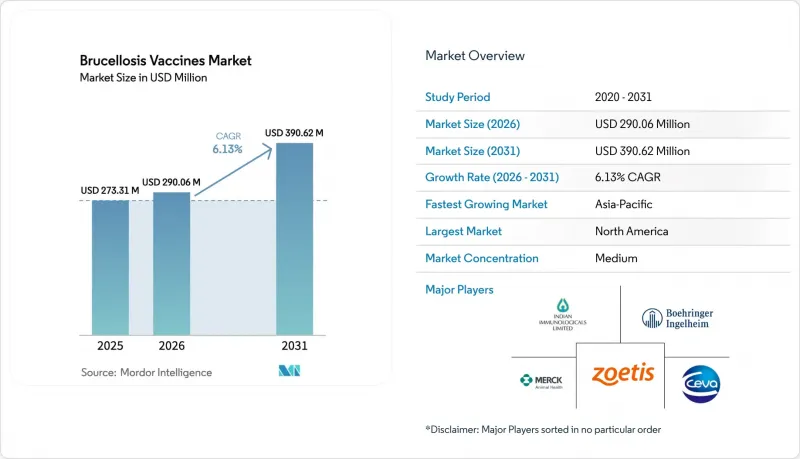
This report is Segmented by Vaccine Type (Live Attenuated, and More), Application (Cattle, Sheep & Goat, Other Applications), End User (Veterinary Hospitals & Clinics, Animal Care/Breeding Centres, Government & NGO Vaccination Campaigns), and Geography (North America, Europe, Asia-Pacific, Middle East & Africa, South America). The Market Forecasts are Provided in Terms of Value (USD).
Global Brucellosis Vaccines Market Trends and Insights
Government-Supported Livestock Vaccination Programs
Public funding is reshaping market economics by underwriting large-scale immunization drives and stipulating vaccine quality standards. In the United States, the cooperative federal program has cut infected herds from 124,000 in 1956 to single-digit counts while sustaining 3.5 million calf doses each year. Gavi's 2026-2030 blueprint replicates this template for lower-income regions, pairing grant finance with the African Vaccine Manufacturing Accelerator. Cost-benefit analyses in India show vaccination benefit-cost ratios above 10 for cattle and above 20 for buffalo, creating powerful fiscal justification for budget allocations. Partnerships tested in West and Central Africa blend public oversight with private logistics, trimming wastage and improving farmer compliance.
Rising Awareness of Zoonotic Disease Risks
The pandemic experience sensitized policymakers and producers to cross-species threats, lifting demand for validated animal vaccines. Surveys in Ethiopia revealed 100% lack of brucellosis knowledge among smallholders despite measurable seroprevalence, prompting national education campaigns. Indian One Health studies documented dangerous Brucella abortus loads in raw milk, steering authorities toward combined vaccination-plus-consumer outreach models. Tajikistan's 2023 response, which vaccinated 5,000 animals after coordinated messaging, highlights how awareness directly affects uptake. Malaysia quantified RM 200.6 million (USD 62.9 million) losses from brucellosis, reinforcing the public health case for prevention.
Cold Chain and Distribution Constraints
Temperature lapses destroy more than half of livestock vaccines shipped to remote areas, eroding program credibility and magnifying disease risk. Field work in India shows that newer solar refrigerators keep storage within range but cannot freeze ice packs for portable carriers, restricting last-mile reach. Economic reviews argue that reinforcing transport nodes may yield higher returns than solely chasing higher thermostability, because cold chain contributes a minor share to total vaccine delivery costs. Thailand's Q-Mark standard for temperature-controlled transport sets a replicable benchmark for other tropical markets where supply integrity falters.
Other drivers and restraints analyzed in the detailed report include:
- Growth in Global Livestock Population
- Technological Advancements in Vaccine Platforms
- Stringent Regulatory and DIVA Compliance Requirements
For complete list of drivers and restraints, kindly check the Table Of Contents.
Segment Analysis
Live attenuated formulations such as RB51 and Rev-1 supplied 48.02% of brucellosis vaccines market share in 2025 thanks to field-proven 70-80% protection and lower cost of goods. These attributes will sustain baseline demand, particularly where eradication campaigns still rely on existing infrastructure. DNA candidates, however, are climbing at an 8.21% CAGR and are expected to carve measurable chunks of the brucellosis vaccines market by 2031 because they meet DIVA requirements and eliminate human infection fears associated with accidental self-inoculation. The EMA guidance released in 2025 removes much of the regulatory ambiguity that once deterred investment, encouraging firms with plasmid or multiepitope constructs to scale up pilot runs.
Sub-unit and recombinant protein lines continue serving niche users who prioritize biosafety, although their market expansion is tempered by adjuvant dependencies and cold-chain sensitivity. Vector-based platforms using bovine adenoviruses are advancing through late-stage pre-clinical milestones and could achieve field approval within the next planning cycle, especially for intranasal cattle dosing that sidesteps needle use and simplifies mass administration. Collectively, these technology streams ensure that the brucellosis vaccines market retains a diverse product mix that can respond to differing regulatory climates and herd management realities.
Complete Report Scope:
- By Vaccine Type
- Live Attenuated
- DNA Vaccine
- Sub-unit / Recombinant Protein
- Vector-Based / Viral-Vectored
- By Application
- Cattle
- Sheep & Goat
- Other Applications
- By End User
- Veterinary Hospitals & Clinics
- Animal Care / Breeding Centres
- Government & NGO Vaccination Campaigns
- Geography
- North America
- United States
- Canada
- Mexico
- Europe
- Germany
- United Kingdom
- France
- Italy
- Spain
- Rest of Europe
- Asia-Pacific
- China
- Japan
- India
- Australia
- South Korea
- Rest of Asia-Pacific
- Middle East & Africa
- GCC
- South Africa
- Rest of Middle East & Africa
- South America
- Brazil
- Argentina
- Rest of South America
- North America
Geography Analysis
North America controlled 39.88% of the brucellosis vaccines market in 2025, an outcome linked to long-running eradication programs, mandatory RFID tagging, and generous federal cost-sharing arrangements. While domestic cattle incidence has been squeezed to isolated wildlife-related flare-ups in the Greater Yellowstone Area, the region's proactive surveillance keeps annual prophylactic demand steady. The United States retains a deep ecosystem of biologic manufacturers, contract research organizations, and university extension networks that collectively sustain innovation and high coverage.
Asia-Pacific is the performance leader with a 7.42% CAGR outlook to 2031. India alone logs estimated brucellosis-linked economic losses of USD 3.4 billion per year, and recent cost-benefit assessments show vaccination can yield ratios above 20:1 for buffalo, prompting state governments to scale procurement. China's concentration on protein security drives substantial investment in provincial Animal Husbandry Stations that bundle Brucella vaccination with TB and FMD programs, while Indonesia and Vietnam channel donor funds toward cold-chain reinforcement and farmer extension. The pace of herd expansion across ASEAN, particularly in small ruminants, guarantees a sizeable addition to the global brucellosis vaccines market.
Europe, backed by EMA's stringent biologics code and harmonized disease notification laws, serves as a center of excellence for advanced platform trials, though endemic prevalence is already low in EU dairy herds. Middle East and Africa exhibit heterogeneous adoption; however, donor-driven pilots such as AgResults and IDRC's Livestock Vaccine Innovation Fund are catalyzing uptake among smallholders in Kenya, Nigeria, and Ethiopia. South America's picture ranges from sophisticated control in Uruguay's beef sector to higher prevalence pockets in the Andean highlands, supporting a mixed demand trajectory yet preserving upside for manufacturers willing to tailor pack sizes and formulations.
- Ceva
- Zoetis
- Merck
- Boehringer Ingelheim
- Indian Immunologicals
- Colorado Serum Company
- CZ Vaccines (Zendal)
- Jordan Bio-Industries Center (JOVAC)
- Laboratories Tornel
- Hester Biosciences
- Biogenesis Bago
- Vaxxinova
- Elanco
- Phibro Animal Health
- Chengdu Tecon Biologic
- China Animal Husbandry Group (CAHG)
- Shenyang Weiyuan Biopharmaceutical
- Anigen (Korea)
Additional Benefits:
- The market estimate (ME) sheet in Excel format
- 3 months of analyst support
TABLE OF CONTENTS
1 Introduction
- 1.1 Study Assumptions & Market Definition
- 1.2 Scope of the Study
2 Research Methodology
3 Executive Summary
4 Market Landscape
- 4.1 Market Overview
- 4.2 Market Drivers
- 4.2.1 Increasing Incidence of Brucellosis
- 4.2.2 Government Supported Livestock Vaccination Programs
- 4.2.3 Rising Awareness of Zoonotic Disease Risks
- 4.2.4 Growth in Global Livestock Population
- 4.2.5 Technological Advancements in Vaccine Platforms
- 4.2.6 Availability of Funding And Incentive Initiatives
- 4.3 Market Restraints
- 4.3.1 Stringent Regulatory and DIVA Compliance Requirements
- 4.3.2 Cold Chain and Distribution Constraints
- 4.3.3 Safety Concerns Over Live Attenuated Vaccines
- 4.3.4 Limited Veterinary Infrastructure in Emerging Regions
- 4.4 Regulatory Landscape
- 4.5 Porter's Five Forces Analysis
- 4.5.1 Threat of New Entrants
- 4.5.2 Bargaining Power of Buyers
- 4.5.3 Bargaining Power of Suppliers
- 4.5.4 Threat of Substitutes
- 4.5.5 Competitive Rivalry
5 Market Size & Growth Forecasts (Value, USD)
- 5.1 By Vaccine Type
- 5.1.1 Live Attenuated
- 5.1.2 DNA Vaccine
- 5.1.3 Sub-unit / Recombinant Protein
- 5.1.4 Vector-Based / Viral-Vectored
- 5.2 By Application
- 5.2.1 Cattle
- 5.2.2 Sheep & Goat
- 5.2.3 Other Applications
- 5.3 By End User
- 5.3.1 Veterinary Hospitals & Clinics
- 5.3.2 Animal Care / Breeding Centres
- 5.3.3 Government & NGO Vaccination Campaigns
- 5.4 Geography
- 5.4.1 North America
- 5.4.1.1 United States
- 5.4.1.2 Canada
- 5.4.1.3 Mexico
- 5.4.2 Europe
- 5.4.2.1 Germany
- 5.4.2.2 United Kingdom
- 5.4.2.3 France
- 5.4.2.4 Italy
- 5.4.2.5 Spain
- 5.4.2.6 Rest of Europe
- 5.4.3 Asia-Pacific
- 5.4.3.1 China
- 5.4.3.2 Japan
- 5.4.3.3 India
- 5.4.3.4 Australia
- 5.4.3.5 South Korea
- 5.4.3.6 Rest of Asia-Pacific
- 5.4.4 Middle East & Africa
- 5.4.4.1 GCC
- 5.4.4.2 South Africa
- 5.4.4.3 Rest of Middle East & Africa
- 5.4.5 South America
- 5.4.5.1 Brazil
- 5.4.5.2 Argentina
- 5.4.5.3 Rest of South America
- 5.4.1 North America
6 Competitive Landscape
- 6.1 Market Concentration
- 6.2 Market Share Analysis
- 6.3 Company Profiles (includes Global level Overview, Market level overview, Core Business Segments, Financials, Headcount, Key Information, Market Rank, Market Share, Products and Services, and analysis of Recent Developments)
- 6.3.1 Ceva Sant Animale
- 6.3.2 Zoetis Inc.
- 6.3.3 Merck Animal Health
- 6.3.4 Boehringer Ingelheim Animal Health
- 6.3.5 Indian Immunologicals Ltd
- 6.3.6 Colorado Serum Company
- 6.3.7 CZ Vaccines (Zendal)
- 6.3.8 Jordan Bio-Industries Center (JOVAC)
- 6.3.9 Laboratories Tornel
- 6.3.10 Hester Biosciences
- 6.3.11 Biogenesis Bago
- 6.3.12 Vaxxinova
- 6.3.13 Elanco Animal Health
- 6.3.14 Phibro Animal Health
- 6.3.15 Chengdu Tecon Biologic
- 6.3.16 China Animal Husbandry Group (CAHG)
- 6.3.17 Shenyang Weiyuan Biopharmaceutical
- 6.3.18 Anigen (Korea)
7 Market Opportunities & Future Outlook
- 7.1 White-Space & Unmet-Need Assessment

