PUBLISHER: Mordor Intelligence | PRODUCT CODE: 2116610

PUBLISHER: Mordor Intelligence | PRODUCT CODE: 2116610
Global Antiemetic Drugs - Market Share Analysis, Industry Trends & Statistics, Growth Forecasts (2026 - 2031)
According to Mordor Intelligence, the antiemetics drugs market size is expected to grow from USD 7.74 billion in 2025 to USD 8.2 billion in 2026 and is forecast to reach USD 10.95 billion by 2031 at 5.92% CAGR over 2026-2031.
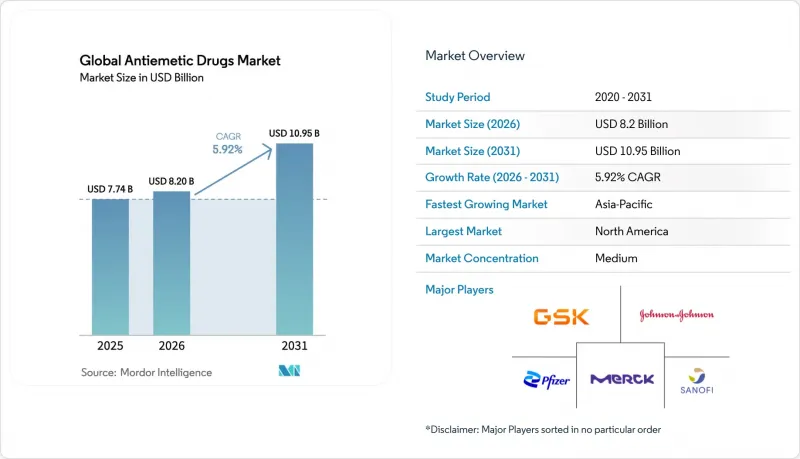
This report Segments the Industry Into Drug Type (Serotonin-Receptor Antagonists, Glucocorticoids, and More), by Application (Chemotherapy, Gastroenteritis, and More), Route of Administration (Oral, Parenteral, and More), Distribution Channel (Hospital Pharmacies, Retail Pharmacies, and More) and Geography (North America, Europe, and More). The Market Forecasts are Provided in Terms of Value (USD).
Global Antiemetic Drugs Market Trends and Insights
Rising incidence of chemotherapy-induced nausea & vomiting
Cancer treatment volumes keep climbing, and up to 40% of patients still encounter breakthrough CINV despite triple-drug prophylaxis. Highly emetogenic regimens such as cisplatin-based protocols are most problematic. Aging populations in North America and Western Europe experience more severe symptoms because of polypharmacy and slower metabolism. China and India are scaling comprehensive cancer centres that routinely embed guideline-based antiemetic regimens, further lifting demand.
Growing clinical adoption of 5-HT3 antagonists for post-operative nausea
Roughly one-third of surgical patients experience PONV, rising to 80% in high-risk laparoscopic or gynaecologic procedures. The US FDA issued draft guidance in October 2024 encouraging developers to pursue combination pharmacological approaches. European guidelines now favour long-acting 5-HT3 agents such as palonosetron for ambulatory surgery, prompting hospitals to standardise on these newer formulations.
Price erosion from generic competition
Patent expiries on NK1 antagonists and serotonin blockers trigger 80% price drops within two years of generic launch, squeezing branded margins and reshaping hospital formularies.
Other drivers and restraints analyzed in the detailed report include:
- Intensifying R&D into novel antiemetic targets
- Expansion of ambulatory infusion centres
- Adverse drug reactions prompting discontinuation
For complete list of drivers and restraints, kindly check the Table Of Contents.
Segment Analysis
Serotonin-receptor antagonists hold 29.12% of 2025 revenue, anchoring the Antiemetics drugs market through reliable efficacy and a mild safety profile. Dopamine antagonists now post the fastest 6.08% CAGR because olanzapine provides strong breakthrough-nausea relief. NK1 agents remain the delayed-phase backbone, and glucocorticoids act as synergists. Innovation resides in GIP agonists and cannabinoid formats, which sit within the "others" category and point to future differentiation.
The serotonin class continues to enjoy wide reimbursement in hospital and retail settings, so substitution barriers are low. Dopamine antagonists gain share where payers value robust symptom control after standard prophylaxis fails. As generics proliferate, balanced multi-mechanism regimens that blend serotonin, dopamine and NK1 blockade underpin clinical guidelines, giving entrenched brands a path to defend volume even as unit prices fall.
Oral dosing captured 43.02% of the Antiemetics drugs market in 2025 and should extend its lead due to patient preference and outpatient trends. Tablets or dissolvable films fit tele-oncology programs and keep nursing time low. Parenteral therapy remains essential during acute vomiting or when oral intake is impossible; recent lipid emulsion injectables supply fast onset with softer infusion-site profiles.
Transdermal and long-acting injectable formats are a small but fast-innovating slice. Depot products that cover multi-day chemotherapy windows cut pill burden, while on-body pumps support personalised titration. These platforms could raise both adherence and willingness to pay, helping manufacturers offset generic erosion in conventional presentations.
Complete Report Scope:
- By Drug Type
- Serotonin-Receptor Antagonists
- Dopamine Receptor Antagonists
- Neurokinin-1 (NK1) Receptor Antagonists
- Glucocorticoids
- Anticholinergics
- Others
- By Application
- Chemotherapy
- Gastroenteritis
- Post-Operative
- Others
- By Route of Administration
- Oral
- Parenteral
- Transdermal & Others
- By Distribution Channel
- Hospital Pharmacies
- Retail Pharmacies
- Online Pharmacies
- Geography
- North America
- United States
- Canada
- Mexico
- Europe
- Germany
- United Kingdom
- France
- Italy
- Spain
- Rest of Europe
- Asia-Pacific
- China
- Japan
- India
- South Korea
- Australia
- Rest of Asia-Pacific
- Middle East and Africa
- GCC
- South Africa
- Rest of Middle East and Africa
- South America
- Brazil
- Argentina
- Rest of South America
- North America
Geography Analysis
North America controlled 38.35% of 2025 revenue through high cancer treatment volumes, insurance coverage for branded drugs, and early adoption of AI-supported dosing software. US FDA approvals such as APONVIE and CINVANTI often set global precedent, granting first launch advantage before generics arrive. Yet intensive price negotiation by pharmacy benefit managers forces companies to prove clinical differentiation or risk steep formulary discounts.
Asia-Pacific records the fastest 6.46% CAGR to 2031. Japan spurs innovation with next-generation NK1 approvals like fosnetupitant, while China's cancer centre expansion multiplies patient starts despite national pressure to procure generics. India's biosimilar producers supply low-cost ondansetron and aprepitant, widening reach into tier-2 cities and supporting steady unit growth.
Europe offers a mature but stable outlook. EMA centralised review speeds pan-regional launches, yet country-level health technology assessments demand clear cost-effectiveness. Recent ESMO guideline updates stress patient-reported outcomes, urging makers to demonstrate better tolerability to secure premium tiers. Hospital tenders frequently bundle antiemetics with chemotherapy contracts, so suppliers position combination or long-acting products as value differentiators.
- GlaxoSmithKline
- Pfizer
- Merck
- Johnson & Johnson
- Sanofi
- Hikma Pharmaceuticals
- Cipla
- Novartis
- Baxter
- Torrent Pharmaceuticals
- Teva Pharmaceutical Industries
- Aurobindo Pharma Ltd.
- Abbvie
- Bausch Health
- Eisai
- Dr. Reddy's Laboratories Ltd.
- Sun Pharmaceuticals Industries
- Takeda Pharmaceuticals
- Lupin
- Fresenius
Additional Benefits:
- The market estimate (ME) sheet in Excel format
- 3 months of analyst support
TABLE OF CONTENTS
1 Introduction
- 1.1 Study Assumptions & Market Definition
- 1.2 Scope of the Study
2 Research Methodology
3 Executive Summary
4 Market Landscape
- 4.1 Market Overview
- 4.2 Market Drivers
- 4.2.1 Rising Incidence of Chemotherapy-induced Nausea & Vomiting (CINV)
- 4.2.2 Growing Clinical Adoption of 5-HT3 Antagonists for Post-operative Nausea
- 4.2.3 Intensifying R&D and Identification of Novel Antiemetic Targets
- 4.2.4 Expansion of Ambulatory Infusion Centres Adopting Antiemetic Protocols
- 4.2.5 Legalisation-led Uptake of Cannabinoid-based Antiemetics
- 4.2.6 AI-driven Predictive Antiemetic Dosing Tools Boosting Adherence
- 4.3 Market Restraints
- 4.3.1 Price Erosion from Generic Competition
- 4.3.2 Adverse Drug Reactions Leading to Discontinuation
- 4.3.3 API Supply-chain Fragility Centred on Limited Chinese Plants
- 4.3.4 Oral Neuro-stimulation Wearables as Non-pharma Substitutes
- 4.4 Value / Supply-Chain Analysis
- 4.5 Regulatory Landscape
- 4.6 Technological Outlook
- 4.7 Porter's Five Forces Analysis
- 4.7.1 Threat of New Entrants
- 4.7.2 Bargaining Power of Buyers
- 4.7.3 Bargaining Power of Suppliers
- 4.7.4 Threat of Substitutes
- 4.7.5 Intensity of Competitive Rivalry
5 Market Size & Growth Forecasts (Value in USD)
- 5.1 By Drug Type
- 5.1.1 Serotonin-Receptor Antagonists
- 5.1.2 Dopamine Receptor Antagonists
- 5.1.3 Neurokinin-1 (NK1) Receptor Antagonists
- 5.1.4 Glucocorticoids
- 5.1.5 Anticholinergics
- 5.1.6 Others
- 5.2 By Application
- 5.2.1 Chemotherapy
- 5.2.2 Gastroenteritis
- 5.2.3 Post-Operative
- 5.2.4 Others
- 5.3 By Route of Administration
- 5.3.1 Oral
- 5.3.2 Parenteral
- 5.3.3 Transdermal & Others
- 5.4 By Distribution Channel
- 5.4.1 Hospital Pharmacies
- 5.4.2 Retail Pharmacies
- 5.4.3 Online Pharmacies
- 5.5 Geography
- 5.5.1 North America
- 5.5.1.1 United States
- 5.5.1.2 Canada
- 5.5.1.3 Mexico
- 5.5.2 Europe
- 5.5.2.1 Germany
- 5.5.2.2 United Kingdom
- 5.5.2.3 France
- 5.5.2.4 Italy
- 5.5.2.5 Spain
- 5.5.2.6 Rest of Europe
- 5.5.3 Asia-Pacific
- 5.5.3.1 China
- 5.5.3.2 Japan
- 5.5.3.3 India
- 5.5.3.4 South Korea
- 5.5.3.5 Australia
- 5.5.3.6 Rest of Asia-Pacific
- 5.5.4 Middle East and Africa
- 5.5.4.1 GCC
- 5.5.4.2 South Africa
- 5.5.4.3 Rest of Middle East and Africa
- 5.5.5 South America
- 5.5.5.1 Brazil
- 5.5.5.2 Argentina
- 5.5.5.3 Rest of South America
- 5.5.1 North America
6 Competitive Landscape
- 6.1 Market Concentration
- 6.2 Market Share Analysis
- 6.3 Company Profiles
- 6.3.1 GlaxoSmithKline plc
- 6.3.2 Pfizer Inc.
- 6.3.3 Merck & Co., Inc.
- 6.3.4 Johnson & Johnson Services, Inc.
- 6.3.5 Sanofi
- 6.3.6 Hikma Pharmaceuticals plc
- 6.3.7 Cipla Ltd.
- 6.3.8 Novartis AG
- 6.3.9 Baxter International Inc.
- 6.3.10 Torrent Pharmaceuticals Ltd.
- 6.3.11 Teva Pharmaceutical Industries Ltd.
- 6.3.12 Aurobindo Pharma Ltd.
- 6.3.13 AbbVie Inc.
- 6.3.14 Bausch Health Companies Inc.
- 6.3.15 Eisai Co., Ltd.
- 6.3.16 Dr. Reddy's Laboratories Ltd.
- 6.3.17 Sun Pharmaceutical Industries Ltd.
- 6.3.18 Takeda Pharmaceutical Co. Ltd.
- 6.3.19 Lupin Ltd.
- 6.3.20 Fresenius Kabi AG
7 Market Opportunities & Future Outlook
- 7.1 White-space & Unmet-Need Assessment

