PUBLISHER: Mordor Intelligence | PRODUCT CODE: 2116611

PUBLISHER: Mordor Intelligence | PRODUCT CODE: 2116611
IV Flush Syringe - Market Share Analysis, Industry Trends & Statistics, Growth Forecasts (2026 - 2031)
According to Mordor Intelligence, the IV flush syringe market size is expected to grow from USD 440.55 million in 2025 to USD 465.84 million in 2026 and is forecast to reach USD 615.72 million by 2031 at 5.74% CAGR over 2026-2031.
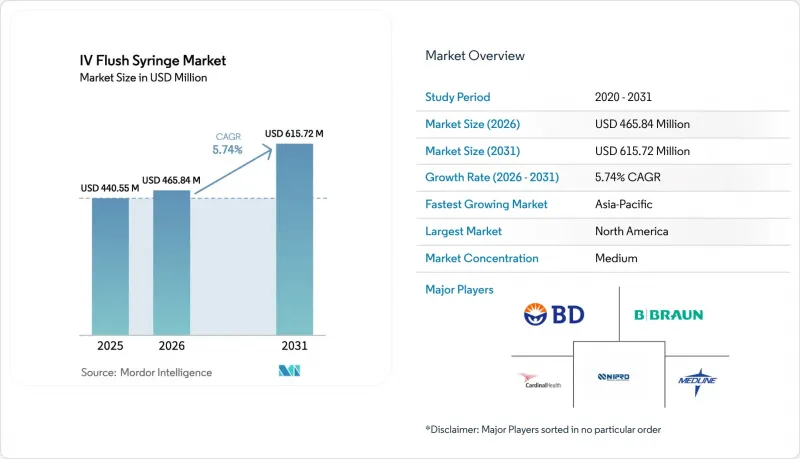
This report is Segmented by Product (Saline IV Flush Syringes and Heparin IV Flush Syringes), Volume Capacity (3 ML, 5 ML, 10 ML, and More), End User (Hospitals and Clinics, and More), Patient Age Group (Adults, Pediatric, and Geriatric) and Geography (North America, Europe, Asia-Pacific, and More). The Market and Forecasts are Provided in Terms of Value (USD).
Global IV Flush Syringe Market Trends and Insights
Rise in Awareness & Global Guidelines for Single-Use Flush Syringes
Updated infection-control directives call for single-patient flush devices to eliminate cross-contamination. The 2024 CDC guidance on central-line care placed pre-filled saline syringes at the center of CLABSI-prevention bundles . European regulators embedded similar requirements in the Medical Device Regulation, pushing hospitals toward validated supplies. Manufacturers that combine flush and hub disinfection in one unit, such as BD's PosiFlush SafeScrub, now enjoy preferential tender status. Consistent rules across regions lower administrative costs for multinational hospital chains. As a result, the IV flush syringe market is benefiting from synchronized demand curves rather than region-specific spikes.
Rising Incidence of Chronic & Infectious Diseases Driving IV Therapy
The aging world population raises long-term catheter use, which in turn boosts flush-syringe volume. Diabetes, cancer, and cardiovascular conditions demand maintenance of patent lines for repeated infusions, increasing daily flushing frequency. Medicare's 2025 expansion of the home-infusion benefit cuts patient out-of-pocket costs, supporting durable demand in the United States. Similar schemes in Japan and South Korea now cover professional nursing visits, expanding product throughput outside hospitals. Persistent infection-control vigilance keeps saline the default, yet specialty heparin formulations are gaining share in oncology suites where thrombosis risk is high.
Stringent FDA and EMA Scrutiny with Spike in Product Recalls
Multiple Class I recalls between 2024 and 2025 exposed defects ranging from syringe-pump incompatibility to particulate contamination. The FDA now requests expanded human-factors data and longer real-time aging studies before clearance . Europe's postmarket surveillance rules raise reporting overhead, prompting small suppliers to exit. Established firms respond with enterprise-wide quality-management upgrades, slowing new product timelines but solidifying brand trust. Although the stricter climate constrains near-term supply, it also sets a higher entry bar that protects incumbents once compliance costs are absorbed.
Other drivers and restraints analyzed in the detailed report include:
- Rapid Switch to Pre-Filled Formats to Curb CLABSI and Save Nursing Time
- Expansion of Home-Infusion & Outpatient Care Settings
- Saline API Shortages in US & EU Causing Intermittent Supply Gaps
For complete list of drivers and restraints, kindly check the Table Of Contents.
Segment Analysis
Saline syringes captured 81.70% of the IV flush syringe market in 2025 thanks to universal protocol alignment and competitive pricing. Clinicians regard normal saline as the safest default for most peripheral and central lines, a stance codified in multiple infection-control guidelines. However, specialty therapy growth is tilting incremental volume toward anticoagulant variants. Heparin syringes exhibit the fastest 6.36% CAGR as oncology centers rely on extended patency for implanted ports. Combination formats that hold saline and heparin in adjacent chambers let caregivers tailor flush regimens while minimizing waste.
Heparin uptake also benefits from rising use of peripherally inserted central catheters in ambulatory settings. Evidence suggests timely anticoagulant flushing reduces device replacement frequency, cutting total cost of care despite higher unit pricing. The regulatory environment remains exacting due to systemic anticoagulation risk, yet large suppliers with pharmacovigilance infrastructure win approvals and capture emerging share. Consequently, product-line breadth has become a differentiator, reinforcing consolidation trends within the IV flush syringe market.
The 10 mL category held 61.85% of the IV flush syringe market size in 2025, mirroring adult catheter flushing guidelines that recommend larger volumes for full lumen clearance. Hospitals value reduced procedure counts, so bulk purchasing favors this volume for central-line routines. Nevertheless, 3 mL formats post a 6.47% CAGR, propelled by pediatric and home-infusion use where smaller fluid loads are critical. Parents administering therapy at home appreciate manageable plunger resistance and minimal liquid waste.
Product developers respond with ergonomic grips and color-coded barrels that distinguish pediatric doses. Intermediate 5 mL syringes maintain relevance for mid-bore catheters, yet the fastest expansion remains at the low end. Smart pump integration now requires precise barrel geometry recognition, encouraging manufacturers to align dimensions across capacities in order to streamline device libraries and lower training time. These design harmonizations tighten customer lock-in and support long-term revenue visibility within the IV flush syringe market.
Complete Report Scope:
- By Product
- Saline IV flush syringes
- Heparin IV flush syringes
- By Volume Capacity
- 3 mL
- 5 mL
- 10 mL
- Others
- By End-User
- Hospitals and Clinics
- Ambulatory Surgical Centers
- Home-care Settings
- Others
- By Patient Age Group
- Adults
- Pediatric
- Geriatric
- By Geography
- North America
- United States
- Canada
- Mexico
- Europe
- Germany
- United Kingdom
- France
- Italy
- Spain
- Rest of Europe
- Asia-Pacific
- China
- Japan
- India
- Australia
- South Korea
- Rest of Asia-Pacific
- Middle East and Africa
- GCC
- South Africa
- Rest of Middle East and Africa
- South America
- Brazil
- Argentina
- Rest of South America
- North America
Geography Analysis
North America contributed 41.05% of global revenue in 2025, supported by robust hospital infrastructure, broad insurance coverage, and rigorous safety mandates. The 2024 saline shortage accelerated substitution toward pre-filled flushes that optimize stock and reduce waste, reinforcing domestic demand. US regulatory vigilance prompts suppliers to maintain real-time traceability, a capability that commands pricing premiums. Canada mirrors these standards, while Mexico's public-health investment upgrades infusion protocols in tertiary centers.
Europe presents a mature yet opportunity-rich environment. Implementation of the Medical Device Regulation in 2025 harmonized reporting and accelerated mutual recognition, simplifying cross-border procurement. Sustainability directives encourage lighter barrels and recyclable packaging, steering incremental innovation. Continued emphasis on infection-prevention targets sustains steady purchasing, and digital inventory platforms adopted by leading hospital trusts further standardize flush volumes.
Asia-Pacific records the fastest 6.61% CAGR and steadily raises its share of the IV flush syringe market. Health-system expansion and insurance reform in China and India unlock new patient cohorts. Japan's super-aged society drives home-infusion uptake, while South Korea's health-tech ecosystem spurs early adoption of connected syringes. Regulatory convergence under the APEC framework cuts dossier review times and encourages technology transfer partnerships, enabling local facilities to scale output faster. Government incentives for domestic medical-device production reduce import reliance and lower landed costs, further accelerating regional uptake.
- BD (Becton, Dickinson & Co.)
- Cardinal Health
- B. Braun
- Nipro
- Medline Industries
- ICU Medical
- Teleflex
- Amsino International
- Nurse Assist
- Excelsior Medical
- Smiths Group
- West Pharmaceutical Services
- Gerresheimer
- Poly Medicure
- Medefil Inc.
- AquaBiliti
- SteriCare Solutions
- Baxter
- Fresenius
- Terumo Corp.
Additional Benefits:
- The market estimate (ME) sheet in Excel format
- 3 months of analyst support
TABLE OF CONTENTS
1 Introduction
- 1.1 Study Assumptions & Market Definition
- 1.2 Scope of the Study
2 Research Methodology
3 Executive Summary
4 Market Landscape
- 4.1 Market Overview
- 4.2 Market Drivers
- 4.2.1 Rise in awareness & global guidelines for single-use flush syringes
- 4.2.2 Rising incidence of chronic & infectious diseases driving IV therapy
- 4.2.3 Rapid switch to pre-filled flush formats to curb CLABSI and save nursing time
- 4.2.4 Expansion of home-infusion & outpatient care settings
- 4.2.5 Growing focus on sterility and safety features
- 4.2.6 Real-time supply-chain platforms enabling just-in-time sterile inventory
- 4.3 Market Restraints
- 4.3.1 Stringent FDA/EMA scrutiny & spike in product recalls
- 4.3.2 Limited nurse training on negative-pressure flushing technique
- 4.3.3 Saline API shortages in US & EU causing intermittent supply gaps
- 4.3.4 Low awareness and adoption in developing regions
- 4.4 Regulatory Landscape
- 4.5 Technological Outlook
- 4.6 Porters Five Forces Analysis
- 4.6.1 Threat of New Entrants
- 4.6.2 Bargaining Power of Buyers/Consumers
- 4.6.3 Bargaining Power of Suppliers
- 4.6.4 Threat of Substitute Products
- 4.6.5 Intensity of Competitive Rivalry
5 Market Size & Growth Forecasts (Value, USD)
- 5.1 By Product
- 5.1.1 Saline IV flush syringes
- 5.1.2 Heparin IV flush syringes
- 5.2 By Volume Capacity
- 5.2.1 3 mL
- 5.2.2 5 mL
- 5.2.3 10 mL
- 5.2.4 Others
- 5.3 By End-User
- 5.3.1 Hospitals and Clinics
- 5.3.2 Ambulatory Surgical Centers
- 5.3.3 Home-care Settings
- 5.3.4 Others
- 5.4 By Patient Age Group
- 5.4.1 Adults
- 5.4.2 Pediatric
- 5.4.3 Geriatric
- 5.5 By Geography
- 5.5.1 North America
- 5.5.1.1 United States
- 5.5.1.2 Canada
- 5.5.1.3 Mexico
- 5.5.2 Europe
- 5.5.2.1 Germany
- 5.5.2.2 United Kingdom
- 5.5.2.3 France
- 5.5.2.4 Italy
- 5.5.2.5 Spain
- 5.5.2.6 Rest of Europe
- 5.5.3 Asia-Pacific
- 5.5.3.1 China
- 5.5.3.2 Japan
- 5.5.3.3 India
- 5.5.3.4 Australia
- 5.5.3.5 South Korea
- 5.5.3.6 Rest of Asia-Pacific
- 5.5.4 Middle East and Africa
- 5.5.4.1 GCC
- 5.5.4.2 South Africa
- 5.5.4.3 Rest of Middle East and Africa
- 5.5.5 South America
- 5.5.5.1 Brazil
- 5.5.5.2 Argentina
- 5.5.5.3 Rest of South America
- 5.5.1 North America
6 Competitive Landscape
- 6.1 Market Concentration
- 6.2 Market Share Analysis
- 6.3 Company Profiles (includes Global level Overview, Market level overview, Core Segments, Financials as available, Strategic Information, Market Rank/Share for key companies, Products & Services, Recent Developments)
- 6.3.1 BD (Becton, Dickinson & Co.)
- 6.3.2 Cardinal Health
- 6.3.3 B. Braun SE
- 6.3.4 Nipro Corporation
- 6.3.5 Medline Industries
- 6.3.6 ICU Medical
- 6.3.7 Teleflex Inc.
- 6.3.8 Amsino International
- 6.3.9 Nurse Assist
- 6.3.10 Excelsior Medical
- 6.3.11 Smiths Medical
- 6.3.12 West Pharmaceutical Services
- 6.3.13 Gerresheimer AG
- 6.3.14 Polymedicure
- 6.3.15 Medefil Inc.
- 6.3.16 AquaBiliti
- 6.3.17 SteriCare Solutions
- 6.3.18 Baxter International
- 6.3.19 Fresenius Kabi
- 6.3.20 Terumo Corp.
7 Market Opportunities & Future Outlook
- 7.1 White-Space & Unmet-Need Assessment

