PUBLISHER: Mordor Intelligence | PRODUCT CODE: 2116614

PUBLISHER: Mordor Intelligence | PRODUCT CODE: 2116614
Global Pain Management Devices - Market Share Analysis, Industry Trends & Statistics, Growth Forecasts (2026 - 2031)
According to Mordor Intelligence, pain management devices market size in 2026 is estimated at USD 12.79 billion, growing from 2025 value of USD 11.67 billion with 2031 projections showing USD 20.2 billion, growing at 9.58% CAGR over 2026-2031.
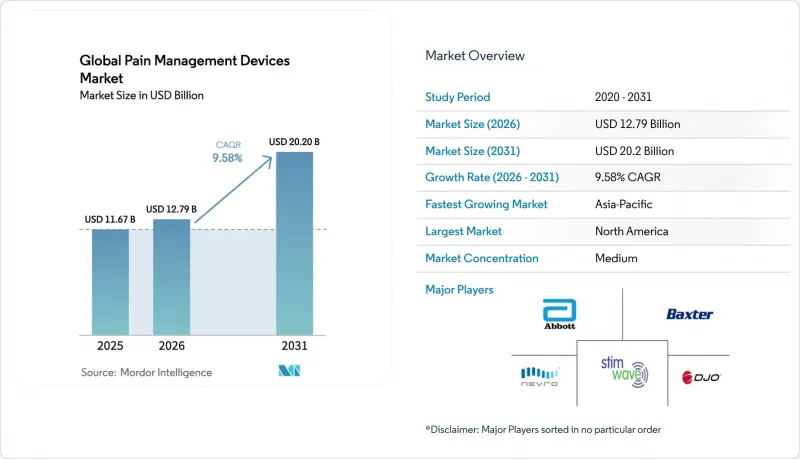
This report Segments the Industry Into by Product Type (Neurostimulation Devices, Infusion Pumps, Ablation Devices), by Application (Musculoskeletal, Cancer Pain, Nand More), by End-User (Physiotherapy Centers, Hospitals and Clinics, Others), and Geography (North America, Europe, Asia-Pacific, Middle East and Africa, South America). The Market Sizes and Forecasts are Provided in Terms of Value (USD).
Global Pain Management Devices Market Trends and Insights
Rising Chronic Pain & Ageing Population
Chronic pain now affects one in four adults in the United States, with prevalence climbing from 12.3% in those aged 18-29 to 36.0% among seniors, a demographic tilt that widens the addressable base for the pain management devices market. The economic toll exceeds USD 725 billion per year for chronic pain care, strengthening cost-effectiveness arguments for device-based interventions that lower long-term drug reliance. Japan reports 22.5% adult prevalence and a 2 trillion yen annual burden, prompting the health ministry to fund multidisciplinary pain centers that emphasize non-pharmacologic modalities . Rural populations show higher pain incidence than urban peers, an imbalance that device-guided home programs can help close by reducing travel needs for follow-up therapy.
Technological Advances in Neuromodulation
Closed-loop neurostimulation shifts treatment from fixed settings to adaptive pulses that respond to evoked compound action potentials hundreds of times per second. Medtronic's Inceptiv system cut overstimulation reports in 93% of study participants while halving low-back pain for 82% within six months. Nevro's AI-enhanced platform, cleared in 2024, learns individual neural patterns to refine energy delivery, elevating responder rates in trial cohorts. Progress in neuromorphic chips, bioresorbable electrodes, and full-body 3 T MRI-conditional leads widens clinical utility and underpins the premium pricing that sustains high R&D reinvestment.
Preference for Pharmaceuticals
Opioids and NSAIDs remain first-line pain therapies in many health systems because they are inexpensive and widely prescribed, delaying device uptake despite acknowledged long-term drawbacks. Emerging markets, where reimbursement for implants is nascent, sustain higher drug reliance, muting early demand for advanced neuromodulation.
Other drivers and restraints analyzed in the detailed report include:
- Favourable Reimbursement for SCS
- AI-driven Closed-loop Stimulation Algorithms
- Wearable-Implantable Sensor Ecosystems
- VC Surge in Peripheral Nerve Stimulation Start-ups
- High Implantation Cost & Limited Implanters
- Insurer Scrutiny over Explantations
For complete list of drivers and restraints, kindly check the Table Of Contents.
Segment Analysis
The pain management devices market size reached USD 11.67 billion in 2025, of which neurostimulation captured 58.23% pain management devices market share in 2025. Closed-loop spinal cord stimulators differentiate through adaptive dosing that halves overstimulation complaints while granting full-body MRI access, features now standard in leading systems. Peripheral nerve stimulators stretch indications to postoperative joints and migraines, aided by outpatient-friendly implants the size of a credit card that house inductive coils. Ablation platforms, advancing at a 10.17% CAGR, leverage cooled RF probes that create larger lesions without charring, producing two-year median relief for facet-mediated back pain. Infusion pumps remain essential for refractory cancer pain, dispensing intrathecal morphine that achieves 87.5% opioid discontinuation at one month, thereby underscoring the multi-modality nature of the pain management devices industry.
Innovation clusters around AI enhancement, with onboard processors parsing compound action potentials thousands of times per minute to tailor amplitude and pulse width. Lead materials shift toward segmented silicone overmoulds that conform to epidural anatomy and cut revision risk. Convergent ecosystems pair implants with wearable accelerometers, enabling automatic posture-based stimulation adjustments that sustain analgesia during daily activities.
Complete Report Scope:
- By Product Type
- Neurostimulation Devices
- Infusion Pumps
- Ablation Devices
- By Application
- Musculoskeletal
- Cancer Pain
- Neuropathic Pain
- Facial Pain & Migraine
- Others
- By End-User
- Physiotherapy Centres
- Hospitals & Clinics
- Others
- By Geography
- North America
- United States
- Canada
- Mexico
- Europe
- Germany
- United Kingdom
- France
- Italy
- Spain
- Rest of Europe
- Asia-Pacific
- China
- Japan
- India
- Australia
- South Korea
- Rest of Asia-Pacific
- Middle East & Africa
- GCC
- South Africa
- Rest of Middle East & Africa
- South America
- Brazil
- Argentina
- Rest of South America
- North America
Geography Analysis
North America, representing 43.10% of global revenue in 2025, benefits from Medicare's broadened coverage, robust private-payor alignment, and a mature clinician base accustomed to implantable technologies. The United States anchors R&D pipelines, with the FDA granting breakthrough-device designation to multiple AI-driven stimulators in 2024, accelerating time-to-market and reinforcing the region's supply-side advantage. Canada follows with growing provincial reimbursements for peripheral stimulation, while Mexico's cross-border medical travel supports neuromodulation procedure volumes.
Europe displays steady, policy-guided uptake governed by the Medical Device Regulation 2017/745, which enforces post-market surveillance and clinical-data verification for every implant class . Germany and the United Kingdom lead implant counts, yet southern states-Italy and Spain-embrace ablation as a cost-contained alternative. The UK's National Institute for Health and Care Excellence is reviewing outcome-based pricing for closed-loop stimulators, potentially modelling value contracts that could echo across EU payor systems. EUDAMED database roll-out augments transparency for physicians and importers, smoothing device traceability across borders.
Asia-Pacific is the fastest-growing territory, with an 11.52% CAGR through 2031. Japan's health ministry funds multidisciplinary pain centers, channelling public insurance toward device-guided therapy that offsets an estimated 2 trillion yen annual burden. China's National Medical Products Administration has streamlined Class III device reviews, shortening domestic approval windows to under nine months, which encourages multinationals to localize assembly lines. India's nascent reimbursement environment still leans on out-of-pocket spending, but pilot inclusion of spinal stimulators in public insurance schemes signals future gains. Australia and South Korea, already early adopters of high-density waveforms, extend regional best practices through professional-society training programs.
Middle East & Africa and South America together remain under 10% of 2024 turnover yet show double-digit expansion as private hospitals import turnkey pain-care suites, often staffed by visiting surgeons from Europe and North America. Government initiatives to cut opioid dependency enhance acceptance of device-based solutions, positioning both regions as long-range opportunities for the pain management devices market.
- Medtronic
- Boston Scientific
- Abbott Laboratories
- Stryker
- Baxter
- ICU Medical
- Enovis
- LivaNova
- DJO Global
- SPR Therapeutics
- Nevro
- Stimwave/Curonix
- Avanos Medical
- Smiths Group
- Nalu Medical
- Saluda Medical
- Globus Medical
Additional Benefits:
- The market estimate (ME) sheet in Excel format
- 3 months of analyst support
TABLE OF CONTENTS
1 Introduction
- 1.1 Study Assumptions & Market Definition
- 1.2 Scope of the Study
2 Research Methodology
3 Executive Summary
4 Market Landscape
- 4.1 Market Overview
- 4.2 Market Drivers
- 4.2.1 Rising Chronic Pain & Ageing Population
- 4.2.2 Technological Advances In Neuromodulation
- 4.2.3 Favourable Reimbursement For Scs
- 4.2.4 Ai-Driven Closed-Loop Stimulation Algorithms
- 4.2.5 Wearable-Implantable Sensor Ecosystems
- 4.2.6 VC surge in peripheral nerve stimulation startups
- 4.3 Market Restraints
- 4.3.1 Preference For Pharmaceuticals
- 4.3.2 High Implantation Cost & Limited Implanters
- 4.3.3 Insurer Scrutiny Over Explantations
- 4.3.4 Chip & Battery Supply-Chain Constraints
- 4.4 Value / Supply-Chain Analysis
- 4.5 Regulatory Landscape
- 4.6 Technological Outlook
- 4.7 Porters Five Forces Analysis
- 4.7.1 Threat of New Entrants
- 4.7.2 Bargaining Power of Buyers
- 4.7.3 Bargaining Power of Suppliers
- 4.7.4 Threat of Substitutes
- 4.7.5 Competitive Rivalry
5 Market Size & Growth Forecasts (Value)
- 5.1 By Product Type
- 5.1.1 Neurostimulation Devices
- 5.1.2 Infusion Pumps
- 5.1.3 Ablation Devices
- 5.2 By Application
- 5.2.1 Musculoskeletal
- 5.2.2 Cancer Pain
- 5.2.3 Neuropathic Pain
- 5.2.4 Facial Pain & Migraine
- 5.2.5 Others
- 5.3 By End-User
- 5.3.1 Physiotherapy Centres
- 5.3.2 Hospitals & Clinics
- 5.3.3 Others
- 5.4 By Geography
- 5.4.1 North America
- 5.4.1.1 United States
- 5.4.1.2 Canada
- 5.4.1.3 Mexico
- 5.4.2 Europe
- 5.4.2.1 Germany
- 5.4.2.2 United Kingdom
- 5.4.2.3 France
- 5.4.2.4 Italy
- 5.4.2.5 Spain
- 5.4.2.6 Rest of Europe
- 5.4.3 Asia-Pacific
- 5.4.3.1 China
- 5.4.3.2 Japan
- 5.4.3.3 India
- 5.4.3.4 Australia
- 5.4.3.5 South Korea
- 5.4.3.6 Rest of Asia-Pacific
- 5.4.4 Middle East & Africa
- 5.4.4.1 GCC
- 5.4.4.2 South Africa
- 5.4.4.3 Rest of Middle East & Africa
- 5.4.5 South America
- 5.4.5.1 Brazil
- 5.4.5.2 Argentina
- 5.4.5.3 Rest of South America
- 5.4.1 North America
6 Competitive Landscape
- 6.1 Market Concentration
- 6.2 Market Share Analysis
- 6.3 Company Profiles (includes Global level Overview, Market level overview, Core Segments, Financials as available, Strategic Information, Market Rank/Share for key companies, Products & Services, and Recent Developments)
- 6.3.1 Medtronic
- 6.3.2 Boston Scientific
- 6.3.3 Abbott
- 6.3.4 Stryker
- 6.3.5 Baxter
- 6.3.6 ICU Medical
- 6.3.7 Enovis
- 6.3.8 LivaNova
- 6.3.9 DJO Global
- 6.3.10 SPR Therapeutics
- 6.3.11 Nevro Corp
- 6.3.12 Stimwave/Curonix
- 6.3.13 Avanos Medical
- 6.3.14 Smith & Nephew
- 6.3.15 Nalu Medical
- 6.3.16 Saluda Medical
- 6.3.17 Globus Medical
7 Market Opportunities & Future Outlook
- 7.1 White-space & Unmet-Need Assessment

