PUBLISHER: Mordor Intelligence | PRODUCT CODE: 2116632

PUBLISHER: Mordor Intelligence | PRODUCT CODE: 2116632
North America Unmanned Systems - Market Share Analysis, Industry Trends & Statistics, Growth Forecasts (2026 - 2031)
According to Mordor Intelligence, the north american unmanned systems market size was valued at USD 11.58 billion in 2025 and estimated to grow from USD 12.81 billion in 2026 to reach USD 21.20 billion by 2031, at a CAGR of 10.62% during the forecast period (2026-2031).
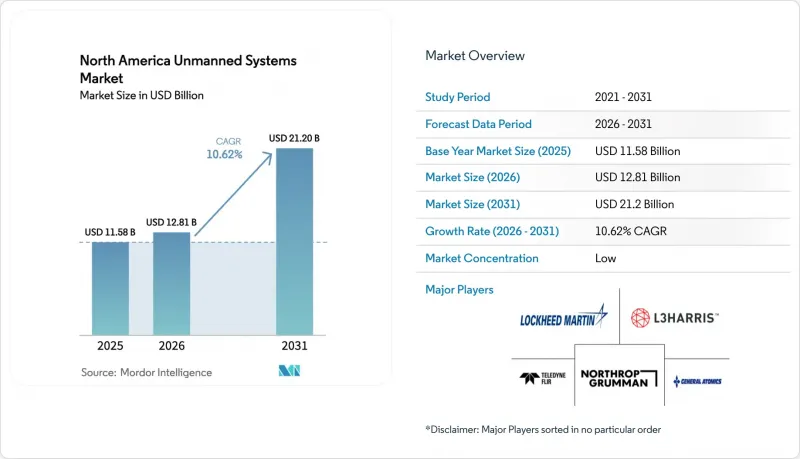
This report is Segmented by Type (Unmanned Aerial Vehicles, Unmanned Ground Vehicles, and Unmanned Underwater Vehicles), Application (Military ISR, Civil and Law-Enforcement, and More), End User (Defense and Homeland Security, Public-Safety Agencies, and More), and Geography (United States, Canada, and Mexico). The Market Forecasts are Provided in Terms of Value (USD).
North America Unmanned Systems Market Trends and Insights
Multi-domain defense modernization accelerating unmanned systems procurement
Rising multi-domain requirements underpin robust US military spending, as illustrated by the USD 10.1 billion FY 2025 uncrewed-vehicle budget request, which is USD 1 billion higher than the prior year. Consolidated Army programs such as Future Tactical UAS and Launched Effects aim to boost cross-domain interoperability, while the Navy's purchase of 49 additional unmanned surface vehicles underscores maritime demand growth. Investments exceeding USD 500 million in counter-drone systems reflect an evolving threat environment and reinforce fleet modernization priorities. The DoD's Replicator program-tasked with fielding thousands of attritable autonomous aircraft-signals an accelerated shift toward large-volume, low-cost systems. These combined initiatives cement defense spending as the chief pillar supporting the North American unmanned systems market.
Commercial drone integration expanding across agriculture and logistics sectors
Registered commercial drones in the United States more than doubled between 2019 and 2024, reaching 842,000 units, and projections indicate a fleet of 1.1 million by 2028. FAA approvals for multi-drone swarm operations enable a single pilot to command heavier payload platforms, widening agricultural use cases such as precision spraying and crop analytics. Logistics adoption follows suit-Walmart's Dallas-Fort Worth operation already covers 1.8 million residents, and industry forecasts anticipate 808 million commercial drone deliveries annually by 2034. The synergy between agriculture and logistics drives producers like MightyFly to develop 100-pound-payload cargo drones capable of 600-mile missions. Together, these milestones validate expanding civilian demand in the North American unmanned systems market.
Inconsistent privacy and data-governance regulations hindering scalability
Fragmented state-level privacy laws in the United States and differing federal-provincial rules in Canada increase compliance costs and constrain multi-jurisdictional operations. Community concerns about sensor-enabled surveillance complicate public safety deployments despite proven emergency-response gains. Unaligned data-retention mandates further restrict cross-border logistics flights and delay nationwide drone-as-first-responder programs. Until uniform standards emerge, governance uncertainty will weigh on expansion plans across the North American unmanned systems market.
Other drivers and restraints analyzed in the detailed report include:
- Regulatory progress enabling large-scale BVLOS operations
- Cost reductions in AI autonomy and edge processing driving broader adoption
- Sensor and chip supply-chain vulnerabilities impacting production timelines
For complete list of drivers and restraints, kindly check the Table Of Contents.
Segment Analysis
Unmanned aerial vehicles (UAVs) held 59.62% of 2025 revenue and are forecast to expand at an 11.42% CAGR through 2031. Their dominance spans nano-class quadcopters for reconnaissance to large fixed-wing cargo drones such as MightyFly's Cento, which carries 100 lbs across 600 miles. The North American unmanned systems market size for UAV applications primarily contributes to overall growth. Unmanned ground vehicles supplement battlefield logistics and explosive-ordnance disposal, while programs retrofitting Black Hawk helicopters for autonomous logistics illustrate how aerial autonomy permeates rotorcraft fleets.
Unmanned underwater vehicles (UUVs) record the smallest unit volumes but benefit from oil-and-gas inspection demand and naval interest in seabed domain awareness. Freedom AUV's recent US Navy trials and Anduril's Rhode Island production facility targeting 200 AUVs per year confirm rising subsea investment. Cross-domain technology transfer is increasing; sonar-enabled deep learning in UUVs and GPS-denied navigation in UAVs share AI algorithms, enabling platform convergence and reinforcing the North American unmanned systems market expansion.
Complete Report Scope:
- By Type
- Unmanned Aerial Vehicles (UAVs)
- Unmanned Ground Vehicles (UGVs)
- Unmanned Underwater Vehicles (UUVs)
- By Application
- Military ISR
- Civil and Law-Enforcement
- Commercial Logistics and Delivery
- Agriculture and Natural-Resources
- Industrial Inspection and Maintenance
- By End User
- Defense and Homeland Security
- Public Safety Agencies
- Enterprise and Industrial Operators
- Service Providers (Drone-as-a-Service)
- By Geography
- United States
- Canada
- Mexico
List of Companies Covered in this Report:
- The Boeing Company
- Lockheed Martin Corporation
- Northrop Grumman Corporation
- General Atomics
- L3Harris Technologies, Inc.
- General Dynamics Corporation
- Elbit Systems Ltd.
- Teledyne FLIR LLC (Teledyne Technologies Incorporated)
- AeroVironment, Inc.
- SZ DJI Technology Co. Ltd.
- Anduril Industries, Inc.
- Kratos Defense & Security Solutions, Inc.
- Skydio, Inc.
- Shield AI, Inc.
- Textron Systems Corporation (Textron Inc.)
- Oceaneering International, Inc.
- Kongsberg Gruppen ASA
- Saab AB
- QinetiQ Group
Additional Benefits:
- The market estimate (ME) sheet in Excel format
- 3 months of analyst support
TABLE OF CONTENTS
1 INTRODUCTION
- 1.1 Study Assumptions and Market Definition
- 1.2 Scope of the Study
2 RESEARCH METHODOLOGY
3 EXECUTIVE SUMMARY
4 MARKET LANDSCAPE
- 4.1 Market Overview
- 4.2 Market Drivers
- 4.2.1 Multi-domain defense modernization accelerating unmanned systems procurement
- 4.2.2 Commercial drone integration expanding across agriculture and logistics sectors
- 4.2.3 Regulatory progress enabling large-scale beyond-visual-line-of-sight operations
- 4.2.4 Cost reductions in AI autonomy and edge processing driving broader adoption
- 4.2.5 Rising demand for AUVs in offshore energy and subsea inspection missions
- 4.2.6 Public safety and emergency response agencies scaling drone-based operations
- 4.3 Market Restraints
- 4.3.1 Inconsistent privacy and data governance regulations hindering scalability
- 4.3.2 Sensor and chip supply-chain vulnerabilities impacting production timelines
- 4.3.3 Delayed counter-UAS acquisitions slowing unmanned system fielding
- 4.3.4 Acoustic emission restrictions limiting underwater vehicle deployment
- 4.4 Value Chain Analysis
- 4.5 Regulatory Landscape
- 4.6 Technological Outlook
- 4.7 Porter's Five Forces Analysis
- 4.7.1 Bargaining Power of Suppliers
- 4.7.2 Bargaining Power of Buyers/Consumers
- 4.7.3 Threat of New Entrants
- 4.7.4 Threat of Substitute Products
- 4.7.5 Intensity of Competitive Rivalry
5 MARKET SIZE AND GROWTH FORECASTS
- 5.1 By Type
- 5.1.1 Unmanned Aerial Vehicles (UAVs)
- 5.1.2 Unmanned Ground Vehicles (UGVs)
- 5.1.3 Unmanned Underwater Vehicles (UUVs)
- 5.2 By Application
- 5.2.1 Military ISR
- 5.2.2 Civil and Law-Enforcement
- 5.2.3 Commercial Logistics and Delivery
- 5.2.4 Agriculture and Natural-Resources
- 5.2.5 Industrial Inspection and Maintenance
- 5.3 By End User
- 5.3.1 Defense and Homeland Security
- 5.3.2 Public Safety Agencies
- 5.3.3 Enterprise and Industrial Operators
- 5.3.4 Service Providers (Drone-as-a-Service)
- 5.4 By Geography
- 5.4.1 United States
- 5.4.2 Canada
- 5.4.3 Mexico
6 COMPETITIVE LANDSCAPE
- 6.1 Market Concentration
- 6.2 Strategic Moves
- 6.3 Market Share Analysis
- 6.4 Company Profiles (includes Global level Overview, Market level overview, Core Segments, Financials as available, Strategic Information, Market Rank/Share for key companies, Products and Services, and Recent Developments)
- 6.4.1 The Boeing Company
- 6.4.2 Lockheed Martin Corporation
- 6.4.3 Northrop Grumman Corporation
- 6.4.4 General Atomics
- 6.4.5 L3Harris Technologies, Inc.
- 6.4.6 General Dynamics Corporation
- 6.4.7 Elbit Systems Ltd.
- 6.4.8 Teledyne FLIR LLC (Teledyne Technologies Incorporated)
- 6.4.9 AeroVironment, Inc.
- 6.4.10 SZ DJI Technology Co. Ltd.
- 6.4.11 Anduril Industries, Inc.
- 6.4.12 Kratos Defense & Security Solutions, Inc.
- 6.4.13 Skydio, Inc.
- 6.4.14 Shield AI, Inc.
- 6.4.15 Textron Systems Corporation (Textron Inc.)
- 6.4.16 Oceaneering International, Inc.
- 6.4.17 Kongsberg Gruppen ASA
- 6.4.18 Saab AB
- 6.4.19 QinetiQ Group
7 MARKET OPPORTUNITIES AND FUTURE OUTLOOK
- 7.1 White-space and Unmet-Need Assessment

