PUBLISHER: Mordor Intelligence | PRODUCT CODE: 2116638

PUBLISHER: Mordor Intelligence | PRODUCT CODE: 2116638
Biotechnology Instruments - Market Share Analysis, Industry Trends & Statistics, Growth Forecasts (2026 - 2031)
According to Mordor Intelligence, the biotechnology instruments market size is expected to grow from USD 89.17 billion in 2025 to USD 93.17 billion in 2026 and is forecast to reach USD 116.07 billion by 2031 at 4.49% CAGR over 2026-2031.
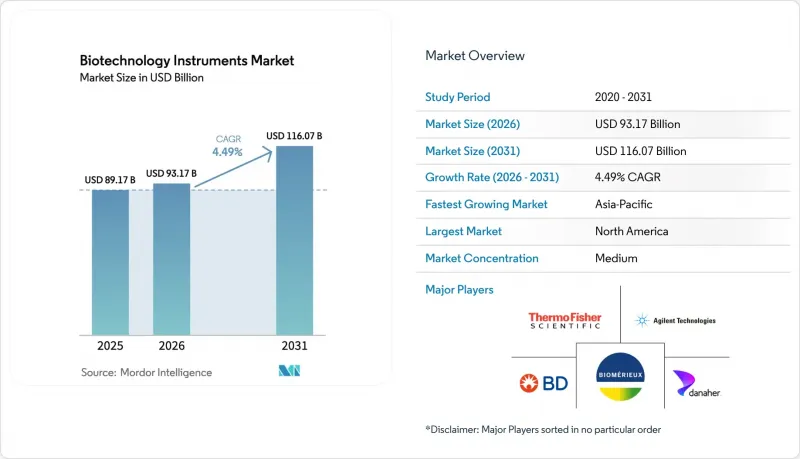
This report is Segmented by Product Type (Lab Automation Instruments [Liquid Handling Systems and More], and More), Distribution Channel [Offline and Online], End-User (Government & Academic Institutes and More), and Geography (North America, Europe, Asia-Pacific, and More). The Market Forecasts are Provided in Terms of Value (USD).
Global Biotechnology Instruments Market Trends and Insights
Surge in Large-Scale Biologics & Cell-Therapy Manufacturing
Manufacturers scaling monoclonal antibodies and autologous cell therapies require closed, modular automation that controls sterility, traceability, and batch variability. Platforms such as the CliniMACS Prodigy integrate washing, selection, activation, and formulation in a single enclosed device that meets GMP guidelines while trimming clean-room footprint. This preference for plug-and-play systems pushes suppliers to bundle hardware, single-use consumables, and process software under one contract, raising switching costs and deepening vendor relationships.
Growth in Point-of-Care Molecular Tests
Hospitals that installed rapid PCR analyzers during the pandemic now extend them to antimicrobial resistance, oncology, and transplant monitoring. Sample-to-answer cartridges collapse extraction, amplification, and detection into a handheld format; premium price tags are justified by shorter waiting times and reduced inpatient stays. Emergency Use Authorization pathways set during COVID-19 have also shortened approval cycles for future bedside assays, accelerating volume commitments for compact thermal cyclers and integrated optics.
Lengthy FDA & CE-IVDR Change-Control Cycles
Software updates or minor hardware tweaks can trigger full validation under CE-IVDR, extending launch timelines by 12-18 months and absorbing scarce regulatory headcount. Mid-tier firms respond by outsourcing compliance documentation to specialized consultancies, but that raises cost bases and discourages frequent iteration of instrument firmware or assay protocols.
Other drivers and restraints analyzed in the detailed report include:
- Expansion of High-Throughput Screening in Drug Discovery
- AI-Driven Predictive Maintenance Cutting Instrument Downtime
- Shortage of Automation-Savvy Lab Technicians
For complete list of drivers and restraints, kindly check the Table Of Contents.
Segment Analysis
Lab automation platforms held 42.10% biotechnology instruments market share in 2025 as pharmaceutical sponsors prioritized reproducibility across sprawling compound libraries and multi-site trials. The biotechnology instruments market size for automation rose alongside single-use bioreactor adoption, which forces every upstream and downstream step onto robotic carriers. Ten-axis collaborative arms paired with vision systems now load microtiter plates, swap pipette tips, and scan barcodes without human intervention, unlocking overnight run capability. Life science consumables record the swiftest 5.77% CAGR because single-use bags, filters, and tips eliminate labor-intensive cleaning steps and assure sterility in personalized therapies. Reagents pre-validated for specific assay kits further reduce downtime, fostering just-in-time inventory models that tie consumable reorder triggers to instrument software. Although IVD platforms sit in the mature basket, their molecular sub-segment climbs steadily as clinicians embrace syndromic panels that consolidate multiple pathogen targets into one swab, narrowing empirical antibiotic use.
Complete Report Scope:
- By Product Type
- Lab Automation Instruments
- Liquid Handling Systems
- Automated Plate Handlers
- Robotic Sample Processors
- Life Science Consumables
- Reagents & Buffers
- Microplates & Tubes
- Pipette Tips & Filtration
- IVD Instruments
- Clinical Chemistry Analyzers
- Hematology Analyzers
- Immunoassay Platforms
- Molecular Diagnostics Systems
- Lab Automation Instruments
- By Distribution Channel
- Offline
- Online
- By End-User
- Government & Academic Institutes
- Pharmaceutical & Biotechnology Companies
- Hospitals & Healthcare Facilities
- Contract Research & Manufacturing Organizations
- By Geography
- North America
- United States
- Canada
- Mexico
- Europe
- Germany
- United Kingdom
- France
- Italy
- Spain
- Rest of Europe
- Asia-Pacific
- China
- India
- Japan
- Australia
- South Korea
- Rest of Asia-Pacific
- Middle East and Africa
- GCC
- South Africa
- Rest of Middle East and Africa
- South America
- Brazil
- Argentina
- Rest of South America
- North America
Geography Analysis
North America retained the largest share of the biotechnology instruments market in 2025 at 40.85%, supported by clustered biopharma headquarters, deep venture funding, and mature contract service ecosystems. Subsidies for domestic semiconductor fabs also aim to buffer the market against future chip shortages. Europe follows with steady expansion driven by robust industrial-biotech policies in Germany and the United Kingdom's focus on synthetic biology startups. Energy-efficiency mandates such as draft ENERGY STAR specifications spur laboratories to replace legacy freezers and incubators with lower-wattage alternatives.
Asia-Pacific registers the fastest 6.05% CAGR to 2031 as China pours capital into biomanufacturing parks, Japan revitalizes its regenerative-medicine sector, and India scales contract chemistry services. Singapore, through tax incentives and predictable regulatory pathways, positions itself as a regional cell-therapy hub that demands automated closed-system instrumentation. Local suppliers coexist with multinationals, but integration competence often tips awards toward global brands able to provide 24-hour service coverage.
The Middle East and Africa record 5.18% CAGR on the back of hospital modernization programs and government-backed research campuses in Saudi Arabia and the United Arab Emirates. South America posts 4.86% growth, with Brazil's vaccine expansion and Argentina's seed-trait research driving demand for portable genomic analyzers that function reliably in high-humidity environments. While purchasing power differs widely, the underlying need for quality-assured instruments that meet global accreditation standards converges across regions, aligning vendor roadmaps toward harmonized specifications.
- Agilent Technologies
- Azenta
- Beckton Dickinson
- bioMerieux
- Bio-Rad Laboratories
- Bruker
- Danaher
- Eppendorf
- Roche
- Hamilton Company
- Hudson Robotics
- Illumina
- Promega
- QIAGEN
- Quest Diagnostics
- Revvity Inc
- Siemens Healthineers
- Tecan Group
- Thermo Fisher Scientific
- Waters Corporation
Additional Benefits:
- The market estimate (ME) sheet in Excel format
- 3 months of analyst support
TABLE OF CONTENTS
1 Introduction
- 1.1 Study Assumptions & Market Definition
- 1.2 Scope of the Study
2 Research Methodology
3 Executive Summary
4 Market Landscape
- 4.1 Market Overview
- 4.2 Market Drivers
- 4.2.1 Surge in large-scale biologics & cell-therapy manufacturing
- 4.2.2 Growth in point-of-care molecular tests
- 4.2.3 Expansion of high-throughput screening in drug discovery
- 4.2.4 AI-driven predictive maintenance cutting instrument downtime
- 4.2.5 Synthetic DNA foundries demanding next-gen automation
- 4.2.6 Government decarbonization rules favouring low-energy lab devices
- 4.3 Market Restraints
- 4.3.1 Lengthy FDA & CE-IVDR change-control cycles
- 4.3.2 Shortage of automation-savvy lab technicians
- 4.3.3 Cyber-security risks in cloud-connected platforms
- 4.3.4 Volatile rare-earth & semiconductor supply for precision motors
- 4.4 Supply Chain Analysis
- 4.5 Technological Outlook
- 4.6 Porter's Five Forces Analysis
- 4.6.1 Bargaining Power of Suppliers
- 4.6.2 Bargaining Power of Buyers
- 4.6.3 Threat of New Entrants
- 4.6.4 Threat of Substitutes
- 4.6.5 Intensity of Rivalry
5 Market Size & Growth Forecasts (Value)
- 5.1 By Product Type
- 5.1.1 Lab Automation Instruments
- 5.1.1.1 Liquid Handling Systems
- 5.1.1.2 Automated Plate Handlers
- 5.1.1.3 Robotic Sample Processors
- 5.1.2 Life Science Consumables
- 5.1.2.1 Reagents & Buffers
- 5.1.2.2 Microplates & Tubes
- 5.1.2.3 Pipette Tips & Filtration
- 5.1.3 IVD Instruments
- 5.1.3.1 Clinical Chemistry Analyzers
- 5.1.3.2 Hematology Analyzers
- 5.1.3.3 Immunoassay Platforms
- 5.1.3.4 Molecular Diagnostics Systems
- 5.1.1 Lab Automation Instruments
- 5.2 By Distribution Channel
- 5.2.1 Offline
- 5.2.2 Online
- 5.3 By End-User
- 5.3.1 Government & Academic Institutes
- 5.3.2 Pharmaceutical & Biotechnology Companies
- 5.3.3 Hospitals & Healthcare Facilities
- 5.3.4 Contract Research & Manufacturing Organizations
- 5.4 By Geography
- 5.4.1 North America
- 5.4.1.1 United States
- 5.4.1.2 Canada
- 5.4.1.3 Mexico
- 5.4.2 Europe
- 5.4.2.1 Germany
- 5.4.2.2 United Kingdom
- 5.4.2.3 France
- 5.4.2.4 Italy
- 5.4.2.5 Spain
- 5.4.2.6 Rest of Europe
- 5.4.3 Asia-Pacific
- 5.4.3.1 China
- 5.4.3.2 India
- 5.4.3.3 Japan
- 5.4.3.4 Australia
- 5.4.3.5 South Korea
- 5.4.3.6 Rest of Asia-Pacific
- 5.4.4 Middle East and Africa
- 5.4.4.1 GCC
- 5.4.4.2 South Africa
- 5.4.4.3 Rest of Middle East and Africa
- 5.4.5 South America
- 5.4.5.1 Brazil
- 5.4.5.2 Argentina
- 5.4.5.3 Rest of South America
- 5.4.1 North America
6 Competitive Landscape
- 6.1 Market Concentration
- 6.2 Competitive Benchmarking
- 6.3 Market Share Analysis
- 6.4 Company Profiles (includes Global level Overview, Market level overview, Core Segments, Financials as available, Strategic Information, Market Rank/Share for key companies, Products & Services, and Recent Developments)
- 6.4.1 Agilent Technologies
- 6.4.2 Azenta US Inc.
- 6.4.3 Becton, Dickinson and Company
- 6.4.4 bioMerieux SA
- 6.4.5 Bio-Rad Laboratories Inc.
- 6.4.6 Bruker Corporation
- 6.4.7 Danaher Corporation
- 6.4.8 Eppendorf SE
- 6.4.9 F. Hoffmann-La Roche AG
- 6.4.10 Hamilton Company
- 6.4.11 Hudson Robotics
- 6.4.12 Illumina Inc.
- 6.4.13 Promega Corporation
- 6.4.14 QIAGEN N.V.
- 6.4.15 Quest Diagnostics
- 6.4.16 Revvity Inc
- 6.4.17 Siemens Healthineers
- 6.4.18 Tecan Group Ltd.
- 6.4.19 Thermo Fisher Scientific
- 6.4.20 Waters Corporation
7 Market Opportunities & Future Outlook
- 7.1 White-space & Unmet-Need Assessment

