PUBLISHER: Mordor Intelligence | PRODUCT CODE: 2116648

PUBLISHER: Mordor Intelligence | PRODUCT CODE: 2116648
Smart Implants - Market Share Analysis, Industry Trends & Statistics, Growth Forecasts (2026 - 2031)
According to Mordor Intelligence, the smart implants market size was valued at USD 6.41 billion in 2025 and estimated to grow from USD 7.62 billion in 2026 to reach USD 18.12 billion by 2031, at a CAGR of 18.92% during the forecast period (2026-2031).
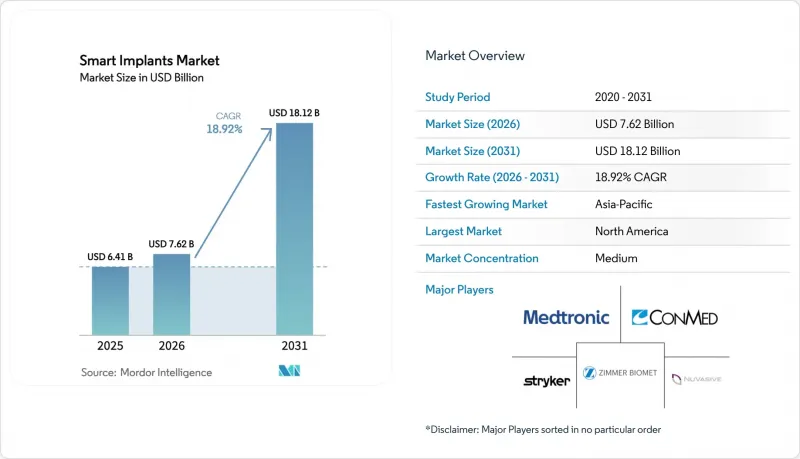
This report is Segmented by Product Type (Orthopedic Smart Implants, Cardiovascular Smart Implants, and More), End User (Hospitals, Ambulatory Surgical Centers, Specialty Clinics, Others), Biomaterial (Titanium and Titanium Alloys, Cobalt-Chrome and Stainless Steel, and More), and Geography (North America, Europe, Asia-Pacific, and More). The Market Forecasts are Provided in Terms of Value (USD).
Global Smart Implants Market Trends and Insights
Growing geriatric population & chronic disorders
The share of people aged 65 and above is projected to double between 2025 and 2050, intensifying demand for joint replacements, cardiac rhythm management and ophthalmic procedures. Smart Implants market players are embedding pressure, temperature and bio-chemical sensors that flag early signs of loosening or infection, reducing costly revision surgeries. Biodegradable sensor platforms that dissolve after healing are moving from lab to clinic, trimming follow-up visits and hospital stays. Continuous rhythm and hemodynamic monitoring in pacemakers and defibrillators is improving outcomes for multimorbid seniors. Health-economic models indicate institutional savings when post-surgical complications fall below 3% of caseloads.
Rising incidence of accidents & sports injuries
Trauma departments now fit fracture plates and ligament anchors that log strain and micromotion, guiding physiotherapy timelines. Integrated accelerometers and gyroscopes reveal adherence to prescribed motion limits, replacing subjective patient diaries. Absorbable polymer screws tailored for anterior cruciate ligament repairs merge with pH sensors that confirm inflammatory status . Rapid 3D-printed titanium plates designed from CT data cut operating room time by 25% and improve anatomical congruence. Data-rich recoveries shorten athlete downtime, restoring productivity and lowering indirect societal costs.
Stringent regulatory approval timelines
Cybersecurity test requirements added in 2023 lengthen 510(k) and PMA reviews by up to 12 months. Europe's MDR demands full clinical evidence for legacy implants, prompting smaller firms to cull product lines and redirect R&D spend. Divergent data-format rules across regulators oblige sponsors to generate parallel submissions, inflating compliance budgets. Novel AI-adaptive systems must now file real-time learning protocols, further stretching review cycles.
Other drivers and restraints analyzed in the detailed report include:
- Technological advancements in smart implants
- Shift to value-based care needing post-surgical data
- High cost & reimbursement gaps
For complete list of drivers and restraints, kindly check the Table Of Contents.
Segment Analysis
Orthopedic devices commanded 48.45% of the Smart Implants market in 2025, underscoring the natural fit between load-bearing joints and continuous kinematic feedback loops. Platforms such as Persona IQ transmit gait symmetry, step count and range of motion every evening via a dedicated base station, giving surgeons an objective view of recovery trajectories. Early trials show unplanned clinic visits dropping by 26% when alerts direct interventions promptly. Cardiovascular systems follow as the fastest riser, posting a 20.01% CAGR through 2031. Abbott's AVEIR leadless pacemaker extends physiologic pacing to the conduction system, broadening candidacy while eliminating pocket infections. Emerging ophthalmic implants like the iDose TR free glaucoma patients from daily adherence burdens for up to three years, demonstrating the broader reach of micro-reservoir technologies.
Growth tailwinds come from robotics-assisted knee and spine surgeries that rely on precise post-op analytics to tune rehabilitation. Ophthalmic and dental niches attract venture backing thanks to smaller anatomical spaces that showcase sensor miniaturisation. Meanwhile, cosmetic and reconstructive segments integrate temperature and pH probes to spot infection early, though their volume remains modest. Continuous pressure mapping within cranio-maxillofacial plates is helping trauma surgeons refine fixation patterns, hinting at wider cross-specialty uptake.
Complete Report Scope:
- By Product Type
- Orthopedic Smart Implants
- Knee Arthroplasty
- Hip Arthroplasty
- Shoulder Arthroplasty
- Spine Fusion
- Fracture Fixation
- Others
- Cardiovascular Smart Implants
- Pacemakers & ICDs
- Smart Stents
- Structural Cardiac Implants
- Ophthalmic Smart Implants
- Smart Intra-ocular Lens
- Glaucoma Implants
- Dental Smart Implants
- Cosmetic and Reconstructive Smart Implants
- Other Smart Implants
- Orthopedic Smart Implants
- By End User
- Hospitals
- Ambulatory Surgical Centers
- Specilaty Clinics
- Others
- By Biomaterial
- Titanium and Titanium Alloys
- Cobalt-Chrome and Stainless Steel
- Bio-absorbable Polymers
- Others
- By Geography
- North America
- United States
- Canada
- Mexico
- Europe
- Germany
- United Kingdom
- France
- Italy
- Spain
- Rest of Europe
- Asia-Pacific
- China
- Japan
- India
- Australia
- South Korea
- Rest of Asia-Pacific
- Middle East and Africa
- GCC
- South Africa
- Rest of Middle East and Africa
- South America
- Brazil
- Argentina
- Rest of South America
- North America
Geography Analysis
North America generates 39.75% of global revenue in 2025, aided by early digital-health adoption, mature payer frameworks and an FDA pathway that gives clear guidance on cybersecurity and clinical evidence. Top device companies cluster near engineering schools and venture hubs, shortening iterative loops from benchtop to bedside. Federal telehealth waivers renewed in 2025 normalize remote implant monitoring, further anchoring demand. Cross-border data flow accords with Canada streamline multi-site trials and open secondary markets.
Asia-Pacific delivers the quickest 20.05% CAGR through 2031. Government procurement preference schemes in China, India and South Korea accelerate domestic manufacturing scale and trim landed prices. China green-lit its first 3D-printed total knee in 2024, a watershed for home-grown innovation. India's updated medical-device code limits promotional spending, nudging companies toward evidence-led marketing. ASEAN smart-hospital blueprints allocate funds for cloud telemetry, promising lift for implant connectivity vendors.
Europe struggles with MDR bottlenecks that push recertification deadlines, yet its rigorous outcome registries produce rich longitudinal datasets that validate Smart Implants market claims. Germany subsidizes digital-health apps, pairing them with neuromodulation implants for chronic back pain. The United Kingdom's NHS pilots digital twins for hip replacements, seeking to cut revision rates by 15% within five years. Scandinavian tenders mandate life-cycle carbon accounting, giving biodegradable platforms a foothold.
- Stryker
- Zimmer Biomet
- Johnson & Johnson
- Medtronic
- Abbott Laboratories
- Boston Scientific
- Smiths Group
- NuVasive
- Globus Medical
- Conmed
- Canary Medical
- IQ Implants USA
- Rejoint
- Smart Implant Solutions
- Arthrex
- MicroPort
- Terumo
- Alcon
- Straumann Group
- Dentsply Sirona
- OrthAlign
- OrthoSensor
- Zimmer Biomet [Rosa Robotics]
Additional Benefits:
- The market estimate (ME) sheet in Excel format
- 3 months of analyst support
TABLE OF CONTENTS
1 Introduction
- 1.1 Study Assumptions & Market Definition
- 1.2 Scope of the Study
2 Research Methodology
3 Executive Summary
4 Market Landscape
- 4.1 Market Overview
- 4.2 Market Drivers
- 4.2.1 Growing geriatric population & chronic disorders
- 4.2.2 Rising incidence of accidents & sports injuries
- 4.2.3 Technological advancements in smart implants
- 4.2.4 Shift to value-based care needing post-surgical data
- 4.2.5 Additive manufacturing of sensor-embedded implants
- 4.2.6 Digital-twin integration for predictive analytics
- 4.3 Market Restraints
- 4.3.1 Stringent regulatory approval timelines
- 4.3.2 High cost & reimbursement gaps
- 4.3.3 Biocompatibility & long-term safety concerns
- 4.3.4 Cyber-security & data-privacy risks
- 4.4 Regulatory Landscape
- 4.5 Technological Outlook
- 4.6 Porters Five Forces Analysis
- 4.6.1 Threat of New Entrants
- 4.6.2 Bargaining Power of Buyers
- 4.6.3 Bargaining Power of Suppliers
- 4.6.4 Threat of Substitutes
- 4.6.5 Intensity of Competitive Rivalry
5 Market Size & Growth Forecasts (Value, USD)
- 5.1 By Product Type
- 5.1.1 Orthopedic Smart Implants
- 5.1.1.1 Knee Arthroplasty
- 5.1.1.2 Hip Arthroplasty
- 5.1.1.3 Shoulder Arthroplasty
- 5.1.1.4 Spine Fusion
- 5.1.1.5 Fracture Fixation
- 5.1.1.6 Others
- 5.1.2 Cardiovascular Smart Implants
- 5.1.2.1 Pacemakers & ICDs
- 5.1.2.2 Smart Stents
- 5.1.2.3 Structural Cardiac Implants
- 5.1.3 Ophthalmic Smart Implants
- 5.1.3.1 Smart Intra-ocular Lens
- 5.1.3.2 Glaucoma Implants
- 5.1.4 Dental Smart Implants
- 5.1.5 Cosmetic and Reconstructive Smart Implants
- 5.1.6 Other Smart Implants
- 5.1.1 Orthopedic Smart Implants
- 5.2 By End User
- 5.2.1 Hospitals
- 5.2.2 Ambulatory Surgical Centers
- 5.2.3 Specilaty Clinics
- 5.2.4 Others
- 5.3 By Biomaterial
- 5.3.1 Titanium and Titanium Alloys
- 5.3.2 Cobalt-Chrome and Stainless Steel
- 5.3.3 Bio-absorbable Polymers
- 5.3.4 Others
- 5.4 By Geography
- 5.4.1 North America
- 5.4.1.1 United States
- 5.4.1.2 Canada
- 5.4.1.3 Mexico
- 5.4.2 Europe
- 5.4.2.1 Germany
- 5.4.2.2 United Kingdom
- 5.4.2.3 France
- 5.4.2.4 Italy
- 5.4.2.5 Spain
- 5.4.2.6 Rest of Europe
- 5.4.3 Asia-Pacific
- 5.4.3.1 China
- 5.4.3.2 Japan
- 5.4.3.3 India
- 5.4.3.4 Australia
- 5.4.3.5 South Korea
- 5.4.3.6 Rest of Asia-Pacific
- 5.4.4 Middle East and Africa
- 5.4.4.1 GCC
- 5.4.4.2 South Africa
- 5.4.4.3 Rest of Middle East and Africa
- 5.4.5 South America
- 5.4.5.1 Brazil
- 5.4.5.2 Argentina
- 5.4.5.3 Rest of South America
- 5.4.1 North America
6 Competitive Landscape
- 6.1 Market Concentration
- 6.2 Market Share Analysis
- 6.3 Company Profiles (includes Global level Overview, Market level overview, Core Segments, Financials as available, Strategic Information, Market Rank/Share for key companies, Products & Services, and Recent Developments)
- 6.3.1 Stryker
- 6.3.2 Zimmer Biomet
- 6.3.3 Johnson & Johnson (DePuy Synthes)
- 6.3.4 Medtronic
- 6.3.5 Abbott
- 6.3.6 Boston Scientific
- 6.3.7 Smith & Nephew
- 6.3.8 NuVasive
- 6.3.9 Globus Medical
- 6.3.10 CONMED
- 6.3.11 Canary Medical
- 6.3.12 IQ Implants USA
- 6.3.13 Rejoint srl
- 6.3.14 Smart Implant Solutions
- 6.3.15 Arthrex
- 6.3.16 MicroPort Scientific
- 6.3.17 Terumo
- 6.3.18 Alcon
- 6.3.19 Straumann
- 6.3.20 Dentsply Sirona
- 6.3.21 OrthAlign
- 6.3.22 OrthoSensor
- 6.3.23 Zimmer Biomet [Rosa Robotics]
7 Market Opportunities & Future Outlook
- 7.1 White-space & Unmet-need Assessment

