PUBLISHER: Mordor Intelligence | PRODUCT CODE: 2116649

PUBLISHER: Mordor Intelligence | PRODUCT CODE: 2116649
Dental Labs - Market Share Analysis, Industry Trends & Statistics, Growth Forecasts (2026 - 2031)
According to Mordor Intelligence, the dental labs market size was valued at USD 26.48 billion in 2025 and is estimated to grow from USD 27.76 billion in 2026 to reach USD 37.49 billion by 2031, at a CAGR of 6.19% during the forecast period (2026-2031).
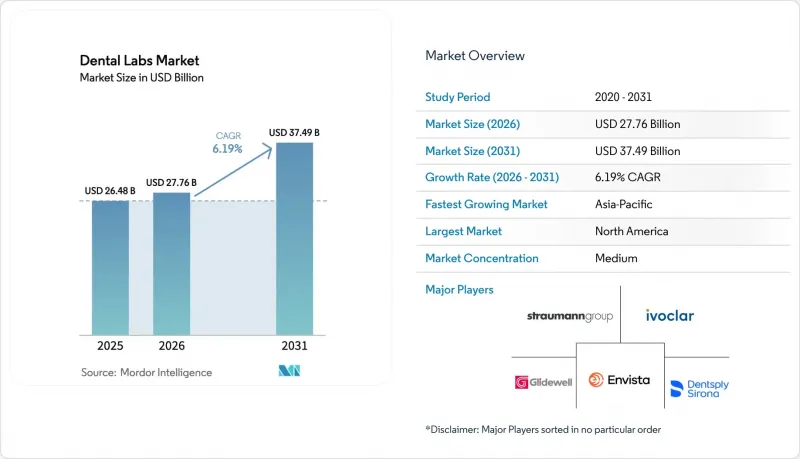
This report is Segmented by Product and Services (Equipment Type [Milling Equipment and More], Consumables and Accessories, Software and Services), Dental Discipline (Orthodontics, Endodontics, and More), Material Type (Metal-Ceramic, Zirconia, and More), Workflow (Digital, Conventional/Analog), End User (Independent Dental Labs, and More), and Geography. The Market Forecasts are Provided in Terms of Value (USD).
Global Dental Labs Market Trends and Insights
Increase in Geriatric Population
United Nations data show the global population aged 65 and older will reach 1.6 billion by 2050, more than doubling 2021 levels. Japan already reports 29% of residents above that age, a pattern mirrored in Italy and Germany. Tooth retention declines sharply after age 70, so full dentures and implant-retained overdentures remain high-volume cases. Pension-funded dental benefits stabilize reimbursement, which secures steady unit value even where overall procedure counts level off. Labs serving this cohort maintain premium pricing because geriatric cases often require occlusal refinements that digital automation cannot fully replace.
Rising Edentulism Prevalence
The World Health Organization estimates 7% of adults worldwide are completely toothless, with rates topping 20% in several low-income regions. First-time denture wearers in India and Nigeria create high-volume opportunities when disposable income rises enough to cover sub-USD 200 prosthetics. The United States still records 13% edentulism among seniors despite decades of preventive care. Laboratories thus operate blended production lines that output both low-cost acrylic dentures for price-sensitive patients and premium implant bars for affluent clients, ensuring broad portfolio coverage.
High Cost of Complex Restorative Work
Full-arch implant rehabilitation can exceed USD 30,000 in the United States, with laboratory fees near one-third of that bill. Median U.S. household income was USD 74,580 in 2023, so many patients delay treatment or choose extractions. Emerging-market affordability is even tighter, which pushes labs to engineer cost-down solutions such as offshore milling and standardized abutment libraries.
Other drivers and restraints analyzed in the detailed report include:
- Growing Demand for Cosmetic Dentistry
- Advancements in Digital Fabrication and CAD/CAM
- Limited Reimbursement Outside OECD
For complete list of drivers and restraints, kindly check the Table Of Contents.
Segment Analysis
Equipment Type controlled 63.63% of revenue in 2025, reflecting high upfront spending on mills, printers, and scanners. Yet Software & Services will rise at 10.37% through 2031, the fastest pace among all categories. Subscription models such as exocad Chairside CAD add recurring revenue and sustain feature updates. Within hardware, CAD/CAM systems held large share, while 3-D printers expand 9.82% annually as additive manufacturing lowers waste. Consumables like zirconia blanks move in line with procedure volumes but face commoditization pressure. The shift signals that intellectual property in algorithms, not machines alone, will drive value capture across the dental labs market.
The emphasis on cloud design suites encourages labs to build proprietary plug-ins that integrate material libraries and quality dashboards, which deepens customer lock-in. ISO 13485 rules for software certification add compliance complexity that favors established vendors able to fund ongoing validation. Smaller labs often partner with third-party platforms rather than develop tools from scratch to avoid multi-million-dollar R&D outlays.
Restorative work contributed 27.63% revenue in 2025, but implant-based restorations will deliver an 8.35% CAGR to 2031 as seniors demand permanence over removable dentures. Labs committed to implant workflows invest in screw-retained libraries, titanium milling, and verification jigs that command price premiums. Orthodontic demand accelerates with clear aligners, yet most volume remains with a handful of digital majors. Prosthodontic dentures still serve cost-sensitive edentulous patients, though implants nibble share when financing plans gain traction.
Complex full-arch bars generate higher unit revenue and therefore buffer labs from chairside crown erosion. However, technicians need implant-specific skills and validation protocols, which raises training costs. This specialization creates a capability gap that favors large laboratories able to hire or train implant teams.
Complete Report Scope:
- By Product and Services
- Equipment Type
- Milling Equipment
- Dental Scanners
- 3-D Printing Systems
- CAD/CAM Systems
- Casting Machines
- Radiology Equipment
- Other Equipment Types
- Consumables and Accessories
- Software and Services
- Equipment Type
- By Dental Discipline
- Orthodontics
- Endodontics
- Restorative
- Oral Care
- Implants
- Prosthodontics
- By Material Type
- Metal-ceramic
- Zirconia
- All-ceramic
- Acrylic & Resins
- Metals & Alloys
- Others
- By Workflow
- Digital
- Conventional / Analog
- By End User
- Independent Dental Labs
- Corporate / Chain Labs
- In-house Dental-office Labs
- Academic & Research Institutes
- By Geography
- North America
- United States
- Canada
- Mexico
- Europe
- Germany
- France
- United Kingdom
- Italy
- Spain
- Rest of Europe
- Asia-Pacific
- China
- Japan
- India
- South Korea
- Australia
- Rest of Asia-Pacific
- Middle East & Africa
- GCC
- South Africa
- Rest of Middle East & Africa
- South America
- Brazil
- Argentina
- Rest of South America
- North America
Geography Analysis
North America delivered 36.32% of 2025 global revenue, driven by high procedure volumes and early CAD/CAM uptake. Yet chairside systems and reimbursement pressure temper growth to low single digits. The dental labs market size in the region remains the highest worldwide but is moving toward margin compression rather than unit expansion.
Asia-Pacific is the fastest-growing territory with an 8.41% CAGR through 2031. China's oral-health campaign seeks 60% dental visit coverage by 2030, while India's liberalized medical-device policy drew USD 1.2 billion investment in 2024-2025. Japan's aging population keeps denture and implant demand resilient despite economic stagnation. South Korea leverages medical tourism, which lifts premium anterior esthetic work.
In Europe, Germany benefits from statutory reimbursement that covers up to 75% of prosthetic costs, sustaining volume. Conversely, United Kingdom NHS shortages curb demand for complex restorative work, sharpening private-sector segmentation. EU MDR's 2024 enforcement adds compliance costs, accelerating consolidation toward labs able to finance quality-management programs.
- Align Technology
- Amann Girrbach
- Argen
- Carbon
- Carestream Health
- Dentsply Sirona
- Envista Holdings
- GC Corporation
- Glidewell Dental
- Henry Schein
- Ivoclar Vivadent
- Kulzer
- Modern Dental Group
- National Dentex Labs
- Planmeca
- Septodont
- SprintRay
- Solventum
- Straumann Group
- VOCO
- ZimVie
Additional Benefits:
- The market estimate (ME) sheet in Excel format
- 3 months of analyst support
TABLE OF CONTENTS
1 Introduction
- 1.1 Study Assumptions & Market Definition
- 1.2 Scope of the Study
2 Research Methodology
3 Executive Summary
4 Market Landscape
- 4.1 Market Overview
- 4.2 Market Drivers
- 4.2.1 Increase in the Geriatric Population
- 4.2.2 Rising Edentulism Prevalence
- 4.2.3 Growing Demand for Cosmetic Dentistry
- 4.2.4 Advancements In Digital Fabrication & CAD/CAM
- 4.2.5 AI-Driven Scan-To-Print Micro-Outsourcing Boom
- 4.2.6 DSOs Consolidating Global Lab Procurement
- 4.3 Market Restraints
- 4.3.1 High Cost of Complex Restorative Work
- 4.3.2 Limited Reimbursement Outside OECD
- 4.3.3 Chairside Milling Cannibalizing Lab Volumes
- 4.3.4 Supply Risk of Zirconia & Rare-Earth Ceramics
- 4.4 Value / Supply-Chain Analysis
- 4.5 Regulatory Landscape
- 4.6 Technological Outlook
- 4.7 Porter's Five Forces Analysis
- 4.7.1 Threat of New Entrants
- 4.7.2 Bargaining Power of Buyers
- 4.7.3 Bargaining Power of Suppliers
- 4.7.4 Threat of Substitutes
- 4.7.5 Intensity of Competitive Rivalry
5 Market Size & Growth Forecasts (Value in USD)
- 5.1 By Product and Services
- 5.1.1 Equipment Type
- 5.1.1.1 Milling Equipment
- 5.1.1.2 Dental Scanners
- 5.1.1.3 3-D Printing Systems
- 5.1.1.4 CAD/CAM Systems
- 5.1.1.5 Casting Machines
- 5.1.1.6 Radiology Equipment
- 5.1.1.7 Other Equipment Types
- 5.1.2 Consumables and Accessories
- 5.1.3 Software and Services
- 5.1.1 Equipment Type
- 5.2 By Dental Discipline
- 5.2.1 Orthodontics
- 5.2.2 Endodontics
- 5.2.3 Restorative
- 5.2.4 Oral Care
- 5.2.5 Implants
- 5.2.6 Prosthodontics
- 5.3 By Material Type
- 5.3.1 Metal-ceramic
- 5.3.2 Zirconia
- 5.3.3 All-ceramic
- 5.3.4 Acrylic & Resins
- 5.3.5 Metals & Alloys
- 5.3.6 Others
- 5.4 By Workflow
- 5.4.1 Digital
- 5.4.2 Conventional / Analog
- 5.5 By End User
- 5.5.1 Independent Dental Labs
- 5.5.2 Corporate / Chain Labs
- 5.5.3 In-house Dental-office Labs
- 5.5.4 Academic & Research Institutes
- 5.6 By Geography
- 5.6.1 North America
- 5.6.1.1 United States
- 5.6.1.2 Canada
- 5.6.1.3 Mexico
- 5.6.2 Europe
- 5.6.2.1 Germany
- 5.6.2.2 France
- 5.6.2.3 United Kingdom
- 5.6.2.4 Italy
- 5.6.2.5 Spain
- 5.6.2.6 Rest of Europe
- 5.6.3 Asia-Pacific
- 5.6.3.1 China
- 5.6.3.2 Japan
- 5.6.3.3 India
- 5.6.3.4 South Korea
- 5.6.3.5 Australia
- 5.6.3.6 Rest of Asia-Pacific
- 5.6.4 Middle East & Africa
- 5.6.4.1 GCC
- 5.6.4.2 South Africa
- 5.6.4.3 Rest of Middle East & Africa
- 5.6.5 South America
- 5.6.5.1 Brazil
- 5.6.5.2 Argentina
- 5.6.5.3 Rest of South America
- 5.6.1 North America
6 Competitive Landscape
- 6.1 Market Concentration
- 6.2 Market Share Analysis
- 6.3 Company Profiles (includes Global level Overview, Market level overview, Core Segments, Financials as available, Strategic Information, Market Rank/Share for key companies, Products and Services, and Recent Developments)
- 6.3.1 Align Technology
- 6.3.2 Amann Girrbach
- 6.3.3 Argen Corporation
- 6.3.4 Carbon
- 6.3.5 Carestream Health
- 6.3.6 Dentsply Sirona
- 6.3.7 Envista Holdings
- 6.3.8 GC Corporation
- 6.3.9 Glidewell Dental
- 6.3.10 Henry Schein, Inc.
- 6.3.11 Ivoclar Vivadent
- 6.3.12 Kulzer GmbH
- 6.3.13 Modern Dental Group
- 6.3.14 National Dentex Labs
- 6.3.15 PLANMECA OY
- 6.3.16 Septodont Holding
- 6.3.17 SprintRay
- 6.3.18 Solventum
- 6.3.19 Straumann Group
- 6.3.20 VOCO GmbH
- 6.3.21 ZimVie Inc.
7 Market Opportunities & Future Outlook
- 7.1 White-space & Unmet-need Assessment

