PUBLISHER: Mordor Intelligence | PRODUCT CODE: 2116655

PUBLISHER: Mordor Intelligence | PRODUCT CODE: 2116655
Audiological Devices - Market Share Analysis, Industry Trends & Statistics, Growth Forecasts (2026 - 2031)
According to Mordor Intelligence, the audiological devices market size is expected to grow from USD 13.99 billion in 2025 to USD 14.81 billion in 2026 and is forecast to reach USD 19.71 billion by 2031 at 5.86% CAGR over 2026-2031.
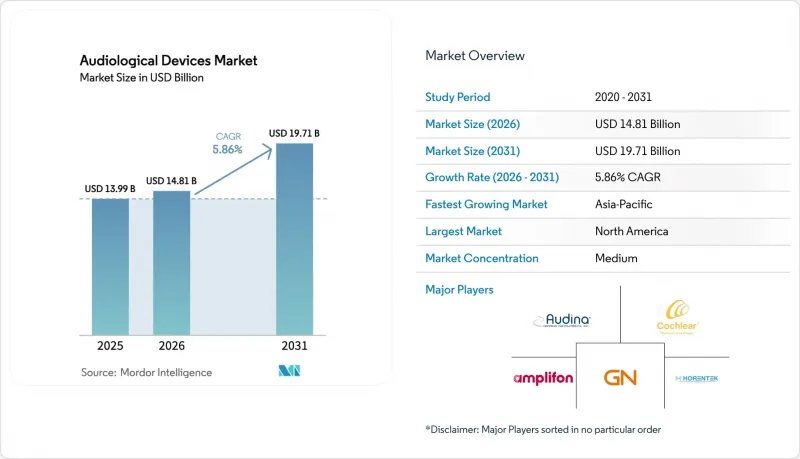
This report is Segmented by Product Type (Hearing Aids, Bone-Anchored Hearing Aids, Cochlear Implants, Diagnostic Devices, Software & Accessories), Disease Type (Otosclerosis, Meniere's Disease, and More), Patient Age-Group (Pediatric, Adults), End User (Hospitals, ENT Clinics, and More), and Geography (North America, Europe, and More). The Market Forecasts are Provided in Terms of Value (USD).
Global Audiological Devices Market Trends and Insights
Aging Population and Rising Prevalence of Hearing Loss
Worldwide demographic ageing is lifting baseline demand as bilateral loss affects 37.9 million Americans and 90.7% of adults above 80 years. This demographic shift creates sustained demand pressure, as age-related hearing loss typically begins with high-frequency deficits that progressively impact speech comprehension in noisy environments. Age-related deficits diminish speech comprehension, increase cognitive decline risk, and reduce workforce productivity, prompting public and private stakeholders to invest in early intervention and rehabilitation.
Rapid Adoption of Digital and Bluetooth-Enabled Hearing Aids
Bluetooth LE Audio and Auracast broadcast functions are now baseline in premium lines, enabling direct links to public address systems and smartphones. Brands such as ReSound, Beltone, and Phonak integrate these features to deliver 10 dB signal-to-noise gains and 45% listening-effort reduction. This connectivity revolution extends beyond entertainment to healthcare integration, with devices now capable of real-time health monitoring and telehealth consultations, positioning hearing aids as comprehensive wellness platforms rather than single-purpose medical devices.
High Upfront Device and Fitting Costs
High upfront costs for devices and fittings pose a significant barrier to the growth of the audiological devices market. Many potential users, especially in emerging economies, find these expenses prohibitive. This financial hurdle limits the accessibility of audiological solutions, curbing market expansion. Average premium hearing aid bundles exceed USD 4,000 per pair, deterring adoption where insurance coverage is limited. Cost-sensitive buyers may postpone purchase or switch to basic amplification products, tempering revenue growth. As a result, manufacturers and providers are exploring innovative financing options and subsidies to mitigate this challenge and broaden their market reach.
Other drivers and restraints analyzed in the detailed report include:
- Government-Led Newborn and Elderly Screening Programmes
- High Noise Exposure in Urban and Industrial Settings
- Persistent Social Stigma Among Younger Users
For complete list of drivers and restraints, kindly check the Table Of Contents.
Segment Analysis
Hearing aids held 60.44% of audiological devices market share in 2025, underpinned by sustained demand from older adults and expanding OTC access. The segment benefits from real-time AI chips that deliver up to 10 dB noise-reduction gains, as seen in Phonak Audeo Sphere Infinio. Receiver-in-the-ear and behind-the-ear styles dominate thanks to space for high-capacity batteries and antennas.
Diagnostic devices are growing fastest at 6.93% CAGR, lifted by broader screening mandates and portable imaging advances such as optical coherence tomography otoscopes. Cochlear implants, bone-anchored aids, and software each target niche needs; fully implantable prototypes from MED-EL and Envoy Medical indicate a future of discreet rehabilitation options.
Meniere's disease accounted for 29.21% of 2025 revenue owing to its multifaceted symptoms that require both vestibular diagnostics and tinnitus-friendly amplification, sustaining demand for premium solutions. The audiological devices market size for this indication will remain robust as awareness campaigns improve early referral patterns.
Otosclerosis is set to record a 6.59% CAGR, supported by refined stapedectomy techniques and conductive-loss-specific hearing aid algorithms. Acoustic neuroma care integrates surgical navigation with post-operative cochlear implantation, while otitis media continues to drive paediatric diagnostic equipment sales such as tympanometers and ultrasound otoscopes.
Complete Report Scope:
- By Product Type
- Hearing Aids
- Behind-the-Ear (BTE)
- Receiver-in-the-Ear (RITE)
- In-the-Ear (ITE)
- Canal Hearing Aids (CHA)
- Bone-Anchored Hearing Aids
- Cochlear Implants
- Diagnostic Devices
- Audiometers
- Tympanometers
- Otoscopes
- Software & Accessories
- Hearing Aids
- By Disease Type
- Otosclerosis
- Meniere's Disease
- Acoustic Neuroma
- Otitis Media
- Others
- By Patient Age-Group
- Pediatric
- Adults
- By End User
- Hospitals
- ENT Clinics
- Home Healthcare
- Ambulatory Surgery Centers
- Other End Users
- By Geography
- North America
- United States
- Canada
- Mexico
- Europe
- Germany
- United Kingdom
- France
- Italy
- Spain
- Rest of Europe
- Asia-Pacific
- China
- Japan
- India
- Australia
- South Korea
- Rest of Asia-Pacific
- Middle East and Africa
- GCC
- South Africa
- Rest of Middle East and Africa
- South America
- Brazil
- Argentina
- Rest of South America
- North America
Geography Analysis
North America captured 34.12% of global revenue in 2025 on the back of advanced infrastructure, strong research pipelines, and the landmark OTC rule that expands retail access. Widespread private insurance and Medicare Advantage plans support premium product uptake, yet patchy traditional Medicare coverage creates affordability gaps.
Asia-Pacific is the fastest-growing region at 7.71% CAGR through 2031, driven by ageing populations in Japan and South Korea and rising disposable incomes in China and India. Government cochlear implant programmes and expanding private clinics accelerate penetration. Urban industrial zones deepen the need for occupational hearing protection, while growing middle-class awareness boosts adoption of advanced hearing aids.
Europe shows steady momentum, supported by universal care models that ensure basic access and stringent regulations that maintain quality. Reimbursement frameworks vary, prompting manufacturers to tailor pricing tiers. Middle East and Africa and South America remain nascent but improving: investments in tertiary hospitals and mobile outreach programmes widen access, while urbanisation lifts noise-related demand.
- Sonova
- Demant
- GN Hearing
- WS Audiology
- Cochlear
- Starkey Laboratories
- Amplifon
- Audina Hearing Instruments
- MED-EL
- Natus Medical
- INVENTIS
- Horentek Hearing Diagnostic
- Beltone (GN subsidiary)
- Rion Co. Ltd.
- Eargo
- Elkon Pvt. Ltd.
- Oticon Medical
- Sivantos (Signia)
- Resound
- Interacoustics
Additional Benefits:
- The market estimate (ME) sheet in Excel format
- 3 months of analyst support
TABLE OF CONTENTS
1 Introduction
- 1.1 Study Assumptions & Market Definition
- 1.2 Scope of the Study
2 Research Methodology
3 Executive Summary
4 Market Landscape
- 4.1 Market Overview
- 4.2 Market Drivers
- 4.2.1 Aging Population and Rising Prevalence of Hearing Loss
- 4.2.2 Rapid Adoption of Digital and Bluetooth-Enabled Hearing Aids
- 4.2.3 Government-Led Newborn and Elderly Hearing-Screening Programs
- 4.2.4 High Noise-Exposure Levels in Urban and Industrial Settings
- 4.2.5 OTC Hearing-Aid Legislation Unlocking Untapped Consumer Base
- 4.2.6 Tele-Audiology Platforms Accelerating Rural Market Penetration
- 4.3 Market Restraints
- 4.3.1 High Upfront Device and Fitting Costs
- 4.3.2 Persistent Social Stigma Among Younger Demographics
- 4.3.3 Patchy Reimbursement in Many Emerging and Developed Markets
- 4.3.4 Semiconductor Supply-Chain Disruptions Impacting Production
- 4.4 Regulatory Landscape
- 4.5 Technological Outlook
- 4.6 Porter's Five Forces Analysis
- 4.6.1 Threat of New Entrants
- 4.6.2 Bargaining Power of Buyers
- 4.6.3 Bargaining Power of Suppliers
- 4.6.4 Threat of Substitutes
- 4.6.5 Competitive Rivalry
5 Market Size & Growth Forecasts (Value)
- 5.1 By Product Type
- 5.1.1 Hearing Aids
- 5.1.1.1 Behind-the-Ear (BTE)
- 5.1.1.2 Receiver-in-the-Ear (RITE)
- 5.1.1.3 In-the-Ear (ITE)
- 5.1.1.4 Canal Hearing Aids (CHA)
- 5.1.2 Bone-Anchored Hearing Aids
- 5.1.3 Cochlear Implants
- 5.1.4 Diagnostic Devices
- 5.1.4.1 Audiometers
- 5.1.4.2 Tympanometers
- 5.1.4.3 Otoscopes
- 5.1.5 Software & Accessories
- 5.1.1 Hearing Aids
- 5.2 By Disease Type
- 5.2.1 Otosclerosis
- 5.2.2 Meniere's Disease
- 5.2.3 Acoustic Neuroma
- 5.2.4 Otitis Media
- 5.2.5 Others
- 5.3 By Patient Age-Group
- 5.3.1 Pediatric
- 5.3.2 Adults
- 5.4 By End User
- 5.4.1 Hospitals
- 5.4.2 ENT Clinics
- 5.4.3 Home Healthcare
- 5.4.4 Ambulatory Surgery Centers
- 5.4.5 Other End Users
- 5.5 By Geography
- 5.5.1 North America
- 5.5.1.1 United States
- 5.5.1.2 Canada
- 5.5.1.3 Mexico
- 5.5.2 Europe
- 5.5.2.1 Germany
- 5.5.2.2 United Kingdom
- 5.5.2.3 France
- 5.5.2.4 Italy
- 5.5.2.5 Spain
- 5.5.2.6 Rest of Europe
- 5.5.3 Asia-Pacific
- 5.5.3.1 China
- 5.5.3.2 Japan
- 5.5.3.3 India
- 5.5.3.4 Australia
- 5.5.3.5 South Korea
- 5.5.3.6 Rest of Asia-Pacific
- 5.5.4 Middle East and Africa
- 5.5.4.1 GCC
- 5.5.4.2 South Africa
- 5.5.4.3 Rest of Middle East and Africa
- 5.5.5 South America
- 5.5.5.1 Brazil
- 5.5.5.2 Argentina
- 5.5.5.3 Rest of South America
- 5.5.1 North America
6 Competitive Landscape
- 6.1 Market Concentration
- 6.2 Market Share Analysis
- 6.3 Company Profiles (includes Global level Overview, Market level overview, Core Segments, Financials as available, Strategic Information, Market Rank/Share for key companies, Products & Services, and Recent Developments)
- 6.3.1 Sonova Holding AG
- 6.3.2 Demant A/S
- 6.3.3 GN Hearing A/S
- 6.3.4 WS Audiology
- 6.3.5 Cochlear Ltd.
- 6.3.6 Starkey Laboratories Inc.
- 6.3.7 Amplifon SpA
- 6.3.8 Audina Hearing Instruments Inc.
- 6.3.9 MED-EL Medical Electronics
- 6.3.10 Natus Medical Inc.
- 6.3.11 INVENTIS s.r.l.
- 6.3.12 Horentek Hearing Diagnostic
- 6.3.13 Beltone (GN subsidiary)
- 6.3.14 Rion Co. Ltd.
- 6.3.15 Eargo Inc.
- 6.3.16 Elkon Pvt. Ltd.
- 6.3.17 Oticon Medical
- 6.3.18 Sivantos (Signia)
- 6.3.19 Resound
- 6.3.20 Interacoustics A/S
7 Market Opportunities & Future Outlook
- 7.1 White-space & Unmet-need Assessment

