PUBLISHER: Mordor Intelligence | PRODUCT CODE: 2116717

PUBLISHER: Mordor Intelligence | PRODUCT CODE: 2116717
Italy Cybersecurity - Market Share Analysis, Industry Trends & Statistics, Growth Forecasts (2026 - 2031)
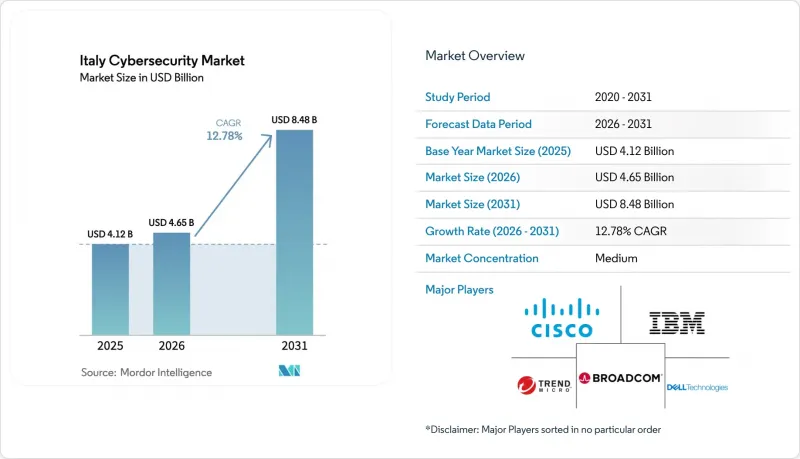
According to Mordor Intelligence, the Italy cybersecurity market size was valued at USD 4.12 billion in 2025 and estimated to grow from USD 4.65 billion in 2026 to reach USD 8.48 billion by 2031, at a CAGR of 12.78% during the forecast period (2026-2031).
This report is Segmented by Offering (Solutions, Services), Deployment Mode (Cloud, On-Premise), Organization Size (SMEs, Large Enterprises), End User (BFSI, Healthcare, IT and Telecom, and More). The Market Forecasts are Provided in Terms of Value (USD).
Italy Cybersecurity Market Trends and Insights
Digital-First Public-Service Mandates Accelerating National Cyber-Perimeter Programs
Italy earmarked 27% of National Recovery and Resilience Plan resources for digital transition, including USD 2.2 billion for cybersecurity. The National Cybersecurity Agency now obliges essential service providers to meet strict perimeter controls, yet only 2% of public administrations currently comply. As municipal portals, welfare payments and national ID services move online, local authorities in Rome, Milan and Turin are upgrading identity management and zero-trust frameworks, often contracting managed security operators to compensate for in-house skill shortages.
Surge in Ransomware Attacks Targeting Italian Industrial Automation Networks
Manufacturing firms absorbed 70% of industrial ransomware incidents in Q4 2024, a shift from mere data theft to operational sabotage. During Q1 2025 alone, Europe logged 135 OT-focused breaches. Factories along the Po Valley are hardening PLCs, segmenting networks and rolling out AI-driven anomaly detection to avoid multi-day production shutdowns. Vendor demand for secure remote-maintenance gateways has reached record levels.
Scarcity of Italian-Speaking Cyber-Talent Raising MSSP Costs
Cybersecurity job postings fell 10% between 2022 and 2024 even as demand climbed, leaving 90% of organisations with skills gaps. Local-language SOC analysts command premiums, pushing smaller firms to delegate monitoring to managed security service providers headquartered in Milan and Rome.
Other drivers and restraints analyzed in the detailed report include:
- EU NIS2 and DORA Compliance Deadlines Driving Budget Re-allocation Toward Security Tooling
- Cloud-Native Start-up Boom in Milan and Turin Intensifying Demand for SaaS Security Posture Management
- Prevailing 'Security - Cost Center' Mind-set Within Mid-Market Manufacturing SMEs
For complete list of drivers and restraints, kindly check the Table Of Contents.
Segment Analysis
Solutions held 64.85% of Italy cybersecurity market share in 2025, led by network firewalls and identity platforms. Budget reallocations tied to NIS2 and DORA sustain robust refresh cycles among large banks and utilities. However, services are projected to record a 13.95% CAGR to 2031, eclipsing product growth as enterprises outsource SOC, penetration testing and incident response to mitigate the talent deficit. Managed detection and response platforms now bundle threat-hunting and regulatory reporting, creating sticky multi-year contracts. Italy cybersecurity market size for services is set to surpass USD 3.18 billion by 2031, aided by demand for 24/7 monitoring anchored in Italian language.
Italy cybersecurity market expands as consulting teams guide compliance mapping, architecture redesign and quantum-resilience pilots. Professional services revenues are rising fastest in Rome's public-sector cluster, while MSSP uptake is highest in Milan's financial quarter where tier-one banks off-load log correlation and digital-forensics workloads during merger integrations. Identity-as-a-Service and zero-trust assessments also gain traction among healthcare networks preparing for electronic health-record rollouts.
On-premise solutions retained 59.85% of Italy cybersecurity market share in 2025, reflecting strong data-sovereignty preferences among critical infrastructure operators. Yet cloud-delivered controls are climbing at an 17.55% CAGR, driven by SaaS productivity suites, remote work, and rising comfort with EU-hosted hyperscale regions. As the Italy cybersecurity market size for cloud deployment surpasses USD 4.36 billion in 2031, demand concentrates on cloud-native SIEM, container runtime defense and policy-as-code automation that streamlines GDPR audits.
Hybrid architectures dominate transitional road maps: threat-intelligence lakes remain on-premise, while vulnerability scanning and backup encryption shift to SaaS. Cross-border data-transfer clauses under GDPR fuel interest in confidential computing and customer-managed keys. Vendors now bundle data-residency dashboards to win cautious public authorities migrating citizen portals to private-cloud nodes in Turin and Bologna.
Complete Report Scope:
- By Offering
- Solutions
- Application Security
- Cloud Security
- Data Security
- Identity and Access Management
- Infrastructure Protection
- Integrated Risk Management
- Network Security Equipment
- Endpoint Security
- Other Solutions
- Services
- Professional Services
- Managed Services
- Solutions
- By Deployment Mode
- Cloud
- On-Premise
- By Organization Size
- SMEs
- Large Enterprises
- By End User
- BFSI
- Healthcare
- IT and Telecom
- Industrial and Defense
- Retail
- Energy and Utilities
- Manufacturing
- Others
List of Companies Covered in this Report:
- IBM Corporation
- Cisco Systems Inc.
- Trend Micro Incorporated
- Broadcom Inc. (Symantec)
- Dell Technologies Inc.
- Fortinet Inc.
- Palo Alto Networks Inc.
- McAfee LLC
- Check Point Software Technologies Ltd.
- Sophos Group plc
- Kaspersky Lab JSC
- Accenture Security
- Leonardo S.p.A.
- Reply S.p.A. (Cluster Reply, Breed Reply)
- TAS Group
- Tinexta Cyber S.p.A.
- Almaviva S.p.A.
- Telsy S.p.A. (TIM Group)
- Cyberoo S.p.A.
- Maggioli Group
Additional Benefits:
- The market estimate (ME) sheet in Excel format
- 3 months of analyst support
TABLE OF CONTENTS
1 INTRODUCTION
- 1.1 Study Assumptions and Market Definition
- 1.2 Scope of the Study
2 RESEARCH METHODOLOGY
3 EXECUTIVE SUMMARY
4 MARKET LANDSCAPE
- 4.1 Market Overview
- 4.2 Market Drivers
- 4.2.1 Digital-First Public-Service Mandates Accelerating National Cyber-Perimeter Programs
- 4.2.2 Surge in Ransomware Attacks Targeting Italian Industrial Automation Networks
- 4.2.3 EU NIS2 and DORA Compliance Deadlines Driving Budget Re-allocation Towards Security Tooling
- 4.2.4 Cloud-Native Start-up Boom in Milan and Turin Intensifying Demand for SaaS Security Posture Management
- 4.2.5 Growth of OT/ICS Installations in Energy Corridor (Po Valley) Expanding Attack Surface
- 4.2.6 Increased Government Incentives for "Made-in-Italy" Cyber Platforms under PNRR Funds
- 4.3 Market Restraints
- 4.3.1 Scarcity of Italian-speaking Cyber-Talent Raising MSSP Costs
- 4.3.2 Prevailing 'Security - Cost Center' Mind-set Within Mid-Market Manufacturing SMEs
- 4.3.3 Fragmented Legacy Telco Infrastructure Hindering Zero-Trust Roll-outs
- 4.3.4 Slow Migration from On-Prem HSMs in Highly Regulated BFSI Segment
- 4.4 Regulatory Outlook
- 4.5 Technological Outlook
- 4.6 Porter's Five Forces Analysis
- 4.6.1 Threat of New Entrants
- 4.6.2 Bargaining Power of Buyers
- 4.6.3 Bargaining Power of Suppliers
- 4.6.4 Threat of Substitutes
- 4.6.5 Intensity of Competitive Rivalry
- 4.7 Impact of Macroeconomic Factors on the Market
- 4.8 Investment and Funding Analysis
5 MARKET SIZE AND GROWTH FORECASTS (VALUE)
- 5.1 By Offering
- 5.1.1 Solutions
- 5.1.1.1 Application Security
- 5.1.1.2 Cloud Security
- 5.1.1.3 Data Security
- 5.1.1.4 Identity and Access Management
- 5.1.1.5 Infrastructure Protection
- 5.1.1.6 Integrated Risk Management
- 5.1.1.7 Network Security Equipment
- 5.1.1.8 Endpoint Security
- 5.1.1.9 Other Solutions
- 5.1.2 Services
- 5.1.2.1 Professional Services
- 5.1.2.2 Managed Services
- 5.1.1 Solutions
- 5.2 By Deployment Mode
- 5.2.1 Cloud
- 5.2.2 On-Premise
- 5.3 By Organization Size
- 5.3.1 SMEs
- 5.3.2 Large Enterprises
- 5.4 By End User
- 5.4.1 BFSI
- 5.4.2 Healthcare
- 5.4.3 IT and Telecom
- 5.4.4 Industrial and Defense
- 5.4.5 Retail
- 5.4.6 Energy and Utilities
- 5.4.7 Manufacturing
- 5.4.8 Others
6 COMPETITIVE LANDSCAPE
- 6.1 Strategic Developments
- 6.2 Vendor Positioning Analysis
- 6.3 Company Profiles (includes Global level Overview, Market level overview, Core Segments, Financials as available, Strategic Information, Products and Services, and Recent Developments)
- 6.3.1 IBM Corporation
- 6.3.2 Cisco Systems Inc.
- 6.3.3 Trend Micro Incorporated
- 6.3.4 Broadcom Inc. (Symantec)
- 6.3.5 Dell Technologies Inc.
- 6.3.6 Fortinet Inc.
- 6.3.7 Palo Alto Networks Inc.
- 6.3.8 McAfee LLC
- 6.3.9 Check Point Software Technologies Ltd.
- 6.3.10 Sophos Group plc
- 6.3.11 Kaspersky Lab JSC
- 6.3.12 Accenture Security
- 6.3.13 Leonardo S.p.A.
- 6.3.14 Reply S.p.A. (Cluster Reply, Breed Reply)
- 6.3.15 TAS Group
- 6.3.16 Tinexta Cyber S.p.A.
- 6.3.17 Almaviva S.p.A.
- 6.3.18 Telsy S.p.A. (TIM Group)
- 6.3.19 Cyberoo S.p.A.
- 6.3.20 Maggioli Group
7 MARKET OPPORTUNITIES AND FUTURE OUTLOOK
- 7.1 White-space and Unmet-Need Assessment

