PUBLISHER: Mordor Intelligence | PRODUCT CODE: 2116733

PUBLISHER: Mordor Intelligence | PRODUCT CODE: 2116733
Pupillometer - Market Share Analysis, Industry Trends & Statistics, Growth Forecasts (2026 - 2031)
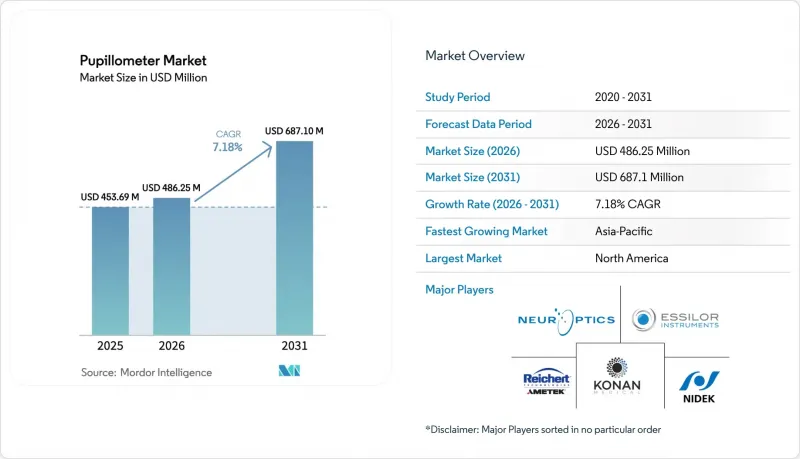
According to Mordor Intelligence, the pupillometer market size was valued at USD 453.69 million in 2025 and estimated to grow from USD 486.25 million in 2026 to reach USD 687.1 million by 2031, at a CAGR of 7.18% during the forecast period (2026-2031).
This report is Segmented by Modality (Handheld Pupillometer, Table-Top Pupillometer, and More), Type (Digital Pupillometer, Video Pupillometer, and More), Application (Ophthalmology, Neurology, and Other Applications), End User (Hospitals, Eye Clinics, and Others), and Geography. The Report Offers the Value (USD) for the Above Segments.
Global Pupillometer Market Trends and Insights
Rise in Awareness & Technological Advances in Quantitative Pupillometry
Clinicians are shifting from subjective flashlight checks to algorithm-driven Neurological Pupillary Index (NPi) readings that correlate tightly with intracranial pressure changes. Real-time analytics now quantify constriction velocity and dilation lag across diverse iris pigmentations. Portable devices equipped with infrared LEDs fit emergency carts and ambulances, widening the pupillometer market in pre-hospital triage. Cloud dashboards plot longitudinal pupil trends, flagging subclinical neurological shifts up to 4 hours earlier than Glasgow Coma Scale variations. Such objective metrics are convincing payers to pilot outcome-based reimbursement models in high-acuity settings.
Growing Prevalence of Neuro-Critical Care & TBI Cases
Global TBI rates remain elevated in aging populations and contact-sport participants, spurring hospitals to add handheld units across trauma bays. Military medics employ ruggedized devices during battlefield triage, where a 30-second pupil scan informs evacuation priority. Cardiac arrest teams use pupillometry for prognostication within the first 24 hours post-ROSC, trimming ICU length of stay when poor neurological outcomes are predicted early. The expanding evidence base positions the pupillometer market for deeper penetration into comprehensive stroke centers and concussion clinics.
High Acquisition Cost & Limited Reimbursements
Capital-intensive units price above USD 20,000, deterring smaller clinics where billing codes remain ambiguous . Absence of a dedicated CPT code forces bundling under general eye exams, cutting cost recovery by up to 40%. Service contracts, software licenses, and staff training push total cost of ownership higher. Emerging smartphone alternatives come in below USD 1,000 and threaten to erode premium hardware margins while broadening the pupillometer market footprint among cost-conscious providers.
Other drivers and restraints analyzed in the detailed report include:
- Increasing Adoption for Glaucoma & Refractive-Surgery Screening
- Integration into AI-Enabled Ophthalmic Diagnostics
- Shortage of Clinicians Trained in Neuro-Ophthalmic Interpretation
For complete list of drivers and restraints, kindly check the Table Of Contents.
Segment Analysis
Hand-held devices are moving the pupillometer market forward with a 7.72% CAGR as emergency departments and athletic programs favor lightweight designs that run an entire shift on a single charge. Table-top systems still secure 54.12% of 2025 revenue by integrating seamlessly into ICU monitoring arrays, offering multi-parameter analytics alongside vital signs.
Advances in lithium-ion batteries and miniaturized optics are shrinking unit weight below 300 grams, allowing first responders to capture pupillary metrics mid-transport. Table-top platforms increasingly bundle AI dashboards that push alerts to neurologists' smartphones, retaining relevance despite their stationary footprint. Market entrants leveraging smartphone chassis bypass proprietary hardware costs, signaling a future where mobility defines competitive edge.
Video units accounted for 51.62% pupillometer market share in 2025, reflecting widespread hospital protocols that require high-frame-rate recordings for medico-legal documentation. Digital infrared devices are gaining at an 7.89% CAGR as sensor fidelity now compensates for iris pigmentation variance.
High-resolution video streams allow frame-by-frame review of constriction dynamics, benefitting teaching hospitals that archive de-identified clips for AI model training. Infrared units excel under ambient-light fluctuations, supporting rural outreach vans where dark room conditions are hard to maintain. Hybrid products combining video and infrared tracking are slated for launch in 2026, aiming to unify best-in-class features while expanding the pupillometer market size across both acute and ambulatory settings.
Complete Report Scope:
- By Modality
- Hand-held Pupillometer
- Table-top Pupillometer
- Smartphone-based Pupillometer
- By Type
- Digital (Infrared) Pupillometer
- Video Pupillometer
- Photorefractor-based Pupillometer
- By Application
- Ophthalmology
- Neurology
- Other Clinical Applications
- By End User
- Hospitals
- Eye Clinics & Vision Centers
- Others
- By Geography
- North America
- United States
- Canada
- Mexico
- Europe
- Germany
- United Kingdom
- France
- Italy
- Spain
- Rest of Europe
- Asia-Pacific
- China
- Japan
- India
- Australia
- South Korea
- Rest of Asia-Pacific
- Middle East & Africa
- GCC
- South Africa
- Rest of Middle East & Africa
- South America
- Brazil
- Argentina
- Rest of South America
- North America
Geography Analysis
North America retained 42.75% of global revenue in 2025 as FDA Class I classification minimizes regulatory overhead, accelerating hospital procurement cycles . Multi-center trials funded by the National Institutes of Health continue to validate new AI algorithms, reinforcing payer confidence. Collegiate athletics increasingly require baseline pupil scans, creating incremental device placements outside traditional hospital settings.
Asia-Pacific is set to register the swiftest trajectory at an 8.53% CAGR through 2031. High myopia prevalence and growing neurologic disease burden are compelling governments to subsidize early-detection technologies. Private ophthalmology chains in India and China are bundling pupil analytics with cataract and refractive packages to differentiate service offerings. Domestic startups are also entering the pupillometer market with low-cost smartphone adaptors, intensifying price competition.
Europe continues to capitalize on cohesive regulatory pathways under the Medical Device Regulation, facilitating faster rollouts of digital infrared innovations. Aging demographics drive elevated glaucoma incidence, sustaining device demand across public hospitals and private clinics. Cross-border telemedicine initiatives linking rural Baltic clinics with neuro-ophthalmology hubs in Germany exemplify collaborative deployment models that extend diagnostic reach.
- NeurOptics
- Essilor Instruments
- Visionix (Luneau Technology)
- Advancing Eyecare (US Ophthalmic)
- Nidek
- HAAG-STREIT Group
- Reichert Technologies
- Konan Medical
- Good-Lite Company
- Grobet USA (Vigor Optical)
- Plusoptix GmbH
- IDMED (NeuroLight)
- Righton Instruments
- Topcon
- Carl Zeiss
- Keeler Ltd.
- Medline Industries
- BVI Medical
- Optomed Plc
- Coburn Technologies
- Marco Ophthalmic
Additional Benefits:
- The market estimate (ME) sheet in Excel format
- 3 months of analyst support
TABLE OF CONTENTS
1 Introduction
- 1.1 Study Assumptions & Market Definition
- 1.2 Scope of the Study
2 Research Methodology
3 Executive Summary
4 Market Landscape
- 4.1 Market Overview
- 4.2 Market Drivers
- 4.2.1 Rise in awareness & technological advances in quantitative pupillometry
- 4.2.2 Growing prevalence of neuro-critical care & TBI cases
- 4.2.3 Increasing adoption for glaucoma & refractive-surgery screening
- 4.2.4 Integration into AI-enabled ophthalmic diagnostics
- 4.2.5 Expansion of point-of-care & tele-neurology platforms
- 4.2.6 Use in sports concussion & battlefield triage protocols
- 4.3 Market Restraints
- 4.3.1 High acquisition cost & limited reimbursements
- 4.3.2 Shortage of clinicians trained in neuro-ophthalmic interpretation
- 4.3.3 Regulatory uncertainty for software-as-medical-device algorithms
- 4.3.4 Data-privacy concerns over cloud-based pupil recordings
- 4.4 Value / Supply-Chain Analysis
- 4.5 Regulatory Landscape
- 4.6 Technological Outlook
- 4.7 Porter's Five Forces Analysis
- 4.7.1 Threat of New Entrants
- 4.7.2 Bargaining Power of Buyers
- 4.7.3 Bargaining Power of Suppliers
- 4.7.4 Threat of Substitutes
- 4.7.5 Intensity of Competitive Rivalry
5 Market Size & Growth Forecasts (Value, USD)
- 5.1 By Modality
- 5.1.1 Hand-held Pupillometer
- 5.1.2 Table-top Pupillometer
- 5.1.3 Smartphone-based Pupillometer
- 5.2 By Type
- 5.2.1 Digital (Infrared) Pupillometer
- 5.2.2 Video Pupillometer
- 5.2.3 Photorefractor-based Pupillometer
- 5.3 By Application
- 5.3.1 Ophthalmology
- 5.3.2 Neurology
- 5.3.3 Other Clinical Applications
- 5.4 By End User
- 5.4.1 Hospitals
- 5.4.2 Eye Clinics & Vision Centers
- 5.4.3 Others
- 5.5 By Geography
- 5.5.1 North America
- 5.5.1.1 United States
- 5.5.1.2 Canada
- 5.5.1.3 Mexico
- 5.5.2 Europe
- 5.5.2.1 Germany
- 5.5.2.2 United Kingdom
- 5.5.2.3 France
- 5.5.2.4 Italy
- 5.5.2.5 Spain
- 5.5.2.6 Rest of Europe
- 5.5.3 Asia-Pacific
- 5.5.3.1 China
- 5.5.3.2 Japan
- 5.5.3.3 India
- 5.5.3.4 Australia
- 5.5.3.5 South Korea
- 5.5.3.6 Rest of Asia-Pacific
- 5.5.4 Middle East & Africa
- 5.5.4.1 GCC
- 5.5.4.2 South Africa
- 5.5.4.3 Rest of Middle East & Africa
- 5.5.5 South America
- 5.5.5.1 Brazil
- 5.5.5.2 Argentina
- 5.5.5.3 Rest of South America
- 5.5.1 North America
6 Competitive Landscape
- 6.1 Market Concentration
- 6.2 Market Share Analysis
- 6.3 Company Profiles (includes Global level Overview, Market level overview, Core Segments, Financials as available, Strategic Information, Market Rank/Share for key companies, Products & Services, and Recent Developments)
- 6.3.1 NeurOptics Inc.
- 6.3.2 Essilor Instruments
- 6.3.3 Visionix (Luneau Technology)
- 6.3.4 Advancing Eyecare (US Ophthalmic)
- 6.3.5 NIDEK Co., Ltd.
- 6.3.6 HAAG-STREIT Group
- 6.3.7 Reichert Technologies
- 6.3.8 Konan Medical
- 6.3.9 Good-Lite Company
- 6.3.10 Grobet USA (Vigor Optical)
- 6.3.11 Plusoptix GmbH
- 6.3.12 IDMED (NeuroLight)
- 6.3.13 Righton Instruments
- 6.3.14 Topcon Corporation
- 6.3.15 Carl Zeiss Meditec AG
- 6.3.16 Keeler Ltd.
- 6.3.17 Medline Industries
- 6.3.18 BVI Medical
- 6.3.19 Optomed Plc
- 6.3.20 Coburn Technologies
- 6.3.21 Marco Ophthalmic
7 Market Opportunities & Future Outlook
- 7.1 White-space & Unmet-need Assessment

