PUBLISHER: Mordor Intelligence | PRODUCT CODE: 2116752

PUBLISHER: Mordor Intelligence | PRODUCT CODE: 2116752
Fabry Disease Treatment - Market Share Analysis, Industry Trends & Statistics, Growth Forecasts (2026 - 2031)
According to Mordor Intelligence, the fabry disease treatment market size is expected to grow from USD 2.63 billion in 2025 to USD 2.83 billion in 2026 and is forecast to reach USD 4.09 billion by 2031 at 7.63% CAGR over 2026-2031.
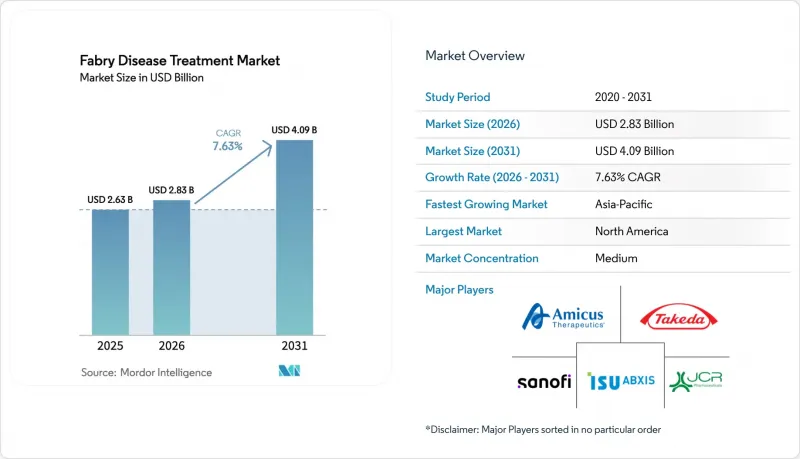
This report is Segmented by Treatment (Enzyme Replacement Therapy, and More), Route of Administration (Intravenous, Oral, and Subcutaneous), Distribution Channel (Hospital Pharmacies, Retail Pharmacies, Specialty Pharmacies, and Online Pharmacies), and Geography (North America, Europe, Asia-Pacific, Middle East & Africa, South America). The Market Forecasts are Provided in Terms of Value (USD).
Global Fabry Disease Treatment Market Trends and Insights
Growing Prevalence of Fabry Disease
Re-evaluation of screening programs indicates Fabry disease affects nearly 1 in 10,000 individuals, a four-fold increase on earlier estimates. Late-onset forms account for most symptomatic cases and often escape detection until organ damage progresses, which creates a significant latent pool of untreated adults. Broader renal and cardiology screening plus newborn testing in several countries funnels higher numbers of presymptomatic carriers into specialty clinics. This expanding patient funnel underpins sustained demand in the Fabry disease treatment market.
Advances in Gene and mRNA Therapies
Multiple AAV-based vectors now show persistent a-galactosidase A expression for at least two years, minimizing immunogenicity and infusion burden. FDA agreement on an accelerated approval path for Sangamo's ST-920 underscores rising regulatory confidence in biomarker-driven endpoints. uniQure's AMT-191 and Exegenesis Bio's EXG110 hold orphan designations and early safety data support single-dose curative potential. Each milestone heightens investor interest and propels the Fabry disease treatment market toward transformative modalities.
High Treatment Costs and Payer Budget Constraints
Elfabrio's annual price surpasses USD 430,000, placing Fabry therapy among the costliest prescriptions worldwide. Insurers often restrict reimbursement until organ pathology is documented, delaying initiation and potentially worsening prognosis. Variable public financing leaves emerging-market patients exposed to catastrophic out-of-pocket fees, muting penetration rates in the Fabry disease treatment market despite rising clinical need.
Other drivers and restraints analyzed in the detailed report include:
- Favorable Orphan-Drug Incentives and Fast-Track Designations
- Increasing Global Healthcare Expenditure on Rare Diseases
- Limited Diagnostic Infrastructure in Emerging Markets
For complete list of drivers and restraints, kindly check the Table Of Contents.
Segment Analysis
Enzyme replacement therapy generated 67.85% of Fabry disease treatment market revenue in 2025 and continues to anchor clinical practice due to decades of safety data. However, gene therapy is forecast to post a 9.18% CAGR, reflecting patient demand for single-dose, potentially curative solutions. Oral chaperone migalastat addresses amenable mutations, and substrate reduction agent venglustat is in Phase III for neuropathic pain management. The diversified pipeline signals that the Fabry disease treatment market will transition toward modality pluralism rather than a single therapeutic hegemon.
Gene therapy sponsors improve vector tropism and dosing efficiency, reducing manufacturing cost and immunogenic risk. Pegunigalsidase alfa's monthly infusion option demonstrates legacy ERT innovation while biosimilar entries loom as patents expire. Collectively, these shifts promise a more competitive and patient-centric Fabry disease treatment market over the next decade.
Complete Report Scope:
- By Treatment
- Enzyme Replacement Therapy
- Oral Chaperone Therapy
- Gene Therapy
- Substrate Reduction Therapy
- Other Treatments
- By Route of Administration
- Intravenous
- Oral
- Subcutaneous
- By Distribution Channel
- Hospital Pharmacies
- Retail Pharmacies
- Specialty Pharmacies
- Online Pharmacies
- Geography
- North America
- United States
- Canada
- Mexico
- Europe
- Germany
- United Kingdom
- France
- Italy
- Spain
- Rest of Europe
- Asia-Pacific
- China
- Japan
- India
- Australia
- South Korea
- Rest of Asia-Pacific
- Middle East & Africa
- GCC
- South Africa
- Rest of Middle East & Africa
- GCC
- South America
- Brazil
- Argentina
- Rest of South America
- North America
Geography Analysis
North America led with 42.85% Fabry disease treatment market revenue in 2025 underpinned by broad newborn screening, specialist centers, and comprehensive reimbursement. The FDA routinely applies priority and breakthrough designations, enabling swift adoption of novel modalities. Despite payer scrutiny, commercial plans typically cover enzyme replacement and migalastat, while multiple gene therapy trials recruit aggressively across the United States and Canada.
Europe ranks second, benefiting from cross-border regulatory harmonization via the EMA and robust academic registries tracking long-term outcomes. National health technology assessments can delay uptake but ultimately assure broad coverage. Recent Scottish approval for pegunigalsidase alfa highlights continued regional expansion of the Fabry disease treatment market. EU research consortia and patient groups provide an integrated ecosystem that supports evidence generation and guideline refinement.
Asia-Pacific is the fastest growing zone at an 8.28% CAGR. Japan's conditional early-access framework and South Korea's national insurance adoption of ERT illustrate mature system capacity. China's rare-disease catalog, expanded reimbursement, and domestic biotech investment collectively accelerate penetration. Rising clinical trial activity and infrastructure upgrades in India and Southeast Asia suggest further upside for the Fabry disease treatment market over the horizon.
- Sanofi
- Takeda Pharmaceuticals
- Amicus Therapeutics
- Chiesi Farmaceutici
- Protalix BioTherapeutics
- JCR Pharmaceuticals
- ISU ABXIS
- Freeline Therapeutics
- Yuhan Corporation
- M6P Therapeutics
- AVROBIO
- Sangamo Therapeutics
- 4D Molecular Therapeutics
- Idorsia
- BioMarin Pharmaceutical
- Orchard Therapeutics
- Moderna Tx
- Ultragenyx
- Rocket Pharmaceuticals
Additional Benefits:
- The market estimate (ME) sheet in Excel format
- 3 months of analyst support
TABLE OF CONTENTS
1 Introduction
- 1.1 Study Assumptions & Market Definition
- 1.2 Scope of the Study
2 Research Methodology
3 Executive Summary
4 Market Landscape
- 4.1 Market Overview
- 4.2 Market Drivers
- 4.2.1 Growing Prevalence of Fabry Disease
- 4.2.2 Advancements in Gene- and mRNA-Based Therapies
- 4.2.3 Favorable Orphan-Drug Incentives and Fast-Track Designations
- 4.2.4 Increasing Global Healthcare Expenditure on Rare Diseases
- 4.2.5 Strategic Collaborations and Licensing Agreements
- 4.2.6 Expansion of Telemedicine and Home-Infusion Services
- 4.3 Market Restraints
- 4.3.1 High Treatment Costs and Payer Budget Constraints
- 4.3.2 Limited Diagnostic Infrastructure in Emerging Markets
- 4.3.3 Manufacturing Capacity Constraints for Advanced Therapies
- 4.3.4 Stringent Reimbursement Criteria and Access Barriers
- 4.4 Regulatory Landscape
- 4.5 Porter's Five Forces Analysis
- 4.5.1 Threat of New Entrants
- 4.5.2 Bargaining Power of Buyers/Consumers
- 4.5.3 Bargaining Power of Suppliers
- 4.5.4 Threat of Substitute Products
- 4.5.5 Intensity of Competitive Rivalry
5 Market Size & Growth Forecasts (Value, USD)
- 5.1 By Treatment
- 5.1.1 Enzyme Replacement Therapy
- 5.1.2 Oral Chaperone Therapy
- 5.1.3 Gene Therapy
- 5.1.4 Substrate Reduction Therapy
- 5.1.5 Other Treatments
- 5.2 By Route of Administration
- 5.2.1 Intravenous
- 5.2.2 Oral
- 5.2.3 Subcutaneous
- 5.3 By Distribution Channel
- 5.3.1 Hospital Pharmacies
- 5.3.2 Retail Pharmacies
- 5.3.3 Specialty Pharmacies
- 5.3.4 Online Pharmacies
- 5.4 Geography
- 5.4.1 North America
- 5.4.1.1 United States
- 5.4.1.2 Canada
- 5.4.1.3 Mexico
- 5.4.2 Europe
- 5.4.2.1 Germany
- 5.4.2.2 United Kingdom
- 5.4.2.3 France
- 5.4.2.4 Italy
- 5.4.2.5 Spain
- 5.4.2.6 Rest of Europe
- 5.4.3 Asia-Pacific
- 5.4.3.1 China
- 5.4.3.2 Japan
- 5.4.3.3 India
- 5.4.3.4 Australia
- 5.4.3.5 South Korea
- 5.4.3.6 Rest of Asia-Pacific
- 5.4.4 Middle East & Africa
- 5.4.4.1 GCC
- 5.4.4.2 South Africa
- 5.4.4.3 Rest of Middle East & Africa
- 5.4.4.3.1 GCC
- 5.4.5 South America
- 5.4.5.1 Brazil
- 5.4.5.2 Argentina
- 5.4.5.3 Rest of South America
- 5.4.1 North America
6 Competitive Landscape
- 6.1 Market Concentration
- 6.2 Market Share Analysis
- 6.3 Company Profiles (includes Global level Overview, Market level overview, Core Business Segments, Financials, Headcount, Key Information, Market Rank, Market Share, Products and Services, and analysis of Recent Developments)
- 6.3.1 Sanofi (Genzyme)
- 6.3.2 Takeda Pharmaceutical
- 6.3.3 Amicus Therapeutics
- 6.3.4 Chiesi Farmaceutici
- 6.3.5 Protalix BioTherapeutics
- 6.3.6 JCR Pharmaceuticals Co., Ltd.
- 6.3.7 ISU ABXIS
- 6.3.8 Freeline Therapeutics
- 6.3.9 Yuhan Corporation
- 6.3.10 M6P Therapeutics
- 6.3.11 AVROBIO
- 6.3.12 Sangamo Therapeutics
- 6.3.13 4D Molecular Therapeutics
- 6.3.14 Idorsia
- 6.3.15 BioMarin Pharmaceutical
- 6.3.16 Orchard Therapeutics
- 6.3.17 Moderna Tx
- 6.3.18 Ultragenyx
- 6.3.19 Rocket Pharmaceuticals
7 Market Opportunities & Future Outlook
- 7.1 White-space & Unmet-Need Assessment

