PUBLISHER: Mordor Intelligence | PRODUCT CODE: 2116772

PUBLISHER: Mordor Intelligence | PRODUCT CODE: 2116772
Butterfly Valve - Market Share Analysis, Industry Trends & Statistics, Growth Forecasts (2026 - 2031)
According to Mordor Intelligence, the butterfly valves market size in 2026 is estimated at USD 14.62 billion, growing from 2025 value of USD 13.7 billion with 2031 projections showing USD 20.27 billion, growing at 6.75% CAGR over 2026-2031.
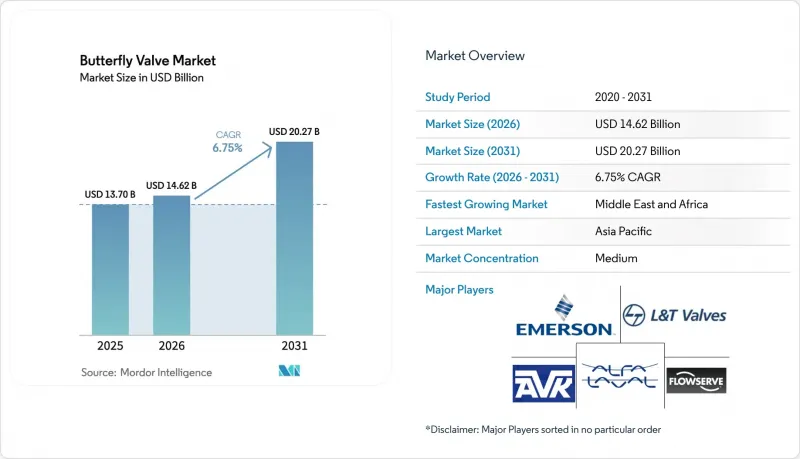
This report is Segmented by Type (High-Performance Butterfly Valves, Lined Butterfly Valves, Resilient-Seated Butterfly Valves, and More), Design (Concentric, Double Offset, Triple Offset), Function (On/Off (Isolation), Control, Throttling), End-User Industry (Oil and Gas, Water and Wastewater, Energy and Power, Chemical, Pharmaceutical, and More), and Geography.
Global Butterfly Valve Market Trends and Insights
Increasing investments in oil and gas refineries and cross-border pipelines
Mega-pipelines such as the 1,443 km East African Crude Oil Pipeline require 65 high-pressure block-valve stations, creating sizable orders for 20-40 in butterfly valves. PETRONAS plans more than 400 well drills between 2025-2027, sustaining upstream demand for high-pressure valves. Long-distance hydrocarbon transport pushes diameters beyond 48 in, encouraging suppliers to upgrade casting and machining capacity. Material selection is shifting toward duplex stainless and Inconel to resist sour-service corrosion. Concurrent renewables build-outs add cooling-circuit needs, blending traditional and new-energy orders within the butterfly valves market.
Expansion of municipal and industrial water-wastewater infrastructure
The City of Akron earmarked USD 380.9 million for 2025 water projects, including USD 141 million for sewer compliance, placing steady orders for resilient-seated butterfly valves. Middlesex County Utilities Authority's USD 23.066 million upgrade swaps aging butterfly valves for more efficient plug valves, illustrating the periodic replacement cycle. NSF/ANSI-certified products now dominate potable-water bids, driving R&D toward lead-free alloys. Cities such as Aurora mandate actuator orientation standards that enhance operator safety and asset management. Long-term funding certainty enables valve makers to blueprint capacity additions with lower risk.
Cavitation/choke risk under low-pressure throttling
When pressure drop exceeds 30-40% of inlet pressure, vapor bubbles implode on the downstream face, eroding discs and seats. Modern plants seek sub-80 dBA noise and low vibration, so engineers increasingly switch to globe valves in critical loops. Bray's Series 39 adopts silicon-carbide liners to curb erosion, but cost rises by 20-30% versus standard coatings. As advanced control systems proliferate, this inherent design limitation caps deeper penetration of throttling duties for the butterfly valves market.
Other drivers and restraints analyzed in the detailed report include:
- Demand for high-performance valves with tight shut-off and high durability
- Triple-offset valves adopted in green-hydrogen electrolyzers
- Volatile supply and cost of fluoropolymer linings (PTFE/PFA)
For complete list of drivers and restraints, kindly check the Table Of Contents.
Segment Analysis
High-performance products captured 54.40% of 2025 revenue, underpinning the largest slice of the butterfly valves market share because process plants prioritize zero-leak reliability in hazardous media. Resilient-seated valves still move high volume for HVAC and benign fluids, but price competition from Asian suppliers thins margins. Lined variants expand at 7.85% CAGR, buoyed by chemical, pharmaceutical, and semicon fabs that require PTFE or PFA barriers against aggressive acids. Chinese producers now refine paste-extrusion techniques that improve bond strength, yet field reports cite occasional lining delamination under 10 bar service.
Innovation centers on modular bodies that accept interchangeable seat rings, allowing OEMs to assemble custom configurations from lean inventories. Triple-offset designs, though premium-priced, earn rising traction in hydrogen, LNG and severe-service circuits because metal-to-metal seals endure thermal shock. Such specialization lifts the average selling price and sustains profitability in the butterfly valves market.
Double-offset geometry held 39.30% of 2025 sales, retaining mainstream status for refinery and power-plant isolation. Computational fluid-dynamics optimizes disc profiles, slicing pressure drop by 10-15% versus legacy patterns. Triple-offset units are forecast to post 8.10% CAGR, propelled by green-hydrogen electrolyzers that demand bidirectional, bubble-tight shut-off to safeguard efficiency. Concentric designs still dominate potable-water lines where pressures stay below 16 bar, but growth flattens as municipalities favour higher-performance seats for long-cycle replacement.
Quadax's 4-offset prototype pushes application envelopes to -253 °C liquid-hydrogen transfer, hinting at a new top-end niche. Tooling complexity and exotic alloys raise entry barriers, lending established patent holders structural advantage. As a result, the butterfly valves market consolidates around a handful of firms that can finance advanced machining and cryogenic test loops.
Complete Report Scope:
- By Type
- High-Performance Butterfly Valves
- Lined Butterfly Valves
- Resilient-Seated Butterfly Valves
- Triple-Offset Butterfly Valves
- Others
- By Design
- Concentric
- Double Offset
- Triple Offset
- By Function
- On/Off (Isolation)
- Control
- Throttling
- By End-User Industry (Value)
- Oil and Gas
- Water and Wastewater
- Energy and Power
- Chemical
- Pharmaceutical
- Food and Beverage
- HVAC and Building Services
- Pulp and Paper
- Others
- By Geography
- North America
- United States
- Canada
- Mexico
- South America
- Brazil
- Argentina
- Rest of South America
- Europe
- Germany
- United Kingdom
- France
- Italy
- Spain
- Russia
- Rest of Europe
- Asia-Pacific
- China
- India
- Japan
- South Korea
- Australia
- Rest of Asia-Pacific
- Middle East and Africa
- Middle East
- South Africa
- Egypt
- Rest of Africa
- Africa
- Brazil
- Argentina
- Rest of South America
- Middle East
- North America
Geography Analysis
Asia-Pacific generated 39.50% of 2025 revenue, underpinned by China's CNY 13 billion (USD 1.8 billion) domestic market expanding at 5.86% CAGR. Chemical plants drive 25-30% of local demand, prompting Neway Valve to post 36.59% revenue growth in 2023. Shanghai Electric Power Valve Factory's CNY 1 billion (USD 0.14 billion) smart-factory build illustrates ongoing regional capacity scale-up. India accelerates refinery and potable-water schemes, while Japan channels stimulus into hydrogen distribution, where KITZ rolls out triple-offset lines.
The Middle East and Africa lead growth at 6.95% CAGR as mega-projects like EACOP and Tanzania LNG proceed to final investment decisions, each specifying hundreds of large-bore butterfly valves. Gulf states promote hydrogen export corridors, demanding 600-lb-rated triple-offset units that few suppliers can certify. Local-content mandates spur joint ventures, altering sourcing strategies across the butterfly valves market.
North America shows replacement-led momentum as shale development stabilizes and municipalities roll out USD 1 billion-plus water programs . The Inflation Reduction Act funnels incentives toward electrolyzer manufacturing, lifting domestic valve orders for green-hydrogen loops. Europe faces PFAS-related cost headwinds but offsets them with aggressive decarbonization grants that require high-performance hydrogen-ready equipment. South America's outlook hinges on commodity cycles; Brazil's pre-salt fields and Argentina's Vaca Muerta basin sustain baseline investment in flow-control hardware.
- Emerson Electric Co.
- Flowserve Corporation
- AVK Holding A/S
- Alfa Laval AB
- L & T Valves Limited
- Crane Co.
- Curtiss-Wright Corporation
- NIBCO Inc.
- Valmet Oyj
- XHVAL Valve Co., Ltd.
- Huamei Machinery Co., Ltd.
- Bray International, Inc.
- A-T Controls, Inc.
- Georg Fischer AG (GF Piping Systems)
- Belimo Holding AG
- Aalberts NV (Apollo Valves)
- Parker-Hannifin Corporation
- KSB SE and Co. KGaA
- SAMSON AG
- Dembla Valves Ltd.
Additional Benefits:
- The market estimate (ME) sheet in Excel format
- 3 months of analyst support
TABLE OF CONTENTS
1 INTRODUCTION
- 1.1 Study Assumptions and Market Definition
- 1.2 Scope of the Study
2 RESEARCH METHODOLOGY
3 EXECUTIVE SUMMARY
4 MARKET LANDSCAPE
- 4.1 Market Overview
- 4.2 Market Drivers
- 4.2.1 Increasing Investments In Oil And Gas Refineries And Cross-Border Pipelines
- 4.2.2 Expansion Of Municipal And Industrial Water Wastewater Infrastructure
- 4.2.3 Demand For High-Performance Valves With Tight Shut-Off And High
- 4.2.4 Triple-Offset Valves Adopted In Green-Hydrogen Electrolyzers
- 4.2.5 IIoT-Enabled Smart Actuators Lowering Total Cost Of Ownership
- 4.2.6 Lightweight Thermoplastic Valves Supporting Decarbonised Utilities
- 4.3 Market Restraints
- 4.3.1 Cavitation/Choke Risk Under Low-Pressure Throttling
- 4.3.2 Price Commoditisation In Low-Spec Resilient Seated Valves
- 4.3.3 Volatile Supply And Cost Of Fluoropolymer Linings (PTFE/PFA)
- 4.3.4 Cyber-Security Concerns In Critical Assets Using IoT Actuators
- 4.4 Regulatory Landscape
- 4.5 Technological Outlook
- 4.6 Porter's Five Forces Analysis
- 4.6.1 Bargaining Power of Suppliers
- 4.6.2 Bargaining Power of Buyers
- 4.6.3 Threat of New Entrants
- 4.6.4 Threat of Substitutes
- 4.6.5 Intensity of Competitive Rivalry
5 MARKET SIZE AND GROWTH FORECASTS (VALUE)
- 5.1 By Type
- 5.1.1 High-Performance Butterfly Valves
- 5.1.2 Lined Butterfly Valves
- 5.1.3 Resilient-Seated Butterfly Valves
- 5.1.4 Triple-Offset Butterfly Valves
- 5.1.5 Others
- 5.2 By Design
- 5.2.1 Concentric
- 5.2.2 Double Offset
- 5.2.3 Triple Offset
- 5.3 By Function
- 5.3.1 On/Off (Isolation)
- 5.3.2 Control
- 5.3.3 Throttling
- 5.4 By End-User Industry (Value)
- 5.4.1 Oil and Gas
- 5.4.2 Water and Wastewater
- 5.4.3 Energy and Power
- 5.4.4 Chemical
- 5.4.5 Pharmaceutical
- 5.4.6 Food and Beverage
- 5.4.7 HVAC and Building Services
- 5.4.8 Pulp and Paper
- 5.4.9 Others
- 5.5 By Geography
- 5.5.1 North America
- 5.5.1.1 United States
- 5.5.1.2 Canada
- 5.5.1.3 Mexico
- 5.5.2 South America
- 5.5.2.1 Brazil
- 5.5.2.2 Argentina
- 5.5.2.3 Rest of South America
- 5.5.3 Europe
- 5.5.3.1 Germany
- 5.5.3.2 United Kingdom
- 5.5.3.3 France
- 5.5.3.4 Italy
- 5.5.3.5 Spain
- 5.5.3.6 Russia
- 5.5.3.7 Rest of Europe
- 5.5.4 Asia-Pacific
- 5.5.4.1 China
- 5.5.4.2 India
- 5.5.4.3 Japan
- 5.5.4.4 South Korea
- 5.5.4.5 Australia
- 5.5.4.6 Rest of Asia-Pacific
- 5.5.5 Middle East and Africa
- 5.5.5.1 Middle East
- 5.5.5.1.1 South Africa
- 5.5.5.1.2 Egypt
- 5.5.5.1.3 Rest of Africa
- 5.5.5.2 Africa
- 5.5.5.2.1 Brazil
- 5.5.5.2.2 Argentina
- 5.5.5.2.3 Rest of South America
- 5.5.5.1 Middle East
- 5.5.1 North America
6 COMPETITIVE LANDSCAPE
- 6.1 Market Concentration
- 6.2 Strategic Moves
- 6.3 Market Share Analysis
- 6.4 Company Profiles (includes Global level Overview, Market level overview, Core Segments, Financials as available, Strategic Information, Market Rank/Share for key companies, Products and Services, and Recent Developments)
- 6.4.1 Emerson Electric Co.
- 6.4.2 Flowserve Corporation
- 6.4.3 AVK Holding A/S
- 6.4.4 Alfa Laval AB
- 6.4.5 L & T Valves Limited
- 6.4.6 Crane Co.
- 6.4.7 Curtiss-Wright Corporation
- 6.4.8 NIBCO Inc.
- 6.4.9 Valmet Oyj
- 6.4.10 XHVAL Valve Co., Ltd.
- 6.4.11 Huamei Machinery Co., Ltd.
- 6.4.12 Bray International, Inc.
- 6.4.13 A-T Controls, Inc.
- 6.4.14 Georg Fischer AG (GF Piping Systems)
- 6.4.15 Belimo Holding AG
- 6.4.16 Aalberts NV (Apollo Valves)
- 6.4.17 Parker-Hannifin Corporation
- 6.4.18 KSB SE and Co. KGaA
- 6.4.19 SAMSON AG
- 6.4.20 Dembla Valves Ltd.
7 MARKET OPPORTUNITIES AND FUTURE OUTLOOK
- 7.1 White-Space and Unmet-Need Assessment

