PUBLISHER: Mordor Intelligence | PRODUCT CODE: 2116789

PUBLISHER: Mordor Intelligence | PRODUCT CODE: 2116789
Starter Cultures - Market Share Analysis, Industry Trends & Statistics, Growth Forecasts (2026 - 2031)
According to Mordor Intelligence, starter cultures market size in 2026 is estimated at USD 1.39 billion, growing from 2025 value of USD 1.32 billion with 2031 projections showing USD 1.83 billion, growing at 5.6% CAGR over 2026-2031.
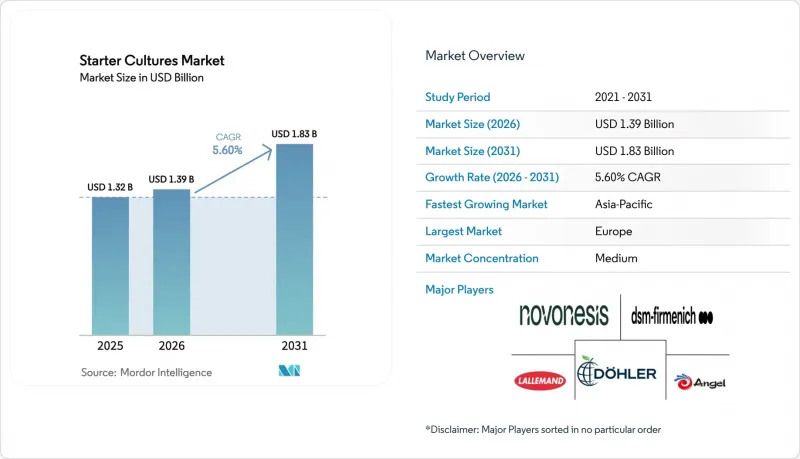
This report is Segmented by Culture Type (Yeast, Bacteria, and Mold), Strain Function (Mesophilic Cultures, Thermophilic Cultures, and More) Form (Freeze-Dried, Liquid, and Frozen), Application (Dairy Products, Bakery and Confectionery, Beverages, and More), and Geography (North America, Europe, Asia-Pacific, South America, and More). The Market Forecasts are Provided in Terms of Value (USD).
Global Starter Cultures Market Trends and Insights
Rising demand for clean-label fermented foods
The clean-label trend has become an industry requirement, as lactic acid bacteria produce natural antimicrobial compounds like bacteriocins that extend product shelf life. This application is particularly effective in dairy products, where protective cultures inhibit pathogens such as Listeria monocytogenes while maintaining product taste and texture. The effectiveness of these cultures in dairy applications has expanded their adoption across other food categories, including meat products, beverages, and bakery items. The global food industry's shift to natural preservation methods has gained momentum through successful implementations across various product categories. Regulatory support for biopreservation, including the European Food Safety Authority's expanded Qualified Presumption of Safety list with new strains like Lacticaseibacillus huelsenbergensis, validates industry investments in natural preservation methods. This innovation supports the industry's transition toward natural preservation solutions while meeting consumer demands for clean-label products.
Growth in dairy alternatives using starter cultures
Specialized starter cultures in plant-based dairy alternatives help replicate traditional dairy textures and flavors through controlled fermentation processes. The combination of lactic acid bacteria and yeasts in mixed-culture fermentation creates improved nutritional profiles and sensory characteristics compared to single-strain methods, as multiple organisms work synergistically to develop complex flavors and textures. Companies are implementing these technologies at a commercial scale to meet market demands. For instance, Perfect Day produces animal-free whey protein through precision fermentation, using programmed microflora to convert sugar into milk proteins identical to those in cow's milk. The protein undergoes extensive filtration and purification processes to create a lactose-free dairy alternative suitable for consumer applications. Similarly, TurtleTree also employs precision fermentation with specialized microorganisms to produce lactoferrin, a significant milk protein component with important nutritional properties. This method reduces environmental impact and meets increasing consumer demand for sustainable dairy alternatives without relying on traditional animal agriculture practices.
High cost of cold-chain logistics
Starter cultures require stable sub-zero temperatures for survival, as power disruptions or transportation delays can lead to cell death and product recalls. In regions with limited refrigeration infrastructure, distributors prefer freeze-dried formats that can withstand room temperature storage, despite their higher production costs. The cold-chain requirements for maintaining starter culture viability create substantial operational expenses throughout the supply chain. Temperature control failures result in culture deterioration and product recalls, negatively impacting manufacturer relationships. Infrastructure limitations particularly affect developing markets, where unreliable power supply and insufficient refrigeration networks restrict starter culture distribution. This challenge is more pronounced for liquid cultures requiring constant refrigeration compared to freeze-dried formats that can withstand ambient conditions. The rising energy costs for cold-chain maintenance have prompted facilities to implement LED lighting and ammonia-based refrigeration systems to reduce energy consumption while maintaining the required temperature conditions across the distribution network.
Other drivers and restraints analyzed in the detailed report include:
- Expansion of artisanal cheese and craft bakery segments
- Adoption of bioprotective cultures as alternatives to chemical preservatives
- Regulatory restrictions on Genetically Modified Microorganisms (GMMs)
For complete list of drivers and restraints, kindly check the Table Of Contents.
Segment Analysis
Bacteria accounted for 56.74% of the starter cultures market share in 2025, with their primary applications in lactic acid production for dairy, bakery, and meat products. Yeast segments are experiencing growth at a 9.35% CAGR, driven by advancements in synthetic biology that enable enhanced aroma production and protein synthesis. Lacticaseibacillus and Streptococcus species maintain their essential role in acidification, texture development, and pathogen control. Yeast applications have expanded from traditional bread making to fermented beverages and dairy alternatives, where Saccharomyces provides consistent texture and mild sweetness. Mold cultures, particularly Aspergillus, remain important in Asian soy fermentation but represent smaller market volumes compared to bacterial and yeast segments.
The competitive landscape is evolving as manufacturers develop yeasts capable of producing dairy-equivalent proteins at an industrial scale, particularly for plant-based products. Bacterial strain development focuses on improving acidification rates and phage resistance to increase production efficiency. Mixed-culture starter solutions combining bacteria, yeast, and mold enable manufacturers to achieve complex flavor profiles while maintaining clean-label requirements.
Thermophilic cultures account for 40.12% of the starter cultures market size in 2025, playing a vital role in yogurt and hard-cheese production processes operating at approximately 45°C. Mesophilic cultures facilitate the production of Cheddar and Gouda cheeses at lower temperatures, maintaining their distinct flavor profiles. The probiotic cultures segment is growing at an 8.6% CAGR, driven by clinical research demonstrating connections between gut microbiota, immune function, and metabolic health. Adjunct cultures enhance aged-cheese flavors, while protective cultures focus on extending product shelf life.
The market shows increasing demand for dual-function probiotics that deliver both processing advantages and health benefits. Manufacturers are incorporating Bifidobacterium and Lactobacillus strains into thermophilic blends to produce yogurt that meets texture requirements while providing digestive health benefits. Research initiatives in Brazil and South Korea focus on identifying native thermophilic strains with enhanced acidification and phage resistance properties to strengthen regional supply chains.
Complete Report Scope:
- By Culture Type
- Bacteria
- Yeast
- Mold
- By Strain Function
- Mesophilic Cultures
- Thermophilic Cultures
- Adjunct Cultures
- Probiotic Cultures
- By Form
- Freeze-Dried
- Liquid
- Frozen
- By Application
- Dairy Products
- Milk
- Cheese
- Yogurt and Kefir
- Other Dairy Products
- Bakery and Confectionery
- Beverages
- Plant-based Fermented Foods
- Meat and Seafood Fermentation
- Dairy Products
- By Geography
- North America
- United States
- Canada
- Mexico
- Rest of North America
- South America
- Brazil
- Argentina
- Rest of South America
- Europe
- Germany
- United Kingdom
- France
- Italy
- Spain
- Russia
- Rest of Europe
- Asia-Pacific
- China
- Japan
- India
- Australia
- Rest of Asia-Pacific
- Middle East and Africa
- South Africa
- Saudi Arabia
- UAE
- Rest of Middle East and Africa
- North America
Geography Analysis
Europe generated 35.21% of starter cultures market revenue in 2025, supported by traditional cheese production, stringent hygiene standards, and established research and development networks. Protected Designation of Origin (PDO) cheeses require specific microbial consortia, ensuring consistent culture demand. The European Food Safety Authority's (EFSA) Qualified Presumption of Safety (QPS) list provides clear regulatory pathways, encouraging strain development and bioprotective applications.
Asia-Pacific is growing at an 8.55% CAGR, driven by increasing urban consumption of yogurt, kimchi, and probiotic beverages. Government investment in precision fermentation research supports market expansion. In June 2024, the University of Illinois Urbana-Champaign received a USD 14.8 million five-year grant to establish the Centre for Precision Fermentation and Sustainability (PreFerS). Funded by Singapore's National Research Foundation (NRF), the center focuses on microbial cell engineering to develop safe and nutritious food products. The Illinois Advanced Research Center at Singapore (Illinois ARCS) will conduct research on food-grade microorganisms and scale up production from laboratory to pilot level.
North America maintains steady growth through developed cold-chain infrastructure and the FDA GRAS (Generally Recognized as Safe) system. The plant-based cheese industry creates additional demand for specialized starter cultures that replicate dairy properties. Mexico's expanding cheese exports increase the need for cultures meeting U.S. standards, while Canada's regulated dairy industry ensures stable starter culture demand.
- Novonesis A/S
- DSM-Firmenich AG
- Dohler Group
- Sacco System (Sacco S.r.l., Caglificio Clerici, CSL)
- Lallemand Inc.
- Angel Yeast Co., Ltd.
- Puratos Group
- International Flavors & Fragrances Inc.
- Lesaffre International
- Bioprox Ingredients SAS
- Dalton Biotechnologies
- Mediterranea Biotecnologie Srl
- Wyeast Laboratories, Inc.
- Proquiga Biotech
- Lactina Ltd.
- Novasol Ingredients Pvt. Ltd
- Alliance, Inc.
- Benny Impex Private Limited
- Punature Food Ingredients Co., Ltd.
- Tropilite Foods Pvt. Ltd.
Additional Benefits:
- The market estimate (ME) sheet in Excel format
- 3 months of analyst support
TABLE OF CONTENTS
1 INTRODUCTION
- 1.1 Study Assumptions and Market Definition
- 1.2 Scope of the Study
2 RESEARCH METHODOLOGY
3 EXECUTIVE SUMMARY
4 MARKET LANDSCAPE
- 4.1 Market Overview
- 4.2 Market Drivers
- 4.2.1 Rising Demand for Clean-Label Fermented Foods
- 4.2.2 Growth in Dairy Alternatives Using Starter Cultures
- 4.2.3 Expansion of Artisanal Cheese and Craft Bakery segments
- 4.2.4 Adoption of Bioprotective Cultures as Alternatives to Chemical Preservatives
- 4.2.5 Advances in Synthetic Biology for Customized, High-Yield Strains
- 4.2.6 Consolidation Among Large-Scale Food and Beverage Manufacturers
- 4.3 Market Restraints
- 4.3.1 High Cost of Cold-Chain Logistics
- 4.3.2 Volatility in Dairy Supply Chains Affecting Culture Utilization
- 4.3.3 Intellectual Property Constraints Around Proprietary Strains
- 4.3.4 Regulatory Restrictions on Genetically Modified Microorganisms (GMMs)
- 4.4 Supply Chain Analysis
- 4.5 Regulatory Landscape
- 4.6 Porter's Five Forces
- 4.6.1 Threat of New Entrants
- 4.6.2 Bargaining Power of Buyers
- 4.6.3 Bargaining Power of Suppliers
- 4.6.4 Threat of Substitutes
- 4.6.5 Intensity of Competitive Rivalry
5 MARKET SIZE AND GROWTH FORECASTS (VALUE)
- 5.1 By Culture Type
- 5.1.1 Bacteria
- 5.1.2 Yeast
- 5.1.3 Mold
- 5.2 By Strain Function
- 5.2.1 Mesophilic Cultures
- 5.2.2 Thermophilic Cultures
- 5.2.3 Adjunct Cultures
- 5.2.4 Probiotic Cultures
- 5.3 By Form
- 5.3.1 Freeze-Dried
- 5.3.2 Liquid
- 5.3.3 Frozen
- 5.4 By Application
- 5.4.1 Dairy Products
- 5.4.1.1 Milk
- 5.4.1.2 Cheese
- 5.4.1.3 Yogurt and Kefir
- 5.4.1.4 Other Dairy Products
- 5.4.2 Bakery and Confectionery
- 5.4.3 Beverages
- 5.4.4 Plant-based Fermented Foods
- 5.4.5 Meat and Seafood Fermentation
- 5.4.1 Dairy Products
- 5.5 By Geography
- 5.5.1 North America
- 5.5.1.1 United States
- 5.5.1.2 Canada
- 5.5.1.3 Mexico
- 5.5.1.4 Rest of North America
- 5.5.2 South America
- 5.5.2.1 Brazil
- 5.5.2.2 Argentina
- 5.5.2.3 Rest of South America
- 5.5.3 Europe
- 5.5.3.1 Germany
- 5.5.3.2 United Kingdom
- 5.5.3.3 France
- 5.5.3.4 Italy
- 5.5.3.5 Spain
- 5.5.3.6 Russia
- 5.5.3.7 Rest of Europe
- 5.5.4 Asia-Pacific
- 5.5.4.1 China
- 5.5.4.2 Japan
- 5.5.4.3 India
- 5.5.4.4 Australia
- 5.5.4.5 Rest of Asia-Pacific
- 5.5.5 Middle East and Africa
- 5.5.5.1 South Africa
- 5.5.5.2 Saudi Arabia
- 5.5.5.3 UAE
- 5.5.5.4 Rest of Middle East and Africa
- 5.5.1 North America
6 COMPETITIVE LANDSCAPE
- 6.1 Market Concentration
- 6.2 Strategic Moves
- 6.3 Market Ranking Analysis
- 6.4 Company Profiles (includes Global level Overview, Market level overview, Core Segments, Financials (if available), Strategic Information, Market Rank/Share for key companies, Products and Services, and Recent Developments)
- 6.4.1 Novonesis A/S
- 6.4.2 DSM-Firmenich AG
- 6.4.3 Dohler Group
- 6.4.4 Sacco System (Sacco S.r.l., Caglificio Clerici, CSL)
- 6.4.5 Lallemand Inc.
- 6.4.6 Angel Yeast Co., Ltd.
- 6.4.7 Puratos Group
- 6.4.8 International Flavors & Fragrances Inc.
- 6.4.9 Lesaffre International
- 6.4.10 Bioprox Ingredients SAS
- 6.4.11 Dalton Biotechnologies
- 6.4.12 Mediterranea Biotecnologie Srl
- 6.4.13 Wyeast Laboratories, Inc.
- 6.4.14 Proquiga Biotech
- 6.4.15 Lactina Ltd.
- 6.4.16 Novasol Ingredients Pvt. Ltd
- 6.4.17 Alliance, Inc.
- 6.4.18 Benny Impex Private Limited
- 6.4.19 Punature Food Ingredients Co., Ltd.
- 6.4.20 Tropilite Foods Pvt. Ltd.
7 MARKET OPPORTUNITIES AND FUTURE OUTLOOK

