PUBLISHER: Mordor Intelligence | PRODUCT CODE: 2116875

PUBLISHER: Mordor Intelligence | PRODUCT CODE: 2116875
India Accounting Professional Services - Market Share Analysis, Industry Trends & Statistics, Growth Forecasts (2026 - 2031)
According to Mordor Intelligence, India accounting professional services market size in 2026 is estimated at USD 15.97 billion, growing from 2025 value of USD 15.32 billion with 2031 projections showing USD 19.66 billion, growing at 4.25% CAGR over 2026-2031.
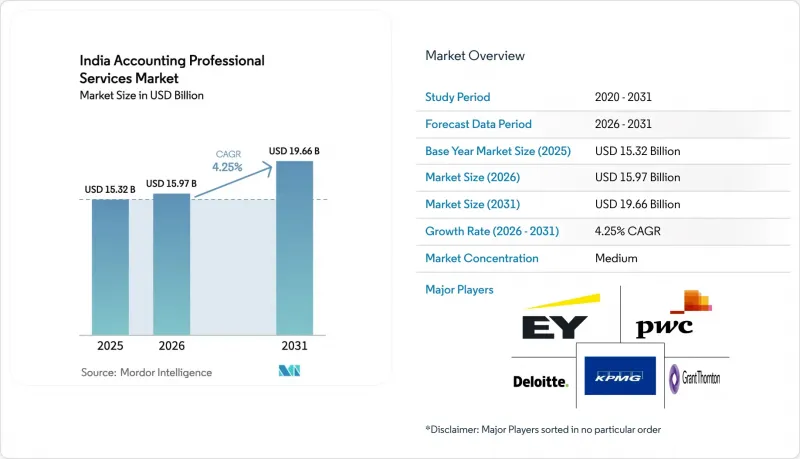
This report is Segmented by Service Type (Audit & Assurance, Tax & Regulatory, Advisory & Consulting, Risk Advisory, and More), Client Size (Large Enterprises, Mid-Market Enterprises, Msmes, and More), Industry Vertical (BFSI, IT & ITeS, Manufacturing & Industrial, and More), and Regional Tier (Tier-1 Cities, Tier-2 and More). The Market Forecasts are Provided in Terms of Value (USD).
India Accounting Professional Services Market Trends and Insights
Expansion of Digital Transformation & Technology Consulting Spend
Enterprises are moving core finance processes onto cloud-native and analytics-rich platforms to align with RBI's real-time fraud-monitoring norms and GST e-invoicing extensions to smaller taxpayers. Big accounting networks earned USD 2.41 billion from technology consulting in FY24 and have doubled STEM talent ratios since 2023, reflecting a pivot toward cybersecurity, AI model-risk, and cloud-cost governance advisory. The Union Budget 2025's simplified direct-tax code and presumptive regime for electronics manufacturing bolster demand for automated compliance engines. Mid-tier firms are following suit by forming platform alliances with enterprise software vendors, an approach that compresses delivery cycles and enhances audit-trail transparency. As firms embed continuous-control monitoring and predictive analytics, the India accounting professional services market demonstrates higher average billing rates for tech-infused assignments. Corporate boards increasingly treat technology competence as a prerequisite when selecting statutory auditors, funneling more engagements into digital-first service lines.
Rising Regulatory Compliance Complexity
GST-Returns 2.0, new e-invoicing thresholds, and NFRA's expanded inspection docket created a multi-layer compliance web. In 2024, NFRA levied USD 0.19 million in penalties on audit firms for quality lapses, underscoring the cost of non-compliance. RBI circulars now oblige banks to adopt AI-enabled fraud analytics and furnish granular incident reporting within 24 hours, elevating demand for forensic accounting and process audits. SEBI's Business Responsibility and Sustainability Reporting (BRSR) mandate adds ESG disclosures to annual accounts, compelling listed firms to enlist cross-disciplinary advisory help. SME promoters cite process complexity as a top challenge, prompting the outsourcing of indirect-tax reconciliations. Heightened penalties have increased the perceived cost of non-compliance, driving steady deal flow into assurance and risk advisory corridors.
Acute Shortage of Skilled Accounting Professionals & High Attrition
India needs about 130,000 new Chartered Accountants annually to meet domestic demand and offshore work, but the current pipeline remains well below that threshold. U.S. firms have increased offshore hiring; one global network plans to more than double its India workforce by 2027. Wage inflation for qualified seniors averages 12% in metros, pushing domestic mid-tier firms into aggressive campus-recruiting and early-promotion programs. ICAI shortened the articleship period from three to two years in 2024 to entice students, yet retention issues persist post-qualification. Volume churn erodes institutional memory, lengthens engagement cycles, and raises onboarding costs, dampening near-term profitability across the India accounting professional services industry.
Other drivers and restraints analyzed in the detailed report include:
- Growth of Global Capability Centers & Shared Service Hubs
- Mandatory Auditor Rotation Increasing Demand for Independent Assurance
- SME Shift Toward DIY SaaS Accounting Platforms
For complete list of drivers and restraints, kindly check the Table Of Contents.
Segment Analysis
Digital transformation & technology consulting contributed 51.12% of the India accounting professional services market and setting the tone for advisory-led growth. The segment's 8.25% forecast CAGR will widen the gap with traditional audit streams as enterprises bundle ERP cloud migration, AI audit model validation, and cyber-risk analytics into multi-year statements of work. Audit & assurance retains defensive relevance because mandatory rotation reinforces demand for fresh perspectives, yet fee pressure persists without complementary tech capability. Tax & regulatory engagements escalate around GST 2.0 reconciliation and the new direct-tax code, while risk advisory capitalizes on ESG and supply-chain reporting mandates. Business services & outsourcing benefits from India's expanding GCC base, which assigns controllership, accounts payable, and treasury support to external shared-service specialists.
Fee structures are changing: high-end technology consulting now operates on outcome-linked retainers, whereas statutory audits follow volume-based ceilings set by regulators. Firms that successfully cross-sell consulting into audit clients see utilization gains and margin uplift. Together, these shifts confirm that the India accounting professional services market is entering a hybrid era where compliance anchors coexist with analytics-rich, platform-centric growth.
Complete Report Scope:
- By Service Type
- Audit & Assurance
- Tax & Regulatory
- Advisory & Consulting
- Risk Advisory
- Business Services & Outsourcing
- Digital Transformation & Technology Consulting
- By Client Size
- Large Enterprises
- Mid-Market Enterprises
- Micro, Small & Medium Enterprises (MSMEs)
- Start-ups & Early-stage Firms
- Government & Public-Sector Undertakings (PSUs)
- By Industry Vertical
- Banking, Financial Services & Insurance (BFSI)
- Information Technology & ITeS
- Manufacturing & Industrial
- Healthcare & Life Sciences
- Consumer & Retail
- Energy & Utilities
- Infrastructure, Real Estate & Construction
- Telecommunications & Media
- Public Sector & NGOs
- Logistics & Transportation
- By Regional Tier
- Tier-1 Cities (Delhi NCR, Mumbai, Bengaluru, Chennai, Kolkata, Hyderabad)
- Tier-2 Cities
- Tier-3 & Emerging Cities
List of Companies Covered in this Report:
- Deloitte India
- EY India
- KPMG India
- PwC India
- Grant Thornton Bharat
- BDO India
- RSM India
- Forvis Mazars India
- Crowe India
- PKF Sridhar & Santhanam
- S.R. Batliboi & Co
- Walker Chandiok & Co
- Nangia Andersen
- ASA & Associates
- Suresh Surana & Associates (RSM)
- Lodha & Co
- S.R. Dinodia & Co
- Kreston Menon
- CBV & Associates
- Varma & Varma
Additional Benefits:
- The market estimate (ME) sheet in Excel format
- 3 months of analyst support
TABLE OF CONTENTS
1 Introduction
- 1.1 Study Assumptions & Market Definition
- 1.2 Scope of the Study
2 Research Methodology
3 Executive Summary
4 Market Landscape
- 4.1 Market Overview
- 4.2 Market Drivers
- 4.2.1 Expansion of digital transformation & technology consulting spend
- 4.2.2 Rising regulatory compliance complexity (GST, NFRA, MCA & RBI directives)
- 4.2.3 Growth of Global Capability Centres (GCCs) & shared service hubs
- 4.2.4 Mandatory auditor rotation increasing demand for independent assurance
- 4.2.5 Government push to create indigenous Big Four accounting champions
- 4.2.6 Adoption of AI-driven continuous audit & compliance platforms
- 4.3 Market Restraints
- 4.3.1 Acute shortage of skilled accounting professionals & high attrition
- 4.3.2 Intensifying regulatory scrutiny & penalties on audit quality
- 4.3.3 Prospective caps on audit-firm market share to curb concentration
- 4.3.4 SME shift toward DIY SaaS accounting platforms
- 4.4 Value / Supply-Chain Analysis
- 4.5 Regulatory Landscape
- 4.6 Technological Outlook
- 4.7 Porter's Five Forces Analysis
- 4.7.1 Bargaining Power of Buyers
- 4.7.2 Bargaining Power of Suppliers
- 4.7.3 Threat of New Entrants
- 4.7.4 Threat of Substitutes
- 4.7.5 Competitive Rivalry
5 Market Size & Growth Forecasts
- 5.1 By Service Type
- 5.1.1 Audit & Assurance
- 5.1.2 Tax & Regulatory
- 5.1.3 Advisory & Consulting
- 5.1.4 Risk Advisory
- 5.1.5 Business Services & Outsourcing
- 5.1.6 Digital Transformation & Technology Consulting
- 5.2 By Client Size
- 5.2.1 Large Enterprises
- 5.2.2 Mid-Market Enterprises
- 5.2.3 Micro, Small & Medium Enterprises (MSMEs)
- 5.2.4 Start-ups & Early-stage Firms
- 5.2.5 Government & Public-Sector Undertakings (PSUs)
- 5.3 By Industry Vertical
- 5.3.1 Banking, Financial Services & Insurance (BFSI)
- 5.3.2 Information Technology & ITeS
- 5.3.3 Manufacturing & Industrial
- 5.3.4 Healthcare & Life Sciences
- 5.3.5 Consumer & Retail
- 5.3.6 Energy & Utilities
- 5.3.7 Infrastructure, Real Estate & Construction
- 5.3.8 Telecommunications & Media
- 5.3.9 Public Sector & NGOs
- 5.3.10 Logistics & Transportation
- 5.4 By Regional Tier
- 5.4.1 Tier-1 Cities (Delhi NCR, Mumbai, Bengaluru, Chennai, Kolkata, Hyderabad)
- 5.4.2 Tier-2 Cities
- 5.4.3 Tier-3 & Emerging Cities
6 Competitive Landscape
- 6.1 Market Concentration
- 6.2 Strategic Moves
- 6.3 Market Share Analysis
- 6.4 Company Profiles (includes Global level Overview, Market level overview, Core Segments, Financials as available, Strategic Information, Market Rank/Share for key companies, Products & Services, and Recent Developments)
- 6.4.1 Deloitte India
- 6.4.2 EY India
- 6.4.3 KPMG India
- 6.4.4 PwC India
- 6.4.5 Grant Thornton Bharat
- 6.4.6 BDO India
- 6.4.7 RSM India
- 6.4.8 Forvis Mazars India
- 6.4.9 Crowe India
- 6.4.10 PKF Sridhar & Santhanam
- 6.4.11 S.R. Batliboi & Co
- 6.4.12 Walker Chandiok & Co
- 6.4.13 Nangia Andersen
- 6.4.14 ASA & Associates
- 6.4.15 Suresh Surana & Associates (RSM)
- 6.4.16 Lodha & Co
- 6.4.17 S.R. Dinodia & Co
- 6.4.18 Kreston Menon
- 6.4.19 CBV & Associates
- 6.4.20 Varma & Varma
7 Market Opportunities & Future Outlook
- 7.1 White-space & Unmet-Need Assessment

