PUBLISHER: Mordor Intelligence | PRODUCT CODE: 2116886

PUBLISHER: Mordor Intelligence | PRODUCT CODE: 2116886
GCC Concrete Blocks - Market Share Analysis, Industry Trends & Statistics, Growth Forecasts (2026 - 2031)
According to Mordor Intelligence, the GCC concrete blocks market size is estimated at 2.58 billion units in 2026, and is expected to reach 3.44 billion units by 2031, at a CAGR of 5.94% during the forecast period (2026-2031).
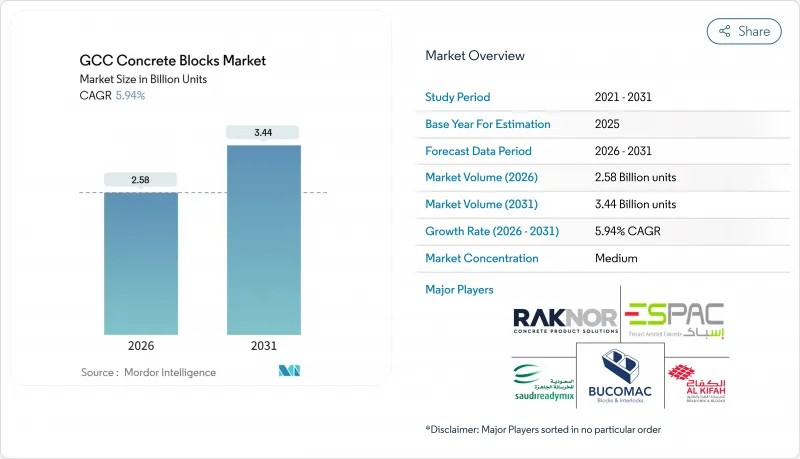
This report is Segmented by Type (Solid Concrete Blocks, Hollow Concrete Blocks, and Other Types (interlocking and Decorative)), Application (Residential, Commercial, Infrastructure, and Industrial and Institutional), and Geography (Saudi Arabia, The United Arab Emirates (UAE), Qatar, Oman, and the Rest of GCC). The Market Forecasts are Provided in Terms of Volume (Units).
GCC Concrete Blocks Market Trends and Insights
Vision-Linked Infrastructure Megaproject Pipeline
Vision-aligned public spending underpins a durable demand floor in the GCC concrete blocks market. Saudi Arabia earmarked USD 181.5 billion for delivery by 2028, with NEOM's The Line alone expected to absorb 500 million block equivalents. Qiddiya and Red Sea tourism zones require decorative and interlocking variants that satisfy both aesthetics and durability standards. In the UAE, the Al Maktoum International Airport expansion and Dubai South logistics district continue to draw hollow unit volumes even as residential activity normalizes. Qatar's North Field East LNG build-out uses non-structural hollow blocks for worker accommodation, peaking near 15 million units annually through 2027. Oman's USD 100 billion Vision 2040 project list favors precast and modular solutions that compress timelines on transport corridors and industrial zones.
Housing Demand from Rapid Urbanization and Population Growth
Regional population expands 1.8% each year, keeping residential demand atop the GCC concrete blocks market hierarchy. Saudi Arabia's Sakani program handed over 220,000 homes in 2025, pulling an estimated 450 million hollow and solid units. The UAE approved 85,000 new dwellings in 2025 as expatriate inflows lifted Dubai and Abu Dhabi occupancy rates, with lightweight blocks preferred on reclaimed coastal plots where soil bearing capacities are low. Qatar targets 10,000 homes per year through 2030 under its National Housing Program, specifying thermal-insulated masonry that satisfies its GSAS energy benchmarks. Oman's social housing scheme seeks 25,000 units by 2028 and mandates hollow units that comply with updated seismic codes.
Cement and Aggregate Price Volatility
Cement traded between SAR 200 and SAR 250 per tonne in 2025, shaving 8-12% off producer margins in the GCC concrete blocks market. Heidelberg Materials noted a 15% hike in clinker costs as natural gas and carbon levies rose in the UAE, prompting investment in waste-heat recovery. Aggregate scarcity in coastal sites forces reliance on recycled concrete that carries a 20-30% premium yet slices embodied carbon by 25%. Qatar's limestone imports bear freight volatility; shipping rates advanced 18% in 2025 amid Red Sea route disruptions. Oman tightened domestic supply via a 5% export duty that further inflated input costs for regional buyers.
Other drivers and restraints analyzed in the detailed report include:
- Shift Toward Prefabricated and Modular Construction
- Sustainability Push for Energy-Efficient Green Blocks
- Competition from AAC and Light-Steel Framing Systems
For complete list of drivers and restraints, kindly check the Table Of Contents.
Segment Analysis
Hollow units captured 70.01% GCC concrete blocks market share in 2025 and are forecast to record a 6.31% CAGR to 2031, a lead cemented by their 0.45-0.55 W/m2K thermal range that satisfies Estidama and Saudi code thresholds. This dominance secures a steady 2026-2031 cumulative demand exceeding 11 billion units, anchoring the GCC concrete blocks market. Developers benefit from lower HVAC loads, realizing energy savings of 18% in Saudi Arabia's Sakani homes using ACICO's recycled-aggregate hollow design. Solid blocks trail, serving low-rise load-bearing jobs where unit weight and seismic ratings take precedence. Niche interlocking and decorative offerings, while below 5% of the GCC concrete blocks market size, enjoy double-digit growth in premium landscape projects that value rapid, mortar-free assembly and customized textures.
Hollow units also give producers supply-chain flexibility. Lightweight formulations allow 25% clinker reduction, easing CO2 disclosure under UAE labeling mandates. In parallel, modifiable core geometries help manufacturers tailor compressive strength from 7.5 MPa to 15 MPa without altering external dimensions, a trait valued in NEOM's mixed-use zoning that spans high-rise, hospitality, and social infrastructure. As certification agencies tighten ISO 16757 verification, the testing pedigree of hollow units further extends their competitive moat. Interlocking products, though emerging, cut labor by 25% and appeal to disaster-response agencies in Oman and Bahrain, suggesting a small but resilient upside.
Complete Report Scope:
- By Type
- Solid Concrete Blocks
- Hollow Concrete Blocks
- Other Types (e.g., interlocking, decorative)
- By Application
- Residential
- Commercial
- Infrastructure
- Industrial and Institutional
- By Geography
- Saudi Arabia
- United Arab Emirates
- Qatar
- Oman
- Rest of GCC
List of Companies Covered in this Report:
- Aamal Cement
- ACICO Group
- Al Jazeera Factory For Construction Materials
- Al Mana Holding
- Al Rajhi Group
- Al RAYYAN Readymix Concrete and Cement Products W.L.L
- Bucomac
- Consent Group
- EMSTEEL
- ESPAC
- Khonaini International Company
- KRB
- MaCon LLC
- MJK Group
- Raknor LLC
- Saudi Readymix
Additional Benefits:
- The market estimate (ME) sheet in Excel format
- 3 months of analyst support
TABLE OF CONTENTS
1 Introduction
- 1.1 Study Assumptions and Market Definition
- 1.2 Scope of the Study
2 Research Methodology
3 Executive Summary
4 Market Landscape
- 4.1 Market Overview
- 4.2 Market Drivers
- 4.2.1 Vision-linked infrastructure megaproject pipeline
- 4.2.2 Housing demand from rapid urbanisation and population growth
- 4.2.3 Shift toward prefabricated and modular construction
- 4.2.4 Sustainability push for energy-efficient green blocks
- 4.2.5 Early adoption of 3D-printed concrete elements
- 4.3 Market Restraints
- 4.3.1 Cement and aggregate price volatility
- 4.3.2 Competition from AAC and light-steel framing systems
- 4.3.3 Water-scarcity constraints on block production
- 4.4 Value Chain Analysis
- 4.5 Porter's Five Forces
- 4.5.1 Bargaining Power of Suppliers
- 4.5.2 Bargaining Power of Buyers
- 4.5.3 Threat of New Entrants
- 4.5.4 Threat of Substitutes
- 4.5.5 Competitive Rivalry
5 Market Size and Growth Forecasts (Volume)
- 5.1 By Type
- 5.1.1 Solid Concrete Blocks
- 5.1.2 Hollow Concrete Blocks
- 5.1.3 Other Types (e.g., interlocking, decorative)
- 5.2 By Application
- 5.2.1 Residential
- 5.2.2 Commercial
- 5.2.3 Infrastructure
- 5.2.4 Industrial and Institutional
- 5.3 By Geography
- 5.3.1 Saudi Arabia
- 5.3.2 United Arab Emirates
- 5.3.3 Qatar
- 5.3.4 Oman
- 5.3.5 Rest of GCC
6 Competitive Landscape
- 6.1 Market Concentration
- 6.2 Strategic Moves
- 6.3 Market Share(%)/Ranking Analysis
- 6.4 Company Profiles (includes Global level Overview, Market level overview, Core Segments, Financials as available, Strategic Information, Market Rank/Share for key companies, Products and Services, and Recent Developments)
- 6.4.1 Aamal Cement
- 6.4.2 ACICO Group
- 6.4.3 Al Jazeera Factory For Construction Materials
- 6.4.4 Al Mana Holding
- 6.4.5 Al Rajhi Group
- 6.4.6 Al RAYYAN Readymix Concrete and Cement Products W.L.L
- 6.4.7 Bucomac
- 6.4.8 Consent Group
- 6.4.9 EMSTEEL
- 6.4.10 ESPAC
- 6.4.11 Khonaini International Company
- 6.4.12 KRB
- 6.4.13 MaCon LLC
- 6.4.14 MJK Group
- 6.4.15 Raknor LLC
- 6.4.16 Saudi Readymix
7 Market Opportunities and Future Outlook
- 7.1 White-space and Unmet-Need Assessment
- 7.2 Growing Awareness Among Consumers for Lightweight materials

