PUBLISHER: Mordor Intelligence | PRODUCT CODE: 2116938

PUBLISHER: Mordor Intelligence | PRODUCT CODE: 2116938
North America Particle Board - Market Share Analysis, Industry Trends & Statistics, Growth Forecasts (2026 - 2031)
According to Mordor Intelligence, north america particle board market size in 2026 is estimated at 15.41 million cubic meters, growing from 2025 value of 14.67 million cubic meters with 2031 projections showing 19.69 million cubic meters, growing at 5.02% CAGR over 2026-2031.
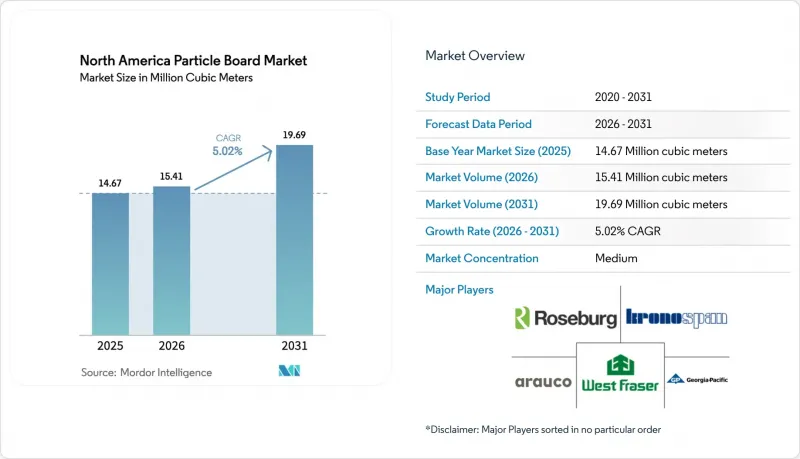
This report is Segmented by Raw Material (Wood [Sawdust, Shavings, Flakes, and Chips], Bagasse, and Other Raw Materials), Application (Furniture, Construction, Infrastructure, Packaging, and Others), and Geography (United States, Canada, and Mexico). The Market Forecasts are Provided in Terms of Volume (Cubic Meters).
North America Particle Board Market Trends and Insights
Growing Demand from the Construction Industry
Residential remodeling spending surpassed expectations in 2024, driving demand for particle board in countertop cores, stair treads, and interior partitions. Single-family housing starts remain comfortably above pre-pandemic baselines, and each new unit incorporates roughly 0.8-1.2 m3 of panel products. Modular construction is scaling in multi-family projects, favoring particle board because the material machines easily and withstands repeated handling during off-site assembly. Canada echoes this pattern, particularly in Ontario and British Columbia, where provincial codes now recognize engineered wood for use in non-load-bearing walls. Infrastructure spending, although a smaller slice of consumption, is lifting particle board volumes in acoustic baffles and temporary formwork used in transit corridors.
Easy Availability of Regional Wood Residues
The 2023 U.S. Department of Energy Billion-Ton Report identified logging residue and unused mill residue as sources of annual waste. Alabama, Georgia, Mississippi, and South Carolina collectively account for significant sawmill by-products each year, prompting mill investment along key rail corridors that connect forests to Gulf Coast ports. Quebec and Ontario enjoy a similar, if colder, dynamic: co-located sawmill and panel operations slash haul distances and stabilize furnish costs. Small-diameter trees harvested through U.S. Forest Service thinning contracts represent an additional source each year, although economics are sensitive to terrain and trucking radius.
Threat of MDF and Plywood Substitutes
Medium-density fiberboard commands a price premium but wins market share in painted cabinets because its fine fibers eliminate the need for edge banding. Plywood retains dominance in structural shelving and sub-floor assemblies where particle board's lower internal bond strength is a disadvantage. Cross-laminated timber is emerging in mid-rise frames and threatens particle board's foothold in non-structural skirting applications. Consumers in premium brackets often equate MDF or plywood with higher quality, particularly for moisture-prone areas such as kitchens and bathrooms. Producers are trialing melamine-urea-formaldehyde recipes, along with wax additives, to improve moisture resistance; however, these upgrades narrow the cost delta with MDF and curb particle board's pricing appeal.
Other drivers and restraints analyzed in the detailed report include:
- Surge in RTA Furniture and DIY Renovation Boom
- State-Level Landfill-Diversion Mandates Unlocking Recycled Feedstock
- Tightening Formaldehyde-Emission Regulations
For complete list of drivers and restraints, kindly check the Table Of Contents.
Segment Analysis
Wood residues captured 57.62% of the North America particle board market share in 2025, reflecting entrenched sawmill infrastructure that channels sawdust, shavings, flakes, and chips into continuous-press furnish. Sawdust feeds the surface layer for a smoother finish, while coarser flakes bulk out the core where density drives bending strength. Chips from pulp operations provide a tertiary stream when low-grade roundwood is plentiful, especially in the U.S. South. Bagasse, the fibrous by-product of sugarcane crushing, is forecast to expand at a 5.38% CAGR through 2031, the fastest rate among feedstocks, helped by partnerships between Louisiana sugar mills and panel makers that monetize what was once a disposal cost. Laboratory trials confirm that bagasse boards bonded with MDI resin pass ANSI A208.1 internal-bond benchmarks. Secondary materials such as hemp hurds and cotton stalks remain niche because year-round supply consistency is elusive, a key requirement for continuous-press scheduling.
Continuous refinements in dryer controls and resin sprays are lowering the moisture penalty of recycled demolition lumber, enabling mills to blend reclaimed chips with virgin furnish without exceeding emissions thresholds. Nevertheless, shifting to higher recycled content demands closer contaminant screening because legacy plywood offcuts often carry phenol-based adhesives that skew formaldehyde assays. Large mills with optical sorting lines absorb this complexity more readily, reinforcing the scale advantage that characterizes the North America particle board market.
Complete Report Scope:
- By Raw Material
- Wood
- Sawdust
- Shavings
- Flakes
- Chips
- Bagasse
- Other Raw Materials
- Wood
- By Application
- Furniture
- Construction
- Infrastructure
- Packaging
- Others
- By Geography
- United States
- Canada
- Mexico
List of Companies Covered in this Report:
- Amerhart
- Arauco
- Boise Cascade
- Collins Products
- Cornerstone Specialty Wood Products LLC
- Egger Wood Products LLC
- Forestral Terranova Mexico SA de CV (MASISA)
- Georgia-Pacific.
- GP Wood Products Inc.
- Kronospan LLC
- Maderas Conglomeradas SA de CV (MACOSA)
- Masonite Corporation
- Panolam Industries International Inc.
- Plummer Forest Products
- Roseburg Forest Products
- Tafisa Canada Inc.
- Timber Products Company
- Uniboard
- West Fraser Timber Co.
- Weyerhaeuser Company
Additional Benefits:
- The market estimate (ME) sheet in Excel format
- 3 months of analyst support
TABLE OF CONTENTS
1 Introduction
- 1.1 Study Assumptions and Market Definition
- 1.2 Scope of the Study
2 Research Methodology
3 Executive Summary
4 Market Landscape
- 4.1 Market Overview
- 4.2 Market Drivers
- 4.2.1 Growing demand from the construction industry
- 4.2.2 Easy availability of regional wood residues
- 4.2.3 Surge in RTA furniture and DIY renovation boom
- 4.2.4 State-level landfill-diversion mandates unlocking recycled feedstock
- 4.2.5 Continuous-press automation cutting unit costs
- 4.3 Market Restraints
- 4.3.1 Threat of MDF and plywood substitutes
- 4.3.2 Tightening formaldehyde-emission regulations
- 4.3.3 Bio-energy projects competing for wood residue supply
- 4.4 Value Chain Analysis
- 4.5 Porter's Five Forces Analysis
- 4.5.1 Bargaining Power of Suppliers
- 4.5.2 Bargaining Power of Buyers
- 4.5.3 Threat of New Entrants
- 4.5.4 Threat of Substitutes
- 4.5.5 Degree of Competition
5 Market Size and Growth Forecasts (Volume)
- 5.1 By Raw Material
- 5.1.1 Wood
- 5.1.1.1 Sawdust
- 5.1.1.2 Shavings
- 5.1.1.3 Flakes
- 5.1.1.4 Chips
- 5.1.2 Bagasse
- 5.1.3 Other Raw Materials
- 5.1.1 Wood
- 5.2 By Application
- 5.2.1 Furniture
- 5.2.2 Construction
- 5.2.3 Infrastructure
- 5.2.4 Packaging
- 5.2.5 Others
- 5.3 By Geography
- 5.3.1 United States
- 5.3.2 Canada
- 5.3.3 Mexico
6 Competitive Landscape
- 6.1 Market Concentration Analysis
- 6.2 Strategic Moves
- 6.3 Market Share (%)/ Ranking Analysis
- 6.4 Company Profiles (includes Global-level Overview, Market-level Overview, Core Segments, Financials as available, Strategic Information, Market Rank/Share, Products and Services, Recent Developments)
- 6.4.1 Amerhart
- 6.4.2 Arauco
- 6.4.3 Boise Cascade
- 6.4.4 Collins Products
- 6.4.5 Cornerstone Specialty Wood Products LLC
- 6.4.6 Egger Wood Products LLC
- 6.4.7 Forestral Terranova Mexico SA de CV (MASISA)
- 6.4.8 Georgia-Pacific.
- 6.4.9 GP Wood Products Inc.
- 6.4.10 Kronospan LLC
- 6.4.11 Maderas Conglomeradas SA de CV (MACOSA)
- 6.4.12 Masonite Corporation
- 6.4.13 Panolam Industries International Inc.
- 6.4.14 Plummer Forest Products
- 6.4.15 Roseburg Forest Products
- 6.4.16 Tafisa Canada Inc.
- 6.4.17 Timber Products Company
- 6.4.18 Uniboard
- 6.4.19 West Fraser Timber Co.
- 6.4.20 Weyerhaeuser Company
7 Market Opportunities and Future Outlook
- 7.1 White-space and Unmet-Need Assessment

