PUBLISHER: Mordor Intelligence | PRODUCT CODE: 2116940

PUBLISHER: Mordor Intelligence | PRODUCT CODE: 2116940
Electrosurgical Generators - Market Share Analysis, Industry Trends & Statistics, Growth Forecasts (2026 - 2031)
According to Mordor Intelligence, the electrosurgical generator market size in 2026 is estimated at USD 2.34 billion, growing from 2025 value of USD 2.23 billion with 2031 projections showing USD 3.01 billion, growing at 5.12% CAGR over 2026-2031.
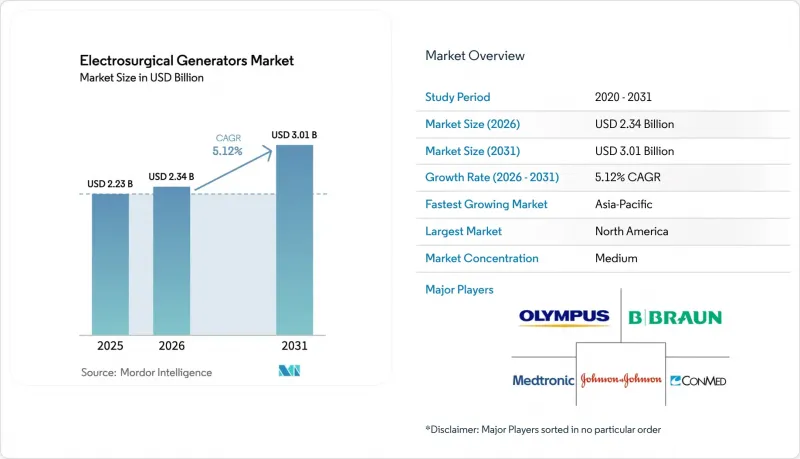
This report Segments the Industry Into by Type (Monopolar Generators, Bipolar Generators, and More), by Application (General Surgery, Urology, and More), by End-User (Hospitals, Ambulatory Surgery Centers, and More), and by Geography (North America, Europe, More). The Market Forecasts are Provided in Terms of Value (USD).
Global Electrosurgical Generators Market Trends and Insights
Rising Prevalence of Chronic Diseases Requiring Surgery
Cardiovascular interventions are climbing as atrial fibrillation now affects close to 60 million people worldwide. Adoption of pulsed field ablation sharpens focus on non-thermal tissue modification, lowering collateral damage and enabling same-day discharge pathways that align with value-based care. Integrated mapping-and-ablation systems reduce procedural complexity, fostering competitive advantage for firms able to pair power sources with real-time navigation.
Growing Adoption of Minimally-Invasive Procedures
Shift toward laparoscopic and robotic surgery intensifies demand for generators that plug directly into robotic stacks. Johnson & Johnson's 2025 DualTo launch illustrates how the electrosurgical generator market rewards platform-agnostic, software-upgradable designs that manage precise thermal envelopes within confined spaces.
Electrosurgical Injuries & Litigation Concerns
Surgical plume exposure equals inhaling 27-30 cigarettes daily, prompting 15 U.S. states to mandate smoke evacuation at the point of generation. Hospitals now prefer generators with built-in plume control, simultaneously meeting compliance and reducing equipment count Vizient.
Other drivers and restraints analyzed in the detailed report include:
- Technological Progress in Bipolar & Ultrasonic Platforms
- Expansion of Ambulatory Surgical Centers in Emerging Markets
- Stringent HF-Device Reclassification by Regulators
For complete list of drivers and restraints, kindly check the Table Of Contents.
Segment Analysis
Monopolar units generated 45.33% electrosurgical generator market share in 2025, underscoring their role in high-volume general surgery. Yet ultrasonic-hybrid generators are scaling at a 6.18% CAGR, buoyed by demand for precise hemostasis in cardiothoracic and gynecologic procedures. Bipolar models cater to settings where isolated current paths are mandatory, whereas dual-mode systems attract multi-specialty centers consolidating capital assets. Disposable compact units-suited to outpatient centers-reflect broader healthcare shifts toward single-use devices that sidestep reprocessing costs. Integrated smoke evacuation further differentiates premium offerings as mandated safety standards tighten.
Procedural convergence is forcing product roadmaps to include AI-driven feedback loops, larger touchscreen interfaces, and cloud-based performance dashboards. The electrosurgical generator market benefits as hospitals use software upgrades instead of full hardware replacement to meet new standards. Over the forecast horizon, incremental gains in algorithmic precision may outpace pure wattage specifications, steering procurement conversations toward evidence of reduced thermal spread rather than headline power ratings.
Complete Report Scope:
- By Product Type
- Monopolar Generators
- Bipolar Generators
- Combined Mono/Bipolar Units
- Ultrasonic-Hybrid Generators
- Argon-Plasma Generator Systems
- Disposable Compact Generators
- By Application
- General Surgery
- Gynecology
- Orthopedics & Spine
- Cardiovascular Surgery
- Neurosurgery
- Urology
- Dermatology & Cosmetology
- ENT & Dental
- By End User
- Hospitals
- Ambulatory Surgical Centers
- Specialty Clinics
- Academic & Research Institutes
- By Geography (Value)
- North America
- United States
- Canada
- Mexico
- Europe
- Germany
- United Kingdom
- France
- Spain
- Italy
- Rest of Europe
- Asia-Pacific
- China
- India
- Japan
- South Korea
- Australia
- Rest of Asia Pacific
- Middle East and Africa
- GCC
- South Africa
- Rest of Middle East and africa
- South America
- Brazil
- Argentina
- Rest of South America
- North America
Geography Analysis
North America held 41.78% of the electrosurgical generator market in 2025, benefiting from entrenched reimbursement structures and state-level smoke-evacuation mandates that accelerate fleet replacement cycles. Nonetheless, market saturation and hospital budget constraints temper incremental unit growth. Canada and Mexico add moderate demand as capacity upgrades align with federal infrastructure funding, while U.S. hospitals prioritize integrated platforms that feed outcome data back to value-based care dashboards.
Asia-Pacific is expanding at a 6.88% CAGR, the fastest region-wide trajectory in the electrosurgical generator market. Urban hospital build-outs, greater insurance penetration, and workforce training programs boost procedure volumes. China's updated risk-based approval pathways and Japan's focus on mechatronic precision open doors for global suppliers, providing they localize supply chains and service hubs. India likewise targets rapid device uptake, propelled by a push to raise surgical throughput per operating room hour.
Europe records measured growth as the Medical Device Regulation heightens documentation demands, favoring incumbents with proven quality management systems. Sustainability imperatives nudge procurement teams toward low-energy-draw generators and recyclable accessories. Germany, the United Kingdom, and France together anchor roughly half of regional revenue, whereas Eastern European markets represent catch-up potential dependent on structural healthcare investment.
- Medtronic
- Johnson & Johnson
- Olympus
- Conmed
- BOWA-electronic GmbH
- B. Braun Melsungen AG (Aesculap)
- Erbe Elektromedizin
- KLS Martin Group
- Stryker
- Boston Scientific
- Smiths Group
- Zimmer Biomet
- Applied Medical Resources
- Acoma Medical Industry Co.
- Xcellance Medical Technologies
- Guangdong Wego Medical
- Microline Surgical
- Ellman International
- Utah Medical Products
- KENTAMED Ltd.
Additional Benefits:
- The market estimate (ME) sheet in Excel format
- 3 months of analyst support
TABLE OF CONTENTS
1 Introduction
- 1.1 Study Assumptions & Market Definition
- 1.2 Scope of the Study
2 Research Methodology
3 Executive Summary
4 Market Landscape
- 4.1 Market Overview
- 4.2 Market Drivers
- 4.2.1 Rising prevalence of chronic diseases requiring surgery
- 4.2.2 Growing adoption of minimally-invasive procedures
- 4.2.3 Technological progress in bipolar & ultrasonic platforms
- 4.2.4 Expansion of ambulatory surgical centers in emerging markets
- 4.2.5 AI-based tissue-specific power modulation uptake
- 4.2.6 Demand for smoke-free ORs driving generator upgrades
- 4.3 Market Restraints
- 4.3.1 Electrosurgical injuries & litigation concerns
- 4.3.2 Stringent HF-device reclassification by regulators
- 4.3.3 Power-supply instability in low-resource hospitals
- 4.3.4 Post-pandemic capital-budget freezes in mid-tier hospitals
- 4.4 Value / Supply-Chain Analysis
- 4.5 Regulatory Landscape
- 4.6 Technological Outlook
- 4.7 Porter's Five Forces
- 4.7.1 Threat of New Entrants
- 4.7.2 Bargaining Power of Suppliers
- 4.7.3 Bargaining Power of Buyers
- 4.7.4 Threat of Substitutes
- 4.7.5 Competitive Rivalry
5 Market Size & Growth Forecasts (Value, USD)
- 5.1 By Product Type
- 5.1.1 Monopolar Generators
- 5.1.2 Bipolar Generators
- 5.1.3 Combined Mono/Bipolar Units
- 5.1.4 Ultrasonic-Hybrid Generators
- 5.1.5 Argon-Plasma Generator Systems
- 5.1.6 Disposable Compact Generators
- 5.2 By Application
- 5.2.1 General Surgery
- 5.2.2 Gynecology
- 5.2.3 Orthopedics & Spine
- 5.2.4 Cardiovascular Surgery
- 5.2.5 Neurosurgery
- 5.2.6 Urology
- 5.2.7 Dermatology & Cosmetology
- 5.2.8 ENT & Dental
- 5.3 By End User
- 5.3.1 Hospitals
- 5.3.2 Ambulatory Surgical Centers
- 5.3.3 Specialty Clinics
- 5.3.4 Academic & Research Institutes
- 5.4 By Geography (Value)
- 5.4.1 North America
- 5.4.1.1 United States
- 5.4.1.2 Canada
- 5.4.1.3 Mexico
- 5.4.2 Europe
- 5.4.2.1 Germany
- 5.4.2.2 United Kingdom
- 5.4.2.3 France
- 5.4.2.4 Spain
- 5.4.2.5 Italy
- 5.4.2.6 Rest of Europe
- 5.4.3 Asia-Pacific
- 5.4.3.1 China
- 5.4.3.2 India
- 5.4.3.3 Japan
- 5.4.3.4 South Korea
- 5.4.3.5 Australia
- 5.4.3.6 Rest of Asia Pacific
- 5.4.4 Middle East and Africa
- 5.4.4.1 GCC
- 5.4.4.2 South Africa
- 5.4.4.3 Rest of Middle East and africa
- 5.4.5 South America
- 5.4.5.1 Brazil
- 5.4.5.2 Argentina
- 5.4.5.3 Rest of South America
- 5.4.1 North America
6 Competitive Landscape
- 6.1 Market Concentration
- 6.2 Market Share Analysis
- 6.3 Company Profiles (includes Global level Overview, Market level overview, Core Segments, Financials as available, Strategic Information, Market Rank/Share for key companies, Products & Services, and Recent Developments)
- 6.3.1 Medtronic plc
- 6.3.2 Johnson & Johnson (Ethicon)
- 6.3.3 Olympus Corporation
- 6.3.4 CONMED Corporation
- 6.3.5 BOWA-electronic GmbH
- 6.3.6 B. Braun Melsungen AG (Aesculap)
- 6.3.7 Erbe Elektromedizin GmbH
- 6.3.8 KLS Martin Group
- 6.3.9 Stryker Corporation
- 6.3.10 Boston Scientific Corporation
- 6.3.11 Smith & Nephew plc
- 6.3.12 Zimmer Biomet Holdings
- 6.3.13 Applied Medical Resources
- 6.3.14 Acoma Medical Industry Co.
- 6.3.15 Xcellance Medical Technologies
- 6.3.16 Guangdong Wego Medical
- 6.3.17 Microline Surgical
- 6.3.18 Ellman International
- 6.3.19 Utah Medical Products
- 6.3.20 KENTAMED Ltd.
7 Market Opportunities & Future Outlook
- 7.1 White-space & Unmet-Need Assessment

