PUBLISHER: Mordor Intelligence | PRODUCT CODE: 2116947

PUBLISHER: Mordor Intelligence | PRODUCT CODE: 2116947
Germany Bathroom Furniture - Market Share Analysis, Industry Trends & Statistics, Growth Forecasts (2026 - 2031)
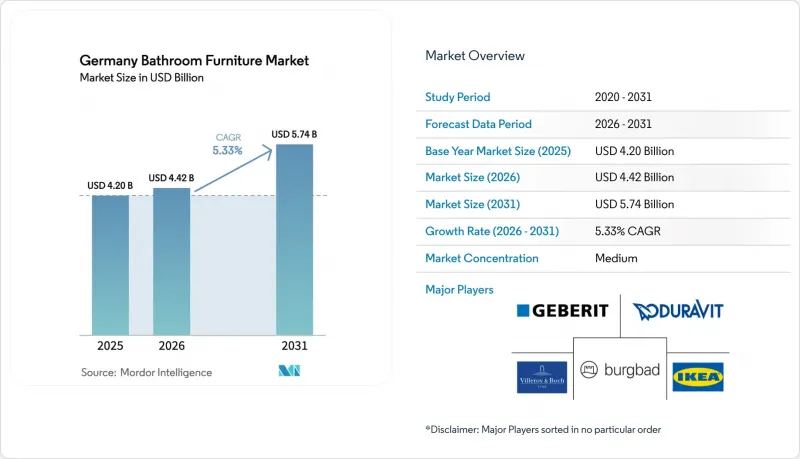
According to Mordor Intelligence, germany's bathroom furniture market size in 2026 is estimated at USD 4.42 billion, growing from 2025 value of USD 4.20 billion with 2031 projections showing USD 5.74 billion, growing at 5.33% CAGR over 2026-2031.
This report is Segmented by Product (Bath Vanity, Console Vanities, Vanity Tops, and More), Material (Wood, Plastic, and More), Price Range (Economy, Mid-Range, and Premium), End User (Residential, and Commercial), Distribution Channels (B2C/Retail, and B2B/Directly From Manufacturers), and Geography (Bavaria, Baden-Wurttemberg, and More). The Market Forecasts are Provided in Terms of Value (USD).
Germany Bathroom Furniture Market Trends and Insights
Ageing Housing Stock Renovations Backed by German Federal Subsidies
Federal housing programs allotting EUR 8 billion between 2018 and 2024 stimulate demand for retrofit-friendly vanities and storage kits that blend accessibility with aesthetics. Roughly one-quarter of Germany's citizens are 60 +; yet only 2% of homes offer age-appropriate bathrooms, driving suppliers such as Duravit and Burgbad to pioneer grab-free drawer profiles and height-adjustable mirrors. Product specs increasingly match barrier-free guidelines without evoking institutional styling, supporting willingness to pay in the premium tier. Municipal subsidy portals further shorten payback periods for homeowners, keeping renovation pipelines active despite labor shortages.
Adoption of Smart IoT-Enabled Bathroom Furniture with Integrated Lighting
Voice- or app-controlled mirrors, LED-framed cabinets, and motion-triggered drawers reposition bathrooms as wellness hubs rather than functional volumes. Early uptake clusters in Berlin loft conversions, where tech-savvy professionals demand personalization and remote diagnostics. Manufacturers interlink faucets, lighting, and vanities to gather water-consumption data, aligning with ESG targets of hotel operators. Brand ecosystems-Duravit's D-Neo platform, Hansgrohe's RainTunes lighting sync-lock customers into upgrade paths and help defend margin dilution from commodity imports.
Labour Shortages & Long Permitting Delaying Renovation Cycles
Planning permissions for new homes slumped by 24.2% year-over-year in May 2024, extending project lead times and inflating subcontractor rates. Multitrade coordination-plumbers, tilers, electricians-makes bathrooms especially vulnerable, pushing some consumers to defer upgrades. Industry responds with prefab panel systems and tool-free fittings that shave labor hours, yet cannot fully offset structural shortages.
Other drivers and restraints analyzed in the detailed report include:
- Premium Sustainable Design Preference & Eco Certification Influence
- Urban Multifamily Construction Fueling Compact Modular Solutions
- Escalating Raw-Material Costs Compressing Manufacturer Margins
For complete list of drivers and restraints, kindly check the Table Of Contents.
Segment Analysis
Storage furniture is forecasted to climb at a 6.07% CAGR, outstripping the overall category pace. Wi-Fi-enabled drawers that log cosmetics expiry dates and humidity-resistant shelving target compact urban bathrooms. Bath vanities retained a commanding 29.40% German bathroom furniture market share in 2025 and anchor renovation budgets because countertop and basin selection set the aesthetic tone. Console variants and mirrors adopt LED backlighting, defogging films, and Bluetooth speakers, weaving technology into traditional silhouettes. Competition pivots from raw volume to software interoperability that locks users into brand ecosystems.
Demand for modular storage also benefits from demographic aging: slide-out laundry hampers mitigate bending, while adjustable shelving adapts to children's growth. Premium lines such as Duravit's Aurena collection introduce porcelain-clad dividers that merge hygienic surfaces with high-design cues. As adoption broadens, suppliers experiment with subscription-based filter replacements for mirror-integrated air purifiers, crystallizing annuity revenue.
Wood's warm tactility and carbon-sink narrative underpin its 31.30% share of Germany bathroom furniture market size in 2025. FSC- or PEFC-certified oak and walnut remain hero finishes, yet veneer thicknesses shrink to reduce material intensity without visual compromise. Cross-laminated panels with bio-based adhesives improve moisture resilience, extending warranty periods. Plastics and advanced polymers trail but clock the highest 5.72% CAGR. WPC blends, commercialized by the LIMOWOOD consortium, divert landfill waste while achieving Class B fire ratings, attracting hospitality specifiers. Hybrid assemblies-oak drawer fronts on recycled-PET carcasses carry aesthetics with resource efficiency and facilitate easier disassembly at the end of life.
Metal frames re-emerge as accents, allowing thinner carcass walls and floating effects. Powder-coated aluminum in matte pastel tones answers pastel design trends forecasted for 2026 interiors. Ceramic or solid-surface tops integrate overflow-free drains to reduce water use, echoing broader German plumbing codes.
Complete Report Scope:
- By Product
- Bath Vanities
- Console Vanities
- Vanity Tops
- Bathroom Mirrors
- Storage Furniture & Accessories
- By Material
- Wood
- Metal
- Plastic & Polymer
- Other Material
- By Price Range
- Economy
- Mid-range
- Premium / Luxury
- By End User
- Residential
- Commercial
- By Distribution Channel
- B2C/Retail
- Home Centers
- Specialty Furniture Stores (including exclusive brand outlets)
- Online
- Other Distribution Channels (includes hypermarkets, supermarkets, teleshopping, warehouse clubs, departmental stores, etc.)
- B2B/Directly from Manufacturers
- B2C/Retail
- By Geography
- Bavaria
- Baden-Wurttemberg
- North Rhine-Westphalia
- Lower Saxony
- Hesse
- Rest of Germany
List of Companies Covered in this Report:
- Burgbad GmbH
- Duravit AG
- Villeroy & Boch AG
- Hansgrohe SE (Axor Furniture Division)
- Artiqua GmbH
- Pelipal GmbH
- Puris Bad GmbH & Co. KG
- KEUCO GmbH & Co. KG
- Alape GmbH
- Badea (nobilia-Werke)
- Hulsta-Werke Huls GmbH & Co. KG
- IKEA
- Roca Sanitario S.A.
- Salgar
- Geberit AG
- Laufen Bathrooms AG
- Crosswater Ltd.
- Ideal Standard International S.A.
- VitrA (EczacIbasI Building Products)
- Boffi S.p.A.
Additional Benefits:
- The market estimate (ME) sheet in Excel format
- 3 months of analyst support
TABLE OF CONTENTS
1 Introduction
- 1.1 Study Assumptions and Market Definition
- 1.2 Scope of the Study
2 Research Methodology
3 Executive Summary
4 Market Landscape
- 4.1 Market Overview
- 4.2 Market Drivers
- 4.2.1 Ageing Housing Stock Renovations Backed by German Federal Subsidies
- 4.2.2 Adoption of Smart IoT-Enabled Bathroom Furniture with Integrated Lighting
- 4.2.3 Premium Sustainable Design Preference & Eco Certification Influence
- 4.2.4 Urban Multifamily Construction Fueling Compact Modular Solutions
- 4.2.5 Rising E-Commerce Penetration Enhancing Product Accessibility
- 4.3 Market Restraints
- 4.3.1 Labour Shortages & Long Permitting Delaying Renovation Cycles
- 4.3.2 Escalating Raw-Material Costs Compressing Manufacturer Margins
- 4.3.3 Price Pressure from DIY Chains on Branded Furniture Vendors
- 4.4 Industry Value Chain Analysis
- 4.5 Porter's Five Forces Analysis
- 4.5.1 Threat of New Entrants
- 4.5.2 Bargaining Power of Suppliers
- 4.5.3 Bargaining Power of Buyers
- 4.5.4 Threat of Substitutes
- 4.5.5 Competitive Rivalry
- 4.6 Insights into the Latest Trends and Innovations in the Market
- 4.7 Insights on Recent Developments (New Product Launches, Strategic Initiatives, Investments, Partnerships, JVs, Expansion, M&As, etc.) in the Market
5 Market Size & Growth Forecasts (Value)
- 5.1 By Product
- 5.1.1 Bath Vanities
- 5.1.2 Console Vanities
- 5.1.3 Vanity Tops
- 5.1.4 Bathroom Mirrors
- 5.1.5 Storage Furniture & Accessories
- 5.2 By Material
- 5.2.1 Wood
- 5.2.2 Metal
- 5.2.3 Plastic & Polymer
- 5.2.4 Other Material
- 5.3 By Price Range
- 5.3.1 Economy
- 5.3.2 Mid-range
- 5.3.3 Premium / Luxury
- 5.4 By End User
- 5.4.1 Residential
- 5.4.2 Commercial
- 5.5 By Distribution Channel
- 5.5.1 B2C/Retail
- 5.5.1.1 Home Centers
- 5.5.1.2 Specialty Furniture Stores (including exclusive brand outlets)
- 5.5.1.3 Online
- 5.5.1.4 Other Distribution Channels (includes hypermarkets, supermarkets, teleshopping, warehouse clubs, departmental stores, etc.)
- 5.5.2 B2B/Directly from Manufacturers
- 5.5.1 B2C/Retail
- 5.6 By Geography
- 5.6.1 Bavaria
- 5.6.2 Baden-Wurttemberg
- 5.6.3 North Rhine-Westphalia
- 5.6.4 Lower Saxony
- 5.6.5 Hesse
- 5.6.6 Rest of Germany
6 Competitive Landscape
- 6.1 Market Concentration
- 6.2 Strategic Moves
- 6.3 Market Share Analysis
- 6.4 Company Profiles (includes Global level Overview, Market level overview, Core Segments, Financials as available, Strategic Information, Market Rank/Share for key companies, Products & Services, and Recent Developments)
- 6.4.1 Burgbad GmbH
- 6.4.2 Duravit AG
- 6.4.3 Villeroy & Boch AG
- 6.4.4 Hansgrohe SE (Axor Furniture Division)
- 6.4.5 Artiqua GmbH
- 6.4.6 Pelipal GmbH
- 6.4.7 Puris Bad GmbH & Co. KG
- 6.4.8 KEUCO GmbH & Co. KG
- 6.4.9 Alape GmbH
- 6.4.10 Badea (nobilia-Werke)
- 6.4.11 Hulsta-Werke Huls GmbH & Co. KG
- 6.4.12 IKEA
- 6.4.13 Roca Sanitario S.A.
- 6.4.14 Salgar
- 6.4.15 Geberit AG
- 6.4.16 Laufen Bathrooms AG
- 6.4.17 Crosswater Ltd.
- 6.4.18 Ideal Standard International S.A.
- 6.4.19 VitrA (EczacIbasI Building Products)
- 6.4.20 Boffi S.p.A.
7 Market Opportunities & Future Outlook
- 7.1 Customization & Modular Solutions
- 7.2 Digitalization and Smart Integration

