PUBLISHER: Mordor Intelligence | PRODUCT CODE: 2116950

PUBLISHER: Mordor Intelligence | PRODUCT CODE: 2116950
Outdoor Solar LED - Market Share Analysis, Industry Trends & Statistics, Growth Forecasts (2026 - 2031)
According to Mordor Intelligence, outdoor solar LED market size in 2026 is estimated at USD 10.08 billion, growing from 2025 value of USD 9.47 billion with 2031 projections showing USD 13.78 billion, growing at 6.45% CAGR over 2026-2031.
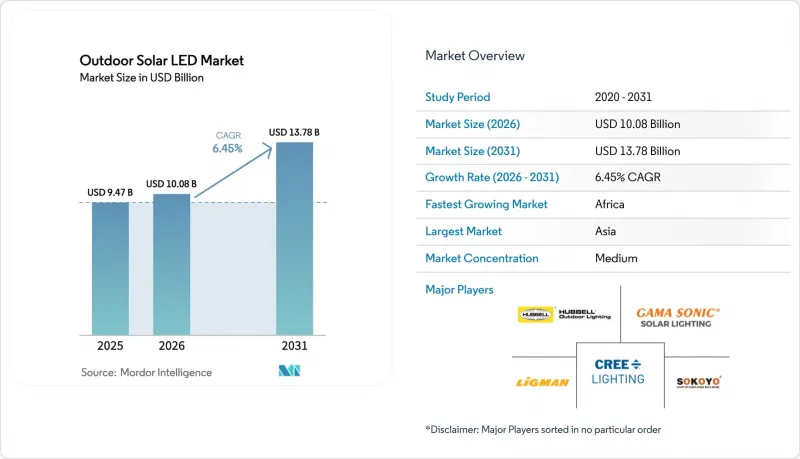
This report is Segmented by Application (Solar LED Street Lights, Solar Garden LED Lights, Solar LED Floodlights, and More), Wattage (Less Than 39 W, 40 W To 149 W, and More Than 150 W), End User Industry (Residential, Commercial, and Industrial), Component (Luminaire (LED Module), Solar Panel, Battery Pack, and More), and Geography. The Market Forecasts are Provided in Terms of Value (USD).
Global Outdoor Solar LED Market Trends and Insights
Mandatory Solar-LED Road-Illumination Mandates in Sub-Saharan Africa
Governments confronting energy poverty now specify solar LEDs in road contracts, creating predictable demand that encourages local assembly plants. The World Bank's USD 35 billion electrification drive recognizes solar as faster and cheaper than extending grids, while private suppliers in Niger already sell quality modules below USD 75, confirming affordability thresholds.
Dark-Sky Regulations Fueling Municipal Retrofits in Europe and North America
Statutes such as Maine's LD 1934 cap brightness and color temperature, forcing municipalities to swap high-pressure sodium units for compliant solar LEDs that natively meet downward-facing and lumen limits. Early adopters like Groveland, Florida, budget six-figure sums for phased retrofits, anchoring a replacement cycle that favors off-grid systems with built-in controls.
Battery Theft and Vandalism Risk in Developing Regions
Municipalities that adopted solar to stop copper wire theft now face new risks as thieves target Li-ion packs. Los Angeles spends USD 20 million yearly on cable repairs, prompting a 900-unit solar rollout, yet tamper-proof housings and alarms raise capex for off-grid systems, particularly in Sub-Saharan Africa where resale incentives remain high.
Other drivers and restraints analyzed in the detailed report include:
- Hybrid Telecom-Tower Upgrades Adopting Solar LEDs in South Asia
- Rural Electrification Programs Accelerating Off-Grid Street Lighting
- High O&M Costs in High-Latitude, Low-Irradiance Cities
For complete list of drivers and restraints, kindly check the Table Of Contents.
Segment Analysis
Street lights contributed USD 3.89 billion to the Outdoor solar LED market size in 2025 and retained 41.12% share as cities favored proven procurement templates. Municipal buyers cite 3-year payback periods and improved citizen safety, illustrated by Seville's 20 SunStay units delivering 3,000 lumens at 175 lm/W. Solar LED floodlights gained traction in industrial yards and stadiums, growing at 8.32% CAGR as insurers demand better night-time surveillance.
Evolving priorities trigger convergence across lighting forms. Fonroche's 67,000-unit Senegal project guarantees 365-night autonomy, validating reliability for large public rolls-outs. Campus managers now blend street, area, and garden fixtures inside a single control platform that dims during low-traffic hours, widening use cases without ballooning O&M costs. As dark-sky rules proliferate, downward-directed floodlights gain an edge, and policy-driven retrofits sustain volume while adding smart features.
Fixtures rated 40 W-149 W represented USD 4.36 billion and 46.05% Outdoor solar LED market share in 2025, balancing brightness with panel size and battery depth. They light most collector roads and retail lots, and standardization keeps installation costs predictable. Units exceeding 150 W are forecast to climb 7.55% CAGR as LiFePO4 packs hit cost thresholds that bring high-mast ports and freight yards into scope.
Cree's XFL10K diode provides 20,000 lumens with longer throw distance, cutting pole counts and civil works. Heat-sink advances and graphite composites alleviate thermal stress, especially in Gulf Coast and equatorial sites. Sub-39 W devices stay niche in decorative landscapes because limited lumen output restricts commercial uptake, yet smart-home ecosystems could unlock incremental demand as prices fall.
Complete Report Scope:
- By Application
- Solar LED Street Lights
- Solar Garden LED Lights
- Solar LED Floodlights
- Solar LED Area Lights
- Solar LED Spot Lights
- By Wattage
- Less than 39 W
- 40 W - 149 W
- Above 150 W
- By End-User Industry
- Residential
- Commercial
- Industrial
- By Component
- Luminaire (LED Module)
- Solar Panel
- Monocrystalline
- Polycrystalline
- Thin-Film
- Battery Pack
- Li-ion
- LiFePO4
- Lead-acid
- Charge Controller and Smart Sensor Unit
- Pole and Mounting Structure
- By Geography
- North America
- United States
- Canada
- Mexico
- Europe
- Germany
- United Kingdom
- France
- Nordics
- Rest of Europe
- South America
- Brazil
- Rest of South America
- Asia-Pacific
- China
- Japan
- India
- South-East Asia
- Rest of Asia-Pacific
- Middle East and Africa
- Middle East
- Gulf Cooperation Council Countries
- Turkey
- Rest of Middle East
- Africa
- South Africa
- Rest of Africa
- Middle East
- North America
Geography Analysis
Asia delivered 44.75% of global revenue in 2025 due to deep supply chains, government subsidies, and massive grid-extension gaps still best solved through off-grid lighting. China anchors module exports, while India's National Solar Mission sponsors village micro-grids that combine telecom, household, and street-light loads into single service packages. Japan's 20 GW perovskite roadmap signals regional R&D leadership that could lower panel weight and broaden rooftop sites. Southeast Asian tower retrofits amplify orders for hybrid lighting kits that share battery strings with radio equipment, improving logistics efficiency.
Africa stands out with a projected 7.2% CAGR through 2031, underpinned by the World Bank loan program and private leasing models targeting 600 million people still without evening light. Niger's retail boom in sub-USD 100 panels proves that affordability has crossed consumer thresholds, while Senegal's record-scale street-light rollout shows how national mandates translate to immediate orders. Emerging assembly plants in Egypt and Kenya add local-content advantages that speed tenders.
The Middle East tripled solar generation in five years as oil exporters diversify. Saudi Arabia targets 58 GW of PV by 2030, and regional LED factories now top 3 GW yearly output, lowering landed costs and shortening lead times. Harsh summer temperatures spur demand for high-thermal-tolerance luminaires and smart cooling. North America and Europe focus on replacement rather than greenfield installations, yet dark-sky ordinances, copper-theft countermeasures, and tax-credit transfers keep budgets flowing, sustaining steady mid-single-digit growth.
- Signify Holding
- Hubbell Outdoor Lighting
- Sokoyo Solar Lighting Co. Ltd
- Sunna Design SA
- Greenshine New Energy
- CREE Lighting
- Gamasonic
- Ligman Lighting
- Jiawei Renewable Energy
- LEADSUN
- OkSolar
- SBM-SolarTech
- SEPCO Solar Electric Power Company
- Solar Street Lights USA
- Acuity Brands (Holophane)
- Fonroche Lighting
- Sol Inc. (Carmanah Technologies)
- SolarOne Solutions
- Evluma
- ELEDLIGHTS
Additional Benefits:
- The market estimate (ME) sheet in Excel format
- 3 months of analyst support
TABLE OF CONTENTS
1 INTRODUCTION
- 1.1 Study Assumptions and Market Definition
- 1.2 Scope of the Study
2 RESEARCH METHODOLOGY
3 EXECUTIVE SUMMARY
4 MARKET LANDSCAPE
- 4.1 Market Overview
- 4.2 Market Drivers
- 4.2.1 Mandatory Solar-LED Road-Illumination Mandates in Sub-Saharan Africa
- 4.2.2 Dark-Sky Regulations Fueling Municipal Retrofits in Europe and North America
- 4.2.3 Hybrid Telecom-Tower Upgrades Adopting Solar LEDs in South Asia
- 4.2.4 Rural Electrification Programs Accelerating Off-Grid Street Lighting (India, Kenya)
- 4.2.5 Rapid Decline in LiFePO4 Battery Prices Enabling High-Wattage Units
- 4.3 Market Restraints
- 4.3.1 Battery Theft and Vandalism Risk in Developing Regions
- 4.3.2 High O&M Costs in High-Latitude, Low-Irradiance Cities
- 4.3.3 Limited Financing Models for Mid-Sized Commercial Campuses
- 4.3.4 Thermal Management Challenges Beyond 150 W Fixtures
- 4.4 Industry Ecosystem Analysis
- 4.5 Technology Snapshot
- 4.6 Porter's Five Forces Analysis
- 4.6.1 Threat of New Entrants
- 4.6.2 Bargaining Power of Buyers
- 4.6.3 Bargaining Power of Suppliers
- 4.6.4 Threat of Substitute Products
- 4.6.5 Intensity of Competitive Rivalry
5 MARKET SIZE AND GROWTH FORECASTS (VALUES)
- 5.1 By Application
- 5.1.1 Solar LED Street Lights
- 5.1.2 Solar Garden LED Lights
- 5.1.3 Solar LED Floodlights
- 5.1.4 Solar LED Area Lights
- 5.1.5 Solar LED Spot Lights
- 5.2 By Wattage
- 5.2.1 Less than 39 W
- 5.2.2 40 W - 149 W
- 5.2.3 Above 150 W
- 5.3 By End-User Industry
- 5.3.1 Residential
- 5.3.2 Commercial
- 5.3.3 Industrial
- 5.4 By Component
- 5.4.1 Luminaire (LED Module)
- 5.4.2 Solar Panel
- 5.4.2.1 Monocrystalline
- 5.4.2.2 Polycrystalline
- 5.4.2.3 Thin-Film
- 5.4.3 Battery Pack
- 5.4.3.1 Li-ion
- 5.4.3.2 LiFePO?
- 5.4.3.3 Lead-acid
- 5.4.4 Charge Controller and Smart Sensor Unit
- 5.4.5 Pole and Mounting Structure
- 5.5 By Geography
- 5.5.1 North America
- 5.5.1.1 United States
- 5.5.1.2 Canada
- 5.5.1.3 Mexico
- 5.5.2 Europe
- 5.5.2.1 Germany
- 5.5.2.2 United Kingdom
- 5.5.2.3 France
- 5.5.2.4 Nordics
- 5.5.2.5 Rest of Europe
- 5.5.3 South America
- 5.5.3.1 Brazil
- 5.5.3.2 Rest of South America
- 5.5.4 Asia-Pacific
- 5.5.4.1 China
- 5.5.4.2 Japan
- 5.5.4.3 India
- 5.5.4.4 South-East Asia
- 5.5.4.5 Rest of Asia-Pacific
- 5.5.5 Middle East and Africa
- 5.5.5.1 Middle East
- 5.5.5.1.1 Gulf Cooperation Council Countries
- 5.5.5.1.2 Turkey
- 5.5.5.1.3 Rest of Middle East
- 5.5.5.2 Africa
- 5.5.5.2.1 South Africa
- 5.5.5.2.2 Rest of Africa
- 5.5.5.1 Middle East
- 5.5.1 North America
6 COMPETITIVE LANDSCAPE
- 6.1 Market Concentration
- 6.2 Strategic Moves (M&A, JV, Partnerships, Licensing)
- 6.3 Market Share Analysis
- 6.4 Company Profiles (includes Global-level Overview, Market-level Overview, Core Segments, Financials, Strategic Information, Market Rank/Share, Products and Services, and Recent Developments)
- 6.4.1 Signify Holding
- 6.4.2 Hubbell Outdoor Lighting
- 6.4.3 Sokoyo Solar Lighting Co. Ltd
- 6.4.4 Sunna Design SA
- 6.4.5 Greenshine New Energy
- 6.4.6 CREE Lighting
- 6.4.7 Gamasonic
- 6.4.8 Ligman Lighting
- 6.4.9 Jiawei Renewable Energy
- 6.4.10 LEADSUN
- 6.4.11 OkSolar
- 6.4.12 SBM-SolarTech
- 6.4.13 SEPCO Solar Electric Power Company
- 6.4.14 Solar Street Lights USA
- 6.4.15 Acuity Brands (Holophane)
- 6.4.16 Fonroche Lighting
- 6.4.17 Sol Inc. (Carmanah Technologies)
- 6.4.18 SolarOne Solutions
- 6.4.19 Evluma
- 6.4.20 ELEDLIGHTS
7 MARKET OPPORTUNITIES AND FUTURE OUTLOOK
- 7.1 White-Space and Unmet-Need Assessment

