PUBLISHER: Mordor Intelligence | PRODUCT CODE: 2116951

PUBLISHER: Mordor Intelligence | PRODUCT CODE: 2116951
Smart Trash Bins - Market Share Analysis, Industry Trends & Statistics, Growth Forecasts (2026 - 2031)
According to Mordor Intelligence, the smart trash bins market size was valued at USD 96.86 million in 2025 and estimated to grow from USD 110.94 million in 2026 to reach USD 218.69 million by 2031, at a CAGR of 14.55% during the forecast period (2026-2031).
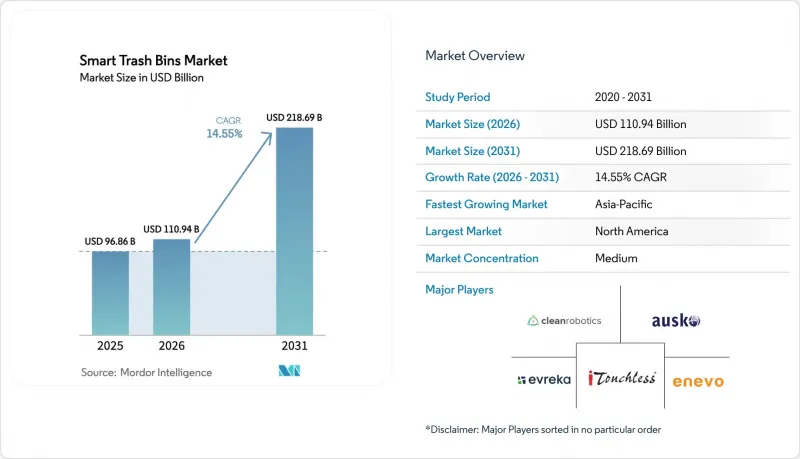
This report is Segmented by Solution Type (Hardware and Software), Sales Channel (Offline and Online), Waste Type (Municipal Solid Waste, Recyclables, and Bio-Waste / Organics), End User (Residential, Commercial, and Municipal), and Geography.
Global Smart Trash Bins Market Trends and Insights
Increasing Smart-City Funding and Mandate
Growing municipal budgets now earmark connected-waste infrastructure as a foundational data layer for wider urban analytics programs. Phoenix transitioned 418,000 collection points to digital monitoring that synchronizes route optimization with sustainability dashboards. Similar allocations appear in European and Canadian grant frameworks that treat sensorized bins as core utilities. Because city planners can overlay waste-generation data on traffic and demographic maps, funding streams have become recurrent. Suppliers benefit from predictable multi-year contracts that improve return on investment calculations, and the model is replicating in mid-tier US counties and Nordic municipalities.
Rapid IoT Sensor Cost Decline and Connectivity Rollout
Average fill-level sensor prices fell by more than 35% between 2023 and 2025, enabling large deployments in budget-constrained jurisdictions. Energy-efficient nodes now run 70 days on small batteries, while LPWAN backhaul eliminates the need for cellular subscriptions. Asian smart city pilots increasingly bundle LoRaWAN gateways with street-lighting upgrades, accelerating rollouts in Vietnam and Indonesia. The resulting network effect commoditizes basic telemetry and shifts competitive leverage to analytics brands that interpret bin-level data into preventive maintenance schedules.
High Upfront CAPEX and Payback Uncertainty
Connected bins cost USD 500-2,000 per unit depending on compaction and AI functions, straining budgets in towns under 100,000 residents. Although route optimization can cut fleet mileage by 25-50%, decision makers struggle to quantify secondary benefits such as reduced litter or methane avoidance. Budget cycles extend two to five years, creating mismatches with rapid hardware iteration. Vendors respond by offering lease-to-own models and performance-based contracts that tie monthly fees to verified diversion gains.
Other drivers and restraints analyzed in the detailed report include:
- Circular-Economy Regulations on Landfill Diversion
- Edge-AI-Enabled Contamination Detection Boosts ROI
- Fragmented Municipal Procurement and Long Bid Cycles
For complete list of drivers and restraints, kindly check the Table Of Contents.
Segment Analysis
Hardware solutions still generate the bulk of smart trash bins market revenue, accounting for 63.25% in 2025. The segment includes fill-level sensors, solar compactors, RFID tags, and ruggedized communication modules that serve as the physical interface between waste streams and data clouds. Hardware sales formed the initial growth engine because municipalities required tangible assets to unlock grant disbursements, and procurement teams favored capital expenditure models that allocate devices to asset registers. Standardization is narrowing performance gaps among vendors, making price parity the norm for sensor payloads.
Software and analytics platforms now represent the fastest-growing revenue component at 15.78% CAGR to 2031. The shift repositions data rather than devices as the primary value driver, enabling suppliers to upsell predictive algorithms, dashboard subscriptions, and application-programming-interface access to third-party planners. As a result, recurring revenue share is expected to exceed 40% of the smart trash bins market size for leading vendors by 2028. Edge-AI upgrades further reduce haulage costs, securing budget approvals even in CAPEX-constrained municipalities. Service providers that combine firmware over-the-air updates with business-intelligence tools enjoy higher renewal rates and lower churn.
Offline integrators captured 57.35% of 2025 revenue because city engineering teams still rely on incumbents for installation, training, and multiyear maintenance. Local distributors navigate building codes, zoning rules, and collective-bargaining agreements that often dictate bin footprint and servicing schedules. Their field technicians also perform warranty repairs that safeguard service-level agreements.
Online platforms, however, are expanding fast at 15.61% CAGR as standardized, smaller-scale smart trash bins enter catalogues on industrial-procurement portals. Municipalities use e-tendering portals for pilot orders that evaluate proof-of-concept metrics before issuing citywide RFPs. Vendors leverage direct-to-customer storefronts to bypass distribution margins and to gather fleet-wide telemetry into centralized clouds without data-handoff delays. Over the forecast horizon, digital channels will likely claim double-digit revenue share increases, particularly for compact indoor units bought by private campuses.
Complete Report Scope:
- By Solution Type (Value)
- Hardware (Fill-level sensors, RFID, optical, compaction)
- Software / Analytics Platforms
- By Sales Channel (Value)
- Offline (Distributors, System Integrators)
- Online (Direct, E-commerce)
- By Waste Type (Value)
- Municipal Solid Waste
- Recyclables
- Bio-waste / Organics
- By End User (Value)
- Residential
- Commercial
- Municipal / Public Spaces
- By Geography
- North America
- United States
- Canada
- Mexico
- South America
- Brazil
- Argentina
- Rest of South America
- Europe
- Germany
- United Kingdom
- France
- Rest of Europe
- Asia Pacific
- China
- Japan
- India
- South Korea
- Rest of Asia Pacific
- Middle East and Africa
- United Arab Emirates
- Saudi Arabia
- South Africa
- Rest of Middle East and Africa
- North America
Geography Analysis
North America held 37.05% of global revenue in 2025, reflecting early grant programs, robust IoT infrastructure, and established vendor ecosystems. Phoenix digitized weekly pickups across 418,000 locations, linking fill-level APIs to its climate dashboard for transparent performance monitoring. New York City's plan for stationary curbside units underscores how dense urban footprints catalyze compactor adoption. Cloud-based platforms integrate seamlessly with 4G and low-power networks prevalent across US and Canadian metro areas, ensuring high uptime and rapid firmware updates.
Asia-Pacific will register a 15.92% CAGR through 2031, the swiftest worldwide. Rapid urbanization forces local governments to leapfrog legacy fleet models and invest directly in AI-enabled waste infrastructure. South Korea's AETECH robots sort 96 items per minute, boosting recycling centers' throughput without expanding labor rosters. Governments in Thailand, Vietnam, and Indonesia embed waste-data requirements in smart-city masterplans, triggering competitive tenders valued at tens of millions of USD. LPWAN coverage grows as utilities deploy network backbones, lowering operating costs compared with cellular telemetry.
Europe maintains steady expansion underpinned by rigorous diversion quotas in the EU Circular Economy Action Plan. Member states must record contamination incidents and recycling output, driving purchase orders for bins equipped with optical sensors and barcode scanners. The European Environment Agency validates technology pilots that demonstrate 30% reductions in residual collections after smart-bin rollout. Nordic cities capitalize on 0G networks from Heliot Europe to monitor rural containers where cellular signals are scarce. As ISO 59000 gains adoption, municipalities employ standardized APIs to transmit diversion metrics directly into environmental-audit platforms, cementing software-as-a-service renewals.
- Bigbelly
- Ecube Labs
- Enevo Inc.
- Sensoneo
- CleanRobotics
- iTouchless Housewares and Products Inc.
- Ausko Pte Ltd
- Hangzhou Bosheen Household Technology
- Bine sp. z o.o.
- Akaba Ltd (Street Master)
- SmartBin (IoT Systems Group)
- EvoEco Inc.
- PEL Waste Reduction Equipment
- Compology
- Evreka
- Euronics Industries Pvt Ltd
- Sehaj Synergy Technologies Pvt Ltd
- SAGE Automation
- WasteHero
- RecycleSmart
Additional Benefits:
- The market estimate (ME) sheet in Excel format
- 3 months of analyst support
TABLE OF CONTENTS
1 INTRODUCTION
- 1.1 Study Assumptions and Market Definition
- 1.2 Scope of the Study
2 RESEARCH METHODOLOGY
3 EXECUTIVE SUMMARY
4 MARKET INSIGHTS
- 4.1 Market Overview
- 4.2 Market Drivers
- 4.2.1 Increasing smart-city funding and mandates
- 4.2.2 Rapid IoT sensor cost decline and connectivity rollout
- 4.2.3 Circular-economy regulations on landfill diversion
- 4.2.4 Edge-AI-enabled contamination detection boosts ROI
- 4.2.5 Rising urban population leading to increased waste generation
- 4.2.6 Carbon-credit monetization for verified diversion data
- 4.3 Market Restraints
- 4.3.1 High upfront CAPEX and payback uncertainty
- 4.3.2 Fragmented municipal procurement and long bid cycles
- 4.3.3 Lack of interoperability / data standards
- 4.3.4 Labor-union push-back on route-optimization job loss
- 4.4 Value Chain Analysis
- 4.5 Regulatory Landscape
- 4.6 Technological Outlook
- 4.7 Porter's Five Forces Analysis
- 4.7.1 Threat of New Entrants
- 4.7.2 Bargaining Power of Suppliers
- 4.7.3 Bargaining Power of Buyers
- 4.7.4 Threat of Substitutes
- 4.7.5 Competitive Rivalry
5 MARKET SIZE AND GROWTH FORECASTS (VALUE)
- 5.1 By Solution Type (Value)
- 5.1.1 Hardware (Fill-level sensors, RFID, optical, compaction)
- 5.1.2 Software / Analytics Platforms
- 5.2 By Sales Channel (Value)
- 5.2.1 Offline (Distributors, System Integrators)
- 5.2.2 Online (Direct, E-commerce)
- 5.3 By Waste Type (Value)
- 5.3.1 Municipal Solid Waste
- 5.3.2 Recyclables
- 5.3.3 Bio-waste / Organics
- 5.4 By End User (Value)
- 5.4.1 Residential
- 5.4.2 Commercial
- 5.4.3 Municipal / Public Spaces
- 5.5 By Geography
- 5.5.1 North America
- 5.5.1.1 United States
- 5.5.1.2 Canada
- 5.5.1.3 Mexico
- 5.5.2 South America
- 5.5.2.1 Brazil
- 5.5.2.2 Argentina
- 5.5.2.3 Rest of South America
- 5.5.3 Europe
- 5.5.3.1 Germany
- 5.5.3.2 United Kingdom
- 5.5.3.3 France
- 5.5.3.4 Rest of Europe
- 5.5.4 Asia Pacific
- 5.5.4.1 China
- 5.5.4.2 Japan
- 5.5.4.3 India
- 5.5.4.4 South Korea
- 5.5.4.5 Rest of Asia Pacific
- 5.5.5 Middle East and Africa
- 5.5.5.1 United Arab Emirates
- 5.5.5.2 Saudi Arabia
- 5.5.5.3 South Africa
- 5.5.5.4 Rest of Middle East and Africa
- 5.5.1 North America
6 COMPETITIVE LANDSCAPE
- 6.1 Market Concentration
- 6.2 Strategic Moves
- 6.3 Market Share Analysis
- 6.4 Company Profiles (includes Global level Overview, Market level overview, Core Segments, Financials as available, Strategic Information, Market Rank/Share for key companies, Products and Services, and Recent Developments)
- 6.4.1 Bigbelly
- 6.4.2 Ecube Labs
- 6.4.3 Enevo Inc.
- 6.4.4 Sensoneo
- 6.4.5 CleanRobotics
- 6.4.6 iTouchless Housewares and Products Inc.
- 6.4.7 Ausko Pte Ltd
- 6.4.8 Hangzhou Bosheen Household Technology
- 6.4.9 Bine sp. z o.o.
- 6.4.10 Akaba Ltd (Street Master)
- 6.4.11 SmartBin (IoT Systems Group)
- 6.4.12 EvoEco Inc.
- 6.4.13 PEL Waste Reduction Equipment
- 6.4.14 Compology
- 6.4.15 Evreka
- 6.4.16 Euronics Industries Pvt Ltd
- 6.4.17 Sehaj Synergy Technologies Pvt Ltd
- 6.4.18 SAGE Automation
- 6.4.19 WasteHero
- 6.4.20 RecycleSmart
7 MARKET OPPORTUNITIES AND FUTURE OUTLOOK
- 7.1 White-space and Unmet-need Assessment

