PUBLISHER: Mordor Intelligence | PRODUCT CODE: 2116967

PUBLISHER: Mordor Intelligence | PRODUCT CODE: 2116967
Middle East Biodegradable Plastics - Market Share Analysis, Industry Trends & Statistics, Growth Forecasts (2026 - 2031)
According to Mordor Intelligence, the middle east biodegradable plastics market size was valued at 175.93 kilotons in 2025 and estimated to grow from 208.52 kilotons in 2026 to reach 488.17 kilotons by 2031, at a CAGR of 18.54% during the forecast period (2026-2031).
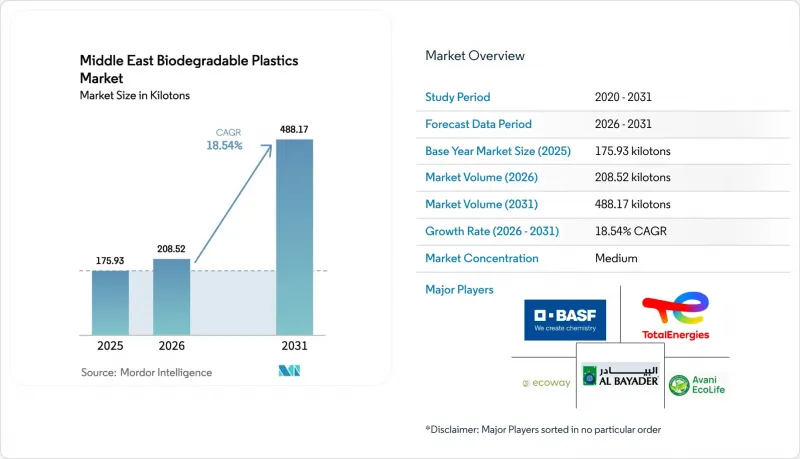
This report is Segmented by Polymer Type (Starch-Based Plastics, Polylactic Acid (PLA), Polyhydroxy Alkanoates (PHA), Polyesters (PBS, and More), and Other Bio-Based Biodegradables), Application (Packaging and Other Applications), and Geography (United Arab Emirates, Saudi Arabia, Qatar, Iran, and Rest of Middle East). The Market Forecasts are Provided in Terms of Volume (Tons).
Middle East Biodegradable Plastics Market Trends and Insights
Government Bans on Single-Use Plastics Drive Substitution Demand
Dubai enforced its single-use plastic ban in June 2024, and Carrefour UAE reported a 70% drop in carrier bag usage during the first quarter of compliance. Saudi Arabia is introducing mirror regulations through the National Center for Waste Management, which aims to achieve 90% landfill diversion by 2040 and allocates capital for expanding composting capacity in the five largest urban clusters. Retail audits and import checkpoints, rather than producer levies, ensure compliance, so cost pressure shifts downstream to converters. Larger FMCG brand owners absorb the resin premium in exchange for label differentiation, but small converters struggle with cash-flow lockups. The policy trajectory hints at future bans on rigid containers and food-service ware once composting throughput ramps.
Corporate Sustainability Targets Reshape Procurement Specifications
Majid Al Futtaim phased out single-use plastics in its Lifestyle division in 2024 and intends to extend this policy across its owned properties by 2025, requiring suppliers to source resins certified to ISO 14855 or EN 13432. Lulu Group is piloting edible film wraps that disintegrate in hot water, a marketing play that doubles as a compliance hedge. TotalEnergies Corbion's Luminy PLA boasts an 85% lower cradle-to-gate carbon footprint compared to petroleum plastics, and its 100% recycled-content grade features a negative footprint, providing procurement officers with a ready-made lifecycle narrative. Retail Green Star leases link tenant ratings to sustainable materials, pushing ecological metrics deep into mall supply chains and signaling that sustainability clauses will soon be standard in GCC commercial property.
Cost Premium Constrains Adoption in Price-Sensitive Segments
Biodegradable resins sell at a 20-50% markup to virgin polyethylene and polypropylene due to high feedstock costs and lower line throughput. FMCG giants absorb the delta to meet ESG targets, but commodity packagers that serve low-margin staples cannot. In the absence of EPR subsidies, the market tends to skew toward premium categories and pilot hospitality programs rather than mass retail. Distributors attempt to mitigate freight costs by transshipping from Asia in break-bulk lots; however, spot rates on the Far East-Gulf lane remain volatile. Local PLA capacity, once operational, will narrow the premium by saving on freight and duties; until then, price remains the primary barrier.
Other drivers and restraints analyzed in the detailed report include:
- Rising Consumer Willingness to Pay for Eco-Labeled Products
- Industrial Composting Infrastructure Determines End-of-Life Viability
- Limited Composting Infrastructure Creates End-of-Life Uncertainty
For complete list of drivers and restraints, kindly check the Table Of Contents.
Segment Analysis
Polyesters secured 38.05% of the Middle East biodegradable plastics market share in 2025 because PBS and PBAT drop seamlessly into existing film lines, and converters appreciate their toughness in extreme Gulf summer logistics. The segment also benefits from ASEAN supply chains that deliver ready-compounded grades with food-contact status. Local poly-butylene succinate synthesis remains limited, but PET resin majors contemplate debottlenecking to run bio-succinate.
PHA is projected to enjoy the fastest growth at a 19.34% CAGR. Its marine biodegradability suits coastal tourism zones under pressure to curb plastic litter. Emirates Biotech has signaled interest in PHA copolymer expansion once its PLA trains are settled, reflecting the converter's appetite for resins that degrade in seawater. Still, fermentation yields lag PLA, keeping PHA price points at a premium. Technology partnerships with enzyme specialists aim to increase yields and make PHA viable for high-volume items, such as straw wraps and snack films, by the late 2020s.
Complete Report Scope:
- By Polymer Type
- Starch-based Plastics
- Polylactic Acid (PLA)
- Polyhydroxy Alkanoates (PHA)
- Polyesters (PBS, PBAT and PCL)
- Other Bio-based Biodegradables
- By Application
- Packaging
- Other Applications
- By Geography
- United Arab Emirates
- Saudi Arabia
- Qatar
- Iran
- Rest of Middle-East
List of Companies Covered in this Report:
- BASF
- Al Bayader International
- Al-Habib Polymers
- Avani Eco
- Avient Corporation
- Cargill Incorporated
- Eastman Chemical Company
- EcoPlast Solutions
- ECOWAY GLOBAL L.L.C.
- Green Packaging Industries
- KiSabz (Maadiran)
- NatureWorks LLC
- Planet Green
- Plastcom Middle East FZC
- TotalEnergies Corbion
Additional Benefits:
- The market estimate (ME) sheet in Excel format
- 3 months of analyst support
TABLE OF CONTENTS
1 Introduction
- 1.1 Study Assumptions and Market Definition
- 1.2 Scope of the Study
2 Research Methodology
3 Executive Summary
4 Market Landscape
- 4.1 Market Overview
- 4.2 Market Drivers
- 4.2.1 Government bans on single-use plastics (UAE, KSA)
- 4.2.2 Corporate sustainability targets from FMCG and retail
- 4.2.3 Rising consumer demand for eco-friendly packaging
- 4.2.4 Industrial composting projects in GCC
- 4.2.5 Saudi Vision 2030 funding bio-refineries
- 4.3 Market Restraints
- 4.3.1 Cost premium over petroleum plastics
- 4.3.2 Limited regional composting / recycling infrastructure
- 4.3.3 Petro-chemical lobby influence on policy
- 4.4 Value Chain Analysis
- 4.5 Porter's Five Forces
- 4.5.1 Bargaining Power of Suppliers
- 4.5.2 Bargaining Power of Buyers
- 4.5.3 Threat of New Entrants
- 4.5.4 Threat of Substitutes
- 4.5.5 Industry Rivalry
5 Market Size and Growth Forecasts (Volume)
- 5.1 By Polymer Type
- 5.1.1 Starch-based Plastics
- 5.1.2 Polylactic Acid (PLA)
- 5.1.3 Polyhydroxy Alkanoates (PHA)
- 5.1.4 Polyesters (PBS, PBAT and PCL)
- 5.1.5 Other Bio-based Biodegradables
- 5.2 By Application
- 5.2.1 Packaging
- 5.2.2 Other Applications
- 5.3 By Geography
- 5.3.1 United Arab Emirates
- 5.3.2 Saudi Arabia
- 5.3.3 Qatar
- 5.3.4 Iran
- 5.3.5 Rest of Middle-East
6 Competitive Landscape
- 6.1 Market Concentration
- 6.2 Strategic Moves
- 6.3 Market Share (%)/Ranking Analysis
- 6.4 Company Profiles (includes Global level Overview, Market level overview, Core Segments, Financials as available, Strategic Information, Market Rank/Share for key companies, Products and Services, and Recent Developments)
- 6.4.1 BASF
- 6.4.2 Al Bayader International
- 6.4.3 Al-Habib Polymers
- 6.4.4 Avani Eco
- 6.4.5 Avient Corporation
- 6.4.6 Cargill Incorporated
- 6.4.7 Eastman Chemical Company
- 6.4.8 EcoPlast Solutions
- 6.4.9 ECOWAY GLOBAL L.L.C.
- 6.4.10 Green Packaging Industries
- 6.4.11 KiSabz (Maadiran)
- 6.4.12 NatureWorks LLC
- 6.4.13 Planet Green
- 6.4.14 Plastcom Middle East FZC
- 6.4.15 TotalEnergies Corbion
7 Market Opportunities and Future Outlook
- 7.1 White-space and Unmet-need Assessment

