PUBLISHER: Mordor Intelligence | PRODUCT CODE: 2117194

PUBLISHER: Mordor Intelligence | PRODUCT CODE: 2117194
India Cybersecurity - Market Share Analysis, Industry Trends & Statistics, Growth Forecasts (2026 - 2031)
According to Mordor Intelligence, the India cybersecurity market size was valued at USD 5.56 billion in 2025 and estimated to grow from USD 6.56 billion in 2026 to reach USD 15.06 billion by 2031, at a CAGR of 18.07% during the forecast period (2026-2031).
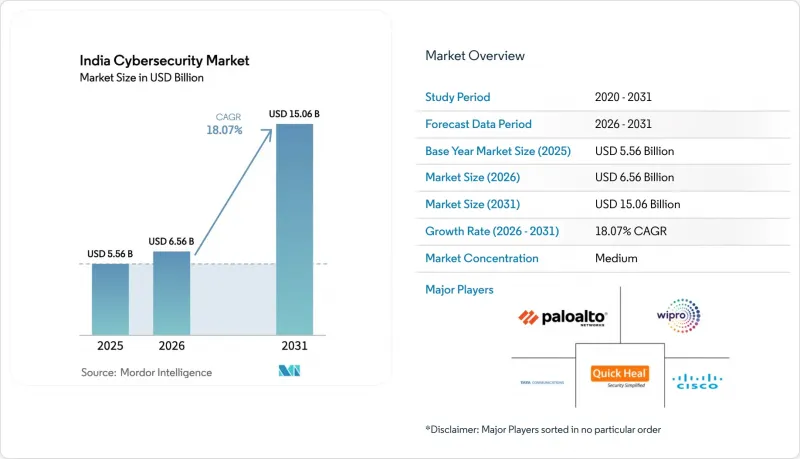
This report is Segmented by Offering (Solutions [Application Security, Cloud Security, and More], Services [Professional Services, and More]), Deployment Mode (Cloud, On-Premise), End-User Industry (BFSI, Healthcare, IT and Telecom, Industrial and Defense, Retail and E-Commerce, and More), End-User Enterprise Size (Large Enterprises, Smes). The Market Forecasts are Provided in Terms of Value (USD).
India Cybersecurity Market Trends and Insights
Digital India and Enterprise Modernization Mandating Robust Cybersecurity Controls
The Digital India program has digitized citizen services at record speed, expanding the national attack surface and making cybersecurity an integral budget line for ministries and state agencies. UPI processes more than 15 billion transactions each month, a scale that forces banks to integrate adaptive authentication and real-time fraud-detection engines . CFO surveys reveal that 60% of Indian corporates will raise security allocations in 2025, notably higher than the 47% global average. Enterprises now embed zero-trust checkpoints in every modernization sprint, resulting in shorter procurement cycles for identity, cloud-workload, and data-loss-prevention controls.
Surge in UPI and Real-Time Payments Driving Identity/Fraud Protection Demand
The Unified Payments Interface has re-defined retail finance, but its convenience also attracts credential-stuffing and man-in-the-browser attacks. Financial institutions logged more than 2,500 security incidents in the second half of 2024 alone. Banks respond by enforcing multi-factor authentication and behavioral biometrics, which in turn stimulates growth for identity-and-access-management (IAM) suites. The sector's move toward zero-trust architectures is supported by regulators that prioritize continuous monitoring over periodic audits, broadening the addressable market for AI-driven fraud-analytics vendors.
Shortage of Certified SOC Analysts
Enterprises struggle to fill tier-1 and tier-2 analyst seats, driving uptake of automation and outsourced monitoring. CERT-In and Fortinet have partnered with universities to embed security curricula that will seed the talent pipeline over the next three years. In the interim, managed detection and response contracts are growing at double-digit rates because service providers can pool scarce expertise across multiple clients.
Other drivers and restraints analyzed in the detailed report include:
- Government DPDP Act and CERT-In Compliance Deadlines Accelerating Security Spend
- 5G and IoT Roll-outs Exposing New Attack Surface in Telecom and Smart Manufacturing
- Price Sensitivity among MSMEs Limiting Adoption of Enterprise-Grade Solutions
For complete list of drivers and restraints, kindly check the Table Of Contents.
Segment Analysis
Solutions remain the revenue anchor, holding 64.58 % of the India cybersecurity market share in 2025. Network security, cloud-workload protection, and identity-and-access management packages are refreshed first whenever boards approve catch-up spending. Vendors add AI analytics and consolidated dashboards to shrink alert fatigue, keeping renewal rates high.
The services arm of the India cybersecurity market is forecast to post an 18.62 % CAGR to 2031 as talent constraints force organizations to outsource detection and response. Managed security service providers that guarantee six-hour incident reporting-mirroring CERT-In rules-win multi-year contracts. Advisory practices that blend compliance and threat-hunting expertise see rising attach rates, confirming that process depth, not head-count scale, now drives buying decisions.
On-premise controls still claim 54.35 % of 2025 spending, largely inside banking, telecom, and critical-infrastructure estates where data-sovereignty audits remain strict. These buyers refresh appliances only if the gear exposes open APIs that feed cloud SIEMs, proving that hybrid design is the new norm.
Conversely, cloud deployments in the India cybersecurity market race ahead at a 21.92 % CAGR, propelled by the fact that 99 % of domestic firms run hybrid clouds. CISOs prize identity brokering, container runtime defense, and posture-management modules that auto-map to DPDPA controls. Cloud-native vendors thus lead short-lists whenever DevOps speed trumps legacy lock-in.
Complete Report Scope:
- By Offering
- Solutions
- Application Security
- Cloud Security
- Data Security
- Identity and Access Management
- Infrastructure Protection
- Integrated Risk Management
- Network Security
- End-point Security
- Services
- Professional Services
- Managed Services
- Solutions
- By Deployment Mode
- Cloud
- On-Premise
- By End-user Industry
- BFSI
- Healthcare
- IT and Telecom
- Industrial and Defense
- Retail and E-commerce
- Energy and Utilities
- Manufacturing
- Others
- By End-user Enterprise Size
- Large Enterprises
- Small and Medium Enterprises (SMEs)
List of Companies Covered in this Report:
- Tata Communications
- Wipro Ltd.
- HCLTech
- Infosys Ltd.
- Tech Mahindra Ltd.
- Cisco Systems, Inc.
- Check Point Software Technologies India
- Sophos Technologies Pvt. Ltd.
- Fortinet Technologies India
- McAfee Software (India) Pvt. Ltd.
- Palo Alto Networks, Inc.
- Quick Heal Technologies Ltd.
- Zscaler India Pvt. Ltd.
- Juniper Networks India Pvt. Ltd.
- Trend Micro India Pvt. Ltd.
- IBM India Pvt. Ltd.
- CrowdStrike India Pvt. Ltd.
- Kaspersky Labs India
- Indusface Pvt. Ltd.
- Safe Security (Lucideus)
- eSec Forte Technologies
- SecurityHQ India
- Cyberops Infosec LLP
- Sequretek
- Sectrio (Subex)
- Innefu Labs
Additional Benefits:
- The market estimate (ME) sheet in Excel format
- 3 months of analyst support
TABLE OF CONTENTS
1 INTRODUCTION
- 1.1 Market Definition and Study Assumptions
- 1.2 Scope of the Study
2 RESEARCH METHODOLOGY
3 EXECUTIVE SUMMARY
4 MARKET LANDSCAPE
- 4.1 Market Overview
- 4.2 Market Drivers
- 4.2.1 Digital India and Enterprise Modernization Mandating Robust Cybersecurity Controls
- 4.2.2 Surge in UPI and Real-Time Payments Driving Identity/Fraud Protection Demand
- 4.2.3 Government DPDP Act and CERT-In Compliance Deadlines Accelerating Security Spend
- 4.2.4 5G and IoT Roll-outs Exposing New Attack Surface in Telecom and Smart Manufacturing
- 4.2.5 Rise of Ransomware-as-a-Service Targeting Public Sector and Critical Infrastructure
- 4.2.6 Venture Capital and Government Grants Fueling Indian Cybersecurity Start-up Ecosystem
- 4.3 Market Restraints
- 4.3.1 Shortage of Certified SOC Analysts
- 4.3.2 Price Sensitivity among MSMEs Limiting Adoption of Enterprise-Grade Solutions
- 4.3.3 Fragmented Regulation on Cross-border Data Flows Creating Procurement Delays
- 4.3.4 Legacy infrastructure complexity
- 4.4 Value Chain Analysis
- 4.5 Evaluation of Critical Regulatory Framework
- 4.6 Impact Assessment of Key Stakeholders
- 4.7 Technological Outlook
- 4.8 Porter's Five Forces Analysis
- 4.8.1 Bargaining Power of Suppliers
- 4.8.2 Bargaining Power of Consumers
- 4.8.3 Threat of New Entrants
- 4.8.4 Threat of Substitutes
- 4.8.5 Intensity of Competitive Rivalry
- 4.9 Impact of Macro-economic Factors
5 MARKET SIZE AND GROWTH FORECASTS (VALUE)
- 5.1 By Offering
- 5.1.1 Solutions
- 5.1.1.1 Application Security
- 5.1.1.2 Cloud Security
- 5.1.1.3 Data Security
- 5.1.1.4 Identity and Access Management
- 5.1.1.5 Infrastructure Protection
- 5.1.1.6 Integrated Risk Management
- 5.1.1.7 Network Security
- 5.1.1.8 End-point Security
- 5.1.2 Services
- 5.1.2.1 Professional Services
- 5.1.2.2 Managed Services
- 5.1.1 Solutions
- 5.2 By Deployment Mode
- 5.2.1 Cloud
- 5.2.2 On-Premise
- 5.3 By End-user Industry
- 5.3.1 BFSI
- 5.3.2 Healthcare
- 5.3.3 IT and Telecom
- 5.3.4 Industrial and Defense
- 5.3.5 Retail and E-commerce
- 5.3.6 Energy and Utilities
- 5.3.7 Manufacturing
- 5.3.8 Others
- 5.4 By End-user Enterprise Size
- 5.4.1 Large Enterprises
- 5.4.2 Small and Medium Enterprises (SMEs)
6 COMPETITIVE LANDSCAPE
- 6.1 Market Concentration
- 6.2 Strategic Moves
- 6.3 Market Share Analysis
- 6.4 Company Profiles (includes Global level Overview, Market level overview, Core Segments, Financials as available, Strategic Information, Market Rank/Share for key companies, Products and Services, and Recent Developments)
- 6.4.1 Tata Communications
- 6.4.2 Wipro Ltd.
- 6.4.3 HCLTech
- 6.4.4 Infosys Ltd.
- 6.4.5 Tech Mahindra Ltd.
- 6.4.6 Cisco Systems, Inc.
- 6.4.7 Check Point Software Technologies India
- 6.4.8 Sophos Technologies Pvt. Ltd.
- 6.4.9 Fortinet Technologies India
- 6.4.10 McAfee Software (India) Pvt. Ltd.
- 6.4.11 Palo Alto Networks, Inc.
- 6.4.12 Quick Heal Technologies Ltd.
- 6.4.13 Zscaler India Pvt. Ltd.
- 6.4.14 Juniper Networks India Pvt. Ltd.
- 6.4.15 Trend Micro India Pvt. Ltd.
- 6.4.16 IBM India Pvt. Ltd.
- 6.4.17 CrowdStrike India Pvt. Ltd.
- 6.4.18 Kaspersky Labs India
- 6.4.19 Indusface Pvt. Ltd.
- 6.4.20 Safe Security (Lucideus)
- 6.4.21 eSec Forte Technologies
- 6.4.22 SecurityHQ India
- 6.4.23 Cyberops Infosec LLP
- 6.4.24 Sequretek
- 6.4.25 Sectrio (Subex)
- 6.4.26 Innefu Labs
7 MARKET OPPORTUNITIES AND FUTURE TRENDS
- 7.1 White-space and Unmet-need Assessment

