PUBLISHER: Mordor Intelligence | PRODUCT CODE: 2117196

PUBLISHER: Mordor Intelligence | PRODUCT CODE: 2117196
Recruitment Software - Market Share Analysis, Industry Trends & Statistics, Growth Forecasts (2026 - 2031)
According to Mordor Intelligence, the recruitment software market size is projected to expand from USD 3.61 billion in 2025 and USD 3.77 billion in 2026 to USD 5.5 billion by 2031, registering a CAGR of 7.85% between 2026 to 2031.
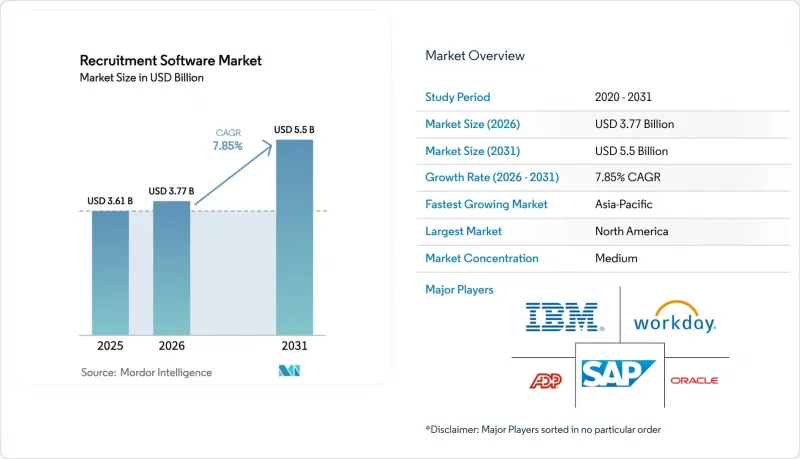
This report is Segmented by Deployment (On-Premises, and Cloud), Organization Size (Small and Medium Enterprises, and Large Enterprises), Component (Solutions, and Services), Functionality (Applicant Tracking System, Recruitment CRM/Marketing, and More), End-User Vertical (IT and Telecom, BFSI, Retail and E-Commerce, and More), and by Geography. The Market Forecasts are Provided in Terms of Value (USD).
Global Recruitment Software Market Trends and Insights
Cloud-First Adoption Across HR Tech Stacks
Enterprises are decommissioning on-premises Applicant Tracking Systems in favor of unified SaaS suites that cut ownership costs and remove data silos. Oracle's 2025 release of autonomous recruiting agents inside Fusion Cloud HCM shows how multi-tenant platforms now automate screening, interview scheduling and offer letters from one interface. Vendors pool anonymized hiring data to train matching algorithms, boosting fill-rate accuracy. Although broadband gaps slow adoption in parts of Latin America and Africa, sovereign-cloud offers and edge compute are narrowing residency barriers. The trend raises integration demand from the recruitment software market vendors, as firms connect cloud recruiting to payroll and performance modules for a single worker record.
Explosion of AI and ML Use-Cases
AI has shifted from pilot scope to enterprise staple. LinkedIn's live listings feed 134 million vacancies into models that optimize ad spend and predict candidate success. Generative copilots from iCIMS and Workday draft outreach, create interview questions and summarize feedback in seconds, trimming cycle time by up to half. Regulators, however, now treat automated hiring as high risk. The EU AI Act obliges explainability dashboards and conformity assessments, steering buyers to vendors with built-in bias detection. Platforms that deliver transparent scoring alongside predictive insights gain a compliance edge in the recruitment software market.
Data-Privacy and Algorithmic-Bias Compliance Costs
The EU AI Act, GDPR Article 22 and New York City Local Law 144 demand bias audits, risk logs and human review, adding USD 0.5-2 million per enterprise rollout. Penalties climb to 7% of global turnover for non-compliance, a threat that redirects budgets from innovation to legal overhead. Large vendors can amortize these costs, while mid-tier suppliers face margin pressure or forced consolidation. Clients therefore gravitate toward providers that certify models and publish continual audit summaries.
Other drivers and restraints analyzed in the detailed report include:
- Surge in Remote and Hybrid Hiring Models Post COVID-19
- Emergence of Autonomous Agentic ATS with Generative-AI Copilots
- Integration Complexity with Ageing HRIS/ERP Landscapes
For complete list of drivers and restraints, kindly check the Table Of Contents.
Segment Analysis
Cloud deployments accounted for 68.73% of 2025 revenue, and that slice is growing faster than the overall recruitment software market at a 9.21% CAGR to 2031. This leadership stems from instant scalability and continuous feature drops, including GPU-intensive large language model inference that on-premises servers cannot afford. Oracle's October 2025 cloud agents illustrate the edge, drawing lessons from anonymized cross-client data to recommend shortlists automatically. On-premises systems remain in sectors such as defense and banking that impose data-sovereignty mandates, but hybrid architectures now let sourcing and engagement modules reside in cloud while candidate records stay behind the firewall. As sovereign-cloud programs mature, even regulated buyers are expected to migrate analytics workloads, narrowing the deployment divide.
The recruitment software market size for cloud deployments is forecast to add USD 1.3 billion by 2031, while on-premises revenue stays nearly flat. Vendors embed cost calculators that prove total ownership savings within 18 months, convincing finance teams to shift budgets from capital expenditure to operating expenditure. This transition unlocks recurring revenue streams and positions providers to cross-sell analytics and learning modules once the core ATS is live. Buyers that embrace full-cloud stacks also gain faster regulatory updates, an advantage as bias-audit mandates evolve yearly.
Large enterprises still bring 60.95% of 2025 revenue in the recruitment software market, thanks to global head-counts that justify premium contracts. Yet, SME demand represents the fastest-growing cohort; the segment is forecast to post a 10.23% CAGR by 2031, as modular, seat-based pricing lowers the entry barrier. Freemium packages from BambooHR and Recruitee start at around USD 50 per user per month, allowing 10-person startups to access AI ranking and automated outreach typically reserved for Fortune 500 HR teams.
Awareness remains low in emerging economies where spreadsheets still track applicants, so vendors localize mobile-first interfaces and partner with regional payroll companies to bundle recruitment features. The recruitment software market share among SMEs is expected to tick up from 39% in 2025 to 45% by 2031. To capture that lift, suppliers streamline onboarding with click-and-connect job-board integrations, minimizing IT dependence for resource-constrained businesses.
Complete Report Scope:
- By Deployment
- On-Premises
- Cloud
- By Organization Size
- Small and Medium Enterprises (SMEs)
- Large Enterprises
- By Component
- Solutions
- Services
- By Functionality
- Applicant Tracking System (ATS)
- Recruitment CRM/Marketing
- Onboarding Software
- Talent Analytics and AI Tools
- Background-check/Assessment Modules
- By End-User Vertical
- IT and Telecom
- BFSI
- Retail and E-commerce
- Manufacturing
- Healthcare and Life Sciences
- Other End-User Verticals
- By Geography
- North America
- United States
- Canada
- Mexico
- South America
- Brazil
- Argentina
- Rest of South America
- Europe
- Germany
- United Kingdom
- France
- Italy
- Spain
- Rest of Europe
- Asia-Pacific
- China
- Japan
- India
- South Korea
- ASEAN
- Rest of Asia-Pacific
- Middle East
- Saudi Arabia
- United Arab Emirates
- Rest of Middle East
- Africa
- South Africa
- Nigeria
- Rest of Africa
- North America
Geography Analysis
North America generated 34.62% of 2025 revenue, reflecting deep HR-tech penetration, high IT budgets and strict equal-opportunity enforcement. Major incumbents like Workday, Oracle and SAP maintain headquarters or significant operations in the region, shortening feedback loops for product iterations. Consolidation is high, as Paychex acquired Paycor in January 2025 to bolster distribution among mid-size employers. Growth, however, decelerates relative to emerging regions because most large enterprises already run modern ATS suites.
Asia-Pacific is the fastest-growing region at a 10.66% CAGR through 2031. India's IT-services giants hire hundreds of thousands of graduates each year, demanding platforms that screen millions of resumes. China's state-owned enterprises favor domestic vendors for data sovereignty, but foreign multinationals standardize on global suites with localized Mandarin interfaces. Japan and South Korea retain referral-centric norms, yet aging demographics compel digital hiring to widen talent pools. Southeast Asian markets, notably Indonesia and Vietnam, represent white space; smartphone penetration exceeds desktop usage, so lightweight, app-centric recruiting tools gain traction.
Europe sits between these dynamics. GDPR and the EU AI Act raise compliance complexity, but free movement within the European Union expands candidate pools, prompting employers to implement bias-monitored sourcing. Germany's mid-sized manufacturers face skilled-trade shortages, and the United Kingdom's post-Brexit labor squeeze fuels adoption. The Middle East and Africa remain nascent; Saudi Arabia's Vision 2030 infrastructure projects elevate formal hiring systems, while South Africa and Nigeria show early mobile-first uptake. Latin America's cloud demand clusters in Brazil and Argentina but is tempered by currency volatility that shrinks import budgets for subscription software.
- SAP SE
- Workday, Inc.
- Oracle Corporation
- Automatic Data Processing, Inc.
- International Business Machines Corporation
- iCIMS, Inc.
- UKG Inc.
- Ceridian HCM Holding Inc.
- Cornerstone OnDemand, Inc.
- Greenhouse Software, Inc.
- SmartRecruiters, Inc.
- Jobvite, Inc.
- BambooHR LLC
- Bullhorn, Inc.
- Lever, Inc.
- Zoho Corporation Pvt. Ltd.
- ClearCompany Talent Management, LLC
- Recruitee B.V.
- PeopleAdmin, Inc.
- Trakstar, LLC
- Eightfold AI, Inc.
- Phenom People, Inc.
- Avature Limited
- Paycor, Inc.
Additional Benefits:
- The market estimate (ME) sheet in Excel format
- 3 months of analyst support
TABLE OF CONTENTS
1 INTRODUCTION
- 1.1 Study Assumptions and Market Definition
- 1.2 Scope of the Study
2 RESEARCH METHODOLOGY
3 EXECUTIVE SUMMARY
4 MARKET LANDSCAPE
- 4.1 Market Overview
- 4.2 Market Drivers
- 4.2.1 Cloud-first Adoption Across HR Tech Stacks
- 4.2.2 Explosion of AI/ML Use-cases in Talent Acquisition Workflows
- 4.2.3 Surge in Remote and Hybrid Hiring Models Post COVID-19
- 4.2.4 Growth of Social-media Recruiting and Employer-branding Platforms
- 4.2.5 Emergence of Autonomous "Agentic ATS" with Generative-AI Copilots
- 4.2.6 VC Funding Shift Toward Skills-graph and Bias-mitigation Analytics
- 4.3 Market Restraints
- 4.3.1 Data-privacy and Algorithmic-bias Compliance Costs
- 4.3.2 Integration Complexity with Ageing HRIS/ERP Landscapes
- 4.3.3 SME Price-sensitivity and Low ATS Awareness in Emerging Markets
- 4.3.4 Growing Buyer Fatigue from Overlapping Point Solutions
- 4.4 Industry Value Chain Analysis
- 4.5 Regulatory Landscape
- 4.6 Technological Outlook
- 4.7 Porter's Five Forces Analysis
- 4.7.1 Bargaining Power of Suppliers
- 4.7.2 Bargaining Power of Buyers
- 4.7.3 Threat of New Entrants
- 4.7.4 Threat of Substitutes
- 4.7.5 Intensity of Competitive Rivalry
5 MARKET SIZE AND GROWTH FORECASTS (VALUE)
- 5.1 By Deployment
- 5.1.1 On-Premises
- 5.1.2 Cloud
- 5.2 By Organization Size
- 5.2.1 Small and Medium Enterprises (SMEs)
- 5.2.2 Large Enterprises
- 5.3 By Component
- 5.3.1 Solutions
- 5.3.2 Services
- 5.4 By Functionality
- 5.4.1 Applicant Tracking System (ATS)
- 5.4.2 Recruitment CRM/Marketing
- 5.4.3 Onboarding Software
- 5.4.4 Talent Analytics and AI Tools
- 5.4.5 Background-check/Assessment Modules
- 5.5 By End-User Vertical
- 5.5.1 IT and Telecom
- 5.5.2 BFSI
- 5.5.3 Retail and E-commerce
- 5.5.4 Manufacturing
- 5.5.5 Healthcare and Life Sciences
- 5.5.6 Other End-User Verticals
- 5.6 By Geography
- 5.6.1 North America
- 5.6.1.1 United States
- 5.6.1.2 Canada
- 5.6.1.3 Mexico
- 5.6.2 South America
- 5.6.2.1 Brazil
- 5.6.2.2 Argentina
- 5.6.2.3 Rest of South America
- 5.6.3 Europe
- 5.6.3.1 Germany
- 5.6.3.2 United Kingdom
- 5.6.3.3 France
- 5.6.3.4 Italy
- 5.6.3.5 Spain
- 5.6.3.6 Rest of Europe
- 5.6.4 Asia-Pacific
- 5.6.4.1 China
- 5.6.4.2 Japan
- 5.6.4.3 India
- 5.6.4.4 South Korea
- 5.6.4.5 ASEAN
- 5.6.4.6 Rest of Asia-Pacific
- 5.6.5 Middle East
- 5.6.5.1 Saudi Arabia
- 5.6.5.2 United Arab Emirates
- 5.6.5.3 Rest of Middle East
- 5.6.6 Africa
- 5.6.6.1 South Africa
- 5.6.6.2 Nigeria
- 5.6.6.3 Rest of Africa
- 5.6.1 North America
6 COMPETITIVE LANDSCAPE
- 6.1 Market Concentration
- 6.2 Strategic Moves
- 6.3 Market Share Analysis
- 6.4 Company Profiles (includes Global level Overview, Market Level Overview, Core Segments, Financials as Available, Strategic Information, Market Rank/Share for Key Companies, Products and Services, and Recent Developments)
- 6.4.1 SAP SE
- 6.4.2 Workday, Inc.
- 6.4.3 Oracle Corporation
- 6.4.4 Automatic Data Processing, Inc.
- 6.4.5 International Business Machines Corporation
- 6.4.6 iCIMS, Inc.
- 6.4.7 UKG Inc.
- 6.4.8 Ceridian HCM Holding Inc.
- 6.4.9 Cornerstone OnDemand, Inc.
- 6.4.10 Greenhouse Software, Inc.
- 6.4.11 SmartRecruiters, Inc.
- 6.4.12 Jobvite, Inc.
- 6.4.13 BambooHR LLC
- 6.4.14 Bullhorn, Inc.
- 6.4.15 Lever, Inc.
- 6.4.16 Zoho Corporation Pvt. Ltd.
- 6.4.17 ClearCompany Talent Management, LLC
- 6.4.18 Recruitee B.V.
- 6.4.19 PeopleAdmin, Inc.
- 6.4.20 Trakstar, LLC
- 6.4.21 Eightfold AI, Inc.
- 6.4.22 Phenom People, Inc.
- 6.4.23 Avature Limited
- 6.4.24 Paycor, Inc.
7 MARKET OPPORTUNITIES AND FUTURE OUTLOOK
- 7.1 White-space and Unmet-Need Assessment

