PUBLISHER: Mordor Intelligence | PRODUCT CODE: 2117199

PUBLISHER: Mordor Intelligence | PRODUCT CODE: 2117199
Europe Food Packaging - Market Share Analysis, Industry Trends & Statistics, Growth Forecasts (2026 - 2031)
According to Mordor Intelligence, the Europe food packaging market size was valued at USD 75.24 billion in 2025 and estimated to grow from USD 78.58 billion in 2026 to reach USD 97.64 billion by 2031, at a CAGR of 4.44% during the forecast period (2026-2031).
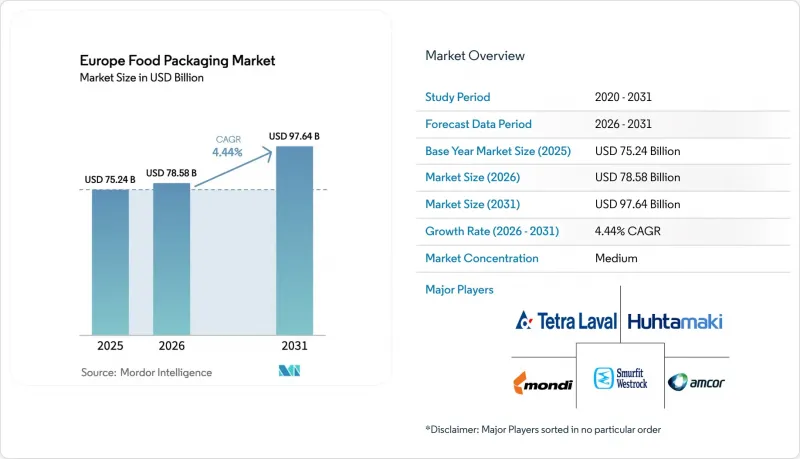
This report is Segmented by Material Type (Plastic, Paper and Paperboard, Metal, Glass, Bioplastics), Product Type (Bottles and Containers, Cartons and Pouches, Cans, and More), End-User (Fruits and Vegetables, Meat, Poultry and Seafood, and More), Packaging Technology (Modified-Atmosphere Packaging, Aseptic Packaging, and More), Country. The Market Forecasts are Provided in Terms of Value (USD).
Europe Food Packaging Market Trends and Insights
Rapid growth of food-service and take-away formats
Take-away meals jumped 28% year over year in Germany during 2024, powered by platform aggregators and workplace mobility shifts. Operators seek multi-compartment and leakproof packs that remain compliant with the Single-Use Plastics (SUP) Directive's reuse stipulations. Reusable container schemes, despite incurring operating costs 15-20% higher than disposables, are rolling out in quick-service chains to mitigate levy exposure. Packaging suppliers are responding with dishwasher-durable PP and molded-fiber solutions fitted with scannable tracking codes for reverse logistics. For small independents, hybrid paper-plastic packs that achieve recyclability without dishwashing present a pragmatic bridge solution. Demand concentration remains strongest in the top-25 EU cities, yet smaller Central European capitals are posting double-digit volume growth, indicating wider market penetration ahead.
E-commerce grocery boom accelerating secondary packaging demand
Online grocery penetration hit 8.3% of European food retail in 2024, reshaping packaging specifications for ship-to-home fulfillment. Temperature swings during last-mile delivery require insulation liners and moisture barriers that traditional shelf-ready packs never encountered. Flexible films with integrated air pouches now dominate fresh produce shipments because they offer protective cushioning at one-tenth the grammage of rigid plastics, trimming freight weight and carbon score alike. Grocers simultaneously wrestle with the PPWR's source-reduction targets, prompting pack-design algorithms that cut void space by 12-15% per parcel. Reverse logistics for ice packs and insulation is emerging as a service niche for logistics firms in Germany and the Netherlands. As cold-chain parcel density rises, packaging converters positioned with rapid-response prototyping and mixed-material competence are winning multi-year supply contracts.
Volatile polymer and aluminum feedstock prices
Virgin LDPE and PP contract prices swung 15-20% quarter-to-quarter through 2024, tied to energy cost spikes and Middle-East cracker turnarounds, eroding converters' margin visibility. Aluminum ingot rose 18% over H1 2024 before retreating in Q3, compelling can-sheet rollers to renegotiate annual supply agreements. Mid-tier converters with limited hedging facilities are adopting dual-sourcing strategies and raising PCR content to buffer fluctuations. Nonetheless, recycled resin trades at a 10-15% premium to virgin in high-purity grades, limiting immediate savings. Film extruders are experimenting with mass-balance PP blends that permit incremental PCR incorporation without sacrificing seal integrity, aiming to protect brand owners from future cost shocks.
Other drivers and restraints analyzed in the detailed report include:
- EU food-safety rules boosting high-barrier solutions
- Sustainability push toward recyclable and paper-based formats
- EU Single-Use Plastics Directive compliance costs
For complete list of drivers and restraints, kindly check the Table Of Contents.
Segment Analysis
Plastic retained a 37.55% stake in Europe food packaging market share in 2025, supported by entrenched extrusion assets and continuously improving PCR streams. Bioplastics, while only a mid-single-digit slice of Europe food packaging market size, will post the highest 7.24% CAGR thanks to regulatory credits and retailer carbon pledges. The spread of closed-loop recycling hubs has stabilized rPET and rHDPE supply, enabling converters to hit 30% PCR thresholds without mechanical-property penalties. In parallel, fiber-based packs upgraded with water-borne dispersion coatings are cannibalizing thin-wall PP yogurt cups, reflecting advances that narrow the moisture barrier gap.
Growth prospects for bioplastics hinge on overcoming agricultural supply shocks and certification fragmentation. Southern Europe drought episodes curbed PLA resin output by low single digits in 2024, awakening interest in non-crop-based PHA and bacterial-cellulose films. Producers are lobbying for a harmonized "compostable at home" mark to reassure consumers and unlock municipal collection scale. Should EU Eco-design rules grant higher EPR rebates to compostables, the delta between bio- and petro-based solutions could compress, accelerating substitution.
Bottles and containers commanded 30.88% of 2025 revenue, anchored by beverage and dairy stalwarts. Films and wraps, however, will outpace all formats at 6.52% CAGR as they underpin the protective secondary layer demanded by online grocery fulfilment. Retailers favor multi-layer PE-PA structures that pair puncture resistance with peel-and-reseal convenience, elevating customer unboxing satisfaction scores. Trays and lids are evolving into mono-PET platforms to harvest recycle-ready credentials, while caps and closures integrate tethered designs to meet SUP rules and curb litter.
Advanced films adopting antimicrobial or antioxidant additives are migrating from premium meats into mainstream produce, extending shelf life by up to 5 days and shrinking shrinkage rates. Lightweighted shrink films allow pallet stabilization with 15% less material, contributing to PPWR reduction mandates. As corrugated e-commerce boxes slim down, wrapped primary packs shoulder greater cushioning duties, reinforcing the indispensability of flexible materials.
Complete Report Scope:
- By Material Type
- Plastic
- Paper and Paperboard
- Metal
- Glass
- Bioplastics
- By Product Type
- Bottles and Containers
- Cartons and Pouches
- Cans
- Films and Wraps
- Trays, Caps and Closures
- By End-user
- Fruits and Vegetables
- Meat, Poultry and Seafood
- Dairy Products
- Bakery and Confectionery
- Ready Meals and Convenience Food
- By Packaging Technology
- Modified-Atmosphere Packaging (MAP)
- Aseptic Packaging
- Vacuum Skin Packaging
- Active and Intelligent Packaging
- Edible and Biodegradable Films
- By Country
- United Kingdom
- Germany
- France
- Italy
- Spain
- Rest of Europe
List of Companies Covered in this Report:
- Amcor plc
- Mondi plc
- Smurfit WestRock
- Tetra Laval International S.A.
- Huhtamaki Oyj
- Sealed Air Corporation
- Constantia Flexibles Group GmbH
- Coveris Holdings S.A.
- Greiner Packaging International GmbH
- ProAmpac LLC
- Oerlemans Packaging Group B.V.
- ALPLA Werke Alwin Lehner GmbH and Co KG
- Coexpan S.A.
- KM Packaging Services Ltd.
- Ardagh Group S.A.
- O-I Glass Inc.
- Can-Pack S.A.
- Stora Enso Oyj
- Metsa Board Corporation
Additional Benefits:
- The market estimate (ME) sheet in Excel format
- 3 months of analyst support
TABLE OF CONTENTS
1 INTRODUCTION
- 1.1 Study Assumptions and Market Definition
- 1.2 Scope of the Study
2 RESEARCH METHODOLOGY
3 EXECUTIVE SUMMARY
4 MARKET LANDSCAPE
- 4.1 Market Overview
- 4.2 Market Drivers
- 4.2.1 Rapid growth of food-service and take-away formats
- 4.2.2 E-commerce grocery boom accelerating secondary packaging demand
- 4.2.3 EU food-safety rules boosting high-barrier solutions
- 4.2.4 Sustainability push toward recyclable and paper-based formats
- 4.2.5 Cold-chain expansion in CEE heightening demand for temperature-resistant packs
- 4.2.6 Demographic shift toward smaller households driving single-portion packs
- 4.3 Market Restraints
- 4.3.1 Volatile polymer and aluminium feedstock prices
- 4.3.2 EU Single-Use Plastics (SUP) Directive compliance costs
- 4.3.3 Skilled-labour shortages in packaging-machinery operations
- 4.3.4 Climate-linked uncertainty in bioplastic feedstock supply
- 4.4 Industry Value Chain Analysis
- 4.5 Regulatory Landscape
- 4.6 Technological Outlook
- 4.7 Porter's Five Forces
- 4.7.1 Bargaining Power of Suppliers
- 4.7.2 Bargaining Power of Buyers
- 4.7.3 Threat of New Entrants
- 4.7.4 Threat of Substitutes
- 4.7.5 Intensity of Competitive Rivalry
- 4.8 Impact of Macroeconomic Factors on the Market
5 MARKET SIZE AND GROWTH FORECASTS (VALUE)
- 5.1 By Material Type
- 5.1.1 Plastic
- 5.1.2 Paper and Paperboard
- 5.1.3 Metal
- 5.1.4 Glass
- 5.1.5 Bioplastics
- 5.2 By Product Type
- 5.2.1 Bottles and Containers
- 5.2.2 Cartons and Pouches
- 5.2.3 Cans
- 5.2.4 Films and Wraps
- 5.2.5 Trays, Caps and Closures
- 5.3 By End-user
- 5.3.1 Fruits and Vegetables
- 5.3.2 Meat, Poultry and Seafood
- 5.3.3 Dairy Products
- 5.3.4 Bakery and Confectionery
- 5.3.5 Ready Meals and Convenience Food
- 5.4 By Packaging Technology
- 5.4.1 Modified-Atmosphere Packaging (MAP)
- 5.4.2 Aseptic Packaging
- 5.4.3 Vacuum Skin Packaging
- 5.4.4 Active and Intelligent Packaging
- 5.4.5 Edible and Biodegradable Films
- 5.5 By Country
- 5.5.1 United Kingdom
- 5.5.2 Germany
- 5.5.3 France
- 5.5.4 Italy
- 5.5.5 Spain
- 5.5.6 Rest of Europe
6 COMPETITIVE LANDSCAPE
- 6.1 Market Concentration
- 6.2 Strategic Moves
- 6.3 Market Share Analysis
- 6.4 Company Profiles {(includes Global-level Overview, Market-level Overview, Core Segments, Financials as available, Strategic Information, Market Rank/Share for key companies, Products and Services, and Recent Developments)}
- 6.4.1 Amcor plc
- 6.4.2 Mondi plc
- 6.4.3 Smurfit WestRock
- 6.4.4 Tetra Laval International S.A.
- 6.4.5 Huhtamaki Oyj
- 6.4.6 Sealed Air Corporation
- 6.4.7 Constantia Flexibles Group GmbH
- 6.4.8 Coveris Holdings S.A.
- 6.4.9 Greiner Packaging International GmbH
- 6.4.10 ProAmpac LLC
- 6.4.11 Oerlemans Packaging Group B.V.
- 6.4.12 ALPLA Werke Alwin Lehner GmbH and Co KG
- 6.4.13 Coexpan S.A.
- 6.4.14 KM Packaging Services Ltd.
- 6.4.15 Ardagh Group S.A.
- 6.4.16 O-I Glass Inc.
- 6.4.17 Can-Pack S.A.
- 6.4.18 Stora Enso Oyj
- 6.4.19 Metsa Board Corporation
7 MARKET OPPORTUNITIES AND FUTURE OUTLOOK
- 7.1 White-space and Unmet-Need Assessment

