PUBLISHER: Mordor Intelligence | PRODUCT CODE: 2117207

PUBLISHER: Mordor Intelligence | PRODUCT CODE: 2117207
Europe Ready-Mix Concrete - Market Share Analysis, Industry Trends & Statistics, Growth Forecasts (2026 - 2031)
According to Mordor Intelligence, the Europe ready-Mix concrete market size is expected to grow from USD 64.27 billion in 2025 to USD 66.33 billion in 2026 and is forecast to reach USD 77.68 billion by 2031 at 3.21% CAGR over 2026-2031.
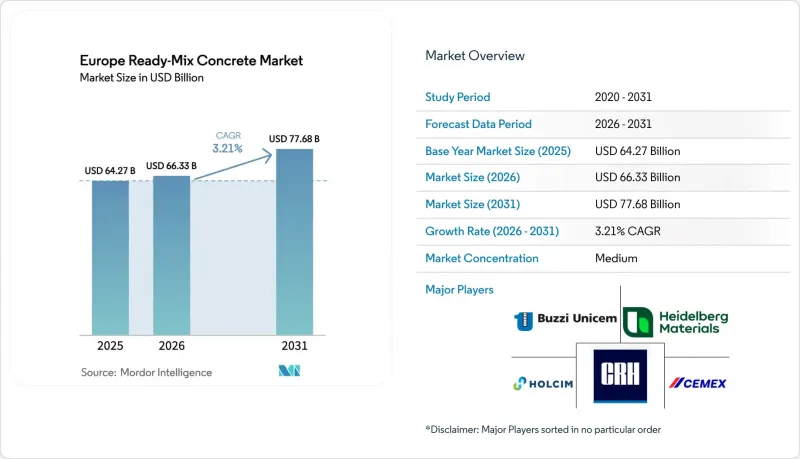
This report is Segmented by End-User Industry (Residential, Commercial, Industrial and Institutional, Infrastructure), Product Type (Transit/Truck-Mix, Central/Batch-Mix, Shrink-Mix), and Geography (Germany, United Kingdom, France, Italy, Spain, Poland, Netherlands, Belgium, Nordic Countries, Rest of Europe). The Market Forecasts are Provided in Terms of Value (USD).
Europe Ready-Mix Concrete Market Trends and Insights
Growing Demand from Residential and Urban-Infill Construction
Urban densification policies are increasing the concrete intensity per dwelling, even as overall housing starts soften. German building codes that tighten thermal-performance thresholds require thicker, higher-strength walls, increasing ready-mix volumes per unit. The Netherlands' EUR 35 billion Climate Fund channels grants to convert former industrial zones into mid-rise residential districts, creating repeat business for suppliers that excel at narrow-site logistics. In France, renovation approvals now dominate permits, favoring specialized mixes formulated for structural reinforcement and energy upgrades. Nordic municipalities continue to subsidize concrete-frame housing that withstands freeze-thaw cycles. Across these markets, producers that couple technical advisory services with just-in-time delivery gain a competitive edge.
Infrastructure Stimulus via EU Green Deal / TEN-T Corridors
The EU has earmarked EUR 2.8 billion for 94 Trans-European Transport Network (TEN-T) projects in 2024, catalyzing sustained demand for bridge decks, viaducts, and rail sub-bases. Poland's role on the Baltic-Adriatic corridor underpins a 5.63% CAGR, while Germany allocates EUR 38.26 billion to transport in the 2025 federal budget, with EUR 2.5 billion ring-fenced for autobahn bridge rehabilitation. France's Grand Paris Express and Turin-Lyon links widen the civil-work pipeline through 2026. Italy channels recovery funds toward flood control and seismic retrofit concrete, sustaining order books for specialized suppliers. These multi-year programs buffer the Europe ready-mix concrete market against housing downturns.
Volatility in Cement and Energy Prices Squeezing Margins
Cement prices climbed in Ireland between 2021 and 2024, mirroring surges across Western Europe as gas markets swung and kiln operators passed on higher energy costs. German contractors report input-cost inflation at 16-month highs in early 2025, prompting tender delays that dampen concrete call-offs. Fuel surcharges only partially offset cost spikes because multi-year supply contracts often cap escalation. Eastern European imports further compress margins in mature markets. Producers respond with dynamic pricing clauses and fleet route optimization to shave diesel use, yet profitability remains sensitive to gas-benchmark volatility until alternative-fuel substitution rises above today's 53% share.
Other drivers and restraints analyzed in the detailed report include:
- Prefabrication and Digital Dispatch Platforms Enhancing Time-Cost Efficiency
- Uptake of 3-D Concrete Printing Requiring Specialized Mixes
- Shortage of SCMs After Coal-Plant Closures
For complete list of drivers and restraints, kindly check the Table Of Contents.
Segment Analysis
Infrastructure applications captured a 5.65% CAGR, well ahead of residential, underpinned by EU recovery funds and climate-resilience mandates. Transport authorities in Germany alone earmarked EUR 166 billion through 2029 for highway bridges and rail upgrades. This pipeline stabilizes ordering cycles, allowing plants to run near rated capacity. The commercial segment remains steady as e-commerce drives warehouse construction, while industrial reshoring fuels demand for concrete flooring. Institutional refurbishments across schools and hospitals pivot on low-carbon specifications that favor suppliers with certified mixes. Overall, infrastructure's share of the Europe ready-mix concrete market size is set to expand as public budgets prioritize asset resilience over new dwellings.
Infrastructure's outperformance also elevates specification complexity. Bridge decks require high early strength and chloride resistance; tunnel sections need fiber-reinforced, micro-silica-enhanced mixes. Producers investing in central labs and mobile testing win supply contracts on performance rather than lowest-price bids. Logistics sophistication-night pours, rail-car feeding and on-site silos-becomes critical on mega-projects, giving vertically integrated majors a scale advantage.
Complete Report Scope:
- By End-user Industry
- Residential
- Commercial
- Industrial and Institutional
- Infrastructure (Road, Rail, Energy, Water)
- By Product Type
- Transit/Truck-Mix
- Central/Batch-Mix
- Shrink-Mix
- By Geography
- Germany
- United Kingdom
- France
- Italy
- Spain
- Poland
- Netherlands
- Belgium
- Nordic Countries
- Rest of Europe
List of Companies Covered in this Report:
- Breedon Group plc
- Buzzi Unicem SpA
- CEMEX S.A.B. de C.V.
- Consolis
- CRH
- Hanson UK
- HeidelbergCement
- HOLCIM
- Mapei SpA
- Sika AG
- Sweco AB
- Thomas Concrete Group
- Titan Cement
- Vicat SA
- Votorantim Cimentos
Additional Benefits:
- The market estimate (ME) sheet in Excel format
- 3 months of analyst support
TABLE OF CONTENTS
1 Introduction
- 1.1 Study Assumptions and Market Definition
- 1.2 Scope of the Study
2 Research Methodology
3 Executive Summary
4 Market Landscape
- 4.1 Market Overview
- 4.2 Market Drivers
- 4.2.1 Growing demand from residential and urban-infill construction
- 4.2.2 Infrastructure stimulus via EU Green Deal / TEN-T corridors
- 4.2.3 Prefabrication and digital dispatch platforms enhancing time-cost efficiency
- 4.2.4 Decarbonisation push for low-carbon concrete formulations
- 4.2.5 Uptake of 3-D concrete printing requiring specialised mixes
- 4.3 Market Restraints
- 4.3.1 Volatility in cement and energy prices squeezing margins
- 4.3.2 Shortage of SCMs after coal-plant closures
- 4.3.3 Stricter EU ETS costs inflating operating expenses
- 4.4 Value Chain Analysis
- 4.5 Porter's Five Forces
- 4.5.1 Bargaining Power of Suppliers
- 4.5.2 Bargaining Power of Buyers
- 4.5.3 Threat of New Entrants
- 4.5.4 Threat of Substitute Products and Services
- 4.5.5 Degree of Competition
5 Market Size and Growth Forecasts (Value)
- 5.1 By End-user Industry
- 5.1.1 Residential
- 5.1.2 Commercial
- 5.1.3 Industrial and Institutional
- 5.1.4 Infrastructure (Road, Rail, Energy, Water)
- 5.2 By Product Type
- 5.2.1 Transit/Truck-Mix
- 5.2.2 Central/Batch-Mix
- 5.2.3 Shrink-Mix
- 5.3 By Geography
- 5.3.1 Germany
- 5.3.2 United Kingdom
- 5.3.3 France
- 5.3.4 Italy
- 5.3.5 Spain
- 5.3.6 Poland
- 5.3.7 Netherlands
- 5.3.8 Belgium
- 5.3.9 Nordic Countries
- 5.3.10 Rest of Europe
6 Competitive Landscape
- 6.1 Market Concentration
- 6.2 Strategic Moves
- 6.3 Market Share**/Ranking Analysis
- 6.4 Company Profiles (includes Global level Overview, Market level overview, Core Segments, Financials as available, Strategic Information, Market Rank/Share for key companies, Products and Services, and Recent Developments)
- 6.4.1 Breedon Group plc
- 6.4.2 Buzzi Unicem SpA
- 6.4.3 CEMEX S.A.B. de C.V.
- 6.4.4 Consolis
- 6.4.5 CRH
- 6.4.6 Hanson UK
- 6.4.7 HeidelbergCement
- 6.4.8 HOLCIM
- 6.4.9 Mapei SpA
- 6.4.10 Sika AG
- 6.4.11 Sweco AB
- 6.4.12 Thomas Concrete Group
- 6.4.13 Titan Cement
- 6.4.14 Vicat SA
- 6.4.15 Votorantim Cimentos
7 Market Opportunities and Future Outlook
- 7.1 White-space and Unmet-Need Assessment

