PUBLISHER: Mordor Intelligence | PRODUCT CODE: 2117209

PUBLISHER: Mordor Intelligence | PRODUCT CODE: 2117209
Middle East Polyethylene - Market Share Analysis, Industry Trends & Statistics, Growth Forecasts (2026 - 2031)
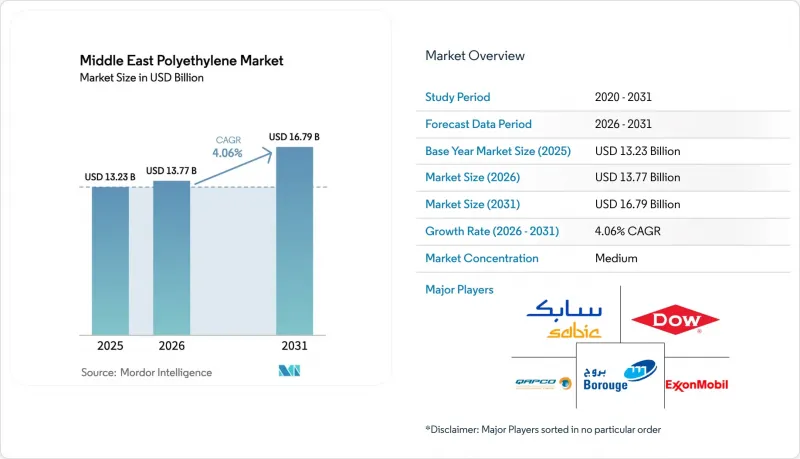
According to Mordor Intelligence, the Middle East polyethylene market size was valued at USD 13.23 billion in 2025 and estimated to grow from USD 13.77 billion in 2026 to reach USD 16.79 billion by 2031, at a CAGR of 4.06% during the forecast period (2026-2031).
This report is Segmented by Product Type (HDPE, LDPE, LLDPE, and Other Product Types), Application (Blow Molding, Films and Sheets, Injection Molding, and More), End-User Industry (Packaging, Transportation, Electrical and Electronics, Building and Construction, and More), and Geography (Saudi Arabia, Qatar, Kuwait, Oman, Iran, and More). Market Forecasts are Provided in Terms of Value (USD).
Middle East Polyethylene Market Trends and Insights
Expansion of Rigid and Flexible Packaging Demand in FMCG and E-Commerce
The regional flexible-packaging market reached USD 10 billion in 2024, with Saudi Arabia leading adoption of recyclable mono-material films that simplify post-consumer sorting under SASO's 2021 regulations. Fast-growing e-commerce platforms such as Amazon.ae and Noon rely on polyethylene mailers, bubble wrap, and air pillows, driving annual protective packaging growth into the high teens. Brand owners shifting to linear low-density polyethylene films meet recyclability targets and benefit from downgauging that cuts material use by up to 15%. These dynamics underpin LLDPE's 5.12% CAGR outlook while cementing films as the single largest application throughout the forecast window.
Industrial Uptake for Automotive and E&E Replacement Parts
Electric-vehicle assembly zones in Abu Dhabi, Dubai, and Saudi Arabia's NEOM project specify polyethylene grades for battery housings, cable insulation, and under-hood components. Borouge's 100,000 tpa cross-linked polyethylene unit at Ruwais supplies specialty compounds for subsea power cables that link expanding solar farms to national grids. Data-center construction tied to sovereign artificial-intelligence programs accelerates consumption of flame-retardant HDPE conduits, supporting a 5.08% CAGR in the electrical and electronics segment.
Readily Available Substitutes Such as PP and PET
Polypropylene and polyethylene terephthalate gain market share in hot-fill containers, beverage bottles, and automotive trim, where thermal resistance outperforms that of polyethylene. Borouge's polypropylene capacity expansion to 720,000 tpa and SABIC's PP5707N grade development diversify portfolios and hedge against polyethylene substitution pressure. Price spreads can swing 20-30% within a quarter during crude oil volatility, prompting converters to switch resins when cost advantages emerge.
Other drivers and restraints analyzed in the detailed report include:
- State-Led Diversification into Petrochemicals Across GCC
- Surge in PE Pipe Demand for District Cooling and Water-Saving Networks
- Feedstock Price Volatility and Import Tariffs in African Outlets
For complete list of drivers and restraints, kindly check the Table Of Contents.
Segment Analysis
High-density polyethylene retained 40.92% of the 2025 Middle East polyethylene market share, buoyed by demand for blow-molded drums, IBCs, and large-diameter pressure pipes. Tasnee's 400,000 tpa HDPE train at Jubail supplies raffia, injection molding, and pipe resins that meet ISO 4427 standards. Low-density polyethylene performs well in shrink films and lamination layers, while linear low-density polyethylene experiences the strongest growth, aided by Borstar Enhanced grades that enable 15-20% downgauging without compromising mechanical properties.
Down-gauged e-commerce mailers, puncture-resistant stretch films, and clarity-enhanced greenhouse covers drive LLDPE's forecast CAGR to 5.05%, narrowing its contribution to the Middle East polyethylene market size to approximately one-third by 2031. Ultra-high-molecular-weight polyethylene and EVA copolymers occupy niche medical, conveyor, and photovoltaic applications, although they collectively account for a share below mid-single digits.
Complete Report Scope:
- By Product Type
- HDPE
- LDPE
- LLDPE
- Other Product Types
- By Application
- Blow Molding
- Films and Sheets
- Injection Molding
- Pipes and Conduits
- Wires and Cables
- Other Applications
- By End-user Industry
- Packaging
- Transportation
- Electrical and Electronics
- Building and Construction
- Agriculture
- Other End-user Industries
- By Geography
- Saudi Arabia
- United Arab Emirates
- Qatar
- Kuwait
- Oman
- Iran
- Rest of Middle East
List of Companies Covered in this Report:
- Advanced Petrochemical Company,
- Amir Kabir Petrochemical Co. (AKPC)
- Borouge
- Dow
- Eastern Petrochemical Company
- Exxon Mobil Corporation
- Ilam Petrochemical
- Jam Petrochemical Co.
- LyondellBasell Industries BV
- Marun Petrochemical Co.
- National Petrochemical Industrial Co. (NPIC)
- Qatar Chemical Company Ltd
- Qatar Petrochemical Company (QAPCO)
- SABIC
- Saudi Ethylene & Polyethylene Co. (Tasnee)
- Saudi Polymers LLC,
- TotalEnergies
Additional Benefits:
- The market estimate (ME) sheet in Excel format
- 3 months of analyst support
TABLE OF CONTENTS
1 Introduction
- 1.1 Study Assumptions & Market Definition
- 1.2 Scope of the Study
2 Research Methodology
3 Executive Summary
4 Market Landscape
- 4.1 Market Overview
- 4.2 Market Drivers
- 4.2.1 Expansion of rigid and flexible packaging demand in FMCG and e-commerce
- 4.2.2 Industrial uptake for automotive and E&E replacement parts
- 4.2.3 State-led diversification into petrochemicals across GCC
- 4.2.4 Surge in PE pipe demand for district cooling and water-saving networks
- 4.2.5 Mandatory recyclate-content rules boosting virgin-recycle PE blends
- 4.3 Market Restraints
- 4.3.1 Readily available substitutes such as PP and PET
- 4.3.2 Feedstock price volatility linked to crude swings
- 4.3.3 Import tariffs in African growth outlets curbing re-exports
- 4.4 Value Chain Analysis
- 4.5 Porter's Five Forces
- 4.5.1 Bargaining Power of Suppliers
- 4.5.2 Bargaining Power of Buyers
- 4.5.3 Threat of New Entrants
- 4.5.4 Threat of Substitutes
- 4.5.5 Degree of Competition
5 Market Size & Growth Forecasts (Value)
- 5.1 By Product Type
- 5.1.1 HDPE
- 5.1.2 LDPE
- 5.1.3 LLDPE
- 5.1.4 Other Product Types
- 5.2 By Application
- 5.2.1 Blow Molding
- 5.2.2 Films and Sheets
- 5.2.3 Injection Molding
- 5.2.4 Pipes and Conduits
- 5.2.5 Wires and Cables
- 5.2.6 Other Applications
- 5.3 By End-user Industry
- 5.3.1 Packaging
- 5.3.2 Transportation
- 5.3.3 Electrical and Electronics
- 5.3.4 Building and Construction
- 5.3.5 Agriculture
- 5.3.6 Other End-user Industries
- 5.4 By Geography
- 5.4.1 Saudi Arabia
- 5.4.2 United Arab Emirates
- 5.4.3 Qatar
- 5.4.4 Kuwait
- 5.4.5 Oman
- 5.4.6 Iran
- 5.4.7 Rest of Middle East
6 Competitive Landscape
- 6.1 Market Concentration
- 6.2 Strategic Moves
- 6.3 Market Share (%)/ Ranking Analysis
- 6.4 Company Profiles (includes Global level Overview, Market level overview, Core Segments, Financials as available, Strategic Information, Market Rank/Share for key companies, Products & Services, and Recent Developments)
- 6.4.1 Advanced Petrochemical Company,
- 6.4.2 Amir Kabir Petrochemical Co. (AKPC)
- 6.4.3 Borouge
- 6.4.4 Dow
- 6.4.5 Eastern Petrochemical Company
- 6.4.6 Exxon Mobil Corporation
- 6.4.7 Ilam Petrochemical
- 6.4.8 Jam Petrochemical Co.
- 6.4.9 LyondellBasell Industries BV
- 6.4.10 Marun Petrochemical Co.
- 6.4.11 National Petrochemical Industrial Co. (NPIC)
- 6.4.12 Qatar Chemical Company Ltd
- 6.4.13 Qatar Petrochemical Company (QAPCO)
- 6.4.14 SABIC
- 6.4.15 Saudi Ethylene & Polyethylene Co. (Tasnee)
- 6.4.16 Saudi Polymers LLC,
- 6.4.17 TotalEnergies
7 Market Opportunities and Future Outlook
- 7.1 White-space and Unmet-Need Assessment

