PUBLISHER: Mordor Intelligence | PRODUCT CODE: 2117210

PUBLISHER: Mordor Intelligence | PRODUCT CODE: 2117210
Photodiode Sensors - Market Share Analysis, Industry Trends & Statistics, Growth Forecasts (2026 - 2031)
According to Mordor Intelligence, photodiode sensors market size in 2026 is estimated at USD 0.83 billion, growing from 2025 value of USD 0.77 billion with 2031 projections showing USD 1.16 billion, growing at 7.12% CAGR over 2026-2031.
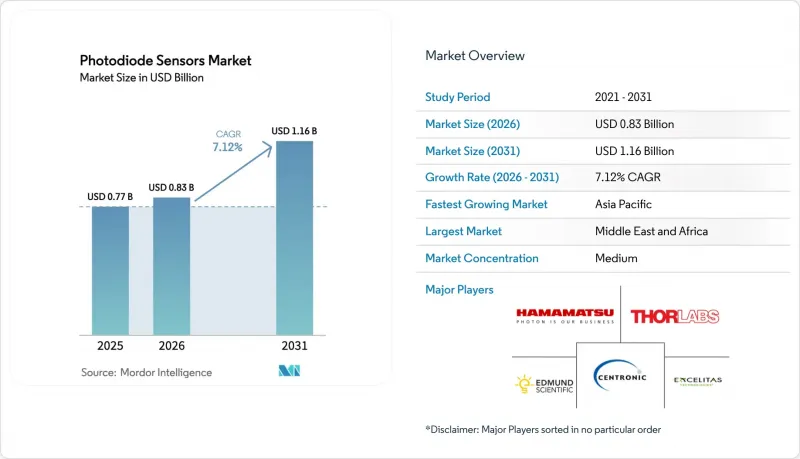
This report is Segmented by Sensor Types (PN Photodiode Sensors, PIN Photodiode Sensors, Avalanche Photodiode Sensors, and More), by Material (Silicon, Silicon-Germanium, and More), by Spectral Range (Ultraviolet, Visible, and More) by End-User Industry (Consumer Electronics, Telecommunications, Aerospace and Defense, and More), and by Geography. The Market Forecasts are Provided in Terms of Value (USD).
Global Photodiode Sensors Market Trends and Insights
Surge in Optical-Fiber & 5G Back-haul Deployments
Data-heavy 5G networks are pushing operators to upgrade backbone links using coherent optical transceivers that rely on low-noise photodiodes. Trials by NTT and NEC using IOWN All-Photonics Networks demonstrated real-time traffic monitoring over existing fiber, confirming dual-use value for infrastructure owners.Academic prototypes have already moved toward 100 Gbps photodiodes capable of 100-km reach, matching early 6G fronthaul benchmarks. Free-space optical links that hit 36.4 Gbit/s highlight the versatility of high-bandwidth receivers in urban environments where trenches are costly. Power-efficient datacenter interconnects show transmitter-side energy efficiency at 1.59 pJ/bit, putting pressure on detector makers to improve receiver sensitivity at similar power budgets.[4] Combined, these requirements place the photodiode sensors market at the heart of next-generation wireline and wireless convergence strategies.
Accelerating LiDAR/ADAS Integration in Vehicles
LiDAR adoption is moving beyond premium brands as cost curves fall rapidly. Sony's IMX479 stacked SPAD depth sensor delivers 300-m detection at 37% photon-detection efficiency with sample shipments slated for autumn 2025. Korea's SPAD roadmap hit 56 ps timing jitter and 8 mm resolution, ideal for short-range driver-assistance systems. Chinese suppliers have spurred price competition, accelerating unit volume growth in mid-range vehicles. VCSEL-to-photodiode co-packaging is cutting bill-of-materials while boosting reliability. FMCW architectures, which depend on heterodyne photodiodes, are now reaching detection limits near theoretical ceilings, validating upcoming production rollouts.[5]
Temperature-Dependent Dark Current & Noise
Dark current rises exponentially with temperature, degrading signal-to-noise ratios in mission-critical photodiode deployments. Thorlabs' recent benchmarks confirmed germanium detectors show the highest dark-current drift, whereas InGaAs variants offer better thermal stability. Organic photodiodes with cross-linked transport layers now deliver 1 nA cm-2 dark-current density at -5 V bias, extending sensor reliability for consumer wearables. Perovskite detectors boasting 2.4X10¹² Jones detectivity promise long-term differentiation once commercial yield hurdles are cleared.
Other drivers and restraints analyzed in the detailed report include:
- Smartphone Demand for Ambient-Light & Proximity Sensing
- Expanded Use in Medical Imaging & Pulse-Oximetry
- Volatile Indium & Gallium Supply Chain
For complete list of drivers and restraints, kindly check the Table Of Contents.
Segment Analysis
PIN devices accounted for 41.42% of the photodiode sensors market share in 2025 as telecom and consumer OEMs favored their cost-performance trade-off. Avalanche photodiodes are forecast to post an 8.23% CAGR through 2031, lifting the photodiode sensors market size as LiDAR mandates single-photon sensitivity. Korea's 56 ps SPAD milestone underscores competitive headroom for timing resolution improvements in automotive safety systems. Device vendors now migrate from discrete components to stacked-sensor architectures, delivering on-chip signal conditioning that simplifies vehicle OEM qualification.
Gallium-nitride PIN avalanche variants target ultraviolet fire-detection and space-borne applications that demand radiation hardness. PN configurations remain viable in value-oriented consumer products, while Schottky designs address microwave photonics where bandwidth trumps quantum efficiency. Ecosystem players invest in laser-receiver co-design to balance gain, linearity, and power, signaling continued divergence within the photodiode sensors market.
Silicon retains 57.38% share of the photodiode sensors market size because CMOS fabs deliver unmatched scale and cost economics. Silicon-germanium devices, with an 8.01% forecast CAGR, improve responsivity at 1.55 µm wavelength yet stay fab-compatible, appealing to telecom OEMs seeking cost parity with legacy Si pipelines. Indium-gallium-arsenide detectors remain indispensable for 700 nm-1.8 µm ranges, commanding premium pricing across data-com optics.
Type-II superlattice architectures show 2.1X1011 cm Hz1/2/W detectivity, 256% above traditional eSWIR offerings, creating opportunities in machine vision and agriculture. Organic photodiodes and quantum-dot hybrids now achieve 5.55X10¹² Jones detectivity at 1.15 µm, indicating cost-effective paths for niche wearables and environmental testers. STMicroelectronics' quantum-dot image sensor roadmap combining 1.62 µm pixel pitch with 60% external quantum efficiency at 1,400 nm hints at mainstream adoption inside the photodiode sensors market.
Complete Report Scope:
- By Sensor Type
- PN Photodiode
- PIN Photodiode
- Avalanche Photodiode (APD)
- Schottky Photodiode
- By Material
- Silicon (Si)
- Silicon-Germanium (SiGe / Ge)
- Indium Gallium Arsenide (InGaAs)
- InGaAsP / InP
- Gallium Nitride (GaN)
- By Spectral Range
- Ultraviolet (200-400 nm)
- Visible (400-700 nm)
- Near-Infrared (0.7-1.4 µm)
- Short-Wave IR (1.4-3 µm)
- Mid/LW IR (>3 µm)
- By End-user Industry
- Consumer Electronics
- Telecommunications
- Aerospace and Defense
- Healthcare
- Automotive
- Industrial Automation and IoT
- Security and Surveillance
- By Geography
- North America
- United States
- Canada
- Mexico
- South America
- Brazil
- Argentina
- Rest of South America
- Europe
- Germany
- United Kingdom
- France
- Italy
- Russia
- Rest of Europe
- APAC
- China
- Japan
- South Korea
- India
- ASEAN
- Rest of APAC
- Middle East and Africa
- GCC
- Turkey
- South Africa
- North America
Geography Analysis
Asia-Pacific dominated the photodiode sensors market with a 45.55% revenue share in 2025, leveraged by dense semiconductor ecosystems in China, Japan, and South Korea. Japan's collaboration between NICT and Sony achieved the first practical quantum-dot surface-emitting laser at 1,550 nm, improving local component depth in optical-fiber communication. Chinese LiDAR producers Hesai and RoboSense accelerate cost deflation, broadening OEM adoption at sub-USD 500 sensor targets. South Korea's KIST breakthroughs in 56 ps SPAD arrays place regional vendors ahead on timing-jitter metrics critical for ADAS.
North America balances innovation and defense demand. Coherent Corp. reported USD 1.43 billion Q2 FY25 revenue, up 27% year over year, showcasing diversified exposure across datacom, instrumentation, and aerospace. CHIPS Act allocations for indium-phosphide expansion will insulate domestic photodiode supply lines against future geopolitical shocks. Quantinuum's new R&D center in New Mexico taps Sandia and Los Alamos labs to accelerate quantum-photonics IP, ensuring a pipeline of next-generation detector prototypes.
Europe commands high-value export niches, shipping EUR 124.6 billion (USD 133.5 billion) in photonics during 2022, equal to 15% global share and supported by 10.5% R&D intensity. Lynred's EUR 85 million (USD 91.1 million) facility expansion in Grenoble will double cleanroom capacity and secure sovereign infrared supply for EU defense programs. VIGO Photonics' HyperPic mid-infrared project, funded by EU grants, demonstrates ongoing commitment to integrated photonic circuits targeting medical and industrial gas sensing. The Middle East & Africa region holds the fastest 2026-2031 CAGR at 9.22% as national smart-city agendas and potential advanced fabs in the UAE catalyze future local demand.
List of Companies Covered in this Report:
- Hamamatsu Photonics K.K.
- Thorlabs Inc.
- Edmund Scientific Corporation (Edmund Optics)
- Centronic Ltd.
- Excelitas Technologies Corp.
- Vishay Intertechnology Inc.
- ams-Osram AG
- First Sensor AG (TE Connectivity)
- Everlight Electronics Co.
- Kyoto Semiconductor Co. Ltd.
- onsemi
- TT Electronics plc
- OSI Optoelectronics
- Nisshinbo Micro Devices
- Broadcom Inc.
- Renesas Electronics Corp.
- Rohm Semiconductor
- Sony Semiconductor Solutions
- Teledyne e2v
Additional Benefits:
- The market estimate (ME) sheet in Excel format
- 3 months of analyst support
TABLE OF CONTENTS
1 INTRODUCTION
- 1.1 Study Assumptions and Market Definition
- 1.2 Scope of the Study
2 RESEARCH METHODOLOGY
3 EXECUTIVE SUMMARY
4 MARKET LANDSCAPE
- 4.1 Market Overview
- 4.2 Market Drivers
- 4.2.1 Surge in optical-fiber and 5G back-haul deployments
- 4.2.2 Accelerating LiDAR/ADAS integration in vehicles
- 4.2.3 Smartphone demand for ambient-light and proximity sensing
- 4.2.4 Expanded use in medical imaging and pulse-oximetry
- 4.2.5 CMOS-compatible SiGe/Sn photodiodes enable low-cost SWIR
- 4.2.6 In-situ photodiode arrays for metal additive-manufacturing QA
- 4.3 Market Restraints
- 4.3.1 Temperature-dependent dark current and noise
- 4.3.2 Competition from integrated image-sensor modules
- 4.3.3 RoHS limits on certain III-V compounds
- 4.3.4 Volatile indium and gallium supply chain
- 4.4 Value / Supply-Chain Analysis
- 4.5 Regulatory Landscape
- 4.6 Technological Outlook
- 4.7 Porter's Five Forces Analysis
- 4.7.1 Threat of New Entrants
- 4.7.2 Bargaining Power of Buyers
- 4.7.3 Bargaining Power of Suppliers
- 4.7.4 Threat of Substitutes
- 4.7.5 Intensity of Competitive Rivalry
5 MARKET SIZE AND GROWTH FORECASTS (VALUE)
- 5.1 By Sensor Type
- 5.1.1 PN Photodiode
- 5.1.2 PIN Photodiode
- 5.1.3 Avalanche Photodiode (APD)
- 5.1.4 Schottky Photodiode
- 5.2 By Material
- 5.2.1 Silicon (Si)
- 5.2.2 Silicon-Germanium (SiGe / Ge)
- 5.2.3 Indium Gallium Arsenide (InGaAs)
- 5.2.4 InGaAsP / InP
- 5.2.5 Gallium Nitride (GaN)
- 5.3 By Spectral Range
- 5.3.1 Ultraviolet (200-400 nm)
- 5.3.2 Visible (400-700 nm)
- 5.3.3 Near-Infrared (0.7-1.4 µm)
- 5.3.4 Short-Wave IR (1.4-3 µm)
- 5.3.5 Mid/LW IR (>3 µm)
- 5.4 By End-user Industry
- 5.4.1 Consumer Electronics
- 5.4.2 Telecommunications
- 5.4.3 Aerospace and Defense
- 5.4.4 Healthcare
- 5.4.5 Automotive
- 5.4.6 Industrial Automation and IoT
- 5.4.7 Security and Surveillance
- 5.5 By Geography
- 5.5.1 North America
- 5.5.1.1 United States
- 5.5.1.2 Canada
- 5.5.1.3 Mexico
- 5.5.2 South America
- 5.5.2.1 Brazil
- 5.5.2.2 Argentina
- 5.5.2.3 Rest of South America
- 5.5.3 Europe
- 5.5.3.1 Germany
- 5.5.3.2 United Kingdom
- 5.5.3.3 France
- 5.5.3.4 Italy
- 5.5.3.5 Russia
- 5.5.3.6 Rest of Europe
- 5.5.4 APAC
- 5.5.4.1 China
- 5.5.4.2 Japan
- 5.5.4.3 South Korea
- 5.5.4.4 India
- 5.5.4.5 ASEAN
- 5.5.4.6 Rest of APAC
- 5.5.5 Middle East and Africa
- 5.5.5.1 GCC
- 5.5.5.2 Turkey
- 5.5.5.3 South Africa
- 5.5.1 North America
6 COMPETITIVE LANDSCAPE
- 6.1 Market Concentration
- 6.2 Strategic Moves
- 6.3 Market Share Analysis
- 6.4 Company Profiles (includes Global level Overview, Market level overview, Core Segments, Financials as available, Strategic Information, Market Rank/Share for key companies, Products and Services, and Recent Developments)
- 6.4.1 Hamamatsu Photonics K.K.
- 6.4.2 Thorlabs Inc.
- 6.4.3 Edmund Scientific Corporation (Edmund Optics)
- 6.4.4 Centronic Ltd.
- 6.4.5 Excelitas Technologies Corp.
- 6.4.6 Vishay Intertechnology Inc.
- 6.4.7 ams-Osram AG
- 6.4.8 First Sensor AG (TE Connectivity)
- 6.4.9 Everlight Electronics Co.
- 6.4.10 Kyoto Semiconductor Co. Ltd.
- 6.4.11 onsemi
- 6.4.12 TT Electronics plc
- 6.4.13 OSI Optoelectronics
- 6.4.14 Nisshinbo Micro Devices
- 6.4.15 Broadcom Inc.
- 6.4.16 Renesas Electronics Corp.
- 6.4.17 Rohm Semiconductor
- 6.4.18 Sony Semiconductor Solutions
- 6.4.19 Teledyne e2v
7 MARKET OPPORTUNITIES AND FUTURE OUTLOOK
- 7.1 White-space and Unmet-need Assessment

