PUBLISHER: Mordor Intelligence | PRODUCT CODE: 2117213

PUBLISHER: Mordor Intelligence | PRODUCT CODE: 2117213
Europe Fashion Accessories - Market Share Analysis, Industry Trends & Statistics, Growth Forecasts (2026 - 2031)
According to Mordor Intelligence, european fashion accessories market size in 2026 is estimated at USD 702.25 billion, growing from 2025 value of USD 665.58 billion with 2031 projections showing USD 917.84 billion, growing at 5.51% CAGR over 2026-2031.
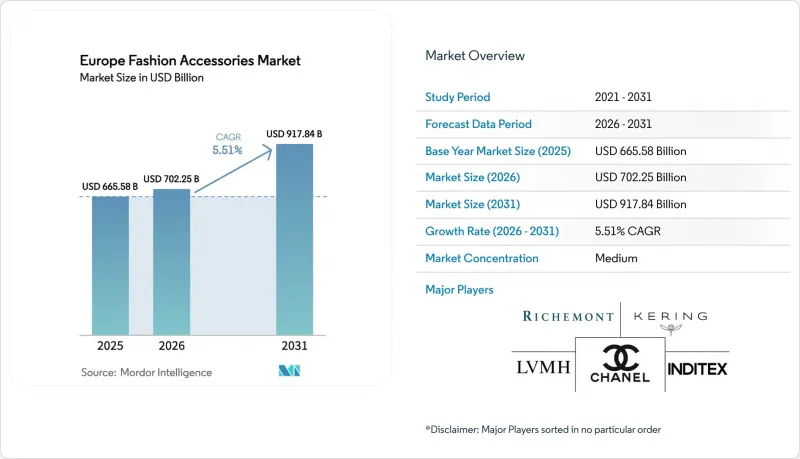
This report is Segmented by Product Type (Footwear, Apparel, Wallets, Handbags, Watches, and More), End User (Men, Women, and Kids/Children), Category (Mass and Premium), Distribution Channel (Offline Stores and Online Stores), and Geography (Germany, United Kingdom, Italy, France, Spain, Netherlands, Poland, Belgium, Sweden, and Rest of Europe). The Market Forecasts are Provided in Terms of Value (USD).
Europe Fashion Accessories Market Trends and Insights
Technological Advancements in Terms of Design and Raw Material
The integration of artificial intelligence and 3D printing technologies is transforming the European fashion market by reducing product development cycles from months to weeks and minimizing material waste. 3D printing enables manufacturers to create intricate designs, prototype rapidly, and produce customized accessories with reduced material wastage. The technology allows for complex geometries and innovative material combinations that were previously impossible with traditional manufacturing methods. The convergence of technology and fashion continues with Dolce Vita's April 2025 partnership with HILOS for on-demand 3D printed footwear, highlighting the market's evolution toward mass customization. These technological integrations enable fashion brands to offer personalized experiences through connected accessories while creating additional revenue streams in traditional craft-based segments.
Strong Demand From Inbound Tourist
Tourism's resurgence in Europe has significantly influenced the fashion accessories market by creating a luxury spending multiplier effect. The shift in consumer preferences toward experiential luxury has positioned accessories as portable status symbols and travel mementos, driving demand for lightweight, versatile pieces suitable for various occasions. Duty-free retail has evolved with brands establishing flagship stores in airports and resort destinations to capture tourist spending before it disperses to local markets. According to UN Tourism, Europe recorded 747 million international arrivals in 2024, representing a 5% increase from 2023, supported by strong intraregional demand . However, the geographic concentration of tourist spending exposes brands to risks from geopolitical tensions and travel restrictions, making diversification across tourist source markets essential for European fashion accessories brands.
Proliferation of Counterfeit Products
Counterfeiting inflicts substantial damage on the fashion industry, as evidenced by the European Union Intellectual Property Office's (EUIPO) January 2024 report, which revealed annual losses of EUR 16 billion across Europe's clothing, cosmetics, and toy sectors, representing 5.2% of their total revenue .The proliferation of lower-priced counterfeit items appeals to cost-conscious consumers, weakening the market position of authentic luxury brands and diminishing their long-term brand equity. The challenge intensifies as counterfeit operations establish production facilities near target markets and employ advanced manufacturing methods that blur the distinction between genuine and fake products, thereby impeding market growth. The rise of e-commerce platforms has further complicated this issue, providing counterfeiters with additional channels to distribute their products while making it increasingly difficult for consumers to verify product authenticity. Additionally, the financial impact extends beyond direct sales losses, as legitimate brands must allocate significant resources to anti-counterfeiting measures and legal actions to protect their intellectual property rights.
Other drivers and restraints analyzed in the detailed report include:
- Increasing Demand For Luxury Products
- Rising Demand For Sportswear From Fitness-Conscious Consumers
- Supply Chain Disruptions
For complete list of drivers and restraints, kindly check the Table Of Contents.
Segment Analysis
Apparel dominates the market with a 59.02% share in 2025, driven by athleisure trends and seasonal refresh cycles that generate consistent purchases across price segments. The footwear segment benefits from sneaker culture and performance-fashion convergence, while watches demonstrate the highest growth potential at 5.78% CAGR through 2031, combining traditional craftsmanship with smart technology. Handbags maintain premium positioning despite slower volume growth, and wallets adapt to digital payment trends through multi-functional designs.
The accessories market continues to evolve with changing consumer preferences, where jewelry shows resilience through investment appeal and personalization trends, including the rise of lab-grown diamonds and sustainable materials. Sunglasses maintain year-round relevance beyond seasonal utility, exemplified by successful collaborations like Saint Laurent x Ray-Ban. This transformation reflects broader lifestyle changes where accessories serve both functional and identity expression purposes, with technology integration enabling premium pricing and differentiation across all categories.
Mass category accessories dominate with a 63.92% market share in 2025, leveraging established retail networks and price-sensitive consumer segments to maintain volume stability. However, premium segments are growing at a 6.45% CAGR through 2031, driven by consumers' willingness to invest in quality, sustainability, and brand prestige. This market bifurcation creates strategic challenges for mid-market brands, which face increasing pressure from both value competitors and accessible luxury alternatives.
The growth in premium accessories is underpinned by consumers viewing high-quality items as long-term investments that maintain value while providing emotional satisfaction. Meanwhile, mass market players focus on rapid product cycles and value engineering to capture fashion trends at accessible price points. Both segments approach sustainability differently - premium brands emphasize craftsmanship and durability, while mass market manufacturers incorporate recycled materials and circular business models to meet regulatory requirements and consumer expectations.
Complete Report Scope:
- By Product Type
- Footwear
- Apparel
- Wallets
- Handbags
- Watches
- Sunglasses
- Jewelery
- By End User
- Men
- Women
- Kids/Children
- By Category
- Mass
- Premium
- By Distribution Channel
- Offline Stores
- Online Stores
- By Geography
- Europe
- Germany
- United Kingdom
- Italy
- France
- Spain
- Netherlands
- Poland
- Belgium
- Sweden
- Rest of Europe
- Europe
List of Companies Covered in this Report:
- Industria de Diseno Textil S.A
- Kering SA
- Richemont SA
- LVMH Moet Hennessy Louis Vuitton SE
- Chanel SA
- H & M Hennes & Mauritz AB
- Adidas AG
- Nike Inc.
- Hermes International SCA
- Prada SpA
- Burberry Group PLC
- Fossil Group Inc.
- Giorgio Armani SpA
- Swatch Group AG
- EssilorLuxottica SA
- Pandora A/S
- Moncler SpA
- PVH Corp.
- Hugo Boss AG
- Marks & Spencer Group PLC
Additional Benefits:
- The market estimate (ME) sheet in Excel format
- 3 months of analyst support
TABLE OF CONTENTS
1 INTRODUCTION
- 1.1 Study Assumptions and Market Definition
- 1.2 Scope of the Study
2 RESEARCH METHODOLOGY
3 EXECUTIVE SUMMARY
4 MARKET LANDSCAPE
- 4.1 Market Overview
- 4.2 Market Drivers
- 4.2.1 Technological Advancements in Terms of Design and Raw Material
- 4.2.2 Strong Demand From Inbound Tourist
- 4.2.3 Increasing Demand For Luxury Products
- 4.2.4 Rising Demand For Sportswear From Fitness-Conscious Consumers
- 4.2.5 Sustainability and Ethical Production
- 4.2.6 Influence of Social Media and Celebrity Endorsements
- 4.3 Market Restraints
- 4.3.1 Proliferation of Counterfeit Products
- 4.3.2 Supply Chain Disruptions
- 4.3.3 Fluctuating Raw Material Prices
- 4.3.4 Rising Trade Barriers and Tariffs
- 4.4 Consumer Behaviour Analysis
- 4.5 Regulatory Outlook
- 4.6 Porter's Five Forces Analysis
- 4.6.1 Bargaining Power of Suppliers
- 4.6.2 Bargaining Power of Buyers
- 4.6.3 Threat of New Entrants
- 4.6.4 Threat of Substitutes
- 4.6.5 Degree of Competition
5 MARKET SIZE AND GROWTH FORECASTS (VALUE)
- 5.1 By Product Type
- 5.1.1 Footwear
- 5.1.2 Apparel
- 5.1.3 Wallets
- 5.1.4 Handbags
- 5.1.5 Watches
- 5.1.6 Sunglasses
- 5.1.7 Jewelery
- 5.2 By End User
- 5.2.1 Men
- 5.2.2 Women
- 5.2.3 Kids/Children
- 5.3 By Category
- 5.3.1 Mass
- 5.3.2 Premium
- 5.4 By Distribution Channel
- 5.4.1 Offline Stores
- 5.4.2 Online Stores
- 5.5 By Geography
- 5.5.1 Europe
- 5.5.1.1 Germany
- 5.5.1.2 United Kingdom
- 5.5.1.3 Italy
- 5.5.1.4 France
- 5.5.1.5 Spain
- 5.5.1.6 Netherlands
- 5.5.1.7 Poland
- 5.5.1.8 Belgium
- 5.5.1.9 Sweden
- 5.5.1.10 Rest of Europe
- 5.5.1 Europe
6 COMPETITIVE LANDSCAPE
- 6.1 Market Concentration
- 6.2 Strategic Moves
- 6.3 Market Share Analysis
- 6.4 Company Profiles (Includes Global-level Overview, Market-level Overview, Core Segments, Financials, Strategic Info, Market Rank/Share, Products and Services, Recent Developments)
- 6.4.1 Industria de Diseno Textil S.A
- 6.4.2 Kering SA
- 6.4.3 Richemont SA
- 6.4.4 LVMH Moet Hennessy Louis Vuitton SE
- 6.4.5 Chanel SA
- 6.4.6 H & M Hennes & Mauritz AB
- 6.4.7 Adidas AG
- 6.4.8 Nike Inc.
- 6.4.9 Hermes International SCA
- 6.4.10 Prada SpA
- 6.4.11 Burberry Group PLC
- 6.4.12 Fossil Group Inc.
- 6.4.13 Giorgio Armani SpA
- 6.4.14 Swatch Group AG
- 6.4.15 EssilorLuxottica SA
- 6.4.16 Pandora A/S
- 6.4.17 Moncler SpA
- 6.4.18 PVH Corp.
- 6.4.19 Hugo Boss AG
- 6.4.20 Marks & Spencer Group PLC
7 MARKET OPPORTUNITIES AND FUTURE OUTLOOK

