PUBLISHER: Mordor Intelligence | PRODUCT CODE: 2117220

PUBLISHER: Mordor Intelligence | PRODUCT CODE: 2117220
Food And Agriculture Testing, Inspection, And Certification - Market Share Analysis, Industry Trends & Statistics, Growth Forecasts (2026 - 2031)
According to Mordor Intelligence, the food and agriculture testing, inspection, and certification market size is expected to grow from USD 30.34 billion in 2025 to USD 32.27 billion in 2026 and is forecast to reach USD 43.92 billion by 2031 at 6.36% CAGR over 2026-2031.
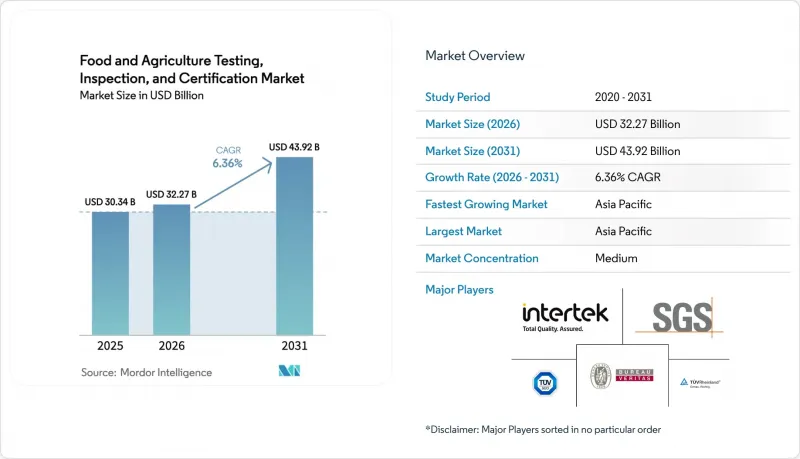
This report is Segmented by Service Type (Testing Services, Inspection Services, and Certification Services), Sourcing Type (In-House and Outsourced), and Geography (North America, South America, Europe, Asia-Pacific, and the Middle East and Africa). The Market Forecasts are Provided in Terms of Value (USD).
Global Food And Agriculture Testing, Inspection, And Certification Market Trends and Insights
Growing stringency of global food-safety regulations
The United States FSMA LAAF program became fully operational in 2024 and requires laboratories to secure specific accreditations for designated analyses, increasing compliance costs and pushing food companies toward accredited third-party providers. Comparable tightening is visible in the European Union, where EFSA broadens risk-assessment frameworks and enforces stricter maximum residue limits, thereby expanding mandatory test panels. ISO 22000 and GFSI-benchmarked schemes such as BRCGS, IFS, and FSSC 22000 reduce regulatory fragmentation, yet they simultaneously elevate the minimum technical bar. As a result, smaller producers that once relied on basic in-house tests must now outsource more complex analyses, enlarging the food safety testing, inspection, and certification market. The requirement for multi-standard compliance turns safety verification into a fixed operating expense, insulating spending from normal economic cycles. Consolidated laboratory networks leverage their accreditation breadth to win long-term contracts and secure price premiums.
Rising cross-border agri-food trade volumes
Global food trade exposes single shipments to multiple regulatory regimes, multiplying the number of required assays per product. An exporter shipping processed seafood from Vietnam to the European Union must satisfy origin and destination pesticide, heavy-metal, microbiological, and labeling standards in parallel, creating incremental testing demand. Laboratories with multi-jurisdictional accreditations are well-positioned as exporters consolidate work with providers that deliver certificates accepted worldwide. Asia-Pacific anchors the growth because it is simultaneously a manufacturing base and a consumer market, leading to bidirectional flows that require verification at both ends. Mutual recognition agreements streamline some documentation yet paradoxically raise total assay counts by lowering barriers for smaller producers to reach new destinations. This dynamic sustains double-digit volume growth for regional laboratories, particularly in hubs such as Thailand and Vietnam.
Fragmented compliance regimes across emerging markets
Country-specific rules in emerging economies diverge from international standards, forcing exporters to navigate overlapping and sometimes conflicting test requirements. Vietnam and Nigeria, for example, introduced new residue limits and certification frameworks that are not yet harmonized with GFSI schemes, driving repeat sampling and duplicate documentation. Laboratories must maintain multiple accreditations, raising operating costs and lengthening turnaround times. Food companies adjust by limiting product lines or avoiding certain destinations, temporarily suppressing testing growth in those corridors until regulatory alignment improves.
Other drivers and restraints analyzed in the detailed report include:
- Expansion of retail private-label food brands
- Consolidation of third-party laboratories
- High cost of multi-standard accreditations for SMEs
For complete list of drivers and restraints, kindly check the Table Of Contents.
Segment Analysis
Testing Services accounted for 57.62% of the food and agriculture testing, inspection, and certification market in 2025, reflecting mandated pathogen, chemical residue, and nutritional analyses that every producer must complete. Certification Services grow faster at a 6.72% CAGR because brands use third-party stamps to differentiate on supermarket shelves. Inspection Services remain a smaller component, constrained by labor intensity yet indispensable for facility audits and process validation. Within Testing Services, demand for next-generation sequencing and LC-MS/MS drives premium pricing, while integrated data portals such as SGS SMART support value-added analytics. Over the forecast period, convergence between testing and certification will create bundled compliance solutions that lock in recurring revenue streams for providers.
Testing Services retain a critical mass because every new regulation, from allergen cross-contact thresholds to microplastic contamination limits, lengthens the assay checklist. Certification's momentum stems from private-label retailers seeking consumer-visible assurances. Laboratories that invest in both categories can cross-sell, secure long contracts, and maintain utilization rates above 80%. SGS's SMART illustrates how real-time dashboards integrate lab data and audit findings, establishing a single compliance narrative for clients. This end-to-end visibility reinforces the importance of outsourcing to large, tech-enabled providers.
Complete Report Scope:
- By Service Type
- Testing Services
- Inspection Services
- Certification Services
- By Sourcing Type
- In-house
- Outsourced
- By Geography
- North America
- United States
- Canada
- Mexico
- South America
- Brazil
- Argentina
- Rest of South America
- Europe
- Germany
- United Kingdom
- France
- Italy
- Spain
- Russia
- Rest of Europe
- Asia-Pacific
- China
- Japan
- India
- South Korea
- South-East Asia
- Rest of Asia-Pacific
- Middle East and Africa
- Middle East
- Saudi Arabia
- United Arab Emirates
- Turkey
- Rest of Middle East
- Africa
- South Africa
- Nigeria
- Rest of Africa
- Middle East
- North America
Geography Analysis
Asia-Pacific posted 43.12% of global revenue in 2025 and is forecast to grow at a 6.98% CAGR through 2031. China, India, and Southeast Asia expand both processing capacity and consumer demand, prompting investments in accredited laboratories. The Government of India funded 100 new NABL-accredited labs in the 2024 budget to support domestic safety oversight and export competitiveness. North America remains a center of regulatory innovation with the FDA's LAAF program driving accreditation upgrades and increasing outsourced sample flows. Europe, while mature, shows steady demand for novel contaminant screening and premium certification services anchored on sustainability and animal-welfare criteria.
The Middle East and Africa represent the fastest emerging opportunity due to rising food imports and infrastructure development. The Philippines set up its first food quality lab in Cagayan Valley with PHP 5 million DOST funding to improve regional safety oversight. Countries in the Gulf Cooperation Council implement unified residue limits modeled on Codex Alimentarius, stimulating assay harmonization. Latin America benefits from soybean and meat export volumes that require multi-jurisdiction certificates, yet fragmented domestic regulations temper growth rates.
Regional comparison highlights divergent drivers. Asia-Pacific's expansion originates from manufacturing scale and export orientation, whereas North America and Europe rely on stringent enforcement and private-label uptake. Africa's growth is tied to donor-funded capacity building and import surveillance. Providers with global lab footprints and digital data networks can arbitrage these regional nuances and maintain high utilization.
- ALS Limited
- AsureQuality Limited
- Bioagri Certificadora S.A.
- Bureau Veritas SA
- BSI Group
- Control Union Certifications B.V.
- Cotecna Inspection SA
- DNV AS
- Eurofins Scientific SE
- Intertek Group plc
- Kiwa NV
- Lloyd's Register Group Limited
- Merieux NutriSciences Corporation
- NSF International
- Perry Johnson Registrars Inc.
- QIMA Limited
- RINA S.p.A.
- SGS SA
- SQI Services Inc.
- TUV NORD GROUP
- TUV Rheinland Group
- TUV SUD AG
- UL LLC
- VERT Laboratories Inc.
Additional Benefits:
- The market estimate (ME) sheet in Excel format
- 3 months of analyst support
TABLE OF CONTENTS
1 INTRODUCTION
- 1.1 Study Assumptions and Market Definition
- 1.2 Scope of the Study
2 RESEARCH METHODOLOGY
3 EXECUTIVE SUMMARY
4 MARKET LANDSCAPE
- 4.1 Market Overview
- 4.2 Market Drivers
- 4.2.1 Growing stringency of global food-safety regulations
- 4.2.2 Rising cross-border agri-food trade volumes
- 4.2.3 Expansion of retail private-label food brands
- 4.2.4 Consolidation of third-party laboratories
- 4.2.5 AI-driven predictive risk profiling of farms
- 4.2.6 Blockchain-enabled end-to-end traceability mandates
- 4.3 Market Restraints
- 4.3.1 Fragmented compliance regimes across emerging markets
- 4.3.2 High cost of multi-standard accreditations for SMEs
- 4.3.3 Shortage of qualified food toxicologists and auditors
- 4.3.4 Climate-driven volatility in sampling representativeness
- 4.4 Industry Value Chain Analysis
- 4.5 Impact of Macroeconomic Factors
- 4.6 Regulatory Landscape
- 4.7 Technological Outlook
- 4.8 Porter's Five Forces Analysis Analysis
- 4.8.1 Threat of New Entrants
- 4.8.2 Bargaining Power of Buyers
- 4.8.3 Bargaining Power of Suppliers
- 4.8.4 Threat of Substitutes
- 4.8.5 Industry Rivalry
5 MARKET SIZE AND GROWTH FORECASTS (VALUE)
- 5.1 By Service Type
- 5.1.1 Testing Services
- 5.1.2 Inspection Services
- 5.1.3 Certification Services
- 5.2 By Sourcing Type
- 5.2.1 In-house
- 5.2.2 Outsourced
- 5.3 By Geography
- 5.3.1 North America
- 5.3.1.1 United States
- 5.3.1.2 Canada
- 5.3.1.3 Mexico
- 5.3.2 South America
- 5.3.2.1 Brazil
- 5.3.2.2 Argentina
- 5.3.2.3 Rest of South America
- 5.3.3 Europe
- 5.3.3.1 Germany
- 5.3.3.2 United Kingdom
- 5.3.3.3 France
- 5.3.3.4 Italy
- 5.3.3.5 Spain
- 5.3.3.6 Russia
- 5.3.3.7 Rest of Europe
- 5.3.4 Asia-Pacific
- 5.3.4.1 China
- 5.3.4.2 Japan
- 5.3.4.3 India
- 5.3.4.4 South Korea
- 5.3.4.5 South-East Asia
- 5.3.4.6 Rest of Asia-Pacific
- 5.3.5 Middle East and Africa
- 5.3.5.1 Middle East
- 5.3.5.1.1 Saudi Arabia
- 5.3.5.1.2 United Arab Emirates
- 5.3.5.1.3 Turkey
- 5.3.5.1.4 Rest of Middle East
- 5.3.5.2 Africa
- 5.3.5.2.1 South Africa
- 5.3.5.2.2 Nigeria
- 5.3.5.2.3 Rest of Africa
- 5.3.5.1 Middle East
- 5.3.1 North America
6 COMPETITIVE LANDSCAPE
- 6.1 Market Concentration
- 6.2 Strategic Moves
- 6.3 Market Share Analysis
- 6.4 Company Profiles (includes Global level Overview, Market level overview, Core Segments, Financials as available, Strategic Information, Market Rank/Share for key companies, Products and Services, and Recent Developments)
- 6.4.1 ALS Limited
- 6.4.2 AsureQuality Limited
- 6.4.3 Bioagri Certificadora S.A.
- 6.4.4 Bureau Veritas SA
- 6.4.5 BSI Group
- 6.4.6 Control Union Certifications B.V.
- 6.4.7 Cotecna Inspection SA
- 6.4.8 DNV AS
- 6.4.9 Eurofins Scientific SE
- 6.4.10 Intertek Group plc
- 6.4.11 Kiwa NV
- 6.4.12 Lloyd's Register Group Limited
- 6.4.13 Merieux NutriSciences Corporation
- 6.4.14 NSF International
- 6.4.15 Perry Johnson Registrars Inc.
- 6.4.16 QIMA Limited
- 6.4.17 RINA S.p.A.
- 6.4.18 SGS SA
- 6.4.19 SQI Services Inc.
- 6.4.20 TUV NORD GROUP
- 6.4.21 TUV Rheinland Group
- 6.4.22 TUV SUD AG
- 6.4.23 UL LLC
- 6.4.24 VERT Laboratories Inc.
7 MARKET OPPORTUNITIES AND FUTURE OUTLOOK
- 7.1 White-space and Unmet-Need Assessment

