PUBLISHER: Mordor Intelligence | PRODUCT CODE: 2117249

PUBLISHER: Mordor Intelligence | PRODUCT CODE: 2117249
Sonobuoy - Market Share Analysis, Industry Trends & Statistics, Growth Forecasts (2026 - 2031)
According to Mordor Intelligence, sonobuoy market size in 2026 is estimated at USD 512.23 million, growing from 2025 value of USD 482.54 million with 2031 projections showing USD 690.34 million, growing at 6.15% CAGR over 2026-2031.
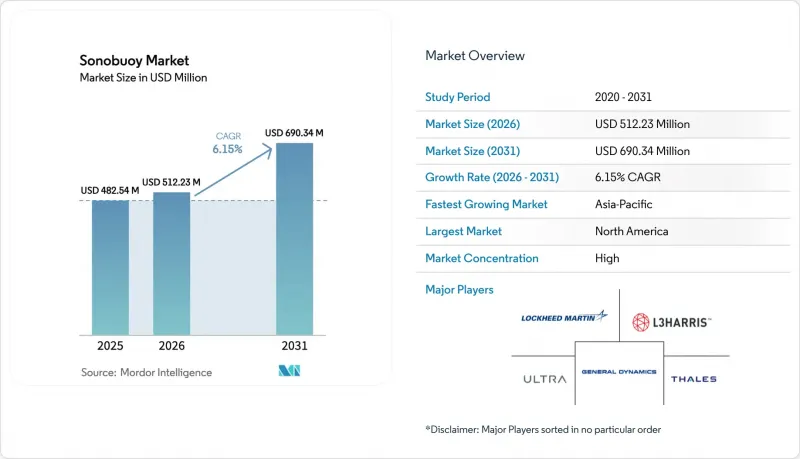
This report is Segmented by Type (Active, Passive, and Special Purpose), Size Class (Size A and Size B), Deployment Method (Free-Fall, Cartridge/Pneumatic Launch, and Spring Launch Systems), Application (Commercial and Defense), and Geography (North America, Europe, Asia-Pacific, South America, and the Middle East and Africa). The Market Forecasts are Provided in Terms of Value (USD).
Global Sonobuoy Market Trends and Insights
Worldwide proliferation of quite diesel-electric and AIP submarines elevating expendable ASW demand
Modern diesel-electric and air-independent-propulsion boats now patrol longer in near-silence, narrowing passive detection windows and compelling navies to seed larger listening fields. Procurement plans signal this urgency: the US Navy budgets for roughly 204,000 buoys yearly to sustain inventory, while Indo-Pacific forces accelerate orders for distributed surveillance grids. Higher exercise tempos and real-world tracking missions translate into sustained consumption, anchoring volume growth across the sonobuoy market.
Shift from analog to digital sonobuoy architectures enabling multichannel data fusion and longer RF links
Digital signal chains compress, encrypt, and forward richer acoustic packets over extended radio links, letting operators merge feeds from dozens of nodes in near real time. Automated classification cuts operator workload and improves first-pass confidence, which is key in high-tempo patrols. These architectures also future-proof fleets against congested electromagnetic environments, making them a core upgrade catalyst within the sonobuoy market.
High supplier concentration and export-control regimes creating procurement bottlenecks
ERAPSCO's long-standing dominance meant a single joint venture fed most US orders; its dissolution forces navies to identify alternate lines while navigating International Traffic in Arms Regulations. New entrants require heavy capital and long qualification cycles, so supply remains tight even as demand climbs. The Defense Production Act funding round seeks to widen capacity, yet export license hurdles still delay deliveries to partner nations, dampening near-term momentum in the sonobuoy market.
Other drivers and restraints analyzed in the detailed report include:
- Adoption of multistatic low-frequency active concepts lowering cost-per-detection and extending range
- Rapid uptake of unmanned aerial and surface launch platforms boosting annual buoy deployment rates
- Stricter environmental regulations on underwater acoustic emissions constraining operational usage
For complete list of drivers and restraints, kindly check the Table Of Contents.
Segment Analysis
Passive devices held 54.62% of the sonobuoy market in 2025, underscoring their value for covert, low-power listening over long distances. Active variants, however, will outpace the aggregate sonobuoy market with a 12.00% CAGR through 2031. They are powered by multistatic low-frequency innovations that push detection horizons while controlling battery drain. Special-purpose models for bathymetry and range monitoring fill a niche but play a crucial role in battle-group readiness.
Digital processing lifts active effectiveness, as algorithms suppress reverberation and highlight transient contacts. The resulting performance leap keeps navies investing, making this slice a pivotal revenue accelerator across the wider sonobuoy market. Parallel civil use for seismic surveys enlarges addressable demand, reflecting growing cross-sector technology spillover within the sonobuoy industry.
Size A forms remained dominant, accounting for 64.55% of the sonobuoy market in 2025, because legacy aircraft racks favor that diameter. Yet, Size B sales rose 13.02% CAGR as unmanned and light patrol planes seek lighter loads without acoustic compromise. Miniaturization advances preserve sensitivity while halving weight, aligning with broader defense trends toward distributed sensing.
SeaGuardian's capacity to double the carriage count when switching to Size B makes a compelling case for inventory diversification. Manufacturers betting on small-form-factor lines now unlock new platform integration fees, reinforcing growth vectors in the sonobuoy market.
Complete Report Scope:
- By Type
- Active
- Passive
- Special Purpose
- By Size Class
- Size A
- Size B
- By Deployment Method
- Free-fall
- Cartridge/Pneumatic Launch
- Spring Launch Systems
- By Application
- Defense
- Anti-Submarine Warfare
- Training and Exercise
- Acoustic Range Monitoring
- Commercial
- Off-shore Energy Exploration
- Oceanographic Research
- Search and Rescue
- Defense
- By Geography
- North America
- United States
- Canada
- Mexico
- Europe
- United Kingdom
- France
- Germany
- Russia
- Rest of Europe
- Asia-Pacific
- China
- India
- Japan
- South Korea
- Rest of Asia-Pacific
- South America
- Brazil
- Argentina
- Rest of South America
- Middle East and Africa
- Middle East
- Saudi Arabia
- United Arab Emirates
- Rest of Middle East
- Africa
- South Africa
- Rest of Africa
- Middle East
- North America
Geography Analysis
North America commanded 41.85% of the sonobuoy market in 2025 due to sizable US Navy budgets, integrated manufacturing clusters, and a long history of experimentation with anti-submarine warfare. Annual buys of roughly 204,000 units set a volume floor that sustains local lines and accelerates R&D into digital and multistatic features. Canada's NATO patrol commitments and Mexico's offshore energy surveys add incremental pull, reinforcing the region's leadership role. After ERAPSCO's breakup, supply-risk worries pushed authorities to channel Defense Production Act funds toward redundancy. This measure should stabilize the North American share, leaving room for foreign advances.
Asia-Pacific posts the fastest 11.47% CAGR through 2031 as submarine fleets expand and maritime boundary disputes intensify. India's co-production pact with Ultra Maritime and Bharat Dynamics Limited illustrates policy support for localized build lines and allied interoperability. Japan embeds sonobuoy upgrades into its Medium-Term Defense Plan, while Australia studies sovereign manufacturing to cut shipping risk. The regional thirst for unmanned platforms also accelerates the adoption of compact buoys, widening the sonobuoy market pipeline.
Europe grows steadily due to NATO standardization, higher Baltic patrol hours, and emerging Indo-Pacific deployments by France, Germany, and Italy. Paris awarded Thales a domestic SonoFlash contract to secure supply and hedge geopolitical uncertainty. Environmental compliance shapes procurement language, pressing suppliers to innovate quieter or shorter-duration devices. Cross-border exercises, such as Dynamic Manta, fuel routine replenishment orders, ensuring Europe remains an essential demand pillar within the sonobuoy market framework.
- Sparton Corporation
- Ultra Electronics Holdings Limited
- L3Harris Technologies, Inc.
- Thales Group
- Lockheed Martin Corporation
- General Dynamics Mission Systems (General Dynamics Corporation)
- ASELSAN A.S.
- Kongsberg Gruppen ASA
- Leonardo S.p.A.
- SAAB AB
- Indra Sistemas, S.A.
- Bharat Electronics Limited
- Hanwha Systems (Hanwha Group)
Additional Benefits:
- The market estimate (ME) sheet in Excel format
- 3 months of analyst support
TABLE OF CONTENTS
1 INTRODUCTION
- 1.1 Study Assumptions and Market Definition
- 1.2 Scope of the Study
2 RESEARCH METHODOLOGY
3 EXECUTIVE SUMMARY
4 MARKET LANDSCAPE
- 4.1 Market Overview
- 4.2 Market Drivers
- 4.2.1 Worldwide proliferation of quiet diesel-electric and AIP submarines elevating expendable ASW demand
- 4.2.2 Shift from analog to digital sonobuoy architectures enabling multichannel data fusion and longer RF links
- 4.2.3 Adoption of multistatic low-frequency active concepts lowering cost-per-detection and extending range
- 4.2.4 Rapid uptake of unmanned aerial and surface launch platforms boosting annual buoy deployment rates
- 4.2.5 Global standardization via NATO STANAG 4748 and MIL-STD 2525E enhancing interoperability across fleets
- 4.2.6 Expansion of deep-water energy exploration requiring expendable acoustics for seabed characterisation
- 4.3 Market Restraints
- 4.3.1 High supplier concentration and export-control regimes creating procurement bottlenecks
- 4.3.2 Stricter environmental regulations on underwater acoustic emissions constraining operational usage
- 4.3.3 Competition from non-expendable alternatives such as LF towed arrays and autonomous UUV sonars
- 4.3.4 Volatile rare-earth and piezo-ceramic feedstock prices driving up unit production costs
- 4.4 Value Chain Analysis
- 4.5 Regulatory or Technological Outlook
- 4.6 Porter's Five Forces Analysis
- 4.6.1 Bargaining Power of Buyers/Consumers
- 4.6.2 Bargaining Power of Suppliers
- 4.6.3 Threat of New Entrants
- 4.6.4 Threat of Substitute Products
- 4.6.5 Intensity of Competitive Rivalry
5 MARKET SIZE AND GROWTH FORECASTS (VALUE)
- 5.1 By Type
- 5.1.1 Active
- 5.1.2 Passive
- 5.1.3 Special Purpose
- 5.2 By Size Class
- 5.2.1 Size A
- 5.2.2 Size B
- 5.3 By Deployment Method
- 5.3.1 Free-fall
- 5.3.2 Cartridge/Pneumatic Launch
- 5.3.3 Spring Launch Systems
- 5.4 By Application
- 5.4.1 Defense
- 5.4.1.1 Anti-Submarine Warfare
- 5.4.1.2 Training and Exercise
- 5.4.1.3 Acoustic Range Monitoring
- 5.4.2 Commercial
- 5.4.2.1 Off-shore Energy Exploration
- 5.4.2.2 Oceanographic Research
- 5.4.2.3 Search and Rescue
- 5.4.1 Defense
- 5.5 By Geography
- 5.5.1 North America
- 5.5.1.1 United States
- 5.5.1.2 Canada
- 5.5.1.3 Mexico
- 5.5.2 Europe
- 5.5.2.1 United Kingdom
- 5.5.2.2 France
- 5.5.2.3 Germany
- 5.5.2.4 Russia
- 5.5.2.5 Rest of Europe
- 5.5.3 Asia-Pacific
- 5.5.3.1 China
- 5.5.3.2 India
- 5.5.3.3 Japan
- 5.5.3.4 South Korea
- 5.5.3.5 Rest of Asia-Pacific
- 5.5.4 South America
- 5.5.4.1 Brazil
- 5.5.4.2 Argentina
- 5.5.4.3 Rest of South America
- 5.5.5 Middle East and Africa
- 5.5.5.1 Middle East
- 5.5.5.1.1 Saudi Arabia
- 5.5.5.1.2 United Arab Emirates
- 5.5.5.1.3 Rest of Middle East
- 5.5.5.2 Africa
- 5.5.5.2.1 South Africa
- 5.5.5.2.2 Rest of Africa
- 5.5.5.1 Middle East
- 5.5.1 North America
6 COMPETITIVE LANDSCAPE
- 6.1 Market Concentration
- 6.2 Strategic Moves
- 6.3 Market Share Analysis
- 6.4 Company Profiles (includes Global level Overview, Market level overview, Core Segments, Financials as available, Strategic Information, Market Rank/Share for key companies, Products and Services, and Recent Developments)
- 6.4.1 Sparton Corporation
- 6.4.2 Ultra Electronics Holdings Limited
- 6.4.3 L3Harris Technologies, Inc.
- 6.4.4 Thales Group
- 6.4.5 Lockheed Martin Corporation
- 6.4.6 General Dynamics Mission Systems (General Dynamics Corporation)
- 6.4.7 ASELSAN A.S.
- 6.4.8 Kongsberg Gruppen ASA
- 6.4.9 Leonardo S.p.A.
- 6.4.10 SAAB AB
- 6.4.11 Indra Sistemas, S.A.
- 6.4.12 Bharat Electronics Limited
- 6.4.13 Hanwha Systems (Hanwha Group)
7 MARKET OPPORTUNITIES AND FUTURE OUTLOOK
- 7.1 White-space and Unmet-Need Assessment

