PUBLISHER: Mordor Intelligence | PRODUCT CODE: 2117270

PUBLISHER: Mordor Intelligence | PRODUCT CODE: 2117270
Europe Aluminium Composite Panel - Market Share Analysis, Industry Trends & Statistics, Growth Forecasts (2026 - 2031)
According to Mordor Intelligence, the european aluminium composite panel market size is expected to grow from USD 1.97 billion in 2025 to USD 2.07 billion in 2026 and is forecast to reach USD 2.68 billion by 2031 at 5.29% CAGR over 2026-2031.
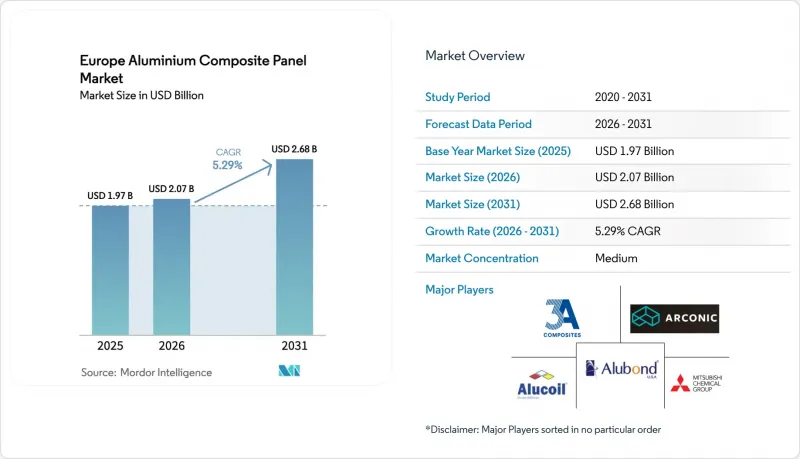
This report is Segmented by Top Coating (PE, PVDF, Other Top Coatings), Application (Interior Decoration, Hoarding and Signage, and More), End-User Industry (Building and Construction, Transportation, and Other End-User Industries), and Geography (Germany, United Kingdom, France, Italy, Spain, NORDICS Countries, and Rest of Europe). The Market Forecasts are Provided in Terms of Value (USD).
Europe Aluminium Composite Panel Market Trends and Insights
Stricter European Union Fire-Safety Codes Boosting A2 and FR Cores
Post-Grenfell regulations eliminated polyethylene-core panels from high-rise specifications across several member states. The UK banned combustible facades above 18 m in 2018, Germany adopted similar limits for buildings above 7 m, and France applied A2-s2,d0 rules on towers over 28 m. These measures have raised demand for mineral-filled cores despite a EUR 15-20 per m2 price premium. National testing differences continue, yet a 2024 working group under EUMEPS signaled progress toward harmonization. Suppliers that already hold full-scale facade certifications are poised to benefit.
Renovation Wave Under EU Green Deal Needs Lightweight Cladding
The Renovation Wave aims to retrofit 35 million buildings by 2030, doubling the annual energy renovation rate. Lightweight ACP over-cladding adds only 5-7 kg per m2, enabling installers to place new insulation without structural reinforcement. Poland, Germany, and Spain earmark Recovery and Resilience funds for such work, and performance standards in the recast Energy Performance of Buildings Directive kick in from 2028. The project flow depends on streamlined permitting and a trained installer base; however, the long-term horizon secures a demand floor through 2050.
Aluminium Price Volatility Post-Ukraine War
Sanctions on Russian metal, high European energy tariffs, and freight premiums lifted LME aluminium to USD 2,400 per tonne in early 2024. Regional smelters curtailed output by 15% compared with 2019, and import duties rose further after the 2025 U.S. tariff round. Fabricators hedge three to six months of exposure but still face margin compression. Many now source recycled coils that carry a USD 200-300 discount and 95% lower embodied carbon, though surface-quality limits keep recycled content below 30% in architectural grades.
Other drivers and restraints analyzed in the detailed report include:
- Rapid Uptake of PVDF Coatings for Durability and Aesthetics
- Growth of Digitally Printed ACPs for Smart Facades and DOOH Ads
- Re-Cladding Liabilities on Combustible PE Cores
For complete list of drivers and restraints, kindly check the Table Of Contents.
Segment Analysis
PVDF finishes dominated the European aluminium composite panel market, accounting for a 59.65% share in 2025, and are on track for a 6.35% CAGR to 2031. The European aluminium composite panel market size for PVDF-coated products benefits from 25-year warranty norms and a proven track record in harsh climates. Architects in coastal regions of Germany, France, and Spain are increasingly viewing polyester as a lifecycle cost risk. Supply tightness in 2024 exposed vulnerabilities, yet substitution remained limited due to warranty requirements and color-retention policies.
PVDF's premium of EUR 5-8 per m2 equates to less than 1% of installed facade cost, making the upgrade decision straightforward for Class A offices, airports, and hospitality assets. Coil coaters that control their own fluoropolymer sourcing, such as 3A Composites, preserved delivery slots even during resin shortages, reinforcing their competitive edge. Polyester retains its share in interior decoration and temporary signage, but its growth lags the headline market.
Complete Report Scope:
- Top Coating
- PE (Polyester)
- PVDF (Polyvinylidene Fluoride)
- Other Top Coatings
- Application
- Interior Decoration
- Hoarding and Signage
- Insulation
- Cladding
- Railway Carrier
- Column Cover and Beam Wrap
- End-User Industry
- Building and Construction
- Transportation (Rail, Auto, Bus, Marine)
- Other End-User Industries
- By Geography
- Germany
- United Kingdom
- France
- Italy
- Spain
- NORDICS Countries
- Rest of Europe
List of Companies Covered in this Report:
- 3A Composites
- Alubond USA
- ALUCOIL
- Alumax Europe GmbH
- Arconic Inc.
- Euramax
- Euro Panel Products Pvt Ltd
- Fairview
- Guangzhou Goodsense Decorative Building Materials Co., Ltd.
- Jyi Shyang Industrial Co., Ltd.
- Mitsubishi Chemical Corporation
- Mulford
- STACBOND
- Valcan
- Xxentria
- Yingjia Aluminium Co. Ltd
Additional Benefits:
- The market estimate (ME) sheet in Excel format
- 3 months of analyst support
TABLE OF CONTENTS
1 Introduction
- 1.1 Study Assumptions and Market Definition
- 1.2 Scope of the Study
2 Research Methodology
3 Executive Summary
4 Market Landscape
- 4.1 Market Overview
- 4.2 Market Drivers
- 4.2.1 Stricter European Union fire-safety codes boosting A2 and FR cores
- 4.2.2 Renovation wave under EU Green Deal needs lightweight cladding
- 4.2.3 Rapid uptake of PVDF coatings for durability and aesthetics
- 4.2.4 Growth of digitally printed ACPs for smart facades and DOOH ads
- 4.2.5 Hydrogen-rail car lightweighting demand for ACP skins
- 4.3 Market Restraints
- 4.3.1 Aluminium price volatility post-Ukraine war
- 4.3.2 Re-cladding liabilities on combustible PE cores
- 4.3.3 PVDF resin shortages due to battery-sector demand
- 4.4 Value Chain Analysis
- 4.5 Porter's Five Forces
- 4.5.1 Bargaining Power of Suppliers
- 4.5.2 Bargaining Power of Consumers
- 4.5.3 Threat of New Entrants
- 4.5.4 Threat of Substitute Products and Services
- 4.5.5 Degree of Competition
5 Market Size and Growth Forecasts (Value)
- 5.1 Top Coating
- 5.1.1 PE (Polyester)
- 5.1.2 PVDF (Polyvinylidene Fluoride)
- 5.1.3 Other Top Coatings
- 5.2 Application
- 5.2.1 Interior Decoration
- 5.2.2 Hoarding and Signage
- 5.2.3 Insulation
- 5.2.4 Cladding
- 5.2.5 Railway Carrier
- 5.2.6 Column Cover and Beam Wrap
- 5.3 End-User Industry
- 5.3.1 Building and Construction
- 5.3.2 Transportation (Rail, Auto, Bus, Marine)
- 5.3.3 Other End-User Industries
- 5.4 By Geography
- 5.4.1 Germany
- 5.4.2 United Kingdom
- 5.4.3 France
- 5.4.4 Italy
- 5.4.5 Spain
- 5.4.6 NORDICS Countries
- 5.4.7 Rest of Europe
6 Competitive Landscape
- 6.1 Market Concentration
- 6.2 Strategic Moves
- 6.3 Market Share(%)/Ranking Analysis
- 6.4 Company Profiles (includes Global level Overview, Market level overview, Core Segments, Financials as available, Strategic Information, Market Rank/Share for key companies, Products and Services, and Recent Developments)
- 6.4.1 3A Composites
- 6.4.2 Alubond USA
- 6.4.3 ALUCOIL
- 6.4.4 Alumax Europe GmbH
- 6.4.5 Arconic Inc.
- 6.4.6 Euramax
- 6.4.7 Euro Panel Products Pvt Ltd
- 6.4.8 Fairview
- 6.4.9 Guangzhou Goodsense Decorative Building Materials Co., Ltd.
- 6.4.10 Jyi Shyang Industrial Co., Ltd.
- 6.4.11 Mitsubishi Chemical Corporation
- 6.4.12 Mulford
- 6.4.13 STACBOND
- 6.4.14 Valcan
- 6.4.15 Xxentria
- 6.4.16 Yingjia Aluminium Co. Ltd
7 Market Opportunities and Future Outlook
- 7.1 White-space and Unmet-Need Assessment

