PUBLISHER: Mordor Intelligence | PRODUCT CODE: 2117277

PUBLISHER: Mordor Intelligence | PRODUCT CODE: 2117277
E-commerce App - Market Share Analysis, Industry Trends & Statistics, Growth Forecasts (2026 - 2031)
According to Mordor Intelligence, the e-commerce app market size is projected to be USD 3.19 trillion in 2025, USD 3.48 trillion in 2026, and reach USD 5.07 trillion by 2031, growing at a CAGR of 7.82% from 2026 to 2031.
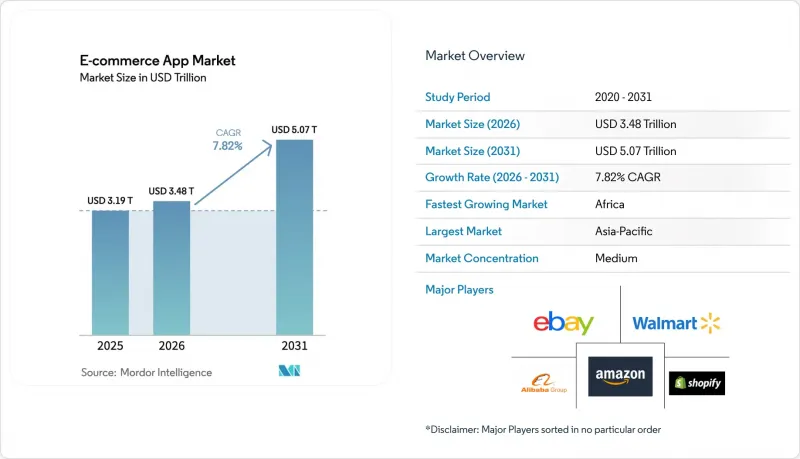
This report is Segmented by Type (Advertisement, Transaction Fees, Subscription Fees, and More), Platform (Android, IOS, and More), Business Model (B2C Marketplace, B2B Marketplace, C2C/Peer-to-Peer, and More), Product Category (Fashion and Apparel, Electronics and Media, Grocery and FMCG, Home and Furniture, Health and Beauty, and More), and Geography. The Market Forecasts are Provided in Terms of Value (USD).
Global E-commerce App Market Trends and Insights
Proliferation of 5G Enhancing Mobile-Commerce Experiences
Single-digit-millisecond latency on 5G enables rich product visualization that had stalled on 4G. In South Korea, 5G penetration reached 50% in 2024, and AR-enabled listings achieved a 2.3x click-through rate compared to static images. Retailers exploit network slicing to guarantee sub-50-millisecond checkout during flash sales, curbing the USD 18 billion in annual losses from cart abandonment. Telcos are also bundling zero-rated data plans that subsidize app usage in price-sensitive markets across Southeast Asia and Latin America, thereby boosting e-commerce app adoption.
Rapid Expansion of Buy-Now-Pay-Later Integrations
BNPL accounted for 9.8% of U.S. e-commerce transactions in 2024, but its reclassification as credit card lending now imposes Regulation Z dispute-resolution obligations that may inflate compliance costs by USD 1.2 billion annually. Despite tighter oversight, PayPal disclosed that BNPL users exhibit a 35% higher lifetime value than one-time buyers, validating installment flexibility as a demand catalyst. Incumbents able to underwrite risk with proprietary data will likely widen moats as the e-commerce app market evolves.
Intensifying Regulatory Scrutiny on App Tracking Transparency
Opt-in rates for Apple's App Tracking Transparency framework slipped to 25% by 2024, severing cross-app identifier graphs that powered retargeting and costing Meta an estimated USD 10 billion in mobile-ad revenue. The European Union levied EUR 2.1 billion in GDPR fines on non-compliant e-commerce apps during 2023-2024, forcing developers to rebuild consent flows that capture 40% less first-session data. Platforms now pivot toward contextual ads and first-party loyalty schemes, yet short-term revenue pressure persists across the e-commerce app market.
Other drivers and restraints analyzed in the detailed report include:
- Growing Social-Commerce Convergence via Short-Video Platforms
- AI-Driven Personalization Increasing Average Order Value
- Escalating Cross-Border Logistics Costs for SMEs
For complete list of drivers and restraints, kindly check the Table Of Contents.
Segment Analysis
Transaction fees accounted for 39.34% of revenue share in 2025, as marketplaces monetized every completed sale, yet subscription fees are on track to expand at an 8.82% CAGR through 2031. Amazon Prime exemplifies the model with 230 million members who contributed USD 40 billion in annual fees during 2025, cushioning revenue against discretionary slowdowns. Rising subscription uptake indicates that predictable logistics perks and exclusive drops outweigh the perceived loss of flexibility for many shoppers, a trend expected to deepen as the e-commerce app market matures.
Recurring billing is increasingly supported by the regulatory framework. Europe's Digital Markets Act prohibits the mandatory use of proprietary payment systems, thereby reducing the dominance of in-app commissions associated with transaction fees. E-commerce applications that integrate transaction income with subscription models experience a 30% decrease in revenue volatility, emphasizing the benefits of diversification.
Android maintained 72.67% of the installed base in 2025, propelled by sub-USD 100 devices popular in Asia and Africa. iOS captured just 19% of downloads but 45% of GMV, driven by affluent user cohorts in North America and Europe. In 2025, WeChat boasted 4.5 million mini-programs on its super-app platform, collectively handling transactions worth USD 420 billion, marking an impressive 8.24% CAGR for the segment.
Mini-programs inherit parent-app credentials and payment methods, boosting retention compared with standalone apps, which lose 70% of new installs within 30 days. China's regulators now require business license displays in mini-programs, raising compliance overhead while solidifying consumer trust. Although North American antitrust scrutiny chills super-app expansion, mini-program traction across Asia positions the format as a durable growth pillar in the e-commerce app market.
Complete Report Scope:
- By Type
- In-app Purchases
- Advertisements
- Subscription Fees
- Transaction Fees
- Freemium Upsell
- By Platform
- Android
- iOS
- Super-App Mini-Programs
- By Business Model
- B2C Marketplace
- B2B Marketplace
- C2C / Peer-to-Peer
- Direct-to-Consumer Brand App
- By Product Category
- Fashion and Apparel
- Electronics and Media
- Grocery and FMCG
- Home and Furniture
- Health and Beauty
- Other Product Categories
- By Geography
- North America
- United States
- Canada
- Mexico
- Europe
- Germany
- United Kingdom
- France
- Russia
- Rest of Europe
- Asia-Pacific
- China
- Japan
- India
- South Korea
- Australia
- Rest of Asia-Pacific
- Middle East and Africa
- Middle East
- Saudi Arabia
- United Arab Emirates
- Rest of Middle East
- Africa
- South Africa
- Egypt
- Rest of Africa
- Middle East
- South America
- Brazil
- Argentina
- Rest of South America
- North America
Geography Analysis
Asia-Pacific generated 42.48% of 2025 revenue, as China's super-app ecosystems embedded retail, payments, and social networking into a single platform, processing 4.5 million daily mini-program transactions. India's Unified Payments Interface cleared 11.6 billion monthly transactions, enabling even street vendors to accept QR-code payments through Paytm and PhonePe. Southeast Asia's live-stream commerce hit USD 180 billion in GMV, compressing discovery-to-purchase cycles to sub-100 seconds.
North America held a 28% share in 2025, with the United States contributing USD 820 billion as Amazon Prime's 180 million domestic members fueled one-day shipping economics. Mexico's app penetration jumped to 48% on the back of MercadoPago micro-loans that extend credit to unbanked consumers. California's Consumer Privacy Act curtailed third-party data sharing, forcing a pivot toward contextual ad strategies across the e-commerce app market.In accordance with the Digital Markets Act, Europe mandated interoperable payments, resulting in an 8 to 12 percentage point reduction in gatekeeper take rates, thereby benefiting third-party developers. Following Brexit, customs frictions extended delivery times in the United Kingdom by 5 days, necessitating dual-fulfillment footprints and consequently increasing logistics costs. While Russia encountered challenges due to payment-network sanctions, these were partially mitigated by the country's domestic Mir rails.
Africa is the fastest-growing region at an 8.89% CAGR, propelled by mobile-money interoperability that cuts cross-border fees from 7% to under 1%. Jumia adopted a 60% cash-on-delivery model in Nigeria and Egypt, deploying GPS-tagged drop-off points where formal addresses are scarce. Implementation lags under the African Continental Free Trade Area still leave customs clearance at 7-10 days, a barrier ripe for digital brokers. Brazil's Pix processed 3.2 billion monthly instant-payment transactions, evaporating three-day settlement lags. MercadoLibre's 1,800 fulfillment sites now enable next-day delivery in major metros, raising service expectations across the region. Argentina's consumers lean on installment plans to hedge against inflationary erosion, underscoring macro volatility's sway over the e-commerce app market.
Middle East markets reached 48% penetration in 2025, buoyed by mandates requiring businesses with annual revenue above SAR 1 million to accept digital payments. Noon and Amazon.ae compete on same-day service despite the 45-degree Celsius summers that challenge perishable logistics. The UAE's VAT-refund app allows tourists to instantly reclaim taxes on eligible purchases, providing a seamless and efficient process. This initiative has significantly contributed to a 14% increase in luxury app purchases, highlighting its positive impact on consumer spending within the country.
- Amazon.com, Inc.
- eBay Inc.
- Walmart Inc.
- Alibaba Group Holding Limited
- Shopify Inc.
- Etsy, Inc.
- Tata UniStore Limited
- Reliance Retail Limited
- Fashnear Technologies Private Limited
- Roadget Business Pte. Ltd.
- MercadoLibre, Inc.
- Flipkart Internet Private Limited
- Rakuten Group, Inc.
- Lazada Group SA
- Shopee Pte. Ltd.
- JD.com, Inc.
- Zalando SE
- Jumia Technologies AG
- Coupang, Inc.
- Alibaba.com Hong Kong Limited
Additional Benefits:
- The market estimate (ME) sheet in Excel format
- 3 months of analyst support
TABLE OF CONTENTS
1 INTRODUCTION
- 1.1 Study Assumptions and Market Definition
- 1.2 Scope of the Study
2 RESEARCH METHODOLOGY
3 EXECUTIVE SUMMARY
4 MARKET LANDSCAPE
- 4.1 Market Overview
- 4.2 Market Drivers
- 4.2.1 Proliferation of 5G Enhancing Mobile-Commerce Experiences
- 4.2.2 Rapid Expansion of Buy-Now-Pay-Later (BNPL) Integrations
- 4.2.3 Growing Social-Commerce Convergence via Short-Video Platforms
- 4.2.4 AI-Driven Personalization Increasing Average Order Value
- 4.2.5 Rising Penetration of Affordable Smartphones in Emerging Economies
- 4.2.6 Government Push for Digital Payments and e-Invoices
- 4.3 Market Restraints
- 4.3.1 Intensifying Regulatory Scrutiny on App Tracking Transparency
- 4.3.2 Escalating Cross-Border Logistics Costs for SMEs
- 4.3.3 Heightened Consumer Concerns Around Data Privacy Breaches
- 4.3.4 Talent Shortage in Mobile Cyber-Security Engineering
- 4.4 Industry Value Chain Analysis
- 4.5 Regulatory Landscape
- 4.6 Technological Outlook
- 4.7 Impact of Macroeconomic Factors on the Market
- 4.8 Porter's Five Forces Analysis
- 4.8.1 Bargaining Power of Suppliers
- 4.8.2 Bargaining Power of Buyers
- 4.8.3 Threat of New Entrants
- 4.8.4 Threat of Substitutes
- 4.8.5 Intensity of Competitive Rivalry
5 MARKET SIZE AND GROWTH FORECASTS (VALUE)
- 5.1 By Type
- 5.1.1 In-app Purchases
- 5.1.2 Advertisements
- 5.1.3 Subscription Fees
- 5.1.4 Transaction Fees
- 5.1.5 Freemium Upsell
- 5.2 By Platform
- 5.2.1 Android
- 5.2.2 iOS
- 5.2.3 Super-App Mini-Programs
- 5.3 By Business Model
- 5.3.1 B2C Marketplace
- 5.3.2 B2B Marketplace
- 5.3.3 C2C / Peer-to-Peer
- 5.3.4 Direct-to-Consumer Brand App
- 5.4 By Product Category
- 5.4.1 Fashion and Apparel
- 5.4.2 Electronics and Media
- 5.4.3 Grocery and FMCG
- 5.4.4 Home and Furniture
- 5.4.5 Health and Beauty
- 5.4.6 Other Product Categories
- 5.5 By Geography
- 5.5.1 North America
- 5.5.1.1 United States
- 5.5.1.2 Canada
- 5.5.1.3 Mexico
- 5.5.2 Europe
- 5.5.2.1 Germany
- 5.5.2.2 United Kingdom
- 5.5.2.3 France
- 5.5.2.4 Russia
- 5.5.2.5 Rest of Europe
- 5.5.3 Asia-Pacific
- 5.5.3.1 China
- 5.5.3.2 Japan
- 5.5.3.3 India
- 5.5.3.4 South Korea
- 5.5.3.5 Australia
- 5.5.3.6 Rest of Asia-Pacific
- 5.5.4 Middle East and Africa
- 5.5.4.1 Middle East
- 5.5.4.1.1 Saudi Arabia
- 5.5.4.1.2 United Arab Emirates
- 5.5.4.1.3 Rest of Middle East
- 5.5.4.2 Africa
- 5.5.4.2.1 South Africa
- 5.5.4.2.2 Egypt
- 5.5.4.2.3 Rest of Africa
- 5.5.4.1 Middle East
- 5.5.5 South America
- 5.5.5.1 Brazil
- 5.5.5.2 Argentina
- 5.5.5.3 Rest of South America
- 5.5.1 North America
6 COMPETITIVE LANDSCAPE
- 6.1 Market Concentration
- 6.2 Strategic Moves
- 6.3 Market Share Analysis
- 6.4 Company Profiles (includes Global Level Overview, Market Level Overview, Core Segments, Financials as Available, Strategic Information, Market Rank/Share for Key Companies, Products and Services, and Recent Developments)
- 6.4.1 Amazon.com, Inc.
- 6.4.2 eBay Inc.
- 6.4.3 Walmart Inc.
- 6.4.4 Alibaba Group Holding Limited
- 6.4.5 Shopify Inc.
- 6.4.6 Etsy, Inc.
- 6.4.7 Tata UniStore Limited
- 6.4.8 Reliance Retail Limited
- 6.4.9 Fashnear Technologies Private Limited
- 6.4.10 Roadget Business Pte. Ltd.
- 6.4.11 MercadoLibre, Inc.
- 6.4.12 Flipkart Internet Private Limited
- 6.4.13 Rakuten Group, Inc.
- 6.4.14 Lazada Group SA
- 6.4.15 Shopee Pte. Ltd.
- 6.4.16 JD.com, Inc.
- 6.4.17 Zalando SE
- 6.4.18 Jumia Technologies AG
- 6.4.19 Coupang, Inc.
- 6.4.20 Alibaba.com Hong Kong Limited
7 MARKET OPPORTUNITIES AND FUTURE OUTLOOK
- 7.1 White-Space and Unmet-Need Assessment

