PUBLISHER: Mordor Intelligence | PRODUCT CODE: 2117283

PUBLISHER: Mordor Intelligence | PRODUCT CODE: 2117283
Menstrual Health Apps - Market Share Analysis, Industry Trends & Statistics, Growth Forecasts (2026 - 2031)
According to Mordor Intelligence, the menstrual health apps market size is expected to grow from USD 1.46 billion in 2025 to USD 1.60 billion in 2026 and is forecast to reach USD 2.52 billion by 2031 at 9.51% CAGR over 2026-2031.
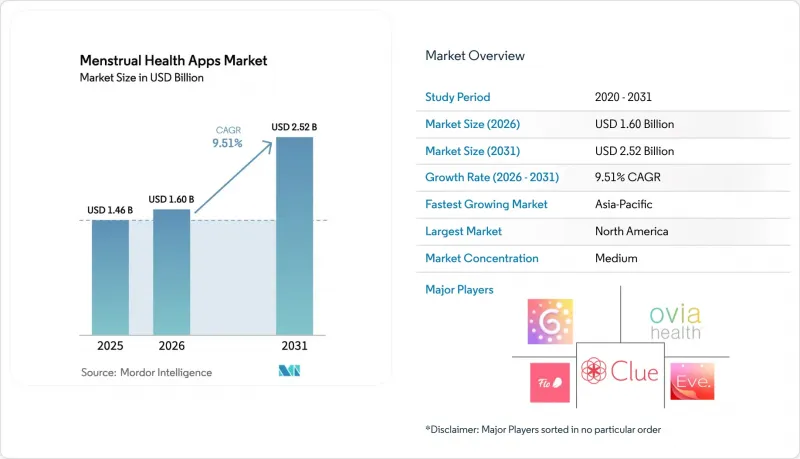
This report is Segmented by Application (Period Cycle Tracking, Fertility & Ovulation Management, Menstrual Health Management & Symptom Analytics), Platform (Android, IOS, Others), Age Group (15-24 Years, 25-34 Years, 35-44 Years, 45+ Years), and Geography (North America, Europe, Asia-Pacific, Middle East and Africa, South America). The Market Forecasts are Provided in Terms of Value (USD).
Global Menstrual Health Apps Market Trends and Insights
Increased Awareness of Menstrual and Reproductive Health
Public-health campaigns reframing menstruation as a rights issue rather than a hygiene concern are widening the menstrual health apps market in low-income regions. UNFPA's 2024 initiative integrated cycle literacy into secondary curricula across 12 nations, while Unicharm India's school program reached 760,000 adolescents by mid-2025, normalizing app use among first-time trackers. Maven Clinic's employer agreements with Amazon, AT&T, and Microsoft convert awareness into enterprise revenue, sidestepping direct-to-consumer acquisition costs. Japan's health ministry logged a 23% annual rise in menstrual-leave claims in fiscal 2024, and downloads of Unicharm's Sofy app crossed 3.37 million by June 2025, illustrating how policy normalization can accelerate digital adoption. Cultural destigmatization is also visible on social media, where Gen Z users share symptom-tracking screenshots, reinforcing peer-to-peer diffusion and deepening the menstrual health apps market footprint. The net result is a broader funnel of novice users who often transition from free tracking to premium analytics within six months.
Rising Smartphone and Mobile-Internet Penetration
GSMA tallied 1.8 billion mobile subscribers and 1.4 billion mobile-internet users across Asia Pacific in 2024, with India's smartphone penetration hitting 54% and Indonesia's at 68%, pushing the menstrual health apps market into millions of new hands. Adjust's 2025 trends report scored Asia Pacific 45, the highest global growth index for health and fitness apps, while India's average cost-per-install sat at USD 0.03, enabling scale acquisition under tight budgets. Android's 57.61% market share in 2025 mirrors this dynamic, yet iOS is expanding faster at a 10.41% CAGR because Apple's multi-device lock-in lifts switching costs. The diverging economics compel dual strategies: Android apps chase volume through ad-supported freemium tiers, whereas iOS apps monetize via annual subscriptions enhanced by wearables. Accelerating 4G rollouts in Africa and Latin America are expected to echo Asia's pattern, setting up the menstrual health apps market for sustained double-digit regional growth.
Growing Data-Privacy and Cyber-Security Concerns
The Federal Trade Commission's 2021 settlement with Flo Health mandates independent privacy audits through 2041, making the case a perpetual reminder of liability in the menstrual health apps market. Mozilla's 2022 review showed 72% of period apps lacked transparent deletion policies, while 40% skipped encryption in transit. California's Delete Act, effective 2026, requires one-click erasure across all brokers, while Connecticut's SB 3 bans geofencing around reproductive-health clinics, raising compliance complexity. Apple's HealthKit integration rules introduced in 2025 now require third-party security assessments, a cost shock for early-stage developers. Together, these frameworks amplify user skepticism and inflate legal budgets, slightly dampening the menstrual health apps market growth rate.
Other drivers and restraints analyzed in the detailed report include:
- Integration with Smart Wearables and Health OS Ecosystems
- Freemium and Subscription Models Accelerating ARPU
- Algorithmic Accuracy and Regulatory Scrutiny of Health Claims
For complete list of drivers and restraints, kindly check the Table Of Contents.
Segment Analysis
Menstrual Health Management and Symptom Analytics is projected to expand at a 10.34% CAGR to 2031, outrunning the broader menstrual health apps market thanks to demand for predictive insights that go beyond ovulation timing. Period Cycle Tracking maintained 45.56% of 2025 revenue, but commoditization looms as Apple and Google continue bundling basic calendars for free. The menstrual health apps market size for symptom analytics is forecast to add nearly USD 420 million in new value over the outlook period, while anomaly alerts for endometriosis and polycystic ovary syndrome help users seek care earlier, tightening links with clinicians.
Flo's November 2025 study of 19 million users confirmed statistically robust correlations between luteal-phase progesterone and symptoms like mood fluctuations, prompting the platform to surface personalized clinical prompts. Natural Cycles rolled out NC° Perimenopause in October 2025, signaling that life-stage verticals can extend customer lifetime value. Fertility & Ovulation Management remains a middle-ground monetizer, but Ava's FDA-cleared bracelet automates data capture via overnight wrist sensors, raising the competitive bar for manual-entry apps. As symptom analytics secure scientific validation, payer acceptance inside employer and insurer benefits is expected to rise, adding an enterprise layer to the menstrual health apps market.
Complete Report Scope:
- By Application
- Period Cycle Tracking
- Fertility & Ovulation Management
- Menstrual Health Management & Symptom Analytics
- By Platform
- Android
- iOS
- Others
- By Age Group
- 15 - 24 Years
- 25 - 34 Years
- 35 - 44 Years
- 45 + Years (Peri- & Post-menopause)
- Geography
- North America
- United States
- Canada
- Mexico
- Europe
- Germany
- United Kingdom
- France
- Italy
- Spain
- Rest of Europe
- Asia-Pacific
- China
- Japan
- India
- Australia
- South Korea
- Rest of Asia-Pacific
- Middle East and Africa
- GCC
- South Africa
- Rest of Middle East and Africa
- South America
- Brazil
- Argentina
- Rest of South America
- North America
Geography Analysis
North America represented 42.12% of 2025 revenue in the menstrual health apps market, lifted by employer benefits, FDA-cleared contraceptive apps, and high smartphone penetration. RevenueCat's 2025 dashboard places median Year-1 value per payer at USD 95.40 in the region, reflecting willingness to pay for premium analytics. Post-Dobbs privacy anxieties spurred California, Connecticut, and Washington to pass consent laws for geolocation and browsing-history linkage, raising compliance overhead for smaller providers.
Europe mirrors North America's regulatory intensity under GDPR and the incoming AI Act, yet Spain's menstrual-leave law and German employer uptake are turning policy into revenue funnels. Asia Pacific is the fastest-growing cluster at 10.59% CAGR, fueled by affordable smartphones and favorable policy, such as Karnataka's 2025 menstrual-leave mandate. GSMA reports 1.8 billion subscribers in the region, underpinning a giant addressable base.
Middle East and Africa and South America are nascent but promising. Brazil's Pix instant-payment network reached 150 million users in 2024, lowering friction for subscription conversions. South African insurers like Discovery Health are piloting cycle-tracking rewards, and Gulf Cooperation Council countries combine near-universal smartphone ownership with cultural guardedness, requiring physician referrals over mainstream marketing.
- Apple Inc. (Cycle Tracking)
- Ava Science
- Bellabeat Inc.
- Biowink GmbH (Clue)
- Eve
- Fitbit
- Flo Health
- Glow Inc.
- GP Apps - Simple Design
- Kindara
- MagicGirl
- Maven Clinic
- Meiyou (Xiamen Meiyou)
- Natural Cycles Nordic AB
- Ovia Health
- Perigee (Cycles)
- Period Tracker by GP Apps
- Planned Parenthood (Spot On)
- Stardust
- Wildflower Health
- Withings SA
Additional Benefits:
- The market estimate (ME) sheet in Excel format
- 3 months of analyst support
TABLE OF CONTENTS
1 Introduction
- 1.1 Study Assumptions & Market Definition
- 1.2 Scope of the Study
2 Research Methodology
3 Executive Summary
4 Market Landscape
- 4.1 Market Overview
- 4.2 Market Drivers
- 4.2.1 Increased awareness of menstrual & reproductive health
- 4.2.2 Rising smartphone & mobile-internet penetration
- 4.2.3 Integration with smart-wearables & health-OS ecosystems
- 4.2.4 Freemium & subscription models accelerating ARPU
- 4.2.5 Menstrual-leave legislation catalysing employer uptake
- 4.2.6 Decentralised health-data wallets enabling trust-based onboarding
- 4.3 Market Restraints
- 4.3.1 Growing data-privacy & cyber-security concerns
- 4.3.2 Algorithmic accuracy & regulatory scrutiny of health claims
- 4.3.3 Post-Roe legal discovery risks for U.S. user data
- 4.3.4 Stricter app-store policies on sensitive health data
- 4.4 Value / Supply-Chain Analysis
- 4.5 Regulatory Landscape
- 4.6 Technological Outlook
- 4.7 Porter's Five Forces Analysis
- 4.7.1 Threat of New Entrants
- 4.7.2 Bargaining Power of Buyers / Consumers
- 4.7.3 Bargaining Power of Suppliers
- 4.7.4 Threat of Substitute Products
- 4.7.5 Intensity of Competitive Rivalry
5 Market Size & Growth Forecasts (Value, USD)
- 5.1 By Application
- 5.1.1 Period Cycle Tracking
- 5.1.2 Fertility & Ovulation Management
- 5.1.3 Menstrual Health Management & Symptom Analytics
- 5.2 By Platform
- 5.2.1 Android
- 5.2.2 iOS
- 5.2.3 Others
- 5.3 By Age Group
- 5.3.1 15 - 24 Years
- 5.3.2 25 - 34 Years
- 5.3.3 35 - 44 Years
- 5.3.4 45 + Years (Peri- & Post-menopause)
- 5.4 Geography
- 5.4.1 North America
- 5.4.1.1 United States
- 5.4.1.2 Canada
- 5.4.1.3 Mexico
- 5.4.2 Europe
- 5.4.2.1 Germany
- 5.4.2.2 United Kingdom
- 5.4.2.3 France
- 5.4.2.4 Italy
- 5.4.2.5 Spain
- 5.4.2.6 Rest of Europe
- 5.4.3 Asia-Pacific
- 5.4.3.1 China
- 5.4.3.2 Japan
- 5.4.3.3 India
- 5.4.3.4 Australia
- 5.4.3.5 South Korea
- 5.4.3.6 Rest of Asia-Pacific
- 5.4.4 Middle East and Africa
- 5.4.4.1 GCC
- 5.4.4.2 South Africa
- 5.4.4.3 Rest of Middle East and Africa
- 5.4.5 South America
- 5.4.5.1 Brazil
- 5.4.5.2 Argentina
- 5.4.5.3 Rest of South America
- 5.4.1 North America
6 Competitive Landscape
- 6.1 Market Concentration
- 6.2 Market Share Analysis
- 6.3 Company Profiles (includes Global level Overview, Market level overview, Core Segments, Financials as available, Strategic Information, Market Rank/Share, Products & Services, Recent Developments)
- 6.3.1 Apple Inc. (Cycle Tracking)
- 6.3.2 Ava Science
- 6.3.3 Bellabeat Inc.
- 6.3.4 Biowink GmbH (Clue)
- 6.3.5 Eve
- 6.3.6 Fitbit Inc.
- 6.3.7 Flo Health
- 6.3.8 Glow Inc.
- 6.3.9 GP Apps - Simple Design
- 6.3.10 Kindara
- 6.3.11 MagicGirl
- 6.3.12 Maven Clinic
- 6.3.13 Meiyou (Xiamen Meiyou)
- 6.3.14 Natural Cycles Nordic AB
- 6.3.15 Ovia Health
- 6.3.16 Perigee (Cycles)
- 6.3.17 Period Tracker by GP Apps
- 6.3.18 Planned Parenthood (Spot On)
- 6.3.19 Stardust
- 6.3.20 Wildflower Health
- 6.3.21 Withings SA
7 Market Opportunities & Future Outlook
- 7.1 White-space & Unmet-need Assessment

