PUBLISHER: Mordor Intelligence | PRODUCT CODE: 2117287

PUBLISHER: Mordor Intelligence | PRODUCT CODE: 2117287
Low-Cost Carrier - Market Share Analysis, Industry Trends & Statistics, Growth Forecasts (2026 - 2031)
According to Mordor Intelligence, the low-cost carrier market size is expected to grow from USD 276.20 million in 2025 to USD 330.24 million in 2026 and is forecasted to reach USD 704.58 million by 2031 at a 16.36% CAGR over 2026-2031.
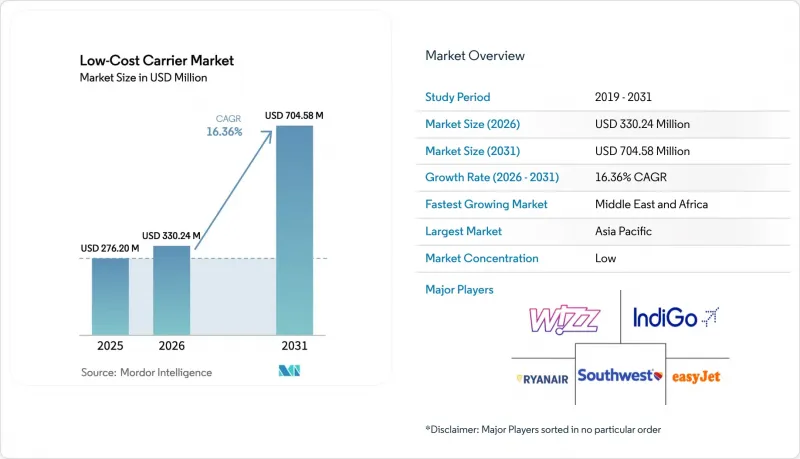
This report is Segmented by Aircraft Type (Narrowbody and Widebody), Destination (Domestic and International), Haul Length (Short-Haul, Medium-Haul, and Long-Haul), Distribution Channel (Online Direct and Travel Agency), and Geography (North America, Europe, Asia-Pacific, South America, and the Middle East and Africa). The Market Forecasts are Provided in Terms of Value (USD).
Global Low-Cost Carrier Market Trends and Insights
Sustained Growth in Price-Sensitive Leisure and VFR Travel Demand
Visiting friends and relatives account for 20-30% of international passengers and exhibit higher price elasticity than business travel, steering volumes toward fares that undercut legacy carriers by 30-50%. India's middle-class expansion has driven demand for one-way flights under USD 50, pushing IndiGo past 2,000 daily flights by the third quarter of FY2025. High-frequency immigrant corridors, such as the South Asia-Gulf, South America-US, and Eastern-Western Europe, buffer load factors during downturns because the trips are quasi-essential. Dynamic pricing now splits long weekends across multiple fare buckets, boosting yield without undermining occupancy. The rise of independent travel shifts bookings to direct channels where carriers capture every ancillary dollar. Mobile penetration exceeds 70% at leading low-cost carriers, enabling push offers that monetize seats, bags, meals, and insurance just moments before departure.
Single-Type Fleet Strategies Enabling Cost-Efficient Narrowbody Operations
Operating a single aircraft family simplifies training, parts inventory, and crew-rostering complexity, yielding durable cost advantages. Ryanair's all-B737 model and Southwest's B737 focus allow shared pilot pools and minimal standby staff. The A320neo family burns 15-20% less fuel than earlier variants, reducing direct operating expenses by 30-40%. IndiGo secured 500 A320neo-family deliveries in 2023, insulating itself from lease-rate increases as OEM backlogs extend beyond seven years. Uniform cabins reduce ground time; easyJet's standardized galleys and single-class seats enable sub-30-minute turns, supporting 11-13 hours of daily utilization.
Structural Aircraft and Engine Supply Chain Constraints Limiting Fleet Growth
Airbus planned to deliver up to 800 jets in 2025, yet faced CFM LEAP engine shortages and fuselage quality snags that slowed handovers. Boeing's B737 MAX line also lagged targets after manufacturing audits, forcing many low-cost carriers to extend leases on older aircraft. Lease rates for A321neo and B737 MAX variants rose more than 15% in 2024-2025, compressing returns when fuel savings fail to offset higher capital costs. With order backlogs stretching back more than 7 years, carriers cannot scale their fleets fast enough to capture demand spikes, thereby throttling market growth.
Other drivers and restraints analyzed in the detailed report include:
- Liberalization of Air-Service Agreements Expanding Point-to-Point Connectivity
- High Aircraft Utilization and Quick-Turnaround Operating Models
- Rising Environmental Compliance Costs on Short-Haul Aviation
For complete list of drivers and restraints, kindly check the Table Of Contents.
Segment Analysis
Narrowbody jets generated 82.01% of capacity in 2025, underscoring their status as the economic backbone of the low-cost carrier market. They remain crucial because runways, gate sizes, and passenger volumes across secondary airports are tailored to single-aisle operations. The low-cost carrier market size attributable to narrowbodies is projected to keep rising at double-digit rates, fueled by A320neo and B737 MAX deliveries that cut per-trip fuel burn. Order backlogs protect fleet expansion plans through 2031 even under supply chain stress.
Widebody operations, though still niche, are expanding at a robust 16.87% CAGR as the 4,700-nautical-mile A321XLR unlocks long-thin routes such as Rome to Boston and Kuala Lumpur to Tokyo. Airlines like Norse Atlantic and AirAsia X demonstrate that dense, no-frills cabins can deliver sub-USD 200 transoceanic fares when load factors exceed 85%. Success hinges on high aircraft days of use and seat density; Norse's 338-seat B787 layout spreads ownership costs across more travelers. As utilization improves, the widebody slice of the low-cost carrier market could double by 2031, although slot scarcity at major long-haul airports remains a limiting factor.
Domestic services retained a 57.24% share of the low-cost carrier market in 2025 because of regulatory simplicity, quick turnaround times, and the absence of immigration procedures, which make trips under three hours profitable. In the US, Southwest, Frontier, and Allegiant collectively schedule thousands of daily legs, while IndiGo operates more than 2,000 domestic flights across 80 Indian cities. Domestic dominance will persist, but its CAGR lags as saturation sets in mature corridors.
International point-to-point flights are growing at an 18.01% CAGR because bilateral reforms have slashed entry barriers. The low-cost carrier market size for international routes is rising fastest along corridors such as South Asia-Middle East and Europe-Southeast Asia, following the EU-ASEAN pact. Air Arabia, flydubai, and Wizz Air are adding secondary city pairs that network carriers have long overlooked. Liberal policies, combined with the A321XLR's range, will expand this slice of the low-cost carrier market, although visas and currency volatility remain planning challenges.
Complete Report Scope:
- By Aircraft Type
- Narrowbody
- Widebody
- By Destination
- Domestic
- International
- By Haul Length
- Short-Haul
- Medium-Haul
- Long-Haul
- By Distribution Channel
- Online Direct
- Travel Agency
- By Geography
- North America
- United States
- Canada
- Mexico
- Europe
- United Kingdom
- France
- Germany
- Italy
- Spain
- Rest of Europe
- Asia-Pacific
- China
- India
- Japan
- South Korea
- Rest of Asia-Pacific
- South America
- Brazil
- Rest of South America
- Middle East and Africa
- Middle East
- Saudi Arabia
- United Arab Emirates
- Rest of Middle East
- Africa
- South Africa
- Rest of Africa
- Middle East
- North America
Geography Analysis
Asia-Pacific held 34.89% of the low-cost carrier market in 2025, anchored by India's double-digit domestic growth and Southeast Asia's open-skies reforms. However, engine shortages limit aircraft additions, creating pent-up demand that supports fare strength. China's Spring Airlines, Cebu Pacific, and VietJet continue to expand their regional routes, which bypass hubs such as Bangkok and Kuala Lumpur.
The Middle East and Africa region is the fastest growing, with a 17.43% CAGR to 2031, as Vision 2030 deregulation spurs new entrants and secondary airport upgrades in Saudi Arabia. flydubai's 150-plane B737 MAX order underscores ambition to link underserved city pairs across Africa and South Asia. In Europe, mature penetration slows growth, but not competition; Ryanair, easyJet, and Wizz Air, together, control more than 40% of intra-European ASKs, yet still chase niche, secondary city pairs.
North America witnessed Spirit Airlines' November 2024 Chapter 11 filing, following its blocked merger with JetBlue, which opened up valuable slots for rivals and signaled a regulatory determination to preserve fare competition. South America remains fragmented as carriers navigate currency fluctuations and fuel cost spikes, although Volaris and Viva Aerobus continue to expand cross-border into the US. Overall, geographic divergence influences the risk-reward profiles within the global low-cost carrier market.
- Southwest Airlines Co.
- Ryanair
- AirAsia Group Berhad
- Indigo (InterGlobe Aviation Limited)
- easyJet PLC
- JetBlue Airways Corporation
- Spirit Airlines
- Norse Atlantic ASA
- Wizz Air Group
- Jetstar Airways Pty Ltd
- GOL Linhas Aereas
- Concesionaria Vuela Compania de Aviacion, S.A.P.I. de C.V. (Volaris)
- Frontier Group Holdings Inc.
- Pegasus Hava TasImacIlIgI A.S. (Pegasus)
- VietJet Aviation
- Cebu Pacific
- Dubai Aviation Corporation
- flynas Company LCC
- Jazeera Airways K.S.C
- WestJet Airlines Ltd. (Sunwing Vacations Inc.)
Additional Benefits:
- The market estimate (ME) sheet in Excel format
- 3 months of analyst support
TABLE OF CONTENTS
1 INTRODUCTION
- 1.1 Study Assumptions and Market Definition
- 1.2 Scope of the Study
2 RESEARCH METHODOLOGY
3 EXECUTIVE SUMMARY
4 MARKET LANDSCAPE
- 4.1 Market Overview
- 4.2 Market Drivers
- 4.2.1 Sustained growth in price sensitive leisure and VFR travel demand
- 4.2.2 Single-type fleet strategies enabling cost-efficient narrowbody operations
- 4.2.3 Liberalization of air service agreements expanding point-to-point connectivity
- 4.2.4 High aircraft utilization and quick turnaround operating models
- 4.2.5 Scalable ancillary revenue ecosystems improving per-seat profitability
- 4.2.6 Access to low-cost secondary airports supporting ultra-low operating expenses
- 4.3 Market Restraints
- 4.3.1 Structural aircraft and engine supply chain constraints limiting fleet growth
- 4.3.2 Rising environmental compliance costs on short-haul aviation
- 4.3.3 Jet fuel price volatility impacting operating margins
- 4.3.4 Global pilot and maintenance workforce shortages increasing unit costs
- 4.4 Value Chain Analysis
- 4.5 Regulatory Outlook
- 4.6 Technological Outlook
- 4.7 Porter's Five Forces Analysis
- 4.7.1 Bargaining Power of Buyers
- 4.7.2 Bargaining Power of Suppliers
- 4.7.3 Threat of New Entrants
- 4.7.4 Threat of Substitutes
- 4.7.5 Intensity of Competitive Rivalry
5 MARKET SIZE AND GROWTH FORECASTS (VALUE)
- 5.1 By Aircraft Type
- 5.1.1 Narrowbody
- 5.1.2 Widebody
- 5.2 By Destination
- 5.2.1 Domestic
- 5.2.2 International
- 5.3 By Haul Length
- 5.3.1 Short-Haul
- 5.3.2 Medium-Haul
- 5.3.3 Long-Haul
- 5.4 By Distribution Channel
- 5.4.1 Online Direct
- 5.4.2 Travel Agency
- 5.5 By Geography
- 5.5.1 North America
- 5.5.1.1 United States
- 5.5.1.2 Canada
- 5.5.1.3 Mexico
- 5.5.2 Europe
- 5.5.2.1 United Kingdom
- 5.5.2.2 France
- 5.5.2.3 Germany
- 5.5.2.4 Italy
- 5.5.2.5 Spain
- 5.5.2.6 Rest of Europe
- 5.5.3 Asia-Pacific
- 5.5.3.1 China
- 5.5.3.2 India
- 5.5.3.3 Japan
- 5.5.3.4 South Korea
- 5.5.3.5 Rest of Asia-Pacific
- 5.5.4 South America
- 5.5.4.1 Brazil
- 5.5.4.2 Rest of South America
- 5.5.5 Middle East and Africa
- 5.5.5.1 Middle East
- 5.5.5.1.1 Saudi Arabia
- 5.5.5.1.2 United Arab Emirates
- 5.5.5.1.3 Rest of Middle East
- 5.5.5.2 Africa
- 5.5.5.2.1 South Africa
- 5.5.5.2.2 Rest of Africa
- 5.5.5.1 Middle East
- 5.5.1 North America
6 COMPETITIVE LANDSCAPE
- 6.1 Market Concentration
- 6.2 Strategic Moves
- 6.3 Market Share Analysis
- 6.4 Company Profiles (includes Global level Overview, Market level overview, Core Segments, Financials as available, Strategic Information, Market Rank/Share for key companies, Products and Services, and Recent Developments)
- 6.4.1 Southwest Airlines Co.
- 6.4.2 Ryanair
- 6.4.3 AirAsia Group Berhad
- 6.4.4 Indigo (InterGlobe Aviation Limited)
- 6.4.5 easyJet PLC
- 6.4.6 JetBlue Airways Corporation
- 6.4.7 Spirit Airlines
- 6.4.8 Norse Atlantic ASA
- 6.4.9 Wizz Air Group
- 6.4.10 Jetstar Airways Pty Ltd
- 6.4.11 GOL Linhas Aereas
- 6.4.12 Concesionaria Vuela Compania de Aviacion, S.A.P.I. de C.V. (Volaris)
- 6.4.13 Frontier Group Holdings Inc.
- 6.4.14 Pegasus Hava TasImacIlIgI A.S. (Pegasus)
- 6.4.15 VietJet Aviation
- 6.4.16 Cebu Pacific
- 6.4.17 Dubai Aviation Corporation
- 6.4.18 flynas Company LCC
- 6.4.19 Jazeera Airways K.S.C
- 6.4.20 WestJet Airlines Ltd. (Sunwing Vacations Inc.)
7 MARKET OPPORTUNITIES AND FUTURE OUTLOOK
- 7.1 White-space and Unmet-Need Assessment

