PUBLISHER: Mordor Intelligence | PRODUCT CODE: 2117293

PUBLISHER: Mordor Intelligence | PRODUCT CODE: 2117293
Self-Expanding Stents - Market Share Analysis, Industry Trends & Statistics, Growth Forecasts (2026 - 2031)
According to Mordor Intelligence, self expanding stents market size in 2026 is estimated at USD 3.77 billion, growing from 2025 value of USD 3.61 billion with 2031 projections showing USD 4.71 billion, growing at 4.53% CAGR over 2026-2031.
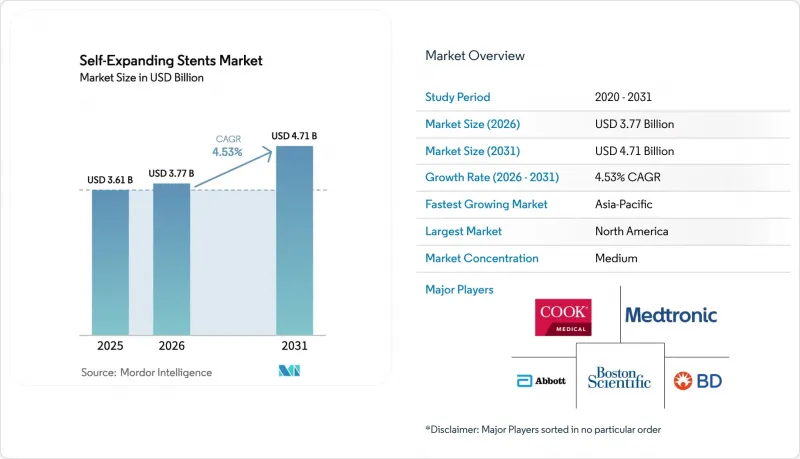
This report is Segmented by Product Type (Carotid Self-Expanding Stents, Gastrointestinal, and More), Material (Nitinol, Cobalt-Chromium, and More), Application (Fem-Pop Artery, Iliac Artery, and More), End-User (Hospitals, Ambulatory Surgical Centers, and More), Delivery Mode (Over-The-Wire (OTW) Systems, and More), and Geography. The Market Forecasts are Provided in Terms of Value (USD).
Global Self-Expanding Stents Market Trends and Insights
High prevalence of cardiovascular and PAD cases
Cardiovascular disease still affects 127.9 million U.S. adults, representing 48.6% of residents aged 20 years and older, despite a fall in heart-disease death rates to 162.1 per 100,000 in 2023. Peripheral artery disease (PAD) now burdens 113 million people aged 40 years and older worldwide. Diabetic patients show an 11.2% PAD prevalence, and elevated triglycerides further heighten risk. These figures guarantee a steady procedural pipeline for the self expanding stents market.
Surge in minimally-invasive peripheral interventions
Endovascular approaches achieve a 97.7% technical success rate in iliac artery lesions classified as TASC II A/B. Office-based labs and ambulatory surgical centers are performing an increasing share of PAD treatments, which lowers admission costs while maintaining comparable outcomes. AI-enhanced real-time device tracking for carotid stent placements has reached remarkable precision levels. These efficiency gains reinforce adoption.
Balloon-angioplasty & drug-therapy alternatives
The BASIL-3 trial found major amputation or death in 58% of drug-eluting stent cases versus 66% for plain balloon angioplasty. Drug-coated balloons and optimized pharmacotherapy offer competitive outcomes without a permanent implant, constraining the self expanding stents market.
Other drivers and restraints analyzed in the detailed report include:
- Rapid nitinol & imaging technology improvements
- Ambulatory surgery shift in vascular care
- Product recalls & stringent regulatory pathways
For complete list of drivers and restraints, kindly check the Table Of Contents.
Segment Analysis
Peripheral and endovascular systems held 32.02% of the self expanding stents market in 2025. Femoral and iliac disease prevalence, together with reimbursement parity for minimally invasive approaches, underpins steady hospital demand. Intracranial devices are advancing at 6.58% CAGR on the back of drug-eluting designs that cut restenosis by 77% versus bare metal. Gastrointestinal units pivot toward biodegradable alternatives after Japan's 2025 clearance of the ELLA-BD polymer esophageal scaffold. Airway and lung indications benefit from polydioxanone stents demonstrating 89.7% clinical effectiveness across a decade.
Nitinol retained a 68.77% self expanding stents market share in 2025 on the strength of shape-memory performance. Cost pressure aside, suppliers continue to refine fatigue resistance and deliver smaller-profile platforms. Polymer-hybrid composites, expanding at 7.93% CAGR, use tailored collagen to hasten endothelial repair without eluting drugs. Iron-based bioresorbables and cobalt-chromium alloys serve niche high-force applications.
Complete Report Scope:
- By Product Type
- Carotid self-expanding stents
- Gastrointestinal self-expanding stents
- Endovascular / Peripheral self-expanding stents
- Airway / Lung self-expanding stents
- Intracranial self-expanding stents
- Others
- By Material
- Nitinol
- Cobalt-chromium
- Stainless steel
- Polymer / Hybrid
- By Application
- Fem-Pop artery
- Iliac artery
- Carotid artery
- Biliary strictures
- Tracheo-bronchial airway
- Intracranial stenosis
- Others
- By End-User
- Hospitals
- Ambulatory Surgical Centers
- Catheterization Laboratories
- By Delivery Mode
- Over-the-Wire (OTW) systems
- Through-the-Scope (TTS) systems
- Stent-on-a-Wire systems
- By Geography
- North America
- United States
- Canada
- Mexico
- Europe
- Germany
- United Kingdom
- France
- Italy
- Spain
- Rest of Europe
- Asia-Pacific
- China
- Japan
- India
- Australia
- South Korea
- Rest of Asia-Pacific
- Middle East and Africa
- GCC
- South Africa
- Rest of Middle East and Africa
- South America
- Brazil
- Argentina
- Rest of South America
- North America
Geography Analysis
North America retained 38.11% of 2025 revenue. Broad insurance coverage for carotid, coronary, and peripheral procedures sustains premium adoption. Breakthrough device designations accelerate U.S. launches, illustrated by Abbott's Esprit BTK scaffold win in 2024. Canada adopts similar protocols, while Mexico enlarges access through public-hospital investments.
Europe remains a clinical excellence hub with cautious spending. The SPORTS trial in 2025 reported 94.5% freedom from target-lesion revascularization for Eluvia versus 80.7% for drug-coated balloons, reinforcing evidence-based uptake. MDR certification rules, however, raise compliance costs and slow rollouts, ultimately consolidating supplier ranks.
Asia-Pacific delivers a 7.32% CAGR through 2031. China's NMPA cleared MicroPort's VitaFlow Liberty Flex system in 2025, underscoring domestic innovation. Japan leads biodegradable gastrointestinal stents, and India embraces next-generation coronary designs such as Abbott's XIENCE Sierra. Government insurance expansion and localized manufacturing lower per-procedure costs, broadening market reach.
- Boston Scientific
- Medtronic
- Abbott Laboratories
- Beckton Dickinson
- Cook Group
- Terumo
- BIOTRONIK
- Cordis
- Merit Medical Systems
- Veryan Medical
- W. L. Gore & Associates
- MicroPort
- Taewoong Medical
- Micro-Tech (Nanjing)
- Lepu Medical
- SINOMED
- Endologix
- Shockwave Medical
- InspireMD
- EndoVascular Engineering
Additional Benefits:
- The market estimate (ME) sheet in Excel format
- 3 months of analyst support
TABLE OF CONTENTS
1 Introduction
- 1.1 Study Assumptions and Market Definition
- 1.2 Scope of the Study
2 Research Methodology
3 Executive Summary
4 Market Landscape
- 4.1 Market Overview
- 4.2 Market Drivers
- 4.2.1 High Prevalence Of Cardiovascular & PAD Cases
- 4.2.2 Surge In Minimally-Invasive Peripheral Interventions
- 4.2.3 Rapid Nitinol & Imaging Technology Improvements
- 4.2.4 Ambulatory-Surgery Shift In Vascular Care
- 4.2.5 Drug-Coated Self-Expanding Stents For BTK Ischemia
- 4.2.6 AI-Enabled Procedural Planning & Sizing Tools
- 4.3 Market Restraints
- 4.3.1 Balloon-Angioplasty & Drug-Therapy Alternatives
- 4.3.2 Product Recalls & Stringent Regulatory Pathways
- 4.3.3 Nitinol Supply-Chain Bottlenecks
- 4.3.4 Limited Long-Term Clinical Surveillance Data
- 4.4 Value / Supply-Chain Analysis
- 4.5 Regulatory Landscape
- 4.6 Technology Outlook
- 4.7 Porter's Five Forces Analysis
- 4.7.1 Bargaining Power of Suppliers
- 4.7.2 Bargaining Power of Buyers
- 4.7.3 Threat of New Entrants
- 4.7.4 Threat of Substitutes
- 4.7.5 Intensity of Competitive Rivalry
5 Market Size and Growth Forecasts (Value-USD)
- 5.1 By Product Type
- 5.1.1 Carotid self-expanding stents
- 5.1.2 Gastrointestinal self-expanding stents
- 5.1.3 Endovascular / Peripheral self-expanding stents
- 5.1.4 Airway / Lung self-expanding stents
- 5.1.5 Intracranial self-expanding stents
- 5.1.6 Others
- 5.2 By Material
- 5.2.1 Nitinol
- 5.2.2 Cobalt-chromium
- 5.2.3 Stainless steel
- 5.2.4 Polymer / Hybrid
- 5.3 By Application
- 5.3.1 Fem-Pop artery
- 5.3.2 Iliac artery
- 5.3.3 Carotid artery
- 5.3.4 Biliary strictures
- 5.3.5 Tracheo-bronchial airway
- 5.3.6 Intracranial stenosis
- 5.3.7 Others
- 5.4 By End-User
- 5.4.1 Hospitals
- 5.4.2 Ambulatory Surgical Centers
- 5.4.3 Catheterization Laboratories
- 5.5 By Delivery Mode
- 5.5.1 Over-the-Wire (OTW) systems
- 5.5.2 Through-the-Scope (TTS) systems
- 5.5.3 Stent-on-a-Wire systems
- 5.6 By Geography
- 5.6.1 North America
- 5.6.1.1 United States
- 5.6.1.2 Canada
- 5.6.1.3 Mexico
- 5.6.2 Europe
- 5.6.2.1 Germany
- 5.6.2.2 United Kingdom
- 5.6.2.3 France
- 5.6.2.4 Italy
- 5.6.2.5 Spain
- 5.6.2.6 Rest of Europe
- 5.6.3 Asia-Pacific
- 5.6.3.1 China
- 5.6.3.2 Japan
- 5.6.3.3 India
- 5.6.3.4 Australia
- 5.6.3.5 South Korea
- 5.6.3.6 Rest of Asia-Pacific
- 5.6.4 Middle East and Africa
- 5.6.4.1 GCC
- 5.6.4.2 South Africa
- 5.6.4.3 Rest of Middle East and Africa
- 5.6.5 South America
- 5.6.5.1 Brazil
- 5.6.5.2 Argentina
- 5.6.5.3 Rest of South America
- 5.6.1 North America
6 Competitive Landscape
- 6.1 Market Concentration
- 6.2 Market Share Analysis
- 6.3 Company Profiles (includes Global level Overview, Market level overview, Core Segments, Financials as available, Strategic Information, Market Rank/Share for key companies, Products and Services, and Recent Developments)
- 6.3.1 Boston Scientific Corporation
- 6.3.2 Medtronic plc
- 6.3.3 Abbott
- 6.3.4 BD
- 6.3.5 Cook Medical
- 6.3.6 Terumo Corporation
- 6.3.7 Biotronik SE & Co. KG
- 6.3.8 Cordis
- 6.3.9 Merit Medical Systems
- 6.3.10 Veryan Medical
- 6.3.11 W. L. Gore & Associates
- 6.3.12 MicroPort Scientific
- 6.3.13 Taewoong Medical
- 6.3.14 Micro-Tech (Nanjing)
- 6.3.15 Lepu Medical
- 6.3.16 SINOMED
- 6.3.17 Endologix
- 6.3.18 Shockwave Medical
- 6.3.19 InspireMD
- 6.3.20 EndoVascular Engineering
7 Market Opportunities and Future Outlook
- 7.1 White-Space and Unmet-Need Assessment

