PUBLISHER: Mordor Intelligence | PRODUCT CODE: 2117298

PUBLISHER: Mordor Intelligence | PRODUCT CODE: 2117298
Single Tooth Implants And Dental Bridges - Market Share Analysis, Industry Trends & Statistics, Growth Forecasts (2026 - 2031)
According to Mordor Intelligence, the single tooth implants and dental bridges market size was valued at USD 6.58 billion in 2025 and estimated to grow from USD 7.03 billion in 2026 to reach USD 9.81 billion by 2031, at a CAGR of 6.88% during the forecast period (2026-2031).
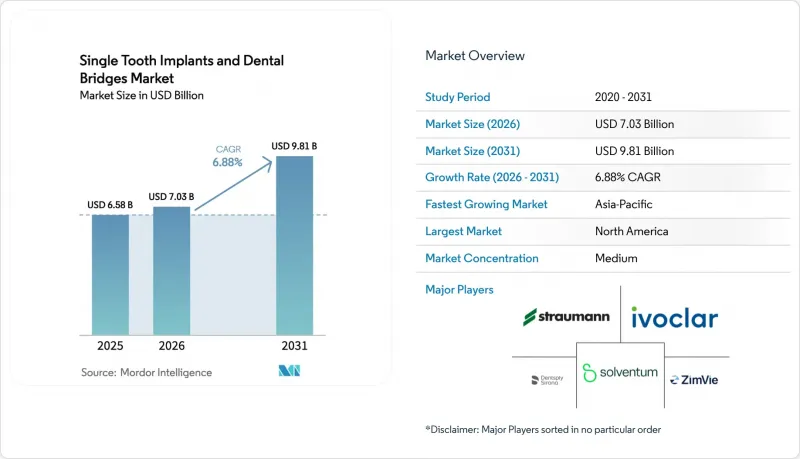
This report is Segmented by Material (Metals, Zirconia & Other Ceramics, Porcelain-Fused-To-Metal), Product (Single Tooth Implants, Dental Bridges), End-User (Dental Clinics, Hospitals, Academic & Research Institutes, Others), and Geography (North America, Europe, Asia-Pacific, Middle East and Africa, South America). The Market Forecasts are Provided in Terms of Value (USD).
Global Single Tooth Implants And Dental Bridges Market Trends and Insights
Rising Demand for Preventive & Cosmetic Dentistry
Urban consumers prioritize early intervention that preserves natural tooth structure and delivers high-end esthetics. The American Dental Association recorded 23% growth in cosmetic procedures in 2024, and single-unit implants are increasingly preferred over tooth-supported bridges because they leave adjacent teeth untouched . Digital smile-design tools align clinical and esthetic goals, while intraoral scanners combined with chairside mills reduce chair time, spurring same-day delivery and higher patient satisfaction. Premium implant materials, especially zirconia, meet esthetic demands in anterior zones and command pricing power. Practices that bundle preventive services with implant therapy achieve stronger lifetime patient value, reinforcing the single tooth implants and dental bridges market's upward curve.
Increasing Prevalence of Edentulous & Geriatric Population
Global longevity keeps demand robust, as 23% of adults aged 65-74 were fully edentulous in 2024 . Immediate-loading protocols show >96% success when comorbidities are controlled, positioning implants as the preferred solution for aging patients. Hydrophilic and bioactive surface technologies improve outcomes in osteoporotic bone, while minimally invasive, outpatient-ready procedures dovetail with aging-in-place care models. Consequently, the single tooth implants and dental bridges market receives a structural tailwind from demographic momentum.
High Procedure Cost & Limited Reimbursement
Implant therapy costs USD 3,000-6,000 per tooth, far exceeding typical annual dental-benefit caps of USD 1,500, leaving a funding shortfall that curbs adoption. Financing plans fill gaps but carry 17.9% average interest, making them less appealing to middle-income patients. Although value-based care models propose bundled payment structures, uptake remains confined to large, integrated health systems. As long as out-of-pocket exposure stays high, demand elasticity will cap upside in price-sensitive regions.
Other drivers and restraints analyzed in the detailed report include:
- Rapid Adoption of Digital Workflows
- Growing Insurance Coverage & Value-Based Dental Care Models
- Shortage of Skilled Implantologists in Emerging Economies
For complete list of drivers and restraints, kindly check the Table Of Contents.
Segment Analysis
Metals retained 58.35% of the single tooth implants and dental bridges market share in 2025 thanks to titanium's four-decade safety record and cost-effective machining. The single tooth implants and dental bridges market size for metals reached USD 3.84 billion that year, reflecting their entrenched clinical acceptance. In contrast, zirconia and other ceramics logged a 7.22% CAGR outlook through 2031, propelled by demand for metal-free esthetics in anterior restorations and growing evidence of favorable soft-tissue response.
Proprietary modifications, such as Nobel Biocare's hydrophilic surface, narrow survival-rate gaps between zirconia and titanium, with five-year rates approaching 97.3%. Regulatory pathways eased when the FDA broadened 510(k) routes in 2024, unlocking faster market entry for ceramic systems. ESG scrutiny over precious-metal use in porcelain-fused-to-metal crowns further tilts momentum toward ceramics, reinforcing the premium-pricing corridor and elevating brand differentiation strategies inside the single tooth implants and dental bridges market.
Complete Report Scope:
- By Material
- Metals
- Zirconia & other ceramics
- Porcelain-Fused-to-Metal (PFM)
- By Product
- Single Tooth Implants
- Dental Bridges
- By End-User
- Dental Clinics
- Hospitals
- Academic & Research Institutes
- Others
- By Geography
- North America
- United States
- Canada
- Mexico
- Europe
- Germany
- United Kingdom
- France
- Italy
- Spain
- Rest of Europe
- Asia-Pacific
- China
- Japan
- India
- Australia
- South Korea
- Rest of Asia-Pacific
- Middle East and Africa
- GCC
- South Africa
- Rest of Middle East and Africa
- South America
- Brazil
- Argentina
- Rest of South America
- North America
Geography Analysis
North America led with 40.78% of 2025 revenues, supported by Medicare Advantage expansions that unlocked implant coverage for 12.4 million seniors. Well-established digital infrastructures speed adoption of chairside workflows, and private insurers increasingly reimburse implant-supported bridges under value-based contracts. U.S. regulatory rigor favors incumbents with the scale to fund clinical trials, thereby concentrating market power.
Europe follows with harmonized EU MDR rules that cut compliance redundancy. Germany reported 847,000 implant procedures in 2024, underpinned by statutory insurance co-payments that offset patient costs. The United Kingdom's MHRA accelerated ceramic-implant approvals post-Brexit, making it an attractive pilot market for innovative materials. Scandinavian countries, buoyed by state dental benefits, posted the world's highest per-capita implant placements, reinforcing premium demand for zirconia solutions.
Asia-Pacific is the fastest riser at a 7.54% CAGR forecast, with China's enhanced insurance plan covering 340 million citizens for restorative dental care. Japan's geriatric needs spur protocols adapted to osteoporotic bone, while South Korea capitalizes on medical tourism that blends esthetics and competitive pricing. India's low implantologist density tempers near-term uptake, yet expanding dental-school capacity and public-private training initiatives suggest an inflection point later in the decade. These dynamics collectively enlarge the single tooth implants and dental bridges market footprint across diverse economic contexts.
- Dentsply Sirona
- Solventum
- Nobel Biocare Services
- ZimVie
- Ivoclar Vivadent
- Straumann Group
- AVINENT
- CAMLOG Biotechnologies
- Bicon
- Envista Holdings
- BioHorizons
- DENTAURUM
- Osstem Implant Co., Ltd.
- Neobiotech Co., Ltd.
- MIS Implants Technologies Ltd.
- Henry Schein
- Glidewell Dental
- Planmeca
- GC Corporation
- Coltene Holding
- Zimmer Biomet
- TAV Dental
Additional Benefits:
- The market estimate (ME) sheet in Excel format
- 3 months of analyst support
TABLE OF CONTENTS
1 Introduction
- 1.1 Study Assumptions & Market Definition
- 1.2 Scope of the Study
2 Research Methodology
3 Executive Summary
4 Market Landscape
- 4.1 Market Overview
- 4.2 Market Drivers
- 4.2.1 Rising demand for preventive & cosmetic dentistry
- 4.2.2 Increasing prevalence of edentulous & geriatric population
- 4.2.3 Rapid adoption of digital workflows
- 4.2.4 Growing insurance coverage & value-based dental care models
- 4.2.5 Proliferation of chair-side milling enabling same-day bridges
- 4.2.6 Expansion of dental-tourism clusters via bilateral health accords
- 4.3 Market Restraints
- 4.3.1 High procedure cost & limited reimbursement
- 4.3.2 Shortage of skilled implantologists in emerging economies
- 4.3.3 Titanium & zirconia supply-chain volatility from geo-political tensions
- 4.3.4 Stricter ESG limits on precious-metal use in PFM restorations
- 4.4 Value / Supply-Chain Analysis
- 4.5 Regulatory Landscape
- 4.6 Technological Outlook
- 4.7 Porter's Five Forces Analysis
- 4.7.1 Threat of New Entrants
- 4.7.2 Bargaining Power of Buyers
- 4.7.3 Bargaining Power of Suppliers
- 4.7.4 Threat of Substitutes
- 4.7.5 Intensity of Competitive Rivalry
5 Market Size & Growth Forecasts (Value, USD)
- 5.1 By Material
- 5.1.1 Metals
- 5.1.2 Zirconia & other ceramics
- 5.1.3 Porcelain-Fused-to-Metal (PFM)
- 5.2 By Product
- 5.2.1 Single Tooth Implants
- 5.2.2 Dental Bridges
- 5.3 By End-User
- 5.3.1 Dental Clinics
- 5.3.2 Hospitals
- 5.3.3 Academic & Research Institutes
- 5.3.4 Others
- 5.4 By Geography
- 5.4.1 North America
- 5.4.1.1 United States
- 5.4.1.2 Canada
- 5.4.1.3 Mexico
- 5.4.2 Europe
- 5.4.2.1 Germany
- 5.4.2.2 United Kingdom
- 5.4.2.3 France
- 5.4.2.4 Italy
- 5.4.2.5 Spain
- 5.4.2.6 Rest of Europe
- 5.4.3 Asia-Pacific
- 5.4.3.1 China
- 5.4.3.2 Japan
- 5.4.3.3 India
- 5.4.3.4 Australia
- 5.4.3.5 South Korea
- 5.4.3.6 Rest of Asia-Pacific
- 5.4.4 Middle East and Africa
- 5.4.4.1 GCC
- 5.4.4.2 South Africa
- 5.4.4.3 Rest of Middle East and Africa
- 5.4.5 South America
- 5.4.5.1 Brazil
- 5.4.5.2 Argentina
- 5.4.5.3 Rest of South America
- 5.4.1 North America
6 Competitive Landscape
- 6.1 Market Concentration
- 6.2 Market Share Analysis
- 6.3 Company Profiles (includes Global level Overview, Market level overview, Core Segments, Financials as available, Strategic Information, Market Rank/Share for key companies, Products & Services, and Recent Developments)
- 6.3.1 Dentsply Sirona
- 6.3.2 Solventum
- 6.3.3 Nobel Biocare Services AG
- 6.3.4 ZimVie Inc
- 6.3.5 Ivoclar Vivadent AG
- 6.3.6 Institut Straumann AG
- 6.3.7 Avinent Implant System S.L.U.
- 6.3.8 CAMLOG Biotechnologies GmbH
- 6.3.9 Bicon, LLC
- 6.3.10 Envista Holdings
- 6.3.11 BioHorizons
- 6.3.12 DENTAURUM GmbH
- 6.3.13 Osstem Implant Co., Ltd.
- 6.3.14 Neobiotech Co., Ltd.
- 6.3.15 MIS Implants Technologies Ltd.
- 6.3.16 Henry Schein, Inc.
- 6.3.17 Glidewell Dental
- 6.3.18 Planmeca Oy
- 6.3.19 GC Corporation
- 6.3.20 Coltene Holding AG
- 6.3.21 Zimmer Biomet Holdings, Inc.
- 6.3.22 TAV Dental
7 Market Opportunities & Future Outlook
- 7.1 White-space & Unmet-Need Assessment

