PUBLISHER: Mordor Intelligence | PRODUCT CODE: 2117313

PUBLISHER: Mordor Intelligence | PRODUCT CODE: 2117313
Parenteral Nutrition - Market Share Analysis, Industry Trends & Statistics, Growth Forecasts (2026 - 2031)
According to Mordor Intelligence, the parenteral nutrition market size was valued at USD 8.50 billion in 2025 and estimated to grow from USD 8.99 billion in 2026 to reach USD 11.94 billion by 2031, at a CAGR of 5.82% during the forecast period (2026-2031).
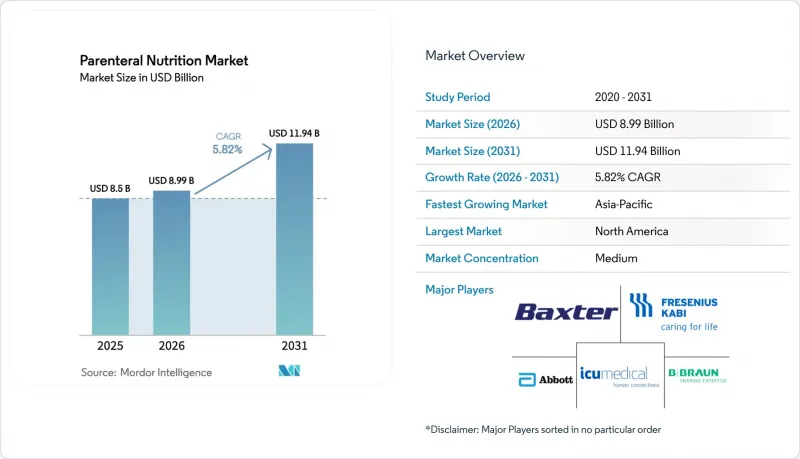
This report is Segmented by Nutrition Type (Carbohydrates, Parenteral Lipid Emulsion, Single Dose Amino Acid Solution, and More), Patient Type (Neonates, Pediatrics, and More), End-User (Hospitals, Clinics, Homecare, and Others) and Geography (North America, Europe, Asia-Pacific, and More). The Market Sizes and Forecasts are Provided in Terms of Value (USD).
Global Parenteral Nutrition Market Trends and Insights
Growing Rate of Pre-Mature Births
Higher survival rates of low-birth-weight infants sustain a strong need for intravenous nutrition. Early amino acid delivery within 24 hours supports superior weight gain and neurodevelopment compared with delayed feeding. Triple-chamber neonatal bags now supply 2.8 g kg1 of amino acids and 80 kcal kg1 daily, aligning bedside practice with updated guidelines. Hospitals also record fewer compounding errors because pharmacy staff activate pre-filled chambers instead of mixing individual components. Broader use of these dedicated bags ensures consistent nutrient profiles that reduce metabolic stress in fragile neonates. Altogether, neonatal demand anchors a reliable growth pillar within the parenteral nutrition market.
Increasing Burden of Chronic Conditions
Chronic illnesses such as inflammatory bowel disease, short bowel syndrome, and malignancy-related cachexia expand the long-term user base. Poland's reimbursement for home intravenous nutrition exceeded EUR 146 million (USD 167 million) in 2024, illustrating the fiscal weight of sustained therapy. Combined enteral and parenteral regimens let physicians meet higher energy targets, improving survival in complex adult patients. Medicare's policy change that removed restrictive coverage determinations further opened access to home programs in the United States.Given long disease duration, the parenteral nutrition market gains a dependable stream of recurring demand across public and private payers.
High Risk of Catheter-Related Infections & Sepsis
Catheter-associated bloodstream infections range from 0.97 to 10.97 per 1,000 catheter days and nearly double inpatient mortality. Antimicrobial lock therapy can cut events below 1.1 per 1,000 catheter days, but widespread rollout requires specialised staff and higher consumable budgets. Some facilities still lack dedicated nutrition support teams, prolonging device dwell time and raising infection odds. As payers tighten sepsis penalties, hospitals may hesitate to start parenteral nutrition when enteral options exist. These safety concerns partly temper growth, yet advances in antimicrobial dressings and education programs are gradually mitigating risk.
Other drivers and restraints analyzed in the detailed report include:
- Rising Prevalence of Malnutrition
- Rapid Uptake of Multi-Chamber Bag Technology
- Volatile Pricing & Shortages of Critical Ingredients
For complete list of drivers and restraints, kindly check the Table Of Contents.
Segment Analysis
Amino acid solutions secured 33.88% of the 2025 revenue base, the most significant slice within the parenteral nutrition market share. The component advances at 5.52% CAGR to 2031 as clinicians prioritize early protein delivery for wound healing, immune defense, and growth. Carbohydrate dextrose solutions follow in volume but face intensified glucose-control protocols that moderate their expansion. Lipid emulsions are pivoting to mixed-oil blends that curb omega-6 overload and reduce cholestasis risk, satisfying pediatric guideline shifts away from pure soybean oil. Vitamins, trace elements, and electrolytes, though smaller in unit sales, remain indispensable for preventing deficiency-related complications during long-term therapy. Stability improvements, such as light-protective multilayer bags, now extend shelf life to seven days in automated pumps, cutting changeovers and nursing time. Collectively, these advances enlarge the parenteral nutrition market by enabling safer, more tailored prescriptions amid rising patient acuity.
Complete Report Scope:
- By Nutrition Type
- Carbohydrates
- Lipid Emulsions
- Amino Acid Solutions
- Vitamins
- Trace Elements
- Electrolytes
- Others
- By Patient Type
- Neonates (Pre-term & Term)
- Pediatrics (1-17 yrs)
- Adults (18-64 yrs)
- Geriatric (Above 65 yrs)
- By End-user
- Hospitals
- Clinics
- Homecare
- Ambulatory Surgical Centres
- By Geography
- North America
- United States
- Canada
- Mexico
- Europe
- Germany
- United Kingdom
- France
- Italy
- Spain
- Rest of Europe
- Asia-Pacific
- China
- Japan
- India
- South Korea
- Australia
- Rest of Asia-Pacific
- Middle East and Africa
- GCC
- South Africa
- Rest of Middle East and Africa
- South America
- Brazil
- Argentina
- Rest of South America
- North America
Geography Analysis
North America remains the leading contributor to the parenteral nutrition market, accounting for approximately 43.85% of global revenue in 2025. CMS's decision to drop restrictive National Coverage Determinations expanded home therapy eligibility, leading to increased utilization in smaller community hospitals. Domestic amino acid plants funded by the HHS-Resilience partnership reduce reliance on overseas inputs and bolster supply security. Technology adoption is also rapid; Baxter's Novum IQ platform downloads drug libraries over the air, aligning dose limits across multiple facilities in real time.
Europe is a mature yet innovative arena. ESPEN and ESPGHAN guidelines standardize practices for both pediatric and adult patients, promoting consistent nutrient delivery across member states. Six nations now codify home parenteral nutrition in legislation, with Denmark covering the majority of patient costs. Wage expenses account for 54% of total neonatal compounding costs, prompting hospitals to shift toward fixed multi-chamber bags to enhance efficiency. Increased scrutiny of soybean-only lipids drives demand for composite emulsions, advancing formulation science throughout the region.
Asia-Pacific stands out as the fastest-growing geography, anticipating a 6.84% CAGR between 2026 and 2031. Japan's audit highlighted underdosing trends, indicating a need for guideline alignment and potential volume growth. Meanwhile, an ICU Medical-Otsuka joint venture will add 1.4 billion IV units annually, extending regional manufacturing and providing a buffer against future shortages. Reimbursement remains uneven: only 40% of surveyed countries subsidize home intravenous nutrition; however, the rising prevalence of chronic diseases is pressuring policymakers toward coverage expansion. These forces combine to elevate the parenteral nutrition market across urban and emerging provincial centers.
- Fresenius
- Baxter
- B. Braun
- ICU Medical
- Option Care Health
- Abbott Laboratories
- Sichuan Kelun Pharma
- Otsuka Pharmaceutical Co.
- Amanta Healthcare
- Aculife Healthcare
- Grifols
- Ajinomoto Co. Inc.
- Pfizer
- Vifor Pharma
- Nestle
- Becton Dickinson & Co.
- Teva Pharmaceutical Industries
- Sosuco Pharma (Numedica)
- Terumo Corp.
- Braun SE (Clinimix)
- Fresenius SE (Vyved)
Additional Benefits:
- The market estimate (ME) sheet in Excel format
- 3 months of analyst support
TABLE OF CONTENTS
1 Introduction
- 1.1 Study Assumptions & Market Definition
- 1.2 Scope of the Study
2 Research Methodology
3 Executive Summary
4 Market Landscape
- 4.1 Market Overview
- 4.2 Market Drivers
- 4.2.1 Growing Rate of Pre-Mature Births
- 4.2.2 Increasing Burden of Chronic Conditions
- 4.2.3 Rising Prevalence of Malnutrition
- 4.2.4 Rapid Uptake of Multi-Chamber Bag Technology
- 4.2.5 Supply-Chain Localization of Amino-Acid Components
- 4.2.6 Expansion Of Reimbursement for Home Parenteral Nutrition
- 4.3 Market Restraints
- 4.3.1 Lack Of Awareness in Developing Countries
- 4.3.2 High Risk of Catheter-Related Infections & Sepsis
- 4.3.3 Volatile Pricing & Shortages of Critical Parenteral Nutrition Ingredients
- 4.3.4 Antimicrobial-Stewardship Limits on Soybean Lipid Use
- 4.4 Supply-Chain Analysis
- 4.5 Regulatory Landscape
- 4.6 Technological Outlook
- 4.7 Porter's Five Forces Analysis
- 4.7.1 Threat of New Entrants
- 4.7.2 Bargaining Power of Buyers/Consumers
- 4.7.3 Bargaining Power of Suppliers
- 4.7.4 Threat of Substitute Products
- 4.7.5 Intensity of Competitive Rivalry
5 Market Size & Growth Forecasts (Value, USD million)
- 5.1 By Nutrition Type
- 5.1.1 Carbohydrates
- 5.1.2 Lipid Emulsions
- 5.1.3 Amino Acid Solutions
- 5.1.4 Vitamins
- 5.1.5 Trace Elements
- 5.1.6 Electrolytes
- 5.1.7 Others
- 5.2 By Patient Type
- 5.2.1 Neonates (Pre-term & Term)
- 5.2.2 Pediatrics (1-17 yrs)
- 5.2.3 Adults (18-64 yrs)
- 5.2.4 Geriatric (Above 65 yrs)
- 5.3 By End-user
- 5.3.1 Hospitals
- 5.3.2 Clinics
- 5.3.3 Homecare
- 5.3.4 Ambulatory Surgical Centres
- 5.4 By Geography
- 5.4.1 North America
- 5.4.1.1 United States
- 5.4.1.2 Canada
- 5.4.1.3 Mexico
- 5.4.2 Europe
- 5.4.2.1 Germany
- 5.4.2.2 United Kingdom
- 5.4.2.3 France
- 5.4.2.4 Italy
- 5.4.2.5 Spain
- 5.4.2.6 Rest of Europe
- 5.4.3 Asia-Pacific
- 5.4.3.1 China
- 5.4.3.2 Japan
- 5.4.3.3 India
- 5.4.3.4 South Korea
- 5.4.3.5 Australia
- 5.4.3.6 Rest of Asia-Pacific
- 5.4.4 Middle East and Africa
- 5.4.4.1 GCC
- 5.4.4.2 South Africa
- 5.4.4.3 Rest of Middle East and Africa
- 5.4.5 South America
- 5.4.5.1 Brazil
- 5.4.5.2 Argentina
- 5.4.5.3 Rest of South America
- 5.4.1 North America
6 Competitive Landscape
- 6.1 Market Concentration
- 6.2 Market Share Analysis
- 6.3 Company Profiles (includes Global level Overview, Market level overview, Core Segments, Financials as available, Strategic Information, Market Rank/Share for key companies, Products, and Recent Developments)
- 6.3.1 Fresenius Kabi AG
- 6.3.2 Baxter International Inc.
- 6.3.3 B. Braun Melsungen AG
- 6.3.4 ICU Medical Inc.
- 6.3.5 Option Care Health Inc.
- 6.3.6 Abbott Laboratories
- 6.3.7 Sichuan Kelun Pharma
- 6.3.8 Otsuka Pharmaceutical Co.
- 6.3.9 Amanta Healthcare
- 6.3.10 Aculife Healthcare
- 6.3.11 Grifols S.A.
- 6.3.12 Ajinomoto Co. Inc.
- 6.3.13 Pfizer Inc.
- 6.3.14 Vifor Pharma
- 6.3.15 Nestle Health Science
- 6.3.16 Becton Dickinson & Co.
- 6.3.17 Teva Pharmaceutical Industries
- 6.3.18 Sosuco Pharma (Numedica)
- 6.3.19 Terumo Corp.
- 6.3.20 Braun SE (Clinimix)
- 6.3.21 Fresenius SE (Vyved)
7 Market Opportunities & Future Outlook
- 7.1 White-space & Unmet-need Assessment

