PUBLISHER: Mordor Intelligence | PRODUCT CODE: 2117319

PUBLISHER: Mordor Intelligence | PRODUCT CODE: 2117319
Property Management Software - Market Share Analysis, Industry Trends & Statistics, Growth Forecasts (2026 - 2031)
According to Mordor Intelligence, the property management software market size reached USD 6.53 billion in 2026 and is projected to climb to USD 9.93 billion by 2031, reflecting an 8.74% CAGR.
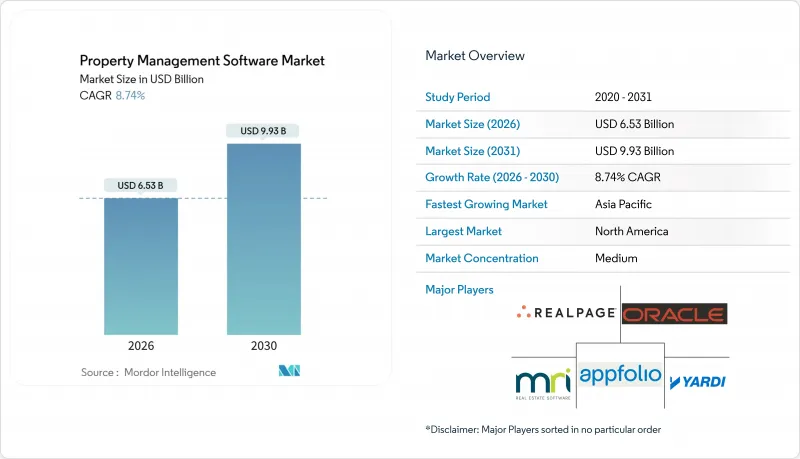
This report is Segmented by Deployment Model (Cloud-Based, On-Premises, and Hybrid), Property Type (Residential, Commercial, and Mixed-Use), End User (Housing Associations, and More), Solution Module (Lease and Tenant Management, and More), Organization Size (Small, Mid, and Large), and Geography (North America, Europe, and More). The Market Forecasts are Provided in Terms of Value (USD).
Global Property Management Software Market Trends and Insights
Growing Adoption of Cloud-Based SaaS Platforms
Cloud deployment eliminates server overhead, cuts IT staffing needs, and provides continuous feature releases that keep portfolios current. Mid-sized landlords report a 30-40% lower total cost of ownership compared to perpetual-license models, while mobile-optimized workflows enable leasing teams to operate from any device. Multi-tenant architectures also accelerate geographic expansion because new property instances spin up in hours, a critical edge for investors closing cross-border acquisitions. Finally, open APIs transform modern platforms into orchestration layers that connect accounting software, payment gateways, and Internet-of-Things sensors, creating a unified data fabric that enhances decision-making quality.
Rising Demand for Integrated Tenant and Lease Automation
Automated document generation, renewal notifications, and escalation calculations now displace manual clerical tasks that once consumed up to 30% of a property manager's labor hours. Tenant portals supporting maintenance requests, digital rent payments, and self-service renewals lift Net Promoter Scores while shrinking administrative costs. Instant-payment functionality, expected to be in use by 59% of property managers by 2028, transforms monthly billing cycles into real-time cash management, and auto-populated lease abstracts reduce acquisition due diligence timelines from weeks to days.
Data-Security and Privacy Concerns in Multi-Tenant SaaS
Recent breaches at Essex Property Trust, TELACU Community Capital, and Berkeley Rent Registry have exposed tens of thousands of tenant records, triggering regulatory probes and prompting buyers to demand SOC 2 Type II audits, penetration tests, and cyber insurance from vendors. Compliance costs rise in tandem, lengthening sales cycles and prompting some landlords to consider hybrid deployments that keep sensitive data on local servers.
Other drivers and restraints analyzed in the detailed report include:
- Compliance Pressure (ASC 842/IFRS 16) Boosting Software Uptake
- AI-Powered Predictive Maintenance for OPEX Reduction
- High Switching Costs from Legacy Systems
For complete list of drivers and restraints, kindly check the Table Of Contents.
Segment Analysis
Hybrid architectures are expanding at a 9.12% CAGR, outpacing the overall property management software market. Operators with multinational portfolios use local servers for personally identifiable information while utilizing the cloud for analytics, gaining compliance with data-residency laws without sacrificing elasticity. In contrast, cloud solutions continue to dominate with a 72.41% market share in property management software in 2025, primarily because they minimize upfront capital expenditures and provide continuous updates. Over time, phased migration strategies prioritize low-risk workflows first, followed by financial modules once security reviews are complete, thereby accelerating the growth of the property management software market for hybrid tools as regulations become more stringent.
Cloud maintenance automation also cuts emergency repairs by 40% and maintenance costs by 30%, tangible proof points that convince risk-averse landlords to shift critical workloads. Government agencies that once specified on-premises deployments now publish hybrid best practices, encouraging operators to classify data and align storage locations accordingly. As artificial-intelligence models demand more compute power, this dual-environment setup lets firms train in the cloud but run inference locally to reduce latency, reinforcing hybrid's long-term role within the property management software market.
Residential assets led 2025 spending, reflecting a 58.19% property management software market share; however, warehouses and distribution centers are growing fastest at a 10.34% CAGR. E-commerce operators rely on specialized lease-management features that handle complex rent structures, cross-dock scheduling, and space utilization analytics, driving the property management software market size for industrial applications upward over the forecast period. Student housing, senior living, and co-living formats each add unique workflow requirements, broadening vendor addressable segments.
Office and retail managers, meanwhile, integrate foot-traffic and occupancy analytics to renegotiate flexible leases, while hospitality operators blend nightly reservations and monthly tenancies within unified systems. Mixed-use projects require consolidated financial statements that allocate expenses across asset classes, prompting investors to standardize on multi-module suites. This diversity of needs encourages vendors to maintain configurable templates, ensuring growth in every property vertical.
Complete Report Scope:
- By Deployment Model
- Cloud-Based
- On-Premises
- Hybrid
- By Property Type
- Residential
- Multifamily
- Single-Family
- Student Housing
- HOA / Condo Associations
- Commercial
- Office
- Retail
- Industrial / Logistics
- Hospitality
- Mixed-Use
- Residential
- By End User
- Property Managers and Agents
- Housing Associations
- Property Investors
- Corporate Real-Estate Departments
- Facilities-Management Firms
- By Solution Module
- Lease and Tenant Management
- Accounting and Reporting
- Maintenance Management
- Marketing and Listing
- Integrated Payments
- Advanced Analytics and AI Tools
- By Organization Size
- Small (1-500 units)
- Mid (501-5 000 units)
- Large (>5 000 units)
- By Geography
- North America
- United States
- Canada
- Mexico
- South America
- Brazil
- Argentina
- Rest of South America
- Europe
- Germany
- United Kingdom
- France
- Italy
- Spain
- Russia
- Rest of Europe
- Asia Pacific
- China
- Japan
- South Korea
- India
- Australia
- New Zealand
- Rest of Asia Pacific
- Middle East
- United Arab Emirates
- Saudi Arabia
- Turkey
- Rest of Middle East
- Africa
- South Africa
- Nigeria
- Kenya
- Rest of Africa
- North America
Geography Analysis
North America accounted for 40.27% of 2025 revenue, leveraging mature multifamily markets, stringent accounting rules, and widespread embedded fintech usage. U.S. rent-control ordinances and state privacy acts also prompt landlords to adopt software that automates compliance and breach reporting. Canada's growing purpose-built rental stock and Mexico's rising middle class present incremental gains despite regulatory complexity and currency risk.
Asia Pacific is the fastest-growing region, set to register a 13.44% CAGR through 2031. Institutional capital earmarked for build-to-rent in Australia, student housing in China, and co-living in India drives platform demand, while logistics expansion across Southeast Asia boosts industrial modules. Residential allocations among ANREV members increased from 11% to 16% between 2020 and 2025, signaling a structural shift in appetite for technology that professionalizes asset management. Rising smartphone penetration and government digitalization agendas further accelerate uptake.
Europe combines mature markets in the United Kingdom, Germany, and France with developing ones in Southern and Eastern countries, where European Union funding modernizes real estate management. The General Data Protection Regulation favors providers with local data centers, and energy-efficiency directives spur adoption of predictive-maintenance features. The Middle East experiences rapid real-estate diversification tied to giga-projects, while South America's growth remains sensitive to political and currency volatility. Africa shows early traction in Kenya and Nigeria but continues to lag because of infrastructure gaps.
- Yardi Systems, Inc.
- RealPage, Inc.
- MRI Software LLC
- AppFolio, Inc.
- Oracle Corporation
- IBM Corporation
- CoreLogic, Inc.
- Entrata, Inc.
- Buildium, LLC (RealPage)
- TenantCloud LLC
- ResMan, LLC
- Propertyware, Inc. (RealPage)
- Console Australia Pty Ltd
- Lula
- Rentec Direct, Inc.
- Hemlane, Inc.
- HappyCo, Inc.
- Building Engines, Inc. (JLL)
- TurboTenant, Inc.
- AppRent, LLC
Additional Benefits:
- The market estimate (ME) sheet in Excel format
- 3 months of analyst support
TABLE OF CONTENTS
1 INTRODUCTION
- 1.1 Study Assumptions and Market Definition
- 1.2 Scope of the Study
2 RESEARCH METHODOLOGY
3 EXECUTIVE SUMMARY
4 MARKET LANDSCAPE
- 4.1 Market Overview
- 4.2 Market Drivers
- 4.2.1 Growing Adoption of Cloud-Based SaaS Platforms
- 4.2.2 Rising Demand for Integrated Tenant and Lease Automation
- 4.2.3 Expansion of Real-Estate Portfolios by Institutional Investors
- 4.2.4 Compliance Pressure (ASC-842/IFRS-16) Boosting Software Uptake
- 4.2.5 Convergence of Property Management and Embedded FinTech
- 4.2.6 AI-Powered Predictive Maintenance for OPEX Reduction
- 4.3 Market Restraints
- 4.3.1 Data-Security and Privacy Concerns in Multi-Tenant SaaS
- 4.3.2 High Switching Costs from Legacy Systems
- 4.3.3 Fragmented Property-Data Standards Hindering Interoperability
- 4.3.4 Tightening PropTech Venture Funding Cycle Post-2022
- 4.4 Industry Value Chain Analysis
- 4.5 Regulatory Landscape
- 4.6 Technological Outlook
- 4.7 Impact of Macroeconomic Factors on the Market
- 4.8 Porter's Five Forces Analysis
- 4.8.1 Threat of New Entrants
- 4.8.2 Bargaining Power of Buyers
- 4.8.3 Bargaining Power of Suppliers
- 4.8.4 Threat of Substitutes
- 4.8.5 Intensity of Competitive Rivalry
5 MARKET SIZE AND GROWTH FORECASTS (VALUE)
- 5.1 By Deployment Model
- 5.1.1 Cloud-Based
- 5.1.2 On-Premises
- 5.1.3 Hybrid
- 5.2 By Property Type
- 5.2.1 Residential
- 5.2.1.1 Multifamily
- 5.2.1.2 Single-Family
- 5.2.1.3 Student Housing
- 5.2.1.4 HOA / Condo Associations
- 5.2.2 Commercial
- 5.2.2.1 Office
- 5.2.2.2 Retail
- 5.2.2.3 Industrial / Logistics
- 5.2.2.4 Hospitality
- 5.2.3 Mixed-Use
- 5.2.1 Residential
- 5.3 By End User
- 5.3.1 Property Managers and Agents
- 5.3.2 Housing Associations
- 5.3.3 Property Investors
- 5.3.4 Corporate Real-Estate Departments
- 5.3.5 Facilities-Management Firms
- 5.4 By Solution Module
- 5.4.1 Lease and Tenant Management
- 5.4.2 Accounting and Reporting
- 5.4.3 Maintenance Management
- 5.4.4 Marketing and Listing
- 5.4.5 Integrated Payments
- 5.4.6 Advanced Analytics and AI Tools
- 5.5 By Organization Size
- 5.5.1 Small (1-500 units)
- 5.5.2 Mid (501-5 000 units)
- 5.5.3 Large (>5 000 units)
- 5.6 By Geography
- 5.6.1 North America
- 5.6.1.1 United States
- 5.6.1.2 Canada
- 5.6.1.3 Mexico
- 5.6.2 South America
- 5.6.2.1 Brazil
- 5.6.2.2 Argentina
- 5.6.2.3 Rest of South America
- 5.6.3 Europe
- 5.6.3.1 Germany
- 5.6.3.2 United Kingdom
- 5.6.3.3 France
- 5.6.3.4 Italy
- 5.6.3.5 Spain
- 5.6.3.6 Russia
- 5.6.3.7 Rest of Europe
- 5.6.4 Asia Pacific
- 5.6.4.1 China
- 5.6.4.2 Japan
- 5.6.4.3 South Korea
- 5.6.4.4 India
- 5.6.4.5 Australia
- 5.6.4.6 New Zealand
- 5.6.4.7 Rest of Asia Pacific
- 5.6.5 Middle East
- 5.6.5.1 United Arab Emirates
- 5.6.5.2 Saudi Arabia
- 5.6.5.3 Turkey
- 5.6.5.4 Rest of Middle East
- 5.6.6 Africa
- 5.6.6.1 South Africa
- 5.6.6.2 Nigeria
- 5.6.6.3 Kenya
- 5.6.6.4 Rest of Africa
- 5.6.1 North America
6 COMPETITIVE LANDSCAPE
- 6.1 Market Concentration
- 6.2 Strategic Moves
- 6.3 Market Share Analysis
- 6.4 Company Profiles (includes Global Level Overview, Market Level Overview, Core Segments, Financials as Available, Strategic Information, Market Rank/Share for Key Companies, Products and Services, and Recent Developments)
- 6.4.1 Yardi Systems, Inc.
- 6.4.2 RealPage, Inc.
- 6.4.3 MRI Software LLC
- 6.4.4 AppFolio, Inc.
- 6.4.5 Oracle Corporation
- 6.4.6 IBM Corporation
- 6.4.7 CoreLogic, Inc.
- 6.4.8 Entrata, Inc.
- 6.4.9 Buildium, LLC (RealPage)
- 6.4.10 TenantCloud LLC
- 6.4.11 ResMan, LLC
- 6.4.12 Propertyware, Inc. (RealPage)
- 6.4.13 Console Australia Pty Ltd
- 6.4.14 Lula
- 6.4.15 Rentec Direct, Inc.
- 6.4.16 Hemlane, Inc.
- 6.4.17 HappyCo, Inc.
- 6.4.18 Building Engines, Inc. (JLL)
- 6.4.19 TurboTenant, Inc.
- 6.4.20 AppRent, LLC
7 MARKET OPPORTUNITIES AND FUTURE OUTLOOK
- 7.1 White-Space and Unmet-Need Assessment

