PUBLISHER: Mordor Intelligence | PRODUCT CODE: 2117336

PUBLISHER: Mordor Intelligence | PRODUCT CODE: 2117336
United States Camping And Caravanning - Market Share Analysis, Industry Trends & Statistics, Growth Forecasts (2026 - 2031)
According to Mordor Intelligence, the United States camping and caravanning market size is expected to grow from USD 27.87 billion in 2025 to USD 29.89 billion in 2026 and is forecast to reach USD 42.35 billion by 2031 at 7.23% CAGR over 2026-2031.
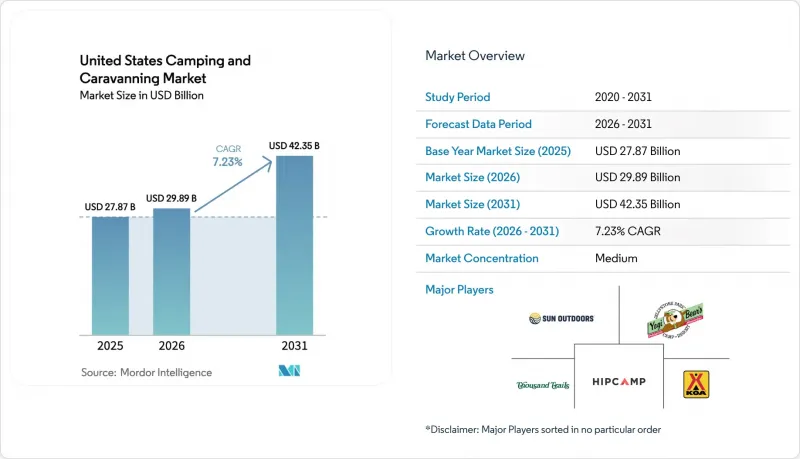
This report is Segmented by Destination Type (state or National Park Campgrounds, Privately Owned Campgrounds, and More), Type of Camper (car Camping, RV Camping, and More), Distribution Channel (direct Sales, Online Travel Agencies, and More), and Geography (Northeast, Midwest, and More). The Market Forecasts are Provided in Terms of Value (USD).
United States Camping And Caravanning Market Trends and Insights
Post-Pandemic Outdoor Recreation Boom Drives Mainstream Adoption
Outdoor recreation added USD 639.5 billion to the U.S. gross domestic product in 2024, with RV-related activities alone delivering USD 26.3 billion in direct value . The United States reported 175.8 million participants in camping and caravanning activities, underscoring the market's role as a vital and growing segment within the nation's leisure spending landscape. This participation level reflects the increasing consumer preference for outdoor recreational activities, driven by factors such as rising disposable incomes, a growing emphasis on wellness, and the appeal of nature-based experiences. This surge transcends income brackets because state parks, gear-rental programs, and discounted public-land passes have lowered access barriers. Annual direct spending tied to camping now totals USD 61 billion and cycles through fuel stations, convenience stores, outfitting shops, and guide services, reinforcing community economic resilience.
Millennial and Generation Z RV Ownership Transforms Market Demographics
First-time RV buyers represent 36% of sales as rental trials via peer-to-peer platforms convert renters into owners . Younger buyers prefer nimble campervans, hybrid pop-ups, and Class B rigs that fit into urban parking dimensions and plug into standard household outlets, redefining product portfolios among leading manufacturers. Social-connectivity requirements push campground operators to upgrade to fibre internet, individual Wi-Fi mesh nodes, and smart-lock shower facilities that guests can reserve in-app. Visual storytelling on Instagram and TikTok elevates the demand for photogenic communal spaces, mural walls, and star-gazing decks, an evolution that keeps the United States camping and caravanning market aligned with broader experience-economy trends. Additionally, the incorporation of remote-work amenities, covered cowork patios, ergonomic seating, and multi-device charging stations converts transient stays into week-long residencies that smooth mid-week demand volatility.
Rising Operational Costs Pressure Campground Margins
Property-insurance premiums rose at double-digit clips through 2024 as carriers recalibrated actuarial models to inflation, supply-chain volatility, and weather extremes. Premium escalation squeezes small-park operators lacking multi-property risk pools, driving some to divest at valuations favourable to larger chains. Land values in coastal and mountain corridors have climbed faster than national farmland averages, lifting carrying costs and lengthening payback periods. Tight labour markets compel operators to offer on-site staff housing, tuition subsidies, or retention bonuses, inflating payroll expense structures. These cost vectors collectively erode margins, tempering the expansion pace within the United States camping and caravanning market.
Other drivers and restraints analyzed in the detailed report include:
- State-Park Infrastructure Modernization Catalyzes Capacity Expansion
- Work-From-Anywhere Culture Enables Extended-Stay Demand
- Wildfire Frequency Restricts Access to Premium Destinations
For complete list of drivers and restraints, kindly check the Table Of Contents.
Segment Analysis
Privately owned campgrounds generated 36.71% of 2025 revenue, underscoring the United States camping and caravanning market size advantage enjoyed by agile operators capable of rapid amenity refreshes and dynamic pricing pivots. Their independence from legislative budget cycles enables quicker adoption of resort-style upgrades such as lazy-river pools, dog parks, and rentable Airstreams. Data-driven membership programs nurture loyalty and fill mid-week gaps, supporting year-round labour retention.
Backcountry and wilderness areas are slated for a 9.21% CAGR through 2031, propelled by experiential travel motivations and widespread social-media amplification. Public-land agencies monetize demand via campsite fees funnelled into trail maintenance, while outfitters provide gear rentals and guided treks to newcomers seeking safety in remote terrains. Limited overnight capacity safeguards ecological integrity, unintentionally preserving premium pricing leverage within this niche of the United States camping and caravanning market. Other destination categories, parking-lot boondocking, private-land marketplaces like Hipcamp, and harvest-host farm stays, fit overflow demand scenarios and specialized tastes. Their permissive cost structures foster entrepreneurial experimentation, from pop-up movie nights to gourmet-food-truck rallies, adding cultural diversity to supply options.
Complete Report Scope:
- By Destination Type
- State or National Park Campgrounds
- Privately Owned Campgrounds
- Public or Privately Owned Land Other Than a Campground
- Backcountry, National Forest or Wilderness Areas
- Parking Lots
- Others
- By Type of Camper
- Car Camping
- RV Camping
- Backpacking
- Others
- By Distribution Channel
- Direct Sales
- Online Travel Agencies
- Traditional Travel Agencies
- By Geography
- Northeast
- Midwest
- South
- West
List of Companies Covered in this Report:
- Kampgrounds of America (KOA)
- Thousand Trails (Equity LifeStyle Properties)
- Sun Outdoors (Sun Communities)
- Jellystone Park
- Good Sam (Camping World Holdings)
- Harvest Hosts
- Hipcamp
- ReserveAmerica
- Outdoorsy
- Escapees RV Club
- ARVC (National Assn. of RV Parks & Campgrounds)
- Blackstone-backed Blue Water Development
- Getaway
- Tentrr
- Boondockers Welcome
- Boating & RV Insurance (Progressive)
- Winnebago Industries
- Thor Industries
- Forest River
- Airstream
Additional Benefits:
- The market estimate (ME) sheet in Excel format
- 3 months of analyst support
TABLE OF CONTENTS
1 Introduction
- 1.1 Study Assumptions & Market Definition
- 1.2 Scope of the Study
2 Research Methodology
3 Executive Summary
4 Market Landscape
- 4.1 Market Overview
- 4.2 Market Drivers
- 4.2.1 Post-pandemic outdoor recreation boom (mainstream)
- 4.2.2 Surging RV ownership among millennials & Gen Z (mainstream)
- 4.2.3 Infrastructure upgrades in state park campgrounds (mainstream)
- 4.2.4 Work-from-anywhere lifestyle fueling "van-life" stays (under-the-radar)
- 4.2.5 Private equity roll-ups professionalising campground chains (under-the-radar)
- 4.2.6 AI-powered dynamic pricing tools boosting site utilisation (under-the-radar)
- 4.3 Market Restraints
- 4.3.1 Rising land and insurance costs for campground operators (mainstream)
- 4.3.2 Stringent zoning regulations limiting new site development (mainstream)
- 4.3.3 Growing wildfire frequency curbing back-country access (under-the-radar)
- 4.3.4 Short-term rental legislation spill-over to RV sites (under-the-radar)
- 4.4 Value / Supply-Chain Analysis
- 4.5 Regulatory Landscape
- 4.6 Technological Outlook
- 4.7 Porter's Five Forces
- 4.7.1 Threat of New Entrants
- 4.7.2 Bargaining Power of Suppliers
- 4.7.3 Bargaining Power of Buyers
- 4.7.4 Threat of Substitutes
- 4.7.5 Industry Rivalry
5 Market Size & Growth Forecasts (Value, USD Billion)
- 5.1 By Destination Type
- 5.1.1 State or National Park Campgrounds
- 5.1.2 Privately Owned Campgrounds
- 5.1.3 Public or Privately Owned Land Other Than a Campground
- 5.1.4 Backcountry, National Forest or Wilderness Areas
- 5.1.5 Parking Lots
- 5.1.6 Others
- 5.2 By Type of Camper
- 5.2.1 Car Camping
- 5.2.2 RV Camping
- 5.2.3 Backpacking
- 5.2.4 Others
- 5.3 By Distribution Channel
- 5.3.1 Direct Sales
- 5.3.2 Online Travel Agencies
- 5.3.3 Traditional Travel Agencies
- 5.4 By Geography
- 5.4.1 Northeast
- 5.4.2 Midwest
- 5.4.3 South
- 5.4.4 West
6 Competitive Landscape
- 6.1 Market Concentration
- 6.2 Strategic Moves
- 6.3 Market Share Analysis
- 6.4 Company Profiles (includes Global level Overview, Market level overview, Core Segments, Financials as available, Strategic Information, Market Rank/Share for key companies, Products & Services, and Recent Developments)
- 6.4.1 Kampgrounds of America (KOA)
- 6.4.2 Thousand Trails (Equity LifeStyle Properties)
- 6.4.3 Sun Outdoors (Sun Communities)
- 6.4.4 Jellystone Park
- 6.4.5 Good Sam (Camping World Holdings)
- 6.4.6 Harvest Hosts
- 6.4.7 Hipcamp
- 6.4.8 ReserveAmerica
- 6.4.9 Outdoorsy
- 6.4.10 Escapees RV Club
- 6.4.11 ARVC (National Assn. of RV Parks & Campgrounds)
- 6.4.12 Blackstone-backed Blue Water Development
- 6.4.13 Getaway
- 6.4.14 Tentrr
- 6.4.15 Boondockers Welcome
- 6.4.16 Boating & RV Insurance (Progressive)
- 6.4.17 Winnebago Industries
- 6.4.18 Thor Industries
- 6.4.19 Forest River
- 6.4.20 Airstream
7 Market Opportunities & Future Outlook
- 7.1 Upsell of ancillary on-site experiences (glamping pods, e-bike rentals)
- 7.2 Expansion of EV-charging-ready RV pads to capture electric RV segment

