PUBLISHER: Mordor Intelligence | PRODUCT CODE: 2117353

PUBLISHER: Mordor Intelligence | PRODUCT CODE: 2117353
Animal Feed Micronutrients - Market Share Analysis, Industry Trends & Statistics, Growth Forecasts (2026 - 2031)
According to Mordor Intelligence, the animal feed micronutrients market size was valued at USD 1.99 billion in 2025 and is projected to grow from USD 2.12 billion in 2026 to USD 2.85 billion by 2031 at a CAGR of 6.10% during the forecasted period from 2026 to 2031.
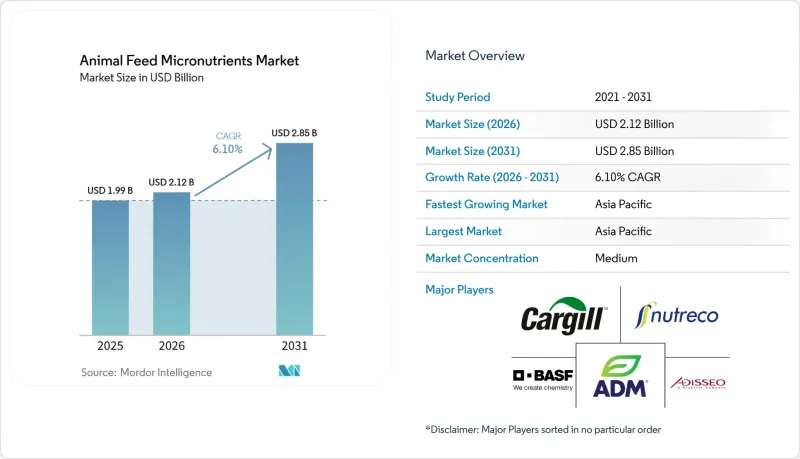
This report is Segmented by Nutrient Type (Trace Minerals, Vitamins, Amino Acids, Enzymes, and Other Micronutrients), by Livestock (Poultry, Ruminants, Swine, and More), and by Geography (North America, Europe, Asia-Pacific, South America, and More). The Market Forecasts are Provided in Terms of Value (USD) and Volume (Metric Tons).
Global Animal Feed Micronutrients Market Trends and Insights
Intensifying Industrial Livestock Production Worldwide
The animal feed micronutrients market is expanding as global livestock production increasingly shifts toward industrial systems that demand consistent and scalable feed formulations. In 2024, global meat production reached 374 million metric tons, with poultry meat holding the largest share, according to the Food and Agriculture Organization (FAO). This transition has driven feed mills to adopt standardized micronutrient inclusion practices, ensuring consistent nutrient distribution and feed quality across large-scale production. For instance, according to the European Feed Manufacturers' Federation (FEFAC), the European Union's total compound feed output reached 147.6 million metric tons in 2025, highlighting the scale of organized feed production. As herd and flock sizes grow, even minor improvements in feed efficiency and animal performance offer significant economic benefits. This trend underscores the importance of trace minerals and vitamins in animal feed, supporting the continued expansion of the animal feed micronutrients market.
Rising Demand for Animal Protein and Quality Meat, Milk, Eggs, and Aquaculture Output
The animal feed micronutrients market is experiencing growth due to the rising demand for animal protein and higher-quality livestock products within global food systems. Producers are focusing on enhancing productivity, animal health, and feed efficiency, which has increased the emphasis on balanced micronutrient supplementation. According to the Food and Agriculture Organization (FAO), global milk production reached 985 million metric tons in 2024, indicating continued growth in dairy output. Achieving higher production targets necessitates precise nutritional management, including sufficient levels of vitamins and trace minerals to support animal health, reproduction, immunity, and overall productivity. As livestock systems become more performance-driven, the demand for feed micronutrients is projected to remain robust.
Volatility in Vitamin and Specialty Mineral Input Costs
Input cost volatility remains a key short-term restraint on the animal feed micronutrients market, as profitability depends heavily on a limited number of upstream suppliers for essential vitamins and specialty trace minerals. In 2025, DSM-Firmenich reported that supply disruptions in the global vitamin market generated an estimated temporary EBITDA contribution of €150 million (USD 162 million), driven by higher vitamin prices resulting from market shortages. These disruptions in the supply of essential feed vitamins can rapidly increase procurement costs for animal nutrition manufacturers, prompting feed producers to delay the adoption of premium organic trace minerals or optimize micronutrient inclusion rates to control costs. Although baseline demand for essential micronutrients remains intact, sustained volatility in input costs can slow the transition to higher-value formulations, thereby restraining growth in the animal feed micronutrients market.
Other drivers and restraints analyzed in the detailed report include:
- Tightening Feed Safety and Traceability Standards
- Shift Toward Higher-Bioavailability Organic and Chelated Micronutrients
- Integrated Feed Additive Programs Reducing Standalone Micronutrient Differentiation
For complete list of drivers and restraints, kindly check the Table Of Contents.
Segment Analysis
The animal feed micronutrients market size for the trace minerals segment accounted for the largest 37.8% in 2025. Their position reflects the broad role of zinc, copper, manganese, selenium, and iron in immune response, enzyme activity, reproduction, bone integrity, and metabolic control across nearly all commercial species. Zinc remains one of the most widely used trace elements because it supports broiler leg health, sow claw strength, and shrimp immune response across very different production systems. Selenium attracts unusually close regulatory attention because the European Union sets a maximum selenium level of 0.5 mg/kg feed for all species and 0.2 mg/kg for organic selenium sources, which has encouraged more careful reformulation toward more efficient organic forms. Chromium remains a smaller part of the animal feed micronutrients market, but it gained more visibility after EFSA approved chromium propionate for all growing poultry species in 2025 at a maximum of 0.4 mg chromium/kg complete feed.
The animal feed micronutrient market for the vitamins segment is forecast to grow at the fastest CAGR of 7.9% from 2026 to 2031. Growth is being supported by stronger use of vitamins A, D3, E, and K in poultry and dairy systems, where reproductive performance, immunity, and production persistence depend on stable nutrient delivery. Water-soluble vitamins are also becoming more important in aquaculture because intensive shrimp and fish systems respond quickly to nutritional stress, transport shocks, and water-quality variability. Enzymes remain a large and stable part of the broader formulation mix, especially phytases in monogastric diets, but specialty micronutrients such as carotenoids, choline, and protected nutrient formats are taking a larger role in premium feeds. China issued the group standard T/SDFA 053-2025 in September 2025 to define recommended astaxanthin inclusion rates for aquaculture species and ornamental fish, demonstrating how carotenoid use is becoming more formalized in high-value feed applications.
Complete Report Scope:
- By Nutrient Type
- Trace Minerals
- Zinc
- Iron
- Copper
- Manganese
- Selenium
- Chromium
- Other Trace Minerals
- Vitamins
- Fat-Soluble Vitamins
- Water-Soluble Vitamins
- Amino Acids
- Methionine
- Lysine
- Threonine
- Tryptophan
- Other Amino Acids
- Enzymes
- Phytases
- Proteases
- Carbohydrases
- Other Enzymes
- Other Micronutrients
- Trace Minerals
- By Livestock
- Poultry
- Broilers
- Layers
- Breeders
- Ruminants
- Dairy Cattle
- Beef Cattle
- Small Ruminants
- Swine
- Piglets
- Grow-Finish Pigs
- Sows and Boars
- Aquaculture
- Fish
- Shrimp and Other Crustaceans
- Equine
- Other Livestock
- Poultry
- By Geography
- North America
- United States
- Canada
- Mexico
- Rest of North America
- South America
- Brazil
- Argentina
- Rest of South America
- Europe
- Germany
- United Kingdom
- France
- Italy
- Spain
- Russia
- Rest of Europe
- Asia-Pacific
- China
- India
- Japan
- Australia
- South Korea
- Indonesia
- Thailand
- Rest of Asia-Pacific
- Middle East
- Saudi Arabia
- United Arab Emirates
- Turkey
- Rest of Middle East
- Africa
- South Africa
- Egypt
- Nigeria
- Rest of Africa
- North America
Geography Analysis
The Asia-Pacific region accounted for the largest share of the animal feed micronutrients market at 42.7% in 2025, and it is also the fastest-growing regional segment, with a projected CAGR of 6.8% from 2026 to 2031. This dominance is attributed to the expansion of commercial feed production across poultry, swine, dairy, and aquaculture value chains. Within the region, China plays a central role due to its majority share in global aquaculture and egg production, both of which depend on micronutrient-intensive feeding systems. Similarly, India's significant contribution to global milk production drives consistent demand for mineral and vitamin supplementation in dairy feed. In addition, Southeast Asia's export-oriented shrimp and fish industries are boosting demand for vitamins, carotenoids, and specialty micronutrient formulations, reinforcing the region's position.
North America is growing moderately, reflecting its mature yet valuable market position. Growth in this region is driven by premiumization, with rising demand for organic trace minerals, species-specific micronutrient solutions, and performance-focused formulations. According to the United States Department of Agriculture (USDA), a cattle inventory of 94.2 million head as of July 2025 provides a strong foundation for beef and dairy micronutrient programs. Mexico and Canada contribute steady demand through their integration with North American feed and livestock systems. In comparison, South America is witnessing faster growth, with Brazil and Argentina adopting standardized micronutrient supplementation practices to support export-oriented poultry, swine, and cattle production.
Europe is anticipated to witness moderate growth, driven by stringent regulatory frameworks that promote the use of high-quality micronutrient formulations. In contrast, Russia faces obstacles due to sanctions and import-substitution policies, which limit access to foreign suppliers. The Middle East is projected to experience significant growth, supported by the increasing adoption of commercial feed, rising investments in food security, and the expansion of formal livestock production systems. Similarly, Africa is projected to achieve steady growth as feed manufacturing becomes more organized and industrialized, although affordability constraints may limit the pace of adoption. Overall, the animal feed micronutrients market is projected to display varied growth trends across regions.
- Cargill, Incorporated
- ADM
- Nutreco N.V. (SHV Holdings N.V.)
- BASF SE
- Adisseo France S.A.S. (China National Bluestar Group Co., Ltd.)
- Evonik Industries AG
- Alltech, Inc.
- Kemin Industries, Inc.
- Novus International, Inc. (Mitsui and Co., Ltd. and Nippon Soda Co., Ltd.)
- Phibro Animal Health Corporation
- De Heus Animal Nutrition B.V. (Royal De Heus)
- Balchem Corporation
- Zinpro Corporation
- Orffa International Holding B.V.
- Biochem Zusatzstoffe Handels- und Produktionsgesellschaft mbH
Additional Benefits:
- The market estimate (ME) sheet in Excel format
- 3 months of analyst support
TABLE OF CONTENTS
1 Introduction
- 1.1 Study Assumptions and Market Definition
- 1.2 Scope of the Study
2 Research Methodology
3 Executive Summary
4 Market Landscape
- 4.1 Market Overview
- 4.2 Market Drivers
- 4.2.1 Intensifying industrial livestock production worldwide
- 4.2.2 Rising demand for animal protein and quality meat, milk, eggs, and aquaculture output
- 4.2.3 Tightening feed safety and traceability standards
- 4.2.4 Shift toward higher-bioavailability organic and chelated micronutrients
- 4.2.5 Precision feeding platforms enabling species-stage-specific dosing
- 4.2.6 Reformulation around alternative ingredients and lower crude-protein diets
- 4.3 Market Restraints
- 4.3.1 Volatility in vitamin and specialty mineral input costs
- 4.3.2 Restrictive inclusion limits and lengthy approvals for certain trace minerals
- 4.3.3 Integrated feed additive programs reducing standalone micronutrient differentiation
- 4.3.4 Micronutrient stability loss during feed storage and pelleting
- 4.4 Regulatory Landscape
- 4.5 Technological Outlook
- 4.6 Porter's Five Forces Analysis
- 4.6.1 Threat of New Entrants
- 4.6.2 Bargaining Power of Suppliers
- 4.6.3 Bargaining Power of Buyers
- 4.6.4 Threat of Substitutes
- 4.6.5 Intensity of Competitive Rivalry
5 Market Size and Growth Forecasts (Value)
- 5.1 By Nutrient Type
- 5.1.1 Trace Minerals
- 5.1.1.1 Zinc
- 5.1.1.2 Iron
- 5.1.1.3 Copper
- 5.1.1.4 Manganese
- 5.1.1.5 Selenium
- 5.1.1.6 Chromium
- 5.1.1.7 Other Trace Minerals
- 5.1.2 Vitamins
- 5.1.2.1 Fat-Soluble Vitamins
- 5.1.2.2 Water-Soluble Vitamins
- 5.1.3 Amino Acids
- 5.1.3.1 Methionine
- 5.1.3.2 Lysine
- 5.1.3.3 Threonine
- 5.1.3.4 Tryptophan
- 5.1.3.5 Other Amino Acids
- 5.1.4 Enzymes
- 5.1.4.1 Phytases
- 5.1.4.2 Proteases
- 5.1.4.3 Carbohydrases
- 5.1.4.4 Other Enzymes
- 5.1.5 Other Micronutrients
- 5.1.1 Trace Minerals
- 5.2 By Livestock
- 5.2.1 Poultry
- 5.2.1.1 Broilers
- 5.2.1.2 Layers
- 5.2.1.3 Breeders
- 5.2.2 Ruminants
- 5.2.2.1 Dairy Cattle
- 5.2.2.2 Beef Cattle
- 5.2.2.3 Small Ruminants
- 5.2.3 Swine
- 5.2.3.1 Piglets
- 5.2.3.2 Grow-Finish Pigs
- 5.2.3.3 Sows and Boars
- 5.2.4 Aquaculture
- 5.2.4.1 Fish
- 5.2.4.2 Shrimp and Other Crustaceans
- 5.2.5 Equine
- 5.2.6 Other Livestock
- 5.2.1 Poultry
- 5.3 By Geography
- 5.3.1 North America
- 5.3.1.1 United States
- 5.3.1.2 Canada
- 5.3.1.3 Mexico
- 5.3.1.4 Rest of North America
- 5.3.2 South America
- 5.3.2.1 Brazil
- 5.3.2.2 Argentina
- 5.3.2.3 Rest of South America
- 5.3.3 Europe
- 5.3.3.1 Germany
- 5.3.3.2 United Kingdom
- 5.3.3.3 France
- 5.3.3.4 Italy
- 5.3.3.5 Spain
- 5.3.3.6 Russia
- 5.3.3.7 Rest of Europe
- 5.3.4 Asia-Pacific
- 5.3.4.1 China
- 5.3.4.2 India
- 5.3.4.3 Japan
- 5.3.4.4 Australia
- 5.3.4.5 South Korea
- 5.3.4.6 Indonesia
- 5.3.4.7 Thailand
- 5.3.4.8 Rest of Asia-Pacific
- 5.3.5 Middle East
- 5.3.5.1 Saudi Arabia
- 5.3.5.2 United Arab Emirates
- 5.3.5.3 Turkey
- 5.3.5.4 Rest of Middle East
- 5.3.6 Africa
- 5.3.6.1 South Africa
- 5.3.6.2 Egypt
- 5.3.6.3 Nigeria
- 5.3.6.4 Rest of Africa
- 5.3.1 North America
6 Competitive Landscape
- 6.1 Market Concentration
- 6.2 Strategic Moves
- 6.3 Market Share Analysis
- 6.4 Company Profiles (Includes Global Level Overview, Market Level Overview, Core Business Segments, Financials, Headcount, Key Information, Market Rank, Market Share, Products and Services, and Analysis of Recent Developments)
- 6.4.1 Cargill, Incorporated
- 6.4.2 ADM
- 6.4.3 Nutreco N.V. (SHV Holdings N.V.)
- 6.4.4 BASF SE
- 6.4.5 Adisseo France S.A.S. (China National Bluestar Group Co., Ltd.)
- 6.4.6 Evonik Industries AG
- 6.4.7 Alltech, Inc.
- 6.4.8 Kemin Industries, Inc.
- 6.4.9 Novus International, Inc. (Mitsui and Co., Ltd. and Nippon Soda Co., Ltd.)
- 6.4.10 Phibro Animal Health Corporation
- 6.4.11 De Heus Animal Nutrition B.V. (Royal De Heus)
- 6.4.12 Balchem Corporation
- 6.4.13 Zinpro Corporation
- 6.4.14 Orffa International Holding B.V.
- 6.4.15 Biochem Zusatzstoffe Handels- und Produktionsgesellschaft mbH
7 Market Opportunities and Future Outlook

