PUBLISHER: Mordor Intelligence | PRODUCT CODE: 2117357

PUBLISHER: Mordor Intelligence | PRODUCT CODE: 2117357
Food Texture - Market Share Analysis, Industry Trends & Statistics, Growth Forecasts (2025 - 2030)
According to Mordor Intelligence, the food texture market size is valued at USD 16.51 billion in 2025 and is forecast to climb to USD 20.45 billion by 2030, reflecting a 6.11% CAGR during the period.
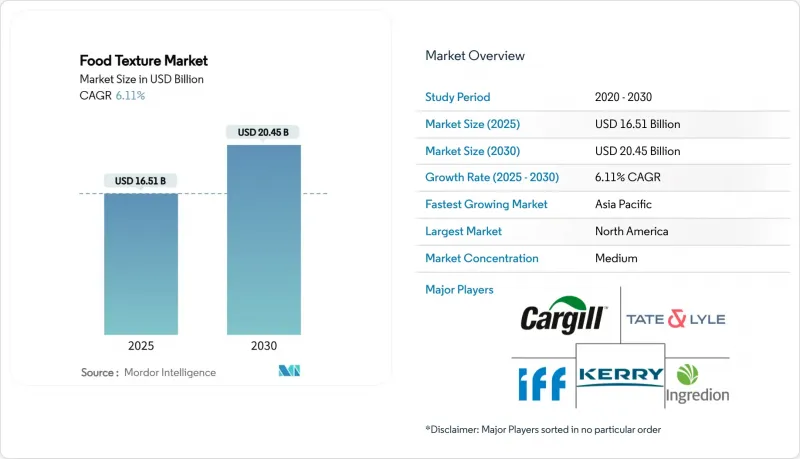
This report is Segmented by Product Type (Hydrocolloids, Starch and Derivatives, and More), Source (Plant-Based, Animal-Based, Microbial and Fermentation-Derived, and More), Form (Powder, Liquid, Gel/Emulsion), Application (Bakery and Confectionery, Dairy and Frozen Desserts, Meat and Poultry Alternatives, Beverages, and More), and Geography. The Market Forecasts are Provided in Terms of Value (USD).
Global Food Texture Market Trends and Insights
Rising demand for clean label and natural ingredients
The shift in consumer preferences toward recognizable ingredients has changed how manufacturers select texturizers, leading to a transition from chemically modified starches to native alternatives that provide similar functionality. Under current Europe and United Kingdom regulations, any substance classified as a food additives, including natural plant extracts with technological functions, requires authorization. This regulatory framework has increased the adoption of established natural texturizers. Companies such as Beneo-Remy and Cargill have developed native rice and corn starches that match the performance of chemically modified variants. The trend has expanded to include hydrocolloids, where manufacturers use enzyme-assisted extraction methods to enhance functionality while maintaining natural ingredient status. The GRAS (Generally Recognized as Safe) approval of fibrillated cellulose demonstrates how natural texturizers can function as rheology modifiers, stabilizers, and fiber supplements while meeting clean-label requirements.
Growth of convenience and processed foods
The growth in ready-to-eat meals and packaged food segments drives consistent demand for texturizers that preserve product quality during extended shelf life periods and various storage conditions. The Asia-Pacific region demonstrates significant growth in convenience food consumption, driven by urbanization and lifestyle changes that increase processed food demand. Hydrocolloids, including xanthan gum and pectin, are crucial for maintaining texture and stability in dairy and frozen food products, particularly where temperature variations can affect product quality. The expansion of the processed food industry creates opportunities for specialized texturizers that address specific challenges, such as preventing ice crystal formation in frozen desserts and maintaining emulsion stability in shelf-stable sauces. The microbial gums market has developed to meet these requirements, with growth potential in traditional applications and new uses, including biodegradable packaging and prebiotic ingredients.
Volatile prices of hydrocolloids and starches
Raw material price volatility creates significant margin pressure for texturizer manufacturers, with agar prices reaching USD 35-45 per kilogram due to supply restrictions in Morocco, nearly triple previous pricing levels. The Moroccan government's reduction in legal Gelidium seaweed harvest from 14,000 tonnes to 6,000 tonnes annually, combined with export limitations of 1,200 tonnes, has created acute shortages affecting both food and laboratory applications. Major suppliers like Thermo Fisher Scientific have suspended raw agar sales, prioritizing other products due to competition from food companies that consume several thousand tonnes annually. This supply-demand imbalance forces manufacturers to seek alternative texturizers or accept higher input costs that reduce profitability. The Indonesian seaweed supply chain faces additional challenges, including poor quality of raw dried seaweed, currency exchange rate fluctuations, and uncertainty in seaweed yields, creating compound volatility effects.
Other drivers and restraints analyzed in the detailed report include:
- Growing awareness of sensory experience in food
- Functional benefits in shelf-life and sensory appeal
- Consumer push-back on mouthfeel enhancers in sugar-reduced SKUs
For complete list of drivers and restraints, kindly check the Table Of Contents.
Segment Analysis
Hydrocolloids hold the dominant market position with a 38.34% share in 2024, due to their versatility in creating stable emulsions, gels, and foams across food applications. The starch and derivatives segment is projected to grow at 7.12% CAGR (2025-2030), supported by innovations in clean-label formulations that maintain functional performance without chemical modifications. Companies such as Ingredion and Cargill have developed native starch blends that provide functionality comparable to modified variants, meeting consumer preferences for simple ingredients.
While gelatin experiences competition from plant-based substitutes, it remains essential in premium applications requiring specific gel strength and thermal reversibility. Pectin continues to grow in fruit-based products and sugar-reduced formulations, where its natural gelling properties support clean-label requirements. Protein-based texturizers are increasing in plant-based meat alternatives, with transglutaminase enabling improved texture and water-holding capacity through cross-linking. Cellulose derivatives have expanded their application range following FDAapproval of fibrillated cellulose as a multifunctional ingredient that serves as a rheology modifier, stabilizer, and fiber supplement.
Plant-based sources hold a 53.89% market share in 2024, driven by consumer preference for natural ingredients and well-established supply chains for seaweed, plant gums, and starch derivatives. According to the United States Department of Agriculture data from 2023, 1.58 million people in Germany adopted plant-based diets, reflecting a significant shift in dietary preferences. Bio-synthetic and precision-fermented texturizers are emerging as the fastest-growing source category with a 7.50% CAGR (2025-2030). This growth stems from technological advancements that enable the production of complex molecules without traditional agriculture. Companies are developing precision fermentation systems to produce ice-structuring proteins and specialized texturizers that offer enhanced functionality compared to plant-derived options.
Animal-based sources experience declining demand due to dietary restrictions and sustainability concerns, though they remain important for specific applications requiring distinct functional properties. Microbial and fermentation-derived texturizers offer advantages in scalability and quality consistency, addressing supply chain vulnerabilities that affect seaweed-based hydrocolloids. The industry's transition toward bio-synthetic sources responds to climate-related supply disruptions while meeting consumer demand for sustainable production methods that minimize environmental impact and maintain product performance.
Complete Report Scope:
- By Product Type
- Hydrocolloids
- Starch and Derivatives
- Gelatin
- Pectin
- Protein-based Texturizers
- Cellulose Derivatives
- By Source
- Plant-based
- Animal-based
- Microbial and Fermentation-derived
- Bio-synthetic/Precision-fermented
- By Form
- Powder
- Liquid
- Gel/Emulsion
- By Application
- Bakery and Confectionery
- Dairy and Frozen Desserts
- Meat and Poultry Alternatives
- Beverages
- Snacks and Ready To Eat Meals
- Sauces, Dressings and Condiments
- Infant and Clinical Nutrition
- By Geography
- North America
- United States
- Canada
- Mexico
- Rest of North America
- Europe
- Germany
- United Kingdom
- Italy
- France
- Spain
- Netherlands
- Rest of Europe
- Asia-Pacific
- China
- India
- Japan
- Australia
- Rest of Asia-Pacific
- South America
- Brazil
- Argentina
- Rest of South America
- Middle East and Africa
- South Africa
- Saudi Arabia
- Rest of Middle East and Africa
- North America
Geography Analysis
North America holds 53.00% market share in 2024, supported by robust regulatory frameworks that enable innovation while maintaining safety standards, as shown by the FDA's GRAS notification system for novel texturizers like fibrillated cellulose. The region's advanced food processing infrastructure and consumer acceptance of premium texture-enhanced products create optimal conditions for high-value texturizer applications. Ingredion's USD 100 million Indianapolis facility expansion reflects industry confidence in the North American market, with strong performance in its Texture & Healthful Solutions segment throughout 2024. The region's focus on clean-label products drives demand for native starches and natural hydrocolloids that provide functionality while meeting consumer preferences for recognizable ingredients.
Asia-Pacific exhibits the fastest growth rate at 7.89% CAGR (2025-2030), driven by increased processed food consumption, urbanization, and improved regulatory harmonization. The region's nutraceutical market, expected to reach USD 441.7 billion by 2026, presents opportunities for functional texturizers that combine sensory and health benefits. Japan's Foods with Function Claims system demonstrates regulatory progress that supports innovation while protecting consumers. China and India emerge as key markets due to their large consumer bases and expanding middle-class populations seeking premium processed foods with advanced texture solutions.
Europe maintains a strong market position through strict regulatory standards that support established natural texturizers while regulating novel additives. The EFSA's food additive re-evaluation program sets international benchmarks while ensuring market confidence in hydrocolloid safety. European purchasers demand sustainability certifications and traceability, creating opportunities for suppliers demonstrating responsible practices. The region's focus on sustainability and clean-label products aligns with developments in precision fermentation for texturizer production. South America and Middle East & Africa offer growth potential through developing food processing industries and increasing consumer sophistication, though regulatory complexities and infrastructure limitations affect market development and cost efficiency.
- Cargill, Incorporated
- International Flavors and Fragrances Inc.
- Ingredion Incorporated
- Kerry Group plc
- Tate & Lyle PLC
- Archer Daniels Midland Company (ADM)
- Silvateam SpA
- DSM-Firmenich AG
- JP&SB International
- Gelita AG
- Rousselot (Darling Ingredients)
- Ashland Global Holdings Inc.
- Hydrosol GmbH & Co. KG
- Gelita AG
- Shandong Dongbao Gelatin Co. Ltd
- Nitta Gelatin Inc.
- Pacific Pectin Inc
- Lucid Colloids Limites
- Foodchem International Corporation
- Lapi Gelatine S.p.a
Additional Benefits:
- The market estimate (ME) sheet in Excel format
- 3 months of analyst support
TABLE OF CONTENTS
1 INTRODUCTION
- 1.1 Study Assumptions and Market Definition
- 1.2 Scope of the Study
2 RESEARCH METHODOLOGY
3 EXECUTIVE SUMMARY
4 MARKET LANDSCAPE
- 4.1 Market Overview
- 4.2 Market Drivers
- 4.2.1 Rising demand for clean label and natural ingredients
- 4.2.2 Growth of convenience and processed foods
- 4.2.3 Growing Awareness of Sensory Experience in Food
- 4.2.4 Functional benefits in shelf-life and sensory appeal
- 4.2.5 Enzyme-enabled in-situ texture modification
- 4.2.6 AI-driven formulation platforms shorten Research and Development cycles
- 4.3 Market Restraints
- 4.3.1 Volatile prices of hydrocolloids and starches
- 4.3.2 Stringent regulatory approvals for novel additives
- 4.3.3 Climate-driven shortages of specialty seaweed extracts
- 4.3.4 Consumer push-back on mouthfeel enhancers in sugar-reduced SKUs
- 4.4 Supply Chain Analysis
- 4.5 Regulatory Outlook
- 4.6 Porter's Five Forces
- 4.6.1 Threat of New Entrants
- 4.6.2 Bargaining Power of Buyers/Consumers
- 4.6.3 Bargaining Power of Suppliers
- 4.6.4 Threat of Substitute Products
- 4.6.5 Intensity of Competitive Rivalry
5 MARKET SIZE AND GROWTH FORECASTS (VALUE)
- 5.1 By Product Type
- 5.1.1 Hydrocolloids
- 5.1.2 Starch and Derivatives
- 5.1.3 Gelatin
- 5.1.4 Pectin
- 5.1.5 Protein-based Texturizers
- 5.1.6 Cellulose Derivatives
- 5.2 By Source
- 5.2.1 Plant-based
- 5.2.2 Animal-based
- 5.2.3 Microbial and Fermentation-derived
- 5.2.4 Bio-synthetic/Precision-fermented
- 5.3 By Form
- 5.3.1 Powder
- 5.3.2 Liquid
- 5.3.3 Gel/Emulsion
- 5.4 By Application
- 5.4.1 Bakery and Confectionery
- 5.4.2 Dairy and Frozen Desserts
- 5.4.3 Meat and Poultry Alternatives
- 5.4.4 Beverages
- 5.4.5 Snacks and Ready To Eat Meals
- 5.4.6 Sauces, Dressings and Condiments
- 5.4.7 Infant and Clinical Nutrition
- 5.5 By Geography
- 5.5.1 North America
- 5.5.1.1 United States
- 5.5.1.2 Canada
- 5.5.1.3 Mexico
- 5.5.1.4 Rest of North America
- 5.5.2 Europe
- 5.5.2.1 Germany
- 5.5.2.2 United Kingdom
- 5.5.2.3 Italy
- 5.5.2.4 France
- 5.5.2.5 Spain
- 5.5.2.6 Netherlands
- 5.5.2.7 Rest of Europe
- 5.5.3 Asia-Pacific
- 5.5.3.1 China
- 5.5.3.2 India
- 5.5.3.3 Japan
- 5.5.3.4 Australia
- 5.5.3.5 Rest of Asia-Pacific
- 5.5.4 South America
- 5.5.4.1 Brazil
- 5.5.4.2 Argentina
- 5.5.4.3 Rest of South America
- 5.5.5 Middle East and Africa
- 5.5.5.1 South Africa
- 5.5.5.2 Saudi Arabia
- 5.5.5.3 Rest of Middle East and Africa
- 5.5.1 North America
6 COMPETITIVE LANDSCAPE
- 6.1 Market Concentration
- 6.2 Strategic Moves
- 6.3 Market Ranking Analysis
- 6.4 Company Profiles (includes Global level Overview, Market level overview, Core Segments, Financials as available, Strategic Information, Market Rank/Share for key companies, Products & Services, and Recent Developments)
- 6.4.1 Cargill, Incorporated
- 6.4.2 International Flavors and Fragrances Inc.
- 6.4.3 Ingredion Incorporated
- 6.4.4 Kerry Group plc
- 6.4.5 Tate & Lyle PLC
- 6.4.6 Archer Daniels Midland Company (ADM)
- 6.4.7 Silvateam SpA
- 6.4.8 DSM-Firmenich AG
- 6.4.9 JP&SB International
- 6.4.10 Gelita AG
- 6.4.11 Rousselot (Darling Ingredients)
- 6.4.12 Ashland Global Holdings Inc.
- 6.4.13 Hydrosol GmbH & Co. KG
- 6.4.14 Gelita AG
- 6.4.15 Shandong Dongbao Gelatin Co. Ltd
- 6.4.16 Nitta Gelatin Inc.
- 6.4.17 Pacific Pectin Inc
- 6.4.18 Lucid Colloids Limites
- 6.4.19 Foodchem International Corporation
- 6.4.20 Lapi Gelatine S.p.a
7 MARKET OPPORTUNITIES AND FUTURE OUTLOOK

