PUBLISHER: Mordor Intelligence | PRODUCT CODE: 2117423

PUBLISHER: Mordor Intelligence | PRODUCT CODE: 2117423
Industrial Vehicles - Market Share Analysis, Industry Trends & Statistics, Growth Forecasts (2026 - 2031)
According to Mordor Intelligence, the industrial vehicles market size is expected to increase from USD 46.13 billion in 2025 to USD 48.36 billion in 2026 and reach USD 61.26 billion by 2031, growing at a CAGR of 4.84% over 2026-2031.
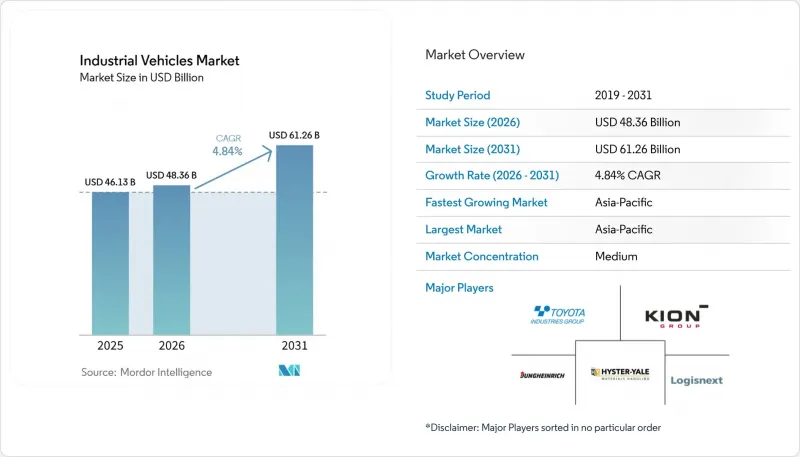
This report is Segmented by Vehicle Type (Forklifts, Tow Tractors, and More), Propulsion Type (Internal Combustion Engine (ICE), Electric, and More), Application (Manufacturing, Warehousing, and More), Weight Category (Light Duty, Medium Duty, and More), Level of Autonomy (Non-Autonomous, Semi-Autonomous and More), and Geography. The Market Forecasts are Provided in Terms of Value (USD) and Volume (Units).
Global Industrial Vehicles Market Trends and Insights
E-commerce-Fueled Warehousing Boom
Record online-order volumes require denser storage, faster picking, and continuous fulfillment cycles, prompting operators to add electric reach trucks and autonomous pallet movers able to navigate narrow aisles safely. In 2025, Amazon announced the deployment of over 1 million robots in its worldwide fulfillment and logistics network, highlighting the vast scale of its material-handling operations. Micro-fulfillment nodes in major cities further stimulate demand for compact industrial vehicle solutions that combine high-throughput lifts with advanced vision-guided navigation. Operators pay premiums for equipment that integrates natively with warehouse-execution software, ensuring real-time inventory accuracy. Same-day delivery norms in the United States and parts of Asia-Pacific reinforce capital flows into next-generation fleets that can operate around the clock without emitting exhaust, thereby supporting stringent indoor-air-quality codes.
Emissions Regulations Accelerating Electrification
California's Zero-Emission Forklift Regulation bans new internal-combustion forklifts, phases out large-spark-ignition units, and projects significant health benefits alongside net fleet savings over each forklift's lifecycle. Europe's Fit for 55 package and China's dual-carbon roadmap echo California's intent, driving up lithium-ion adoption rates. BYD's Blade Battery, combined with FLASH chargers, enables quick pit stops, allowing operators to recharge during shift breaks and retire spare batteries. The Environmental Protection Agency reinitiated Tier 5 rulemaking. Concurrently, Iowa's right-to-repair statute broadens service access, highlighting regulatory divergence amidst a unified push for electrification . Operators unable to finance the shift from internal-combustion fleets face risks of stranded assets and declining resale values.
High Upfront Cost of Electric / Automated Vehicles
Electric forklifts command a significant premium over their internal-combustion counterparts, with batteries alone potentially adding substantial costs to the final bill. This price hike extends payback periods for operators already grappling with tight margins. Hyster-Yale reported a decline in sales, resulting in a net loss as customers postponed purchases amid macroeconomic uncertainties. In a bid to navigate these challenges, the company is reducing its workforce, targeting annual savings in the long term. Meanwhile, manufacturers that can't finance customers or showcase a lower total cost of ownership face the risk of losing market share to budget-friendly Chinese competitors.
Other drivers and restraints analyzed in the detailed report include:
- Automation and Safety Needs Amid Labor Shortages
- Battery-as-a-Service Lowering Capex Barriers
- Battery-Metal and Chip Supply Bottlenecks
For complete list of drivers and restraints, kindly check the Table Of Contents.
Segment Analysis
Forklifts generated 40.15% of the industrial vehicles market size in 2025, sustaining their central role in general material handling. Automated guided vehicles, though smaller in absolute dollars, are pacing at a 9.13% CAGR, benefiting from 24/7 uptime and labor substitution economics. At fully automated terminals, container-handling trucks have seen average selling prices rise. Meanwhile, tow tractors have carved out a niche, primarily serving airport ground support. Incumbents like Toyota Industries, KION, and Jungheinrich face pressure from stagnant forklift volumes, pushing them to innovate with lithium-ion integration and over-the-air diagnostics.
Chinese AGV manufacturers, such as Xunji Zhixing and VisionNav, utilize VNSLAM accuracy to offer competitive pricing and faster delivery cycles, challenging Western brands. KION's IMOCO and QBIIK software enhance overall equipment effectiveness, underscoring the growing importance of software layers in driving future value beyond hardware. Hyster-Yale's automated IDA truck combines AI vision, collision-avoidance, and lithium-ion batteries as premium upgrades, potentially doubling revenue per unit when bundled with orchestration software.
The industrial vehicles market share for internal-combustion engines stood at 85.33% in 2025, yet electrics are expanding at 8.79%, supported by zero-emission rules and falling battery costs. Port Newark has placed an order for hybrid straddle carriers, highlighting the growing trend of hybrid drivetrains in ports. While compressed natural gas forklifts find a niche in petrochemical hubs, infrastructure limitations hinder their broader adoption.
BYD's innovative FLASH charger significantly reduces idle time. This efficiency enables fleets with a single battery to seamlessly cater to multi-shift demands. California's regulatory push is set to further elevate electric vehicle adoption. This underscores the power of regulation in driving adoption, even when the economic benefits are marginal. Vendors lacking a robust lithium-ion lineup may find themselves sidelined, missing out on bids from retailers and food-and-beverage producers that prioritize indoor zero-emission compliance.
Complete Report Scope:
- By Vehicle Type
- Forklifts
- Tow Tractors
- Container Handling Trucks
- Industrial Tractors
- Automated Guided Vehicles (AGVs)
- Personnel Carriers
- Scissor Lifts
- Boom Lifts
- Others
- By Propulsion Type
- Internal Combustion Engine (ICE)
- Electric
- Hybrid
- CNG / LPG
- By Application
- Manufacturing
- Automotive
- Chemical
- Food and Beverages
- Metals and Machinery
- Warehousing
- Freight and Logistics
- Construction
- Agriculture
- Retail
- Others
- Manufacturing
- By Weight Category
- Light Duty
- Medium Duty
- Heavy Duty
- By Level of Autonomy
- Non-Autonomous
- Semi-Autonomous
- Fully Autonomous
- By Geography
- North America
- United States
- Canada
- Rest of North America
- South America
- Brazil
- Argentina
- Rest of South America
- Europe
- United Kingdom
- Germany
- Spain
- Italy
- France
- Russia
- Rest of Europe
- Asia-Pacific
- India
- China
- Japan
- South Korea
- Rest of Asia-Pacific
- Middle East and Africa
- United Arab Emirates
- Saudi Arabia
- Turkey
- Egypt
- South Africa
- Rest of Middle East and Africa
- North America
Geography Analysis
Asia-Pacific commanded 42.66% of the industrial vehicles market share in 2025 and is expected to grow at 6.15% through 2031. Chinese AGV vendors achieving high navigation accuracy are making significant inroads in grocery, electronics, and cross-border e-commerce fulfillment centers. This push has bolstered Hangcha's sales, moving a substantial number of electric forklifts domestically. In India, production-linked incentives are luring foreign direct investments, particularly in smartphones and auto parts. This influx is spurring warehouse expansions. However, the inconsistent grid power is hindering the adoption of lithium-ion technology, especially outside tier-1 cities. Meanwhile, Japan and South Korea are weaving intra-logistics into their Manufacturing 4.0 strategies. Yet, Toyota Industries faced a setback, with its materials-handling revenue dipping due to settlement costs, underscoring the industry's regulatory vulnerabilities.
North America may have a smaller market volume, but it commands premium pricing. This is largely due to California's stringent zero-emission rules and the anticipated EPA Tier 5 standards, which elevate technical specifications. Port Newark is taking strides towards electrification, with hybrid straddle carriers booked for delivery. Retail giants are pushing the envelope on automation, as evidenced by Walmart's retrofit in Opelousas. In Europe, the trend is unmistakable: Germany champions Industry 4.0 initiatives, and KION, even amidst raw-material inflation, sees its order intake surge to a notable EUR 11.705 billion, leading to strong revenue outcomes.
While South America, the Middle East, and Africa command a smaller share of the industrial vehicles market, they are ripe with green-field opportunities. Brazil's Suape terminal is set to become APM's inaugural fully electric port in Latin America, featuring remote-operated cranes and electric yard tractors. The Port of Montreal, with backing from the Canada Infrastructure Bank, is expanding its Contrecceur facility, adding significant TEU capacity. Meanwhile, Lome Container Terminal is modernizing with Konecranes' TruConnect, upgrading to remote-monitored reach stackers and empty-container handlers, highlighting the growing traction of digital service contracts, even in markets with modest unit sales volumes.
- Toyota Industries Corporation
- KION Group AG
- Jungheinrich AG
- Mitsubishi Logisnext Co. Ltd.
- Hyster-Yale Materials Handling Inc.
- Crown Equipment Corporation
- BYD Company Ltd.
- Hangcha Group Co. Ltd.
- Komatsu Ltd.
- Doosan Industrial Vehicle Co. Ltd.
- Clark Material Handling Company
- Hyundai Construction Equipment Co.
- Caterpillar Inc.
- Raymond Corporation
- JCB Ltd.
Additional Benefits:
- The market estimate (ME) sheet in Excel format
- 3 months of analyst support
TABLE OF CONTENTS
1 Introduction
- 1.1 Study Assumptions & Market Definition
- 1.2 Scope of the Study
2 Research Methodology
3 Executive Summary
4 Market Landscape
- 4.1 Market Overview
- 4.2 Market Drivers
- 4.2.1 E-commerce-Fueled Warehousing Boom
- 4.2.2 Emissions Regulations Accelerating Electrification
- 4.2.3 Automation and Safety Needs Amid Labor Shortages
- 4.2.4 Manufacturing 4.0 Integration of Intra-Logistics
- 4.2.5 5G Private Networks Enabling Fleet Orchestration
- 4.2.6 Battery-as-a-Service Lowering Capex Barriers
- 4.3 Market Restraints
- 4.3.1 High Upfront Cost of Electric / Automated Vehicles
- 4.3.2 Battery-Metal and Chip Supply Bottlenecks
- 4.3.3 Cyber-Security Risks in Connected Fleets
- 4.3.4 Legacy Floor Quality Limiting AGV/AMR Navigation
- 4.4 Value / Supply-Chain Analysis
- 4.5 Regulatory Landscape
- 4.6 Technological Outlook
- 4.7 Porter's Five Forces
- 4.7.1 Threat of New Entrants
- 4.7.2 Bargaining Power of Suppliers
- 4.7.3 Bargaining Power of Buyers
- 4.7.4 Threat of Substitutes
- 4.7.5 Competitive Rivalry
5 Market Size & Growth Forecasts (Value (USD) and Volume (Units))
- 5.1 By Vehicle Type
- 5.1.1 Forklifts
- 5.1.2 Tow Tractors
- 5.1.3 Container Handling Trucks
- 5.1.4 Industrial Tractors
- 5.1.5 Automated Guided Vehicles (AGVs)
- 5.1.6 Personnel Carriers
- 5.1.7 Scissor Lifts
- 5.1.8 Boom Lifts
- 5.1.9 Others
- 5.2 By Propulsion Type
- 5.2.1 Internal Combustion Engine (ICE)
- 5.2.2 Electric
- 5.2.3 Hybrid
- 5.2.4 CNG / LPG
- 5.3 By Application
- 5.3.1 Manufacturing
- 5.3.1.1 Automotive
- 5.3.1.2 Chemical
- 5.3.1.3 Food and Beverages
- 5.3.1.4 Metals and Machinery
- 5.3.2 Warehousing
- 5.3.3 Freight and Logistics
- 5.3.4 Construction
- 5.3.5 Agriculture
- 5.3.6 Retail
- 5.3.7 Others
- 5.3.1 Manufacturing
- 5.4 By Weight Category
- 5.4.1 Light Duty
- 5.4.2 Medium Duty
- 5.4.3 Heavy Duty
- 5.5 By Level of Autonomy
- 5.5.1 Non-Autonomous
- 5.5.2 Semi-Autonomous
- 5.5.3 Fully Autonomous
- 5.6 By Geography
- 5.6.1 North America
- 5.6.1.1 United States
- 5.6.1.2 Canada
- 5.6.1.3 Rest of North America
- 5.6.2 South America
- 5.6.2.1 Brazil
- 5.6.2.2 Argentina
- 5.6.2.3 Rest of South America
- 5.6.3 Europe
- 5.6.3.1 United Kingdom
- 5.6.3.2 Germany
- 5.6.3.3 Spain
- 5.6.3.4 Italy
- 5.6.3.5 France
- 5.6.3.6 Russia
- 5.6.3.7 Rest of Europe
- 5.6.4 Asia-Pacific
- 5.6.4.1 India
- 5.6.4.2 China
- 5.6.4.3 Japan
- 5.6.4.4 South Korea
- 5.6.4.5 Rest of Asia-Pacific
- 5.6.5 Middle East and Africa
- 5.6.5.1 United Arab Emirates
- 5.6.5.2 Saudi Arabia
- 5.6.5.3 Turkey
- 5.6.5.4 Egypt
- 5.6.5.5 South Africa
- 5.6.5.6 Rest of Middle East and Africa
- 5.6.1 North America
6 Competitive Landscape
- 6.1 Market Concentration
- 6.2 Strategic Moves
- 6.3 Market Share Analysis
- 6.4 Company Profiles (Includes Global Level Overview, Market Level Overview, Core Segments, Financials as Available, Strategic Information, Market Rank/Share for Key Companies, Products and Services, SWOT Analysis, and Recent Developments)
- 6.4.1 Toyota Industries Corporation
- 6.4.2 KION Group AG
- 6.4.3 Jungheinrich AG
- 6.4.4 Mitsubishi Logisnext Co. Ltd.
- 6.4.5 Hyster-Yale Materials Handling Inc.
- 6.4.6 Crown Equipment Corporation
- 6.4.7 BYD Company Ltd.
- 6.4.8 Hangcha Group Co. Ltd.
- 6.4.9 Komatsu Ltd.
- 6.4.10 Doosan Industrial Vehicle Co. Ltd.
- 6.4.11 Clark Material Handling Company
- 6.4.12 Hyundai Construction Equipment Co.
- 6.4.13 Caterpillar Inc.
- 6.4.14 Raymond Corporation
- 6.4.15 JCB Ltd.
7 Market Opportunities & Future Outlook
- 7.1 White-space & Unmet-Need Assessment

