PUBLISHER: Mordor Intelligence | PRODUCT CODE: 2117429

PUBLISHER: Mordor Intelligence | PRODUCT CODE: 2117429
Automotive Fuel Rail - Market Share Analysis, Industry Trends & Statistics, Growth Forecasts (2026 - 2031)
According to Mordor Intelligence, the automotive fuel rail market size was valued at USD 4.15 billion in 2025, expected to reach USD 4.32 billion in 2026, and is projected to reach USD 5.31 billion by 2031, growing at a CAGR of 4.21% over 2026-2031.
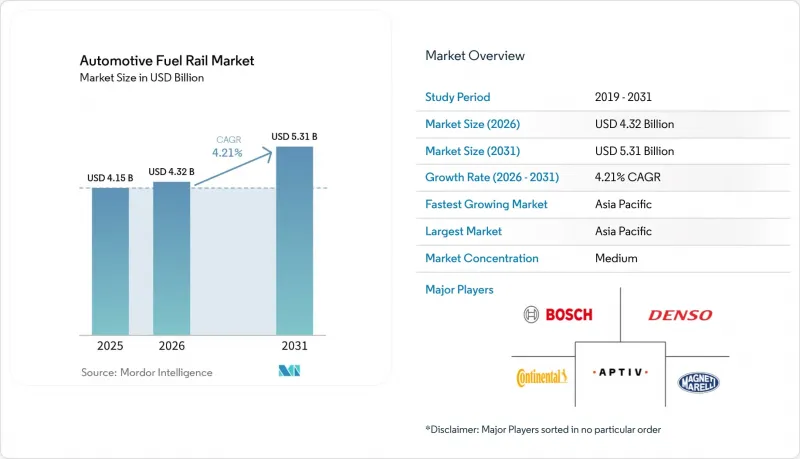
This report is Segmented by Engine Configuration (Inline Engine and V-Engine), Material Type (Stainless Steel and More), Pressure System (High-Pressure Fuel Rail and Low-Pressure Fuel Rail), Vehicle Type (Passenger Cars and Commercial Vehicles), Fuel Type, Delivery Method, Distribution Channel, and Geography. The Market Forecasts are Provided in Terms of Value (USD) and Volume (Units).
Global Automotive Fuel Rail Market Trends and Insights
Tightening Euro 6d, China VI-b, and US LEV III Emissions Norms Spur High-Pressure Rails
Governments are now measuring particulate numbers (PN) under real-world driving conditions. This has compelled OEMs to adopt high-pressure injection systems, which atomize fuel finely enough to significantly reduce PN compared to traditional port fuel injection . European standards have set stringent limits on particulate emissions, a benchmark reflected in China's regulations, while the United States has further tightened its domestic gasoline standards. Duplex stainless grades, known for their superior strength, enable the production of thinner walls. This innovation not only reduces overall weight but also ensures compliance with the high-pressure requirements . Tier-1 suppliers, leveraging their advanced metallurgy expertise and system-level validation capabilities, are successfully securing contracts. Meanwhile, smaller firms face difficulties in financing the necessary tooling and extensive testing cycles required to meet.
OEM Drive Toward 350-Bar GDI for 15% Lower Fuel Burn in Downsized Engines
Automakers are transitioning from larger, naturally aspirated engines to smaller, turbocharged alternatives equipped with advanced fuel systems. This change significantly reduces fuel consumption, contributing to improved efficiency and helping manufacturers avoid penalties associated with corporate average fuel economy standards. Examples of this global trend include Stellantis' innovative inline-six engine, Hyundai's advanced fuel system development program, and Bosch's high-performance platforms, all of which highlight the widespread adoption of this approach. With a relatively low additional cost, these advanced fuel systems offer a more cost-effective solution compared to hybrid technologies, which require a much higher investment per vehicle. Consequently, demand is increasingly concentrated among suppliers capable of providing integrated solutions, including injectors, pumps, and fuel rails, as complete and compatible systems.
EV Share Above 30% of New Sales in Europe by 2030 Curbs ICE Rail Demand
The EU's Fit for 55 plan aims to significantly increase the adoption of battery-electric vehicles (BEVs) over the next decade and phase out internal combustion engines (ICEs) in the near future. This transition is expected to gradually reduce Europe's addressable fuel-rail volume in the coming years. In Central European economies, where fuel-rail assembly accounts for a substantial share of manufacturing GDP, suppliers must adapt by shifting toward hybrid or hydrogen platforms to avoid plant closures. Although global firms can mitigate risks by reallocating capacity to regions such as Asia and Latin America, European fabricators that rely solely on traditional manufacturing methods face an increased risk of obsolescence.
Other drivers and restraints analyzed in the detailed report include:
- Rapid APAC Light-Vehicle Production Recovery Post-2023 Chip Crunch
- Stainless-to-Aluminum Rail Lightweighting to Offset Heavier After-Treatment
- Raw-Material Price Volatility for Nickel-Bearing Stainless Grades
For complete list of drivers and restraints, kindly check the Table Of Contents.
Segment Analysis
Inline engines accounted for 56.17% of the 2025 volume in the automotive fuel rail market and are forecast to grow at a 4.23% CAGR through 2031. They allow a single rail to feed all cylinders, thereby trimming tube length and reducing material costs. Inline designs fit transverse front-wheel-drive platforms that dominate global passenger-car output, and they simplify emissions certification because a single downstream sensor monitors all injectors.
Turbocharged inline-fours and inline-sixes also underpin downsizing strategies. Stellantis replaced large V8S with its Hurricane inline-six, slashing rail count and cost. Toyota's hydrogen-fueled GR Corolla shows the architecture can adapt to alternative fuels, sustaining demand even under zero-carbon rules. As SUVs migrate to front-drive architectures in China and India, inline dominance will rise further.
Stainless steel made up 47.26% of 2025 shipments, and aluminum alloy will post a 4.43% CAGR, the fastest of any material line in the automotive fuel rail market. At a density of 2.7 g/cm3, aluminum reduces the rail mass by almost half compared to stainless steel. OEMs recoup that saving quickly because after-treatment adds 20-30 kg and forces design trade-offs elsewhere.
Stainless retains relevance in ultra-high-pressure prototypes above 500 bar, yet duplex advances cannot offset aluminum's density edge and raw-material cost swings tied to nickel. Suppliers investing in extrusion presses, friction-stir welding, and automated leak-test lines report order books stretching into 2030, confirming the aluminum structural demand tailwind.
High-pressure variants (>= 250 bar) accounted for 68.26% of 2025 output and are set for a 4.27% CAGR through 2031, reflecting global convergence toward 350-bar GDI norms. These rails can efficiently reduce particulate-number emissions and help OEMs delay adoption of gasoline particulate filters.
Low-pressure rails remain in flex-fuel and port-injected segments, especially in Brazil, where ethanol blends rose to 30% in 2025. Yet as pressure climbs, warranty and service complexity grow: replacement of one-time-use crush washers and specialized gauges lifts repair bills above USD 3,500. Integrated suppliers that can certify pumps, rails, and injectors as a single system, therefore capture the lion's share of new programs.
Complete Report Scope:
- By Engine Configuration
- Inline Engine
- V-Engine
- By Material Type
- Stainless Steel
- Aluminum Alloy
- Plastic
- Steel Forged
- By Pressure System
- High-Pressure Fuel Rail
- Low-Pressure Fuel Rail
- By Vehicle Type
- Passenger Cars
- Hatchback
- Sedan
- SUV
- Coupe
- Commercial Vehicles
- LCV
- MCV
- HCV
- Passenger Cars
- By Fuel Type
- Gasoline
- Diesel
- Flex Fuel (E10-E85)
- CNG/LPG
- Biofuel/Synthetic
- Hydrogen
- By Delivery Method
- Gasoline Direct Injection (GDI)
- Port Fuel Injection (PFI)
- Common-Rail Diesel Injection
- By Distribution Channel
- OEM (Factory-Fitted)
- Aftermarket (Replacement)
- By Geography
- North America
- United States
- Canada
- Rest of North America
- South America
- Brazil
- Argentina
- Rest of South America
- Europe
- United Kingdom
- Germany
- Spain
- Italy
- France
- Russia
- Rest of Europe
- Asia-Pacific
- India
- China
- Japan
- South Korea
- Rest of Asia-Pacific
- Middle East and Africa
- United Arab Emirates
- Saudi Arabia
- Turkey
- Egypt
- South Africa
- Rest of Middle East and Africa
- North America
Geography Analysis
Asia-Pacific supplied 38.83% of 2025 demand and is tracking a 4.37% CAGR through 2031, the fastest regional growth rate. China's production rebound, India's E20 initiative, and low EV penetration across ASEAN economies are supporting internal combustion engine (ICE) vehicle volumes. Product plans continue to prioritize hybridization over full electrification, keeping fuel-rail content per vehicle largely intact despite powertrain evolution.
In the medium term, Europe holds a significant share of market volume. However, as the battery electric vehicle (BEV) segment is expected to surpass a critical threshold later in the decade, the region is preparing for a contraction. The Carbon Border Adjustment Mechanism is increasing stainless steel prices, while plants in Central Europe linked to ICE platforms face the risk of underutilization. In response to changes in EU policy, suppliers with operations in North Africa and Turkey are strategically adjusting their export routes.
During the same period, North and South America collectively account for a substantial share of shipments. The United States prioritizes high-pressure gasoline direct injection (GDI) systems for large trucks and SUVs. Meanwhile, Brazil's ethanol-reliant vehicle fleet requires corrosion-resistant low-pressure rails. In Canada, EV incentives are reducing the assembly of new ICE vehicles, although hybrid pickups remain a key driver of rail orders. Argentina and Colombia both rely on aftermarket conversions to sustain demand amid economic challenges. The Middle East and Africa account for the remaining market share. Production in the region is concentrated in Turkey and South Africa, while Saudi Arabia is attracting OEMs through duty-free zones that support completely knocked-down (CKD) assembly.
- Robert Bosch GmbH
- Denso Corporation
- Continental AG
- Aptiv PLC
- Magneti Marelli
- USUI Co. Ltd.
- Linamar Corporation
- Hitachi Astemo
- TI Automotive
- Aisin Corporation
- BorgWarner Inc.
- Stanadyne LLC
- Valeo SA
Additional Benefits:
- The market estimate (ME) sheet in Excel format
- 3 months of analyst support
TABLE OF CONTENTS
1 Introduction
- 1.1 Study Assumptions & Market Definition
- 1.2 Scope of the Study
2 Research Methodology
3 Executive Summary
4 Market Landscape
- 4.1 Market Overview
- 4.2 Market Drivers
- 4.2.1 Tightening Euro 6d, China VI-b and US LEV III Emissions Norms Spur High-Pressure Rails
- 4.2.2 OEM Drive Toward 350-Bar GDI for 15% Lower Fuel Burn in Downsized Engines
- 4.2.3 Rapid APAC Light-Vehicle Production Recovery Post-2023 Chip Crunch
- 4.2.4 Stainless-to-Aluminum Rail Light-Weighting to Offset Heavier After-Treatment
- 4.2.5 Surge in Ethanol/E85 Flex-Fuel Programs in Brazil, India and US Midwest
- 4.2.6 Hydrogen ICE Pilots (Toyota, Cummins) Require Novel High-Pressure Rails
- 4.3 Market Restraints
- 4.3.1 EV Share Above 30% of New Sales in Europe by 2030 Curbs ICE Rail Demand
- 4.3.2 Raw-Material Price Volatility for Nickel-Bearing Stainless Grades
- 4.3.3 Technician Skill Gap for Above 350-Bar Service Raises Warranty Costs
- 4.3.4 Counterfeit Aftermarket Rails in South-East Asia Undermining Brand Trust
- 4.4 Value / Supply-Chain Analysis
- 4.5 Regulatory Landscape
- 4.6 Technological Outlook
- 4.7 Porter's Five Forces
- 4.7.1 Threat of New Entrants
- 4.7.2 Bargaining Power of Suppliers
- 4.7.3 Bargaining Power of Buyers
- 4.7.4 Threat of Substitutes
- 4.7.5 Competitive Rivalry
5 Market Size & Growth Forecasts (Value (USD) and Volume (Units))
- 5.1 By Engine Configuration
- 5.1.1 Inline Engine
- 5.1.2 V-Engine
- 5.2 By Material Type
- 5.2.1 Stainless Steel
- 5.2.2 Aluminum Alloy
- 5.2.3 Plastic
- 5.2.4 Steel Forged
- 5.3 By Pressure System
- 5.3.1 High-Pressure Fuel Rail
- 5.3.2 Low-Pressure Fuel Rail
- 5.4 By Vehicle Type
- 5.4.1 Passenger Cars
- 5.4.1.1 Hatchback
- 5.4.1.2 Sedan
- 5.4.1.3 SUV
- 5.4.1.4 Coupe
- 5.4.2 Commercial Vehicles
- 5.4.2.1 LCV
- 5.4.2.2 MCV
- 5.4.2.3 HCV
- 5.4.1 Passenger Cars
- 5.5 By Fuel Type
- 5.5.1 Gasoline
- 5.5.2 Diesel
- 5.5.3 Flex Fuel (E10-E85)
- 5.5.4 CNG/LPG
- 5.5.5 Biofuel/Synthetic
- 5.5.6 Hydrogen
- 5.6 By Delivery Method
- 5.6.1 Gasoline Direct Injection (GDI)
- 5.6.2 Port Fuel Injection (PFI)
- 5.6.3 Common-Rail Diesel Injection
- 5.7 By Distribution Channel
- 5.7.1 OEM (Factory-Fitted)
- 5.7.2 Aftermarket (Replacement)
- 5.8 By Geography
- 5.8.1 North America
- 5.8.1.1 United States
- 5.8.1.2 Canada
- 5.8.1.3 Rest of North America
- 5.8.2 South America
- 5.8.2.1 Brazil
- 5.8.2.2 Argentina
- 5.8.2.3 Rest of South America
- 5.8.3 Europe
- 5.8.3.1 United Kingdom
- 5.8.3.2 Germany
- 5.8.3.3 Spain
- 5.8.3.4 Italy
- 5.8.3.5 France
- 5.8.3.6 Russia
- 5.8.3.7 Rest of Europe
- 5.8.4 Asia-Pacific
- 5.8.4.1 India
- 5.8.4.2 China
- 5.8.4.3 Japan
- 5.8.4.4 South Korea
- 5.8.4.5 Rest of Asia-Pacific
- 5.8.5 Middle East and Africa
- 5.8.5.1 United Arab Emirates
- 5.8.5.2 Saudi Arabia
- 5.8.5.3 Turkey
- 5.8.5.4 Egypt
- 5.8.5.5 South Africa
- 5.8.5.6 Rest of Middle East and Africa
- 5.8.1 North America
6 Competitive Landscape
- 6.1 Market Concentration
- 6.2 Strategic Moves
- 6.3 Market Share Analysis
- 6.4 Company Profiles (includes Global Level Overview, Market Level Overview, Core Segments, Financials as Available, Strategic Information, Market Rank/Share for Key Companies, Products and Services, SWOT Analysis, and Recent Developments)
- 6.4.1 Robert Bosch GmbH
- 6.4.2 Denso Corporation
- 6.4.3 Continental AG
- 6.4.4 Aptiv PLC
- 6.4.5 Magneti Marelli
- 6.4.6 USUI Co. Ltd.
- 6.4.7 Linamar Corporation
- 6.4.8 Hitachi Astemo
- 6.4.9 TI Automotive
- 6.4.10 Aisin Corporation
- 6.4.11 BorgWarner Inc.
- 6.4.12 Stanadyne LLC
- 6.4.13 Valeo SA
7 Market Opportunities & Future Outlook
- 7.1 White-space & Unmet-Need Assessment

