PUBLISHER: Mordor Intelligence | PRODUCT CODE: 2117430

PUBLISHER: Mordor Intelligence | PRODUCT CODE: 2117430
Automotive Engine Valve - Market Share Analysis, Industry Trends & Statistics, Growth Forecasts (2026 - 2031)
According to Mordor Intelligence, the automotive engine valve market size is expected to increase from USD 5.83 billion in 2025 to USD 6.06 billion in 2026 and reach USD 7.35 billion by 2030, growing at a CAGR of 3.93% over 2025-2030.
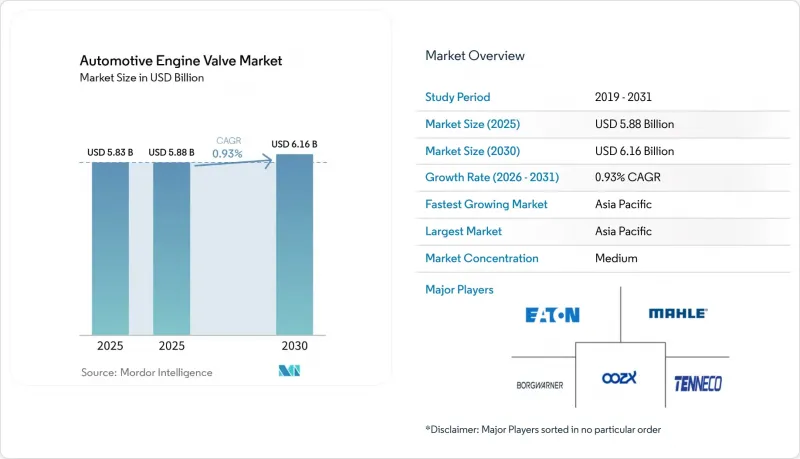
This report is Segmented by Valve Type (Mono-Metallic and More), Function Type (Intake and Exhaust), Material Type (Steel, Titanium, and Nickel-Based Alloys), Vehicle Type (Passenger Cars and More), Fuel Type (Gasoline and More), Distribution Channel (OEM and Aftermarket), and Geography. The Market Forecasts are Provided in Terms of Value (USD) and Volume (Units).
Global Automotive Engine Valve Market Trends and Insights
Stringent Emission and Fuel-Efficiency Rules
Euro 7, in force since 2025, mandates 10 years or 200,000 km of compliance and tighter PN10 particulate limits, prompting widespread use of variable valve timing (VVT) and lift (VVL). The International Council on Clean Transportation calculates that VVT/VVL yields 1-5.5% fuel-economy gains when paired with cylinder deactivation . BorgWarner will deliver variable cam-timing units for an East Asian OEM's 2026 hybrids, and EPA Tier 4 rules, starting in model year 2027, further tighten NMOG+NOx thresholds. Denso's U.S. patent 9002618 details a learning-phase VCT algorithm that preserves combustion stability during phase shifts . These regulations steer OEMs toward precision, heat-resistant exhaust valves, thereby enlarging the addressable automotive engine valve market.
Rising Global Vehicle Production
Commercial-vehicle builds are offsetting softness in passenger cars, benefiting valve suppliers. In December 2025, Ashok Leyland reported a significant year-on-year surge in domestic medium- and heavy-commercial vehicle (MHCV) sales, reflecting strong growth in this segment. Simultaneously, sales of light-commercial vehicles grew notably, underscoring robust freight demand in India . Notably, MHCV engines use more valves than passenger cars. Given their harsher duty cycles, these engines also require valve replacements more frequently. Industry forecasts indicate steady growth in India's MHCV volumes over the next few years. Additionally, a reduction in GST rates has led to a considerable decrease in new-truck costs, encouraging pre-buying. With the production mix increasingly favoring commercial vehicles, the automotive engine valve market finds a buffer against the challenges posed by electrification.
Rapid Power-Train Electrification
Battery-electric vehicles (BEVs) are set to dominate the automotive landscape, already accounting for a significant portion of global light-vehicle sales in 2025. In China, BEV sales have surpassed half of the market, while Vietnam is steadily approaching a substantial share. Each BEV's emergence translates to a notable reduction in demand for valves used in internal combustion engines (ICE). Furthermore, Europe's draft regulation on end-of-life vehicles is increasing costs associated with dismantling ICEs, making BEVs an increasingly favorable option in terms of total ownership costs. While hybrids provide some relief to the declining demand for ICE components, they rely on smaller engines, which further reduces the need for valves per vehicle. Rane Engine Valve highlights this industry shift, indicating that a considerable portion of its fiscal year revenue now comes from segments less affected by the transition to electrification, such as marine engines. As the automotive landscape evolves, electrification poses challenges for the engine valve market, even as heavy-duty and niche ICE sectors remain resilient.
Other drivers and restraints analyzed in the detailed report include:
- Engine Downsizing and Turbocharging
- CNG/LPG Fleet Expansion
- Titanium & Nickel Alloy Price Volatility
For complete list of drivers and restraints, kindly check the Table Of Contents.
Segment Analysis
Hollow sodium-filled valves captured growing interest as OEMs sought to mitigate the 850 °C exhaust-gas peaks prevalent in turbocharged engines. In 2025, mono-metallic units dominated by volume owing to a cost advantage of USD 2-4 per valve, accounting for 57.18% of the automotive engine valve market. Yet adoption of hollow formats is proceeding at a 3.95% CAGR because sodium cooling lowers valve-head temperature by nearly 100 °C, thereby lengthening service life during heavy-duty cycles.
The automotive engine valve market size for hollow units is still modest. Yet, high-performance gasoline and heavy-duty diesel programs increasingly specify them to avoid USD 10,000-20,000 repair bills tied to valve failure. BMW's S85 and Nissan's VR38DETT inventories confirm migration from motorsport to series production. Continued cost declines in cold-working and rolling techniques should narrow the premium over bi-metallic offerings and accelerate mainstream penetration.
Intake valves accounted for 63.37% of 2025 sales, driven by higher per-engine counts and lower material grades. However, the exhaust subset is expanding faster at a 3.98% CAGR because Euro 7 durability mandates elevate peak-temperature and thermal-cycling demands. Exhaust units increasingly deploy nickel alloys and nitrided coatings, nudging average selling prices and boosting the automotive engine valve market size for premium materials.
FUJI OOZX's 14 million-unit Toyota contract underscores the scale at which advanced exhaust valves are now sourced. Variable lift and cylinder-deactivation architectures impose +-0.02 mm stem-diameter tolerances, raising the bar for machining precision. In CNG and LPG retrofits, hardened Stellite seats are mandatory, further strengthening growth on the exhaust side of the automotive engine valve market.
Complete Report Scope:
- By Valve Type
- Mono-metallic Valves
- Bi-metallic Valves
- Hollow Valves
- By Function Type
- Intake Valves
- Exhaust Valves
- By Material Type
- Steel
- Titanium
- Nickel-based Alloys
- By Vehicle Type
- Passenger Cars
- Light Commercial Vehicles (LCVs)
- Medium and Heavy Commercial Vehicles (MHCVs)
- Buses and Coaches
- By Fuel Type
- Gasoline
- Diesel
- CNG/LPG
- By Distribution Channel
- OEM
- Aftermarket
- By Geography
- North America
- United States
- Canada
- Rest of North America
- South America
- Brazil
- Argentina
- Rest of South America
- Europe
- United Kingdom
- Germany
- Spain
- Italy
- France
- Russia
- Rest of Europe
- Asia-Pacific
- India
- China
- Japan
- South Korea
- Rest of Asia-Pacific
- Middle East and Africa
- United Arab Emirates
- Saudi Arabia
- Turkey
- Egypt
- South Africa
- Rest of Middle East and Africa
- North America
Geography Analysis
Asia-Pacific, with a 45.67% share of revenue in 2025, is expected to grow steadily with a CAGR of 4.14% over the forecast period. India's auto-component exports have grown robustly, while Japanese OEMs have made substantial investments to enhance local engine manufacturing capabilities, underscoring the region's growing importance in the automotive engine valve market. China remains a leader in single-country production volumes; however, the rising penetration of battery electric vehicles (BEVs) is reducing demand for internal combustion engine (ICE) components in passenger cars, even as commercial vehicle production continues to thrive. Additionally, Japanese companies such as FUJI OOZX and Nittan Valve are expanding their global footprint, with FUJI's facility in Mexico strategically positioned to benefit from North American trade agreements.
Europe occupies a moderate position in the market. The implementation of stricter emission standards, such as Euro 7, is driving the adoption of advanced technologies like variable lift systems, which is increasing demand for precision-engineered valves. However, the growing adoption of BEVs and the introduction of end-of-life vehicle (ELV) regulations pose long-term challenges for ICE component manufacturers. In North America, the dominance of light trucks and the trend of near-shoring are providing significant advantages. For instance, Tenneco's expansion in Mexico is reducing lead times for major automakers in the region, thereby strengthening North America's role in the automotive engine valve market.
Although South America and the Middle East & Africa are smaller contributors to the market, they are experiencing accelerated growth. In Nigeria, the government's focus on compressed natural gas (CNG) and Egypt's incentives for gas conversion are driving increased demand for aftermarket valves. In Brazil, commercial-vehicle manufacturers are upgrading engines to meet stricter emission standards, incorporating higher-quality exhaust valves. Collectively, these emerging markets are helping to offset the decline in demand for ICE components in developed economies, largely driven by the shift toward electrification.
- Eaton Corporation
- Mahle GmbH
- Fuji Oozx Inc.
- BorgWarner Inc.
- Federal-Mogul (Tenneco)
- Denso Corporation
- Aisan Industry Co., Ltd.
- Rane Engine Valve Ltd.
- Ferrea Racing Components
- Nittan Valve Co.
- Continental AG
- Schaeffler Group
- Hitachi Astemo
- Valeo SA
Additional Benefits:
- The market estimate (ME) sheet in Excel format
- 3 months of analyst support
TABLE OF CONTENTS
1 Introduction
- 1.1 Study Assumptions & Market Definition
- 1.2 Scope of the Study
2 Research Methodology
3 Executive Summary
4 Market Landscape
- 4.1 Market Overview
- 4.2 Market Drivers
- 4.2.1 Stringent Emission and Fuel-Efficiency Regulations
- 4.2.2 Rising Global Vehicle Production
- 4.2.3 Engine Downsizing and Turbocharging Trends
- 4.2.4 CNG/LPG Fleet Expansion in Asia and MEA
- 4.2.5 Regional Micro-Machining and Near-Sourcing of Valves
- 4.2.6 Predictive-Maintenance Enabled "Smart" Valves
- 4.3 Market Restraints
- 4.3.1 Rapid Power-Train Electrification
- 4.3.2 Titanium and Nickel Alloy Price Volatility
- 4.3.3 Proliferation of Counterfeit Aftermarket Valves
- 4.3.4 Recycling Compliance for Bimetallic Valves
- 4.4 Value / Supply-Chain Analysis
- 4.5 Regulatory Landscape
- 4.6 Technological Outlook
- 4.7 Porter's Five Forces
- 4.7.1 Threat of New Entrants
- 4.7.2 Bargaining Power of Suppliers
- 4.7.3 Bargaining Power of Buyers
- 4.7.4 Threat of Substitutes
- 4.7.5 Competitive Rivalry
5 Market Size & Growth Forecasts (Value (USD) and Volume (Units))
- 5.1 By Valve Type
- 5.1.1 Mono-metallic Valves
- 5.1.2 Bi-metallic Valves
- 5.1.3 Hollow Valves
- 5.2 By Function Type
- 5.2.1 Intake Valves
- 5.2.2 Exhaust Valves
- 5.3 By Material Type
- 5.3.1 Steel
- 5.3.2 Titanium
- 5.3.3 Nickel-based Alloys
- 5.4 By Vehicle Type
- 5.4.1 Passenger Cars
- 5.4.2 Light Commercial Vehicles (LCVs)
- 5.4.3 Medium and Heavy Commercial Vehicles (MHCVs)
- 5.4.4 Buses and Coaches
- 5.5 By Fuel Type
- 5.5.1 Gasoline
- 5.5.2 Diesel
- 5.5.3 CNG/LPG
- 5.6 By Distribution Channel
- 5.6.1 OEM
- 5.6.2 Aftermarket
- 5.7 By Geography
- 5.7.1 North America
- 5.7.1.1 United States
- 5.7.1.2 Canada
- 5.7.1.3 Rest of North America
- 5.7.2 South America
- 5.7.2.1 Brazil
- 5.7.2.2 Argentina
- 5.7.2.3 Rest of South America
- 5.7.3 Europe
- 5.7.3.1 United Kingdom
- 5.7.3.2 Germany
- 5.7.3.3 Spain
- 5.7.3.4 Italy
- 5.7.3.5 France
- 5.7.3.6 Russia
- 5.7.3.7 Rest of Europe
- 5.7.4 Asia-Pacific
- 5.7.4.1 India
- 5.7.4.2 China
- 5.7.4.3 Japan
- 5.7.4.4 South Korea
- 5.7.4.5 Rest of Asia-Pacific
- 5.7.5 Middle East and Africa
- 5.7.5.1 United Arab Emirates
- 5.7.5.2 Saudi Arabia
- 5.7.5.3 Turkey
- 5.7.5.4 Egypt
- 5.7.5.5 South Africa
- 5.7.5.6 Rest of Middle East and Africa
- 5.7.1 North America
6 Competitive Landscape
- 6.1 Market Concentration
- 6.2 Strategic Moves
- 6.3 Market Share Analysis
- 6.4 Company Profiles (includes Global Level Overview, Market Level Overview, Core Segments, Financials as Available, Strategic Information, Market Rank/Share for Key Companies, Products and Services, SWOT Analysis, and Recent Developments)
- 6.4.1 Eaton Corporation
- 6.4.2 Mahle GmbH
- 6.4.3 Fuji Oozx Inc.
- 6.4.4 BorgWarner Inc.
- 6.4.5 Federal-Mogul (Tenneco)
- 6.4.6 Denso Corporation
- 6.4.7 Aisan Industry Co., Ltd.
- 6.4.8 Rane Engine Valve Ltd.
- 6.4.9 Ferrea Racing Components
- 6.4.10 Nittan Valve Co.
- 6.4.11 Continental AG
- 6.4.12 Schaeffler Group
- 6.4.13 Hitachi Astemo
- 6.4.14 Valeo SA
7 Market Opportunities & Future Outlook
- 7.1 White-space & Unmet-Need Assessment

