PUBLISHER: Mordor Intelligence | PRODUCT CODE: 2117435

PUBLISHER: Mordor Intelligence | PRODUCT CODE: 2117435
Gasoline Direct Injection - Market Share Analysis, Industry Trends & Statistics, Growth Forecasts (2026 - 2031)
According to Mordor Intelligence, the gasoline direct injection market size was valued at USD 9.47 billion in 2025 and is estimated to grow from USD 10.19 billion in 2026 to reach USD 14.71 billion by 2031, at a CAGR of 7.61% during the forecast period (2026-2031).
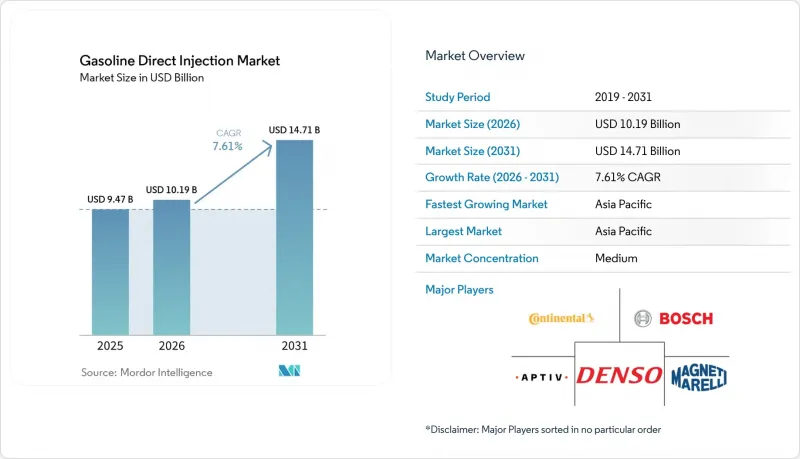
This report is Segmented by Component (Fuel Injectors and More), Engine Type (Inline-3 and More), Vehicle Type (Hatchback and More), Sales Channel (OEM and Aftermarket), and Geography. The Market Forecasts are Provided in Terms of Value (USD).
Global Gasoline Direct Injection Market Trends and Insights
Stricter Emission & Fuel-Economy Standards
New standards such as Euro 7 PN10, China's GB 19578-2024, and the U.S. EPA Tier 3 rule are forcing OEMs to adopt multi-pulse strategies and gasoline particulate filters . On-board fuel-consumption monitoring makes every vehicle a rolling audit, creating a compliance premium for closed-loop, high-pressure systems. Suppliers are responding by adding redundant lambda probes and particulate sensors, raising sensor content per vehicle. Bharat Stage VI Phase 3 will extend this standard to India in 2027, tightening particulate limits and mandating real-driving-cycle emissions testing. The synchronous effect across regions compresses development timelines and pushes Tier-1s to expand 350-bar injector capacity .
OEM Engine Downsizing & Turbocharging
Three-cylinder and small four-cylinder turbos are rapidly replacing larger-displacement units as automakers chase fleet CO2 targets without incurring full-hybrid costs. Stellantis's 2.0-liter Hurricane 4 and Toyota's 2.0-liter turbo show how 350-bar direct injection, pre-chamber ignition, and synthetic-fuel readiness can deliver V6-level output with double-digit fuel savings. Inline-3 engines, despite NVH challenges, now power mainstream A/B-segment models in China and Europe. Variable-displacement fuel pumps and piezoelectric injectors support the high pressure and multiple injections these downsized engines require, keeping the gasoline direct injection market relevant in segments that might otherwise migrate straight to battery-electric alternatives.
Rapid Electrification of Passenger Vehicles
EVs are expected to significantly reduce daily oil consumption in the coming years, thereby shrinking the market for internal combustion engines (ICE). China's NEV credit is projected to increase substantially in the near future. Meanwhile, Europe aims to achieve a dominant EV market share within the next decade, and the U.S. targets a significant shift toward EV adoption during the same period. These initiatives are steering R&D investments towards battery systems, sidelining next-gen injectors. This trend limits growth for the gasoline direct injection market, even as hybrids continue to utilize the technology. Suppliers are now tasked with a strategic shift: safeguarding their combustion revenue streams while expanding their electric-drive product offerings.
Other drivers and restraints analyzed in the detailed report include:
- Growing Gasoline-Vehicle Production in Asia-Pacific
- High-Pressure (>=350 bar) Injection Systems
- Intake-Valve Carbon Build-Up Warranty Risk
For complete list of drivers and restraints, kindly check the Table Of Contents.
Segment Analysis
Sensor suites gained momentum because Euro 7 and U.S. OBD III rules require real-time monitoring of fuel-air ratios and particulate output. Fuel injectors still accounted for 38.81% of 2025 revenue due to their high unit pricing, but sensor sales will outpace all other components at a 7.63% CAGR. That trajectory lifts the gasoline direct injection market size for sensors as OEMs deploy wideband lambda probes, PM sensors, and on-rail pressure transducers.
In premium cars, piezoelectric injectors are steadily replacing their solenoid counterparts. Continental's rail-pressure sensors offer high accuracy across a wide temperature range. These sensors back adaptive maps housed in advanced electronic control units. Additionally, as oxygen sensors age and mass airflow systems become fouled, they hinder limp-home strategies. This has spurred a growing aftermarket demand, generating service revenue that bolsters the gasoline direct injection market throughout a vehicle's lifecycle.
Inline-4 engines held 67.73% of the 2025 segment value, but tough fleet-average CO2 caps in China and Europe make three-cylinder turbos the growth story, lifting their share of the gasoline direct-injection market through 2031. Stellantis and Toyota examples show how 350-bar GDI and pre-chamber ignition can deliver V6 performance from small blocks.
NVH hurdles that once limited the inline-3's appeal are mitigated by balance shafts and active mounts, which are growing at a 7.66% CAGR through 2031. Ford's 1.0-liter EcoBoost and Volkswagen's 1.0-liter TSI set early benchmarks, encouraging suppliers to scale crankshafts, pumps, and injectors for high BMEP operation. V6 and V8 designs retreat to pickups and performance SUVs, where towing and brand heritage still command premium pricing.
Complete Report Scope:
- By Component
- Fuel Injectors
- Engine Control Units (ECUs)
- Sensors
- Fuel Pumps
- Fuel Rails
- By Engine Type
- Inline-3 (I3)
- Inline-4 (I4)
- V6
- V8
- By Vehicle Type
- Hatchback
- Sedan
- SUVs/MUVs
- Van
- Pick-up Truck
- By Sales Channel
- OEM
- Aftermarket
- By Geography
- North America
- United States
- Canada
- Rest of North America
- South America
- Brazil
- Argentina
- Rest of South America
- Europe
- United Kingdom
- Germany
- Spain
- Italy
- France
- Russia
- Rest of Europe
- Asia-Pacific
- India
- China
- Japan
- South Korea
- Rest of Asia-Pacific
- Middle East and Africa
- United Arab Emirates
- Saudi Arabia
- Turkey
- Egypt
- South Africa
- Rest of Middle East and Africa
- North America
Geography Analysis
Asia-Pacific generated 36.48% of 2025 regional revenue, and a 7.71% CAGR to 2031 makes it the geographic engine for the gasoline direct injection market. India's record passenger-vehicle sales, the E20 rollout, and sustained SUV demand are forcing local suppliers to adopt corrosion-resistant injectors and adaptive ethanol mapping. China's hybrid exports surged in the early part of 2025, underscoring the pivotal role of Gasoline Direct Injection (GDI) in range-extender designs, especially in regions with underdeveloped charging infrastructure.
In 2025, Europe commanded a notable share of the market. However, the costs associated with Euro 7 compliance and stringent EV mandates have tempered volume growth. In response, Original Equipment Manufacturers (OEMs) are integrating GDI with 48-V mild hybrids. This combination facilitates engine-off coasting and immediate restarts, enhancing efficiency without the need for plug-in components. North America is adopting a similar approach, especially in premium SUVs and pickups. Here, the demands of towing duty cycles validate the use of gasoline engines, bolstering the market share of gasoline direct injection, high-pressure injectors, and particulate filters.
South America, spearheaded by Brazil's flex-fuel vehicles, alongside the Middle East and Africa, rounds out the remaining revenue contributions. In Brazil, the use of gasoline blended with ethanol requires injectors to deliver higher flow rates to compensate for ethanol's lower energy density. This requirement bolsters the dedicated flex-fuel GDI production lines. Meanwhile, in the Gulf Cooperation Council nations, where electrification is still gaining momentum, imported gasoline SUVs benefit from robust aftermarket networks. These networks not only extend the system's lifespan but also generate additional revenue for the gasoline direct-injection market.
- Robert Bosch GmbH
- Denso Corporation
- Continental AG
- Aptiv PLC
- Magneti Marelli S.p.A.
- Hitachi Astemo Ltd.
- Keihin Corporation
- Stanadyne LLC
- Eaton Corporation
- Infineon Technologies AG
- TI Fluid Systems
- BorgWarner Inc.
- Orbital Corporation Ltd.
- Airtex Products
- Holley Performance Products
- Helio Precision Products
- MSR Technologies
- Motonic Corporation
- Raydiance Inc.
Additional Benefits:
- The market estimate (ME) sheet in Excel format
- 3 months of analyst support
TABLE OF CONTENTS
1 Introduction
- 1.1 Study Assumptions & Market Definition
- 1.2 Scope of the Study
2 Research Methodology
3 Executive Summary
4 Market Landscape
- 4.1 Market Overview
- 4.2 Market Drivers
- 4.2.1 Stricter Emission & Fuel-Economy Standards
- 4.2.2 OEM Engine Downsizing & Turbocharging
- 4.2.3 Growing Gasoline-Vehicle Production In Apac
- 4.2.4 Integration Of Gdi In Hybrid Powertrains
- 4.2.5 High-Pressure (more than or equal to 350 Bar) Injection Systems
- 4.2.6 Edge-Computing Ecus & Ota Fuel Mapping
- 4.3 Market Restraints
- 4.3.1 Rapid Electrification Of Passenger Vehicles
- 4.3.2 High Cost & Maintenance Complexity
- 4.3.3 Intake-Valve Carbon Build-Up Warranty Risk
- 4.3.4 Future PN Regulations Raising Compliance Costs
- 4.4 Value / Supply-Chain Analysis
- 4.5 Regulatory Landscape
- 4.6 Technological Outlook
- 4.7 Porter's Five Forces
- 4.7.1 Threat of New Entrants
- 4.7.2 Bargaining Power of Suppliers
- 4.7.3 Bargaining Power of Buyers
- 4.7.4 Threat of Substitutes
- 4.7.5 Competitive Rivalry
5 Market Size & Growth Forecasts (Value (USD))
- 5.1 By Component
- 5.1.1 Fuel Injectors
- 5.1.2 Engine Control Units (ECUs)
- 5.1.3 Sensors
- 5.1.4 Fuel Pumps
- 5.1.5 Fuel Rails
- 5.2 By Engine Type
- 5.2.1 Inline-3 (I3)
- 5.2.2 Inline-4 (I4)
- 5.2.3 V6
- 5.2.4 V8
- 5.3 By Vehicle Type
- 5.3.1 Hatchback
- 5.3.2 Sedan
- 5.3.3 SUVs/MUVs
- 5.3.4 Van
- 5.3.5 Pick-up Truck
- 5.4 By Sales Channel
- 5.4.1 OEM
- 5.4.2 Aftermarket
- 5.5 By Geography
- 5.5.1 North America
- 5.5.1.1 United States
- 5.5.1.2 Canada
- 5.5.1.3 Rest of North America
- 5.5.2 South America
- 5.5.2.1 Brazil
- 5.5.2.2 Argentina
- 5.5.2.3 Rest of South America
- 5.5.3 Europe
- 5.5.3.1 United Kingdom
- 5.5.3.2 Germany
- 5.5.3.3 Spain
- 5.5.3.4 Italy
- 5.5.3.5 France
- 5.5.3.6 Russia
- 5.5.3.7 Rest of Europe
- 5.5.4 Asia-Pacific
- 5.5.4.1 India
- 5.5.4.2 China
- 5.5.4.3 Japan
- 5.5.4.4 South Korea
- 5.5.4.5 Rest of Asia-Pacific
- 5.5.5 Middle East and Africa
- 5.5.5.1 United Arab Emirates
- 5.5.5.2 Saudi Arabia
- 5.5.5.3 Turkey
- 5.5.5.4 Egypt
- 5.5.5.5 South Africa
- 5.5.5.6 Rest of Middle East and Africa
- 5.5.1 North America
6 Competitive Landscape
- 6.1 Market Concentration
- 6.2 Strategic Moves
- 6.3 Market Share Analysis
- 6.4 Company Profiles (includes Global Level Overview, Market Level Overview, Core Segments, Financials as Available, Strategic Information, Market Rank/Share for Key Companies, Products and Services, SWOT Analysis, and Recent Developments)
- 6.4.1 Robert Bosch GmbH
- 6.4.2 Denso Corporation
- 6.4.3 Continental AG
- 6.4.4 Aptiv PLC
- 6.4.5 Magneti Marelli S.p.A.
- 6.4.6 Hitachi Astemo Ltd.
- 6.4.7 Keihin Corporation
- 6.4.8 Stanadyne LLC
- 6.4.9 Eaton Corporation
- 6.4.10 Infineon Technologies AG
- 6.4.11 TI Fluid Systems
- 6.4.12 BorgWarner Inc.
- 6.4.13 Orbital Corporation Ltd.
- 6.4.14 Airtex Products
- 6.4.15 Holley Performance Products
- 6.4.16 Helio Precision Products
- 6.4.17 MSR Technologies
- 6.4.18 Motonic Corporation
- 6.4.19 Raydiance Inc.
7 Market Opportunities & Future Outlook
- 7.1 White-space & Unmet-Need Assessment

