PUBLISHER: Mordor Intelligence | PRODUCT CODE: 2117447

PUBLISHER: Mordor Intelligence | PRODUCT CODE: 2117447
United States Tire - Market Share Analysis, Industry Trends & Statistics, Growth Forecasts (2026 - 2031)
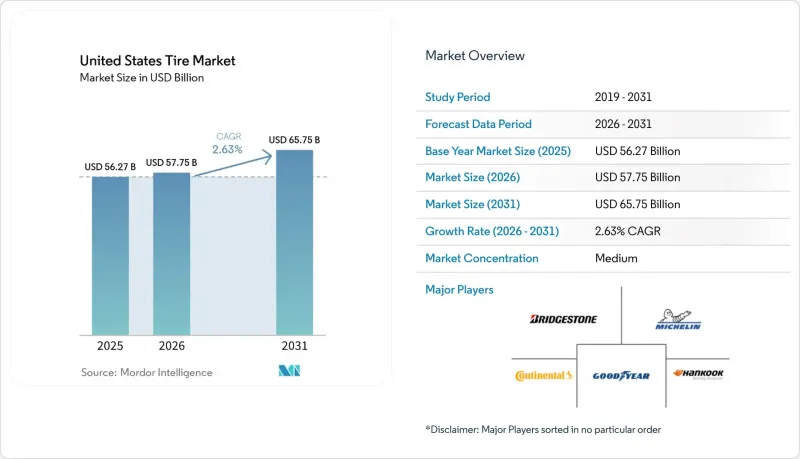
According to Mordor Intelligence, the United States tire market size was valued at USD 56.27 billion in 2025 and is estimated at USD 57.75 billion in 2026, and is projected to reach USD 65.75 billion by 2031, at a CAGR of 2.63% during the forecast period (2026-2031).
This report is Segmented by Season (Summer and More), Tire Design (Radial and More), Vehicle Type (Two-Wheeler, Passenger Cars and More), Application (On-Road and Off-Road), End User (OEM and Aftermarket), Rim Size (Below 15 Inches, 15 To 20 Inches, and Above 20 Inches), and Propulsion (Internal-Combustion Vehicles and More). The Market Forecasts are Provided in Terms of Value (USD) and Volume (Units).
United States Tire Market Trends and Insights
Aging Vehicle Fleet and Higher VMT Boost Replacement Demand
The climbing average vehicle age to 12.5 years extends the domestic parc, yet lifts tire turnover as suspension wear accelerates tread degradation. Vehicle miles traveled rebounded exponentially in 2024, matching pre-pandemic levels and compounding usage intensity. The Federal Highway Administration forecasts total United States vehicle miles traveled will grow 0.5-0.6% annually from 2019 through 2050, with light-duty vehicles advancing 0.4-0.5%, single-unit trucks 1.9-2.1%, and combination trucks 1.1-1.3%. This divergence matters because commercial segments generate disproportionate replacement cycles-a single-unit delivery van or Class 8 tractor accumulates mileage three to five times faster than a passenger sedan, compressing tire life and multiplying annual purchases per vehicle. Simultaneously, the average age of light-duty vehicles on United States roads has climbed past 12 years, a record driven by pandemic-era supply-chain disruptions, elevated new-vehicle prices, and improved durability that defers scrapping.
SUV and Light-Truck Mix Lifts Average Rim Size And ASP
Currently, three-fifths of new vehicles produced in the United States are SUVs and light trucks, which typically utilize 17 to 20-inch rims, compared to the 15 to 16-inch rims that are standard for sedans. These larger rim formats not only command higher average prices but also consistently contribute to increased revenue per unit. As automakers continue to phase out several sedan lines, the larger wheel size has shifted from being a premium feature to becoming the new standard. This transition has significantly improved manufacturer profit margins while also raising the replacement costs borne by consumers, thereby driving substantial value expansion within the United States tire market.
Natural and Synthetic-Rubber Price Volatility
Natural-rubber spot prices reached 205-206 U.S. cents per kilogram in February through April 2026, approaching one-year highs, as the Association of Natural Rubber Producing Countries projected 2026 global demand of 15.6 million tons against production of 15.2 million tons-the sixth consecutive annual deficit. Seasonal supply constraints during Southeast Asia's February-to-May wintering period, weather disruptions, leaf-blight disease outbreaks, and aging plantations with declining yields compound the structural imbalance, while speculative positioning in futures markets amplifies price swings.
Other drivers and restraints analyzed in the detailed report include:
- Corporate and Federal Fuel-Efficiency Rules Favor Low-RR Radials
- Surge of Tire E-Commerce and Mobile Installers Widens Reach
- Faster EV Tire Wear Raises Warranty and Brand-Image Risk
For complete list of drivers and restraints, kindly check the Table Of Contents.
Segment Analysis
In 2025, all-season tires dominated the United States market, capturing a robust 61.28% share. Meanwhile, winter tire units, although accounting for a smaller segment, are experiencing a notable CAGR of 2.65%, driven by heightened safety awareness and increasingly severe storms reshaping consumer preferences.
Winter tires are now expanding their presence beyond the traditional snowbelt regions, reaching temperate areas that are encountering unpredictable weather patterns. The introduction of the Three Peak Mountain Snowflake certification in 2024 has distinctly differentiated product offerings. As climate variability continues to influence the market, manufacturers of all-season tires are incorporating snow-capable features into their products. This trend indicates a gradual blurring of seasonal boundaries within the tire market.
In 2025, radials held a dominant 89.92% share of the United States tire market, which reflects decades of strategic optimization and global scaling. At the same time, airless tire models, despite maintaining a modest share of less than 1%, demonstrated growth with a CAGR of 2.67%, targeting commercial applications that emphasize puncture resilience.
Michelin's UPTIS and Bridgestone's Air Free concepts provide insights into the pathway toward market acceptance. Although current manufacturing costs and ride comfort limitations are restricting widespread adoption, advancements in technology indicate the potential for achieving long-term parity. This development could lead to a significant transformation in the United States tire market landscape.
In 2025, passenger cars commanded a dominant 65.37% share of the United States tire market, experiencing a surprising surge with a 2.76% CAGR, driven by the dual forces of electrification and a heightened demand for premium retrofits. While commercial light trucks, supported by e-commerce logistics, enjoyed growth, they lagged behind in pace.
As fleets electrify, there is a pronounced shift towards high-performance compounds, essential for handling added weight and torque. Meanwhile, ride-share and subscription services are redefining purchase priorities, placing a premium on longevity over traditional individual owner preferences. These evolving dynamics not only bolster the passenger segment's dominance but also strengthen the overall United States tire market landscape.
Complete Report Scope:
- By Season
- Summer
- Winter
- All-Season
- By Tire Design
- Radial
- Bias
- Non-pneumatic/Airless
- By Vehicle Type
- Two-Wheelers
- Passenger Cars
- Light Commercial Vehicles
- Heavy Commercial Trucks and Buses
- Off-the-Road and Specialty (OTR, Agriculture, Mining, Racing)
- By Application
- On-Road
- Off-Road
- By End User
- OEM
- Aftermarket
- By Rim Size
- Below 15 inches
- 15 to 20 inches
- Above 20 inches
- By Propulsion
- Internal-Combustion Vehicles
- Battery-Electric Vehicles
- Hybrid and Fuel-Cell Vehicles
List of Companies Covered in this Report:
- Michelin SCA
- Goodyear Tire & Rubber Co.
- Bridgestone Corp.
- Continental AG
- Hankook
- Yokohama Rubber Co.
- Pirelli & C. S.p.A.
- Sumitomo (Dunlop/Falken)
- Toyo Tire Corp.
- Kumho Tire Co.
- Cooper (Goodyear)
- BFGoodrich
- Nokian Tyres
- Nexen
- Giti Tire
- Sailun Group
- Titan International
- Carlisle Companies
- MRF Tyres
Additional Benefits:
- The market estimate (ME) sheet in Excel format
- 3 months of analyst support
TABLE OF CONTENTS
1 Introduction
- 1.1 Study Assumptions and Market Definition
- 1.2 Scope of the Study
2 Research Methodology
3 Executive Summary
4 Market Landscape
- 4.1 Market Overview
- 4.2 Market Drivers
- 4.2.1 Aging Vehicle Fleet and Higher VMT Boost Replacement Demand
- 4.2.2 SUV and Light-Truck Mix Lifts Average Rim Size And ASP
- 4.2.3 Corporate and Federal Fuel-Efficiency Rules Favor Low-RR Radials
- 4.2.4 Surge of Tire E-Commerce and Mobile Installers Widens Reach
- 4.2.5 Domestic EV-Tire Capacity (E.G., Enso) Unlocks High-Margin Niche
- 4.2.6 State-Level Recycled-Rubber Mandates Spur Sustainable Lines
- 4.3 Market Restraints
- 4.3.1 Natural and Synthetic-Rubber Price Volatility
- 4.3.2 Import Tariffs/Trade Frictions Inflate Landed Costs
- 4.3.3 Faster EV Tire Wear Raises Warranty and Brand-Image Risk
- 4.3.4 Urban Shift to Ride-Sharing and Micromobility Trims Per-Capita Demand
- 4.4 Value/Supply-Chain Analysis
- 4.5 Regulatory Landscape
- 4.6 Technological Outlook
- 4.7 Porter's Five Forces
- 4.7.1 Threat of New Entrants
- 4.7.2 Bargaining Power of Suppliers
- 4.7.3 Bargaining Power of Buyers
- 4.7.4 Threat of Substitutes
- 4.7.5 Competitive Rivalry
5 Market Size and Growth Forecasts (Value (USD) and Volume (Units))
- 5.1 By Season
- 5.1.1 Summer
- 5.1.2 Winter
- 5.1.3 All-Season
- 5.2 By Tire Design
- 5.2.1 Radial
- 5.2.2 Bias
- 5.2.3 Non-pneumatic/Airless
- 5.3 By Vehicle Type
- 5.3.1 Two-Wheelers
- 5.3.2 Passenger Cars
- 5.3.3 Light Commercial Vehicles
- 5.3.4 Heavy Commercial Trucks and Buses
- 5.3.5 Off-the-Road and Specialty (OTR, Agriculture, Mining, Racing)
- 5.4 By Application
- 5.4.1 On-Road
- 5.4.2 Off-Road
- 5.5 By End User
- 5.5.1 OEM
- 5.5.2 Aftermarket
- 5.6 By Rim Size
- 5.6.1 Below 15 inches
- 5.6.2 15 to 20 inches
- 5.6.3 Above 20 inches
- 5.7 By Propulsion
- 5.7.1 Internal-Combustion Vehicles
- 5.7.2 Battery-Electric Vehicles
- 5.7.3 Hybrid and Fuel-Cell Vehicles
6 Competitive Landscape
- 6.1 Market Concentration
- 6.2 Strategic Moves
- 6.3 Market Share Analysis
- 6.4 Company Profiles (Includes Global Level Overview, Market Level Overview, Core Segments, Financials as Available, Strategic Information, Market Rank/Share for Key Companies, Products and Services, SWOT Analysis, and Recent Developments)
- 6.4.1 Michelin SCA
- 6.4.2 Goodyear Tire & Rubber Co.
- 6.4.3 Bridgestone Corp.
- 6.4.4 Continental AG
- 6.4.5 Hankook
- 6.4.6 Yokohama Rubber Co.
- 6.4.7 Pirelli & C. S.p.A.
- 6.4.8 Sumitomo (Dunlop/Falken)
- 6.4.9 Toyo Tire Corp.
- 6.4.10 Kumho Tire Co.
- 6.4.11 Cooper (Goodyear)
- 6.4.12 BFGoodrich
- 6.4.13 Nokian Tyres
- 6.4.14 Nexen
- 6.4.15 Giti Tire
- 6.4.16 Sailun Group
- 6.4.17 Titan International
- 6.4.18 Carlisle Companies
- 6.4.19 MRF Tyres
7 Market Opportunities and Future Outlook
- 7.1 White-Space and Unmet-Need Assessment

