PUBLISHER: Mordor Intelligence | PRODUCT CODE: 2117458

PUBLISHER: Mordor Intelligence | PRODUCT CODE: 2117458
North America Electric Vehicle - Market Share Analysis, Industry Trends & Statistics, Growth Forecasts (2026 - 2031)
According to Mordor Intelligence, the North America electric vehicle market size is projected to expand from USD 95.05 billion in 2025 and USD 102.66 billion in 2026 to USD 150.92 billion by 2031, registering an 8.01% CAGR between 2026 and 2031.
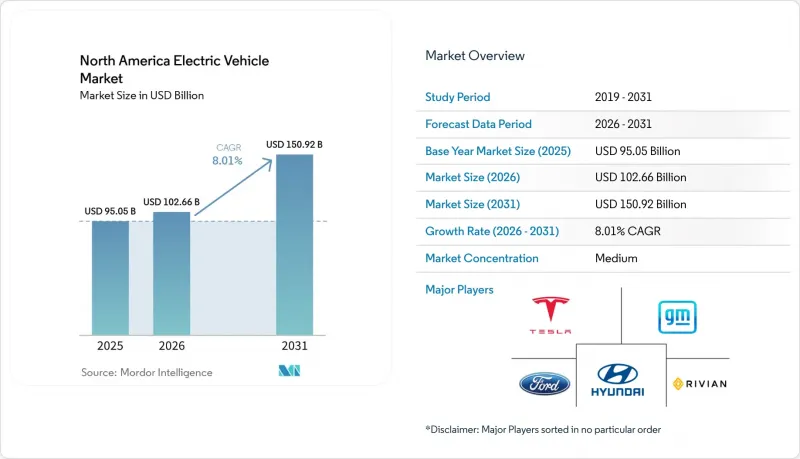
This report is Segmented by Vehicle Type (Passenger Cars, Light Commercial Vehicles, and More), Propulsion Type (Battery Electric Vehicles, Plug-In Hybrid Electric Vehicles, and More), Drive Type (Front-Wheel Drive, Rear-Wheel Drive, and More), Power Output (Below 100 KW, 100-250 KW, and More), and Country. The Market Forecasts are Provided in Terms of Value (USD) and Volume (Units).
North America Electric Vehicle Market Trends and Insights
Declining Battery Costs and Extended Range
Pack prices fell to USD 108/kWh in 2025 and are expected to ease further as lithium-iron-phosphate chemistries scale. Tesla and LG Energy Solution announced a Michigan LFP cell facility scheduled for 2027[2], underscoring the regional shift in chemistry production. Range anxiety is easing because most 2026 model launches clear the 300-mile mark, as seen in the Chevrolet Equinox EV at a USD 35,000 entry price. Cold-weather degradation, however, still trims roughly one-third of the rated range, particularly constraining Canadian uptake. Even so, every incremental cost reduction expands the addressable pool of buyers for whom total ownership savings eclipse sticker premiums.
Federal Tax Incentives and IRA Subsidies
The Inflation Reduction Act offers sizeable manufacturing credits, shortening payback periods for both consumers and automakers. Eligibility thresholds rise each year, forcing firms to realign their supply chains toward North American components. Treasury guidance issued in 2024 disqualified batteries with graphite from entities of concern, pushing OEMs toward Australian and Canadian contracts. Vertically integrated manufacturers with domestic cell lines meet these rules more easily, strengthening their cost position versus joint-venture-reliant peers. The commercial-vehicle credit of up to USD 40,000 per unit has spurred conversions of parcel and municipal fleets, enabling corporate buyers to fully monetize the subsidy. As the thresholds ratchet upward, compliance costs will favor suppliers with onshore refining and midstream capacity.
Inadequate Public Charging Infrastructure Density
NREL calculates a need for 28 million ports by 2030, but only 8 million existed at 2025's close. Permitting bottlenecks limit roll-outs despite a USD 5 billion federal corridor program. Rural areas in the Midwest and Appalachia fall below one charger per 100 square miles, dissuading long-distance travel. Canada's province-specific networks lack interoperability, requiring multiple payment systems for cross-border drives. Until density gaps shrink, consumer confidence and resale values will remain under pressure.
Other drivers and restraints analyzed in the detailed report include:
- Automakers' Electrification Roadmaps and Investments
- Domestic Battery Supply-Chain Localization Under USMCA Incentives
- High Upfront Purchase Price vs. ICE Alternatives
For complete list of drivers and restraints, kindly check the Table Of Contents.
Segment Analysis
Passenger cars held 77.13% of 2025 revenue but face a gentler growth curve as first-wave early adopters saturate. Light commercial vehicles, the fastest-growing slice, are slated for a 9.02% CAGR, reflecting parcel carriers and municipal fleets switching en masse to battery vans. Contract awards from the U.S. Postal Service and Amazon validate the durability of fleet demand, while municipal bus tenders extend electrification into public transit. The North American electric vehicle market size for commercial vans will therefore expand more quickly than for passenger sedans, even though the absolute base is smaller.
Fleet duty cycles amplify uptime gains: predictable routes enable depot charging and higher daily utilization, lowering cost per mile. Regulations mandating zero-emission municipal fleets intensify momentum in refuse collection and airport shuttle applications. Financing models are also evolving; leasing companies now bundle chargers and maintenance, flattening capital burdens for city agencies. As incentives taper, operators should still benefit from residual-value clarity because large-parcel fleets provide a secondary market for used vans in less-demanding roles.
Battery-electric platforms secured 70.25% of 2025 sales, anchoring the propulsion landscape of the North American electric vehicle market. Fuel-cell models will, however, chart the quickest percentage rise at 11.22% CAGR, albeit from a much smaller baseline. California's network of 60-plus hydrogen stations and Canada's pilot corridors lure heavy-duty operators wary of battery weight penalties. The North American electric vehicle market share of FCEVs will therefore inch upward in the long-haul freight and intercity coach niches, where rapid refueling unlocks asset utilization.
OEM resource allocation signals diverging bets: several legacy brands canceled plug-in hybrid updates to redeploy capital toward battery packs that meet content rules and qualify for credits. Meanwhile, partnerships between truck makers and industrial-gas suppliers demonstrate confidence in green-hydrogen cost curves. Market watchers expect fuel cells to remain complementary rather than competitive in light-duty segments unless hydrogen prices drop near the USD 2/kg parity threshold policymakers target.
Complete Report Scope:
- By Vehicle Type
- Passenger Cars
- Light Commercial Vehicles (LCVs)
- Medium and Heavy Commercial Vehicles (M&HCVs)
- Buses and Coaches
- By Propulsion Type
- Battery Electric Vehicles (BEV)
- Plug-in Hybrid Electric Vehicles (PHEV)
- Hybrid Electric Vehicles (HEV)
- Fuel-Cell Electric Vehicles (FCEV)
- By Drive Type
- Front-Wheel Drive (FWD)
- Rear-Wheel Drive (RWD)
- All-Wheel Drive (AWD)
- By Power Output
- Below 100 kW
- 100-250 kW
- Above 250 kW
- By Country
- United States
- Canada
- Mexico
List of Companies Covered in this Report:
- Tesla, Inc.
- General Motors Company
- Ford Motor Company
- Hyundai Motor Company
- Rivian Automotive, Inc.
- Stellantis N.V.
- Lucid Group, Inc.
- Nissan Motor Co., Ltd.
- Honda Motor Co., Ltd.
- BMW Group
- Mercedes-Benz Group AG
- Volvo Car AB
- BYD Auto Co., Ltd.
- Lion Electric Company
- Nikola Corporation
- Daimler Truck Holding AG
- PACCAR Inc.
Additional Benefits:
- The market estimate (ME) sheet in Excel format
- 3 months of analyst support
TABLE OF CONTENTS
1 Introduction
- 1.1 Study Assumptions & Market Definition
- 1.2 Scope of the Study
2 Research Methodology
3 Executive Summary
4 Market Landscape
- 4.1 Market Overview
- 4.2 Market Drivers
- 4.2.1 Declining Battery Costs and Extended Range
- 4.2.2 Federal Tax Incentives and IRA Subsidies
- 4.2.3 Automakers' Electrification Roadmaps and Investments
- 4.2.4 Domestic Battery Supply-Chain Localization Under USMCA Incentives
- 4.2.5 Vehicle-to-Grid (V2G) Pilots by Regional Utilities
- 4.2.6 Vertically-Integrated Battery Recycling Ecosystems
- 4.3 Market Restraints
- 4.3.1 Inadequate Public Charging Infrastructure Density
- 4.3.2 High Upfront Purchase Price vs. ICE Alternatives
- 4.3.3 BEV Resale-Value Uncertainty in Secondary Markets
- 4.3.4 Grid Interconnection Delays for DC Fast-Charging Hubs
- 4.4 Value / Supply-Chain Analysis
- 4.5 Regulatory Landscape
- 4.6 Technological Outlook
- 4.7 Porter's Five Forces
- 4.7.1 Threat of New Entrants
- 4.7.2 Bargaining Power of Suppliers
- 4.7.3 Bargaining Power of Buyers
- 4.7.4 Threat of Substitutes
- 4.7.5 Competitive Rivalry
5 Market Size & Growth Forecasts (Value (USD) and Volume (Units))
- 5.1 By Vehicle Type
- 5.1.1 Passenger Cars
- 5.1.2 Light Commercial Vehicles (LCVs)
- 5.1.3 Medium and Heavy Commercial Vehicles (M&HCVs)
- 5.1.4 Buses and Coaches
- 5.2 By Propulsion Type
- 5.2.1 Battery Electric Vehicles (BEV)
- 5.2.2 Plug-in Hybrid Electric Vehicles (PHEV)
- 5.2.3 Hybrid Electric Vehicles (HEV)
- 5.2.4 Fuel-Cell Electric Vehicles (FCEV)
- 5.3 By Drive Type
- 5.3.1 Front-Wheel Drive (FWD)
- 5.3.2 Rear-Wheel Drive (RWD)
- 5.3.3 All-Wheel Drive (AWD)
- 5.4 By Power Output
- 5.4.1 Below 100 kW
- 5.4.2 100-250 kW
- 5.4.3 Above 250 kW
- 5.5 By Country
- 5.5.1 United States
- 5.5.2 Canada
- 5.5.3 Mexico
6 Competitive Landscape
- 6.1 Market Concentration
- 6.2 Strategic Moves
- 6.3 Market Share Analysis
- 6.4 Company Profiles (Includes Global Level Overview, Market Level Overview, Core Segments, Financials as Available, Strategic Information, Market Rank/Share for Key Companies, Products and Services, SWOT Analysis, and Recent Developments)
- 6.4.1 Tesla, Inc.
- 6.4.2 General Motors Company
- 6.4.3 Ford Motor Company
- 6.4.4 Hyundai Motor Company
- 6.4.5 Rivian Automotive, Inc.
- 6.4.6 Stellantis N.V.
- 6.4.7 Lucid Group, Inc.
- 6.4.8 Nissan Motor Co., Ltd.
- 6.4.9 Honda Motor Co., Ltd.
- 6.4.10 BMW Group
- 6.4.11 Mercedes-Benz Group AG
- 6.4.12 Volvo Car AB
- 6.4.13 BYD Auto Co., Ltd.
- 6.4.14 Lion Electric Company
- 6.4.15 Nikola Corporation
- 6.4.16 Daimler Truck Holding AG
- 6.4.17 PACCAR Inc.
7 Market Opportunities & Future Outlook
- 7.1 White-space & Unmet-Need Assessment

