PUBLISHER: Mordor Intelligence | PRODUCT CODE: 2117485

PUBLISHER: Mordor Intelligence | PRODUCT CODE: 2117485
Valganciclovir - Market Share Analysis, Industry Trends & Statistics, Growth Forecasts (2026 - 2031)
According to Mordor Intelligence, the valganciclovir market size was valued at USD 1.55 billion in 2025 and is estimated to grow from USD 1.63 billion in 2026 to reach USD 2.12 billion by 2031, at a CAGR of 5.40% during the forecast period (2026-2031).
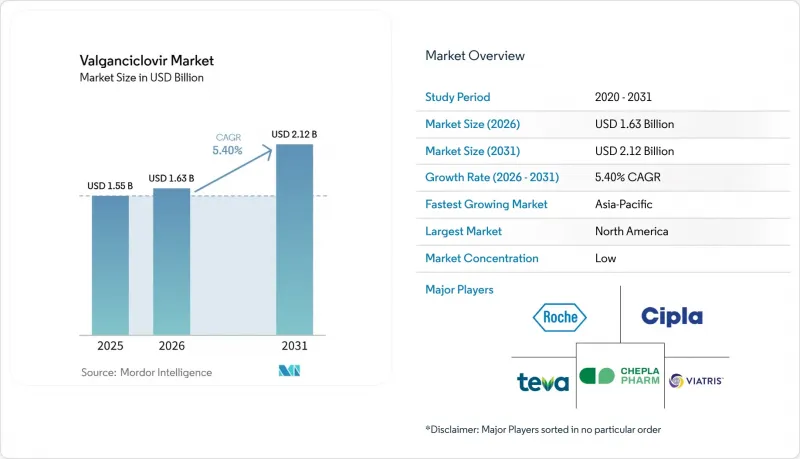
This report is Segmented by Product Type (Tablets, Powder for Oral Solution), Indication (CMV Retinitis, CMV Infection, Post-Transplant Prophylaxis, Congenital CMV), Patient Type (Pediatric, Adult, Geriatric), Distribution Channel (Hospital Pharmacies, Retail Pharmacies, and More), and Geography (North America, Europe, Asia-Pacific, and More). The Market Forecasts are Provided in Terms of Value (USD).
Global Valganciclovir Market Trends and Insights
Rising Solid Organ And Stem Cell Transplant Volumes
The valganciclovir market is directly tied to transplant procedure growth because each new recipient adds a defined prophylaxis or treatment course. Global solid organ transplants reached 173,727 procedures in 2024, and kidney transplants alone contributed 110,467 cases, which kept the transplant setting at the center of the valganciclovir market. Updated international CMV guidelines recommend 6 months of valganciclovir prophylaxis for D+/R- kidney transplant recipients, which supports durable prescription volumes in the largest organ category.
Lung transplant volume rose 6% in 2024 to 8,236 procedures, and these patients often require 12 months or more of prophylaxis, which gives them much higher drug exposure per patient than other organ groups. Stem cell transplant also sustains demand because CMV reactivation affects 40% to 60% of allogeneic recipients in the absence of prophylaxis, which extends the relevance of the valganciclovir market beyond solid organ programs. This pattern keeps revenue weighted toward procedures with longer prophylaxis windows rather than only toward the highest procedure counts.
Expanding Immunocompromised Patient Pool
The valganciclovir market is broadening because clinically relevant CMV risk now extends well beyond traditional transplant cohorts. CMV viremia occurs in 40% to 60% of allogeneic HSCTrecipients without prophylaxis, which keeps antiviral demand elevated in hematology practice as well as transplant medicine. The treatment base is also widening across patients receiving JAK inhibitors, TNF-alpha inhibitors, high-dose corticosteroids, and BTK inhibitors, where CMV surveillance and preemptive therapy are becoming more common in routine practice.
Congenital CMV is adding a small but growing prescribing pool because European consensus guidance identifies valganciclovir as the drug of choice for symptomatic neonates and supports 6-month treatment courses with documented hearing and neurodevelopmental benefit. United States-level neonatal screening programs are reporting 0.3% prevalence, which means better case finding can gradually increase pediatric demand in the valganciclovir market as more infants enter treatment windows earlier. CMV retinitis also remains relevant in AIDS and non-HIV immunocompromised populations, which prevents the addressable base from narrowing to transplant recipients alone.
Hematologic And Renal Safety Constraints
The valganciclovir market is constrained by a toxicity profile that remains clinically significant even in established transplant centers. In a real-world U.S. cohort of 15,398 kidney transplant recipients, nearly three-quarters of patients on valganciclovir or ganciclovir prophylaxis developed neutropenia or leukopenia, and those patients had more inpatient admissions, more outpatient visits, and more laboratory tests than matched patients without myelosuppression. Short-term hazard ratios for neutropenia reached 39.6 in patients exposed to valganciclovir for 1 to 90 days versus unexposed controls, which shows how quickly safety events can emerge.
The clinical problem is more serious because patients with myelosuppression still showed a 3.95-fold higher risk of CMV disease during prophylaxis, which suggests that dose changes and interruptions can weaken protection. Renal function monitoring and dose adjustment also complicate routine use, especially in older and medically complex recipients. These constraints are opening space for alternatives such as letermovir in toxicity-intolerant patients, which limits upside for the valganciclovir market in its largest indication.
Other drivers and restraints analyzed in the detailed report include:
- Shift From Inpatient Intravenous Therapy To Outpatient Oral Therapy
- Generic Entry And Broader Access After Patent Expiry
- Heavy Laboratory Monitoring Burden
For complete list of drivers and restraints, kindly check the Table Of Contents.
Segment Analysis
Tablets captured 93.23% share of the valganciclovir market size in 2025, which shows how strongly adult transplant protocols shape product demand. The 450 mg film-coated tablet remains the standard format for adult prophylaxis at 900 mg per day, and for CMV retinitis induction at 1,800 mg per day, so its lead in the valganciclovir market is based on routine adult use rather than short-term channel factors. Adult transplant recipients are the largest patient pool, and they usually do not need the dosing flexibility that a liquid formulation provides. The tablet format also fits stable outpatient refill behavior, which supports the broader oral-care shift across the valganciclovir market.
Powder for oral solution is projected to grow fastest at a 7.32% CAGR through 2031, and that makes it the clearest niche expansion area within the product mix. The FDA prescribing information revised in June 2025 identifies the 50 mg/mL oral solution as the preferred pediatric formulation for patients aged 4 months to 16 years, because body-surface-area-based dosing cannot be matched precisely with tablets.
Post-transplant prophylaxis held 58.32% of the valganciclovir market share in 2025 and is also projected to expand at a 7.12% CAGR through 2031, which makes it both the largest and fastest-growing indication. That combination is unusual, and it shows how deeply the valganciclovir market depends on transplant prevention protocols rather than rescue treatment. The fourth international CMV guidelines continue to position valganciclovir as the most commonly used prophylaxis agent, with recommended durations ranging from 3 months in some intermediate-risk kidney recipients to 12 months or more in D+/R- lung recipients.
Complete Report Scope:
- By Product Type
- Tablets
- Powder for Oral Solution
- By Indication
- Cytomegalovirus (CMV) Retinitis
- Cytomegalovirus (CMV) Infection
- Post-Transplant Prophylaxis
- Congenital CMV Infection
- By Patient Type
- Pediatric Patients
- Adult Patients
- Geriatric Patients
- By Distribution Channel
- Hospital Pharmacies
- Retail Pharmacies
- Online Pharmacies
- Other Distribution Channels
- By Geography
- North America
- United States
- Canada
- Mexico
- Europe
- Germany
- United Kingdom
- France
- Italy
- Spain
- Rest of Europe
- Asia-Pacific
- China
- India
- Japan
- Australia
- South Korea
- Rest of Asia-Pacific
- Middle East and Africa
- GCC
- South Africa
- Rest of Middle East and Africa
- South America
- Brazil
- Argentina
- Rest of South America
- North America
Geography Analysis
North America held 43.67% of global revenue in 2025, which gave the region the largest share of the valganciclovir market. The United States remains the main regional driver because it has the largest national transplant program and over 23,000 kidney transplants were recorded in 2023 through OPTN, with each patient typically entering a standard prophylaxis course. Broad generic availability also supports regional scale, and CMS-linked NADAC data showed the oral solution price falling from USD 3.36/mL in June 2024 to USD 1.29/mL by February 2026, which improved access across institutional and retail formularies.
Asia-Pacific is forecast to record the fastest CAGR at 7.14% through 2031, while Europe remains a mature but actively managed regional pillar of the valganciclovir market. Europe continues to benefit from the 2024 international CMV guideline framework, which is shaping prophylaxis practice across Germany, France, Italy, Spain, and the United Kingdom. France provided direct evidence of ongoing institutional demand in 2026 through 3-year procurement contracts for both tablets and oral solutions, which shows that transplant and neonatal centers are maintaining stable purchasing activity.
- Apotex
- Aurobindo Pharma
- CHEPLAPHARM Arzneimittel GmbH
- Cipla
- Dr. Reddy's Laboratories
- Roche
- Granules India
- Hetero Labs Limited
- Lupin
- Natco Pharma Limited
- Sandoz Group AG
- Strides Pharma Science
- Sun Pharmaceuticals Industries
- Teva Pharmaceutical Industries
- Viatris
- Zydus Lifesciences Limited
Additional Benefits:
- The market estimate (ME) sheet in Excel format
- 3 months of analyst support
TABLE OF CONTENTS
1 Introduction
- 1.1 Study Assumptions & Market Definition
- 1.2 Scope of the Study
2 Research Methodology
3 Executive Summary
4 Market Landscape
- 4.1 Market Overview
- 4.2 Market Drivers
- 4.2.1 Rising Solid Organ and Stem Cell Transplant Volumes
- 4.2.2 Expanding Immunocompromised Patient Pool
- 4.2.3 Shift From Inpatient Intravenous Therapy to Outpatient Oral Therapy
- 4.2.4 Generic Entry and Broader Access After Patent Expiry
- 4.2.5 CMV DNA Monitoring Expands Preemptive Prophylaxis Use
- 4.2.6 Pediatric-Friendly Oral Formulations Improve Adoption
- 4.3 Market Restraints
- 4.3.1 Hematologic and Renal Safety Constraints
- 4.3.2 Heavy Laboratory Monitoring Burden
- 4.3.3 Antiviral Resistance Risk in Repeated Exposure
- 4.3.4 Reimbursement Gaps in Resource-Constrained Markets
- 4.4 Supply-Chain Analysis
- 4.5 Regulatory Landscape
- 4.6 Technological Outlook
- 4.7 Porter's Five Forces Analysis
- 4.7.1 Threat of New Entrants
- 4.7.2 Bargaining Power of Suppliers
- 4.7.3 Bargaining Power of Buyers
- 4.7.4 Threat of Substitutes
- 4.7.5 Industry Rivalry
5 Market Size & Growth Forecasts (Value, USD)
- 5.1 By Product Type
- 5.1.1 Tablets
- 5.1.2 Powder for Oral Solution
- 5.2 By Indication
- 5.2.1 Cytomegalovirus (CMV) Retinitis
- 5.2.2 Cytomegalovirus (CMV) Infection
- 5.2.3 Post-Transplant Prophylaxis
- 5.2.4 Congenital CMV Infection
- 5.3 By Patient Type
- 5.3.1 Pediatric Patients
- 5.3.2 Adult Patients
- 5.3.3 Geriatric Patients
- 5.4 By Distribution Channel
- 5.4.1 Hospital Pharmacies
- 5.4.2 Retail Pharmacies
- 5.4.3 Online Pharmacies
- 5.4.4 Other Distribution Channels
- 5.5 By Geography
- 5.5.1 North America
- 5.5.1.1 United States
- 5.5.1.2 Canada
- 5.5.1.3 Mexico
- 5.5.2 Europe
- 5.5.2.1 Germany
- 5.5.2.2 United Kingdom
- 5.5.2.3 France
- 5.5.2.4 Italy
- 5.5.2.5 Spain
- 5.5.2.6 Rest of Europe
- 5.5.3 Asia-Pacific
- 5.5.3.1 China
- 5.5.3.2 India
- 5.5.3.3 Japan
- 5.5.3.4 Australia
- 5.5.3.5 South Korea
- 5.5.3.6 Rest of Asia-Pacific
- 5.5.4 Middle East and Africa
- 5.5.4.1 GCC
- 5.5.4.2 South Africa
- 5.5.4.3 Rest of Middle East and Africa
- 5.5.5 South America
- 5.5.5.1 Brazil
- 5.5.5.2 Argentina
- 5.5.5.3 Rest of South America
- 5.5.1 North America
6 Competitive Landscape
- 6.1 Market Concentration
- 6.2 Market Share Analysis
- 6.3 Company Profiles {(includes Global level Overview, Market level overview, Core Segments, Financials as available, Strategic Information, Market Rank/Share for key companies, Products & Services, and Recent Developments)}
- 6.3.1 Apotex Inc.
- 6.3.2 Aurobindo Pharma Limited
- 6.3.3 CHEPLAPHARM Arzneimittel GmbH
- 6.3.4 Cipla Limited
- 6.3.5 Dr. Reddy's Laboratories Ltd.
- 6.3.6 F. Hoffmann-La Roche Ltd.
- 6.3.7 Granules India Limited
- 6.3.8 Hetero Labs Limited
- 6.3.9 Lupin Limited
- 6.3.10 Natco Pharma Limited
- 6.3.11 Sandoz Group AG
- 6.3.12 Strides Pharma Science Limited
- 6.3.13 Sun Pharmaceutical Industries Limited
- 6.3.14 Teva Pharmaceutical Industries Ltd.
- 6.3.15 Viatris Inc.
- 6.3.16 Zydus Lifesciences Limited
7 Market Opportunities & Future Outlook
- 7.1 White-space & unmet-need assessment

