PUBLISHER: Mordor Intelligence | PRODUCT CODE: 2117487

PUBLISHER: Mordor Intelligence | PRODUCT CODE: 2117487
Synthetic Leather - Market Share Analysis, Industry Trends & Statistics, Growth Forecasts (2026 - 2031)
According to Mordor Intelligence, the synthetic leather market size is projected to expand from USD 45.22 billion in 2025 and USD 48.84 billion in 2026 to USD 71.86 billion by 2031, registering a CAGR of 8.03% between 2026 to 2031.
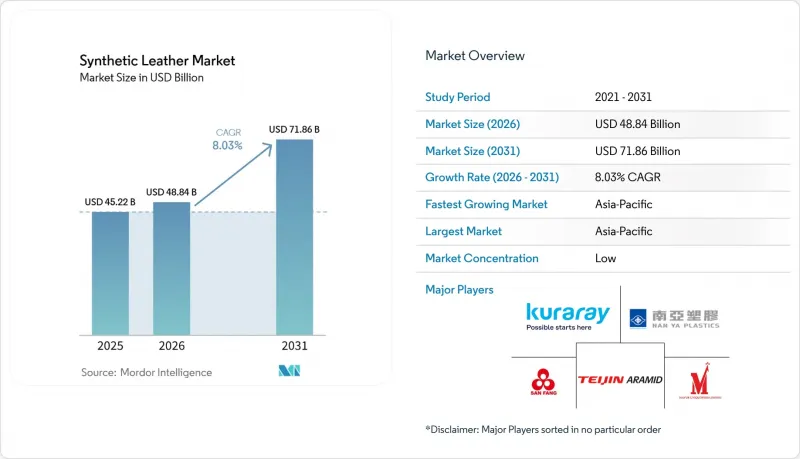
This report is Segmented by Leather Type (PU Synthetic Leather, PVC Synthetic Leather, and More), Manufacturing Technology (Water-Based PU Coating, Solvent-Free PU Systems, and More), Application (Footwear, Automotive Interiors, and More), and Geography (Asia-Pacific, North America, Europe, South America, and Middle-East and Africa). The Market Forecasts are Provided in Terms of Value (USD).
Global Synthetic Leather Market Trends and Insights
PU Replacing PVC: Formulation Economics Shift the Base Material
The synthetic leather market is seeing a steady shift toward PU, as it offers a more favorable balance of compliance readiness, visual quality, and suitability for premium applications than PVC. Residual dimethylformamide limits in finished articles increase the operating burden on conventional solvent-heavy lines, as multiple hot-water washes may be required to meet stricter thresholds, raising both process costs and energy use. This pressure is most significant in high-volume supply chains where buyers want lower solvent exposure without sacrificing grain finish, softness, or consistency. Larger converters with upgraded coating capacity are better positioned in the synthetic leather market, as they can absorb retrofit costs and respond more quickly to buyer qualification requirements. The result is a faster transition in the base material mix, with PU strengthening its position in categories where appearance, compliance, and durability are evaluated together.
Vegan-Material Demand: OEM Commitments are Hardening into Procurement Specs
The synthetic leather market is gaining support from a broader shift toward animal-free materials in both fashion and vehicle interiors. Mercedes-Benz introduced a vegan-certified electric vehicle interior featuring ARTICO synthetic leather across major touchpoints, demonstrating that animal-free content is now part of product specification rather than marketing language. Hyundai CRADLE also partnered with UNCAGED Innovations in August 2025 to develop grain-based leather alternatives for vehicles, indicating that automakers are investing upstream in material development rather than waiting for standard commercial supply. These changes raise quality requirements in the synthetic leather market, as producers now need to offer traceable, technically stable variants that can meet stricter procurement requirements. This also widens the path for premium pricing where brands want lower environmental impact without compromising tactile quality or visual consistency.
PFAS, DMF, and Vinyl-Based Chemical Regulations: Compliance Cost as a Market Reshaper
Tighter regulations on PFAS, DMF, and vinyl-linked formulations present a clear restraint for the synthetic leather market, as compliance now affects both chemical choices and export readiness. The EU perfluorohexanoic acid (PFHxA) regulation adds pressure on affected product categories, including clothing, accessories, and related coated materials, narrowing the scope for legacy treatments in European channels. France has also introduced restrictions on PFAS-containing textiles and footwear effective January 2026, increasing the urgency for reformulation and testing among suppliers that serve those product lines. For mid-tier exporters, the challenge extends beyond chemical substitution to include the costs of documentation, batch testing, and recall prevention when a single production line serves multiple end markets. This slows parts of the synthetic leather market, as smaller manufacturers may delay upgrades, lose access to premium channels, or shift toward lower-specification applications where compliance requirements are less stringent.
Other drivers and restraints analyzed in the detailed report include:
- Automotive Cabin Premiumization: EV Architecture Redefines the Substrate
- Waterborne and Solvent-Free Technology: The New Production Baseline
- Hydrolysis and Heat-Aging Durability: A Hidden Barrier to Market Expansion
For complete list of drivers and restraints, kindly check the Table Of Contents.
Segment Analysis
PU accounted for 51.36% of total demand in 2025, maintaining a clear lead over other leather types in the synthetic leather market. This position reflects its ability to meet a wider range of performance and appearance requirements than PVC, particularly in premium footwear, upholstery, and vehicle interiors. Bio-based synthetic leather is the fastest-growing leather type, projected to expand at a 9.80% CAGR through 2031, indicating a demand shift even before full cost parity is achieved. PVC retains a presence in price-sensitive applications such as entry-level footwear and lower-end furnishings, supported by a large installed process base and cost advantages. Silicone and TPO/TPU variants hold smaller shares in the synthetic leather market but are gaining traction in applications where heat stability, weather resistance, or specialized surface performance take priority over price.
The leather type mix also reflects the pace of technical development in the synthetic leather industry. A 2025 study in ACS Sustainable Chemistry & Engineering found that bio-based poly(ester amide) coatings derived from 1,4-butanediol and adipic acid achieved tensile strength 8 times higher than constituent homopolymers and delivered more than 60% biodegradation relative to cellulose under composting conditions within one month. This progress supports the case for premium bio-based materials by narrowing the gap between sustainability and usable performance. PU is therefore likely to retain its lead through the forecast period, while bio-based grades expand first in programs where branding, compliance, and supplier collaboration carry more weight than lowest-cost output.
Complete Report Scope:
- By Leather Type
- PU Synthetic Leather
- PVC Synthetic Leather
- Bio-based Synthetic Leather
- Silicone Synthetic Leather
- TPO/TPU Synthetic Leather
- By Manufacturing Technology
- Solvent-based Coagulation and Coating
- Water-based PU Coating
- Solvent-free PU Systems
- By Application
- Footwear
- Furnishing
- Chairs
- Sofas
- Other Upholstery
- Automotive Interiors
- Seats
- Door Trims and Panels
- Dashboard and Instrument Panel Surfaces
- Steering Wheel and Console Surfaces
- Other Interior Surfaces
- Bags, Wallets and Luggage
- Wallets
- Bags
- Purses
- Clothing and Fashion Accessories
- Jackets
- Belts
- Other Apparel Accessories
- Sports and Leisure Goods
- Marine and Specialty Uses
- By Geography
- Asia-Pacific
- China
- Japan
- India
- South Korea
- Rest of Asia-Pacific
- North America
- United States
- Canada
- Mexico
- Europe
- Germany
- United Kingdom
- France
- Italy
- Spain
- Russia
- Rest of Europe
- South America
- Brazil
- Argentina
- Rest of South America
- Middle-East and Africa
- Saudi Arabia
- United Arab Emirates
- South Africa
- Rest of Middle-East and Africa
- Asia-Pacific
Geography Analysis
Asia-Pacific accounted for 45.71% of global demand in 2025 and is forecast to grow at a 8.81% CAGR through 2031, making it both the largest and fastest-growing region in the synthetic leather market. The region benefits from China's large converting base, India's expanding footwear manufacturing position, and a dense supply chain linking raw materials, coating capacity, and export channels. This combination gives Asia-Pacific a scale advantage in mainstream categories while supporting a gradual shift toward higher-grade PU output. Japan remains relevant in the premium tier, with companies such as Toray Industries, Kuraray, and Asahi Kasei holding established positions in microfiber and high-performance materials for automotive and fashion applications. Given the region's depth, many technology and cost transitions in the broader synthetic leather market continue to originate in Asia-Pacific before spreading to other regions.
North America and Europe represent the highest-value regional pair in the synthetic leather market, driven by regulatory compliance requirements and interior quality expectations that are more stringent than in most other regions. Demand in both regions is supported by premium waterborne and solvent-free PU grades that meet lower-emission and higher-performance product specifications. Vulcaflex S.p.A. reflected this trend in June 2026 with its plan to invest almost USD 70 million in its first North American plant in Auburn, Alabama, to supply automotive customers across the United States, Canada, and Mexico. In Europe, tighter chemical regulations and stricter buyer requirements continue to support demand for upgraded PU systems, even as total volume growth remains slower than in Asia.
South America, the Middle East, and Africa represent a longer-cycle opportunity for the synthetic leather market, with demand tied to footwear output, furnishing consumption, and the gradual localization of automotive assembly. Brazil and Argentina remain the primary South American demand centers, where regional footwear manufacturing creates a meaningful market for coated materials at competitive prices. Saudi Arabia and the UAE serve as the main consumption hubs in the Middle East, supported by demand for hospitality furnishings and fashion retail. Growth across these regions remains below the global average due to less developed converter infrastructure and inconsistent enforcement of quality and sustainability standards. As a result, lower-cost polyvinyl chloride (PVC)-heavy products are likely to remain prevalent in these markets for longer than in Europe or North America.
- Anhui Anli Material Technology Co., Ltd.
- Asahi Kasei Corporation
- Baiksan Co., Ltd.
- BASF SE
- Continental AG
- Covestro AG
- Dow Inc.
- FILWEL Co., Ltd.
- Fujian Polytech Technology Corp., Ltd.
- H.R. Polycoats Pvt. Ltd.
- Jasch Industries Limited
- Kolon Industries, Inc.
- KURARAY CO., LTD.
- Mayur Uniquoters Limited
- NAN YA PLASTICS CORPORATION
- Responsive Industries Limited
- San Fang Chemical Industry Co., Ltd.
- Seiren Co., Ltd.
- TEIJIN LIMITED
- Toray Industries, Inc.
- Wanhua Chemical Group Co., Ltd.
Additional Benefits:
- The market estimate (ME) sheet in Excel format
- 3 months of analyst support
TABLE OF CONTENTS
1 Introduction
- 1.1 Study Assumptions & Market Definition
- 1.2 Scope of the Study
2 Research Methodology
3 Executive Summary
4 Market Landscape
- 4.1 Market Overview
- 4.2 Market Drivers
- 4.2.1 PU replacing PVC and genuine leather in mass-premium uses
- 4.2.2 Vegan-material demand from footwear and fashion brands
- 4.2.3 Automotive cabin premiumization and EV interior demand
- 4.2.4 Waterborne and solvent-free PU commercialization
- 4.2.5 Hidden-HMI and translucent interior surface adoption
- 4.3 Market Restraints
- 4.3.1 PFAS, DMF and vinyl-chloride compliance pressure
- 4.3.2 Hydrolysis and heat-aging limits in low-cost grades
- 4.3.3 Bio-based synthetic leather cost premium and scale constraints
- 4.4 Value Chain Analysis
- 4.5 Porter's Five Forces Analysis
- 4.5.1 Supplier Power
- 4.5.2 Buyer Power
- 4.5.3 Threat of Substitutes
- 4.5.4 Threat of New Entrants
- 4.5.5 Competitive Rivalry
5 Market Size & Growth Forecasts (Value and Volume)
- 5.1 By Leather Type
- 5.1.1 PU Synthetic Leather
- 5.1.2 PVC Synthetic Leather
- 5.1.3 Bio-based Synthetic Leather
- 5.1.4 Silicone Synthetic Leather
- 5.1.5 TPO/TPU Synthetic Leather
- 5.2 By Manufacturing Technology
- 5.2.1 Solvent-based Coagulation and Coating
- 5.2.2 Water-based PU Coating
- 5.2.3 Solvent-free PU Systems
- 5.3 By Application
- 5.3.1 Footwear
- 5.3.2 Furnishing
- 5.3.2.1 Chairs
- 5.3.2.2 Sofas
- 5.3.2.3 Other Upholstery
- 5.3.3 Automotive Interiors
- 5.3.3.1 Seats
- 5.3.3.2 Door Trims and Panels
- 5.3.3.3 Dashboard and Instrument Panel Surfaces
- 5.3.3.4 Steering Wheel and Console Surfaces
- 5.3.3.5 Other Interior Surfaces
- 5.3.4 Bags, Wallets and Luggage
- 5.3.4.1 Wallets
- 5.3.4.2 Bags
- 5.3.4.3 Purses
- 5.3.5 Clothing and Fashion Accessories
- 5.3.5.1 Jackets
- 5.3.5.2 Belts
- 5.3.5.3 Other Apparel Accessories
- 5.3.6 Sports and Leisure Goods
- 5.3.7 Marine and Specialty Uses
- 5.4 By Geography
- 5.4.1 Asia-Pacific
- 5.4.1.1 China
- 5.4.1.2 Japan
- 5.4.1.3 India
- 5.4.1.4 South Korea
- 5.4.1.5 Rest of Asia-Pacific
- 5.4.2 North America
- 5.4.2.1 United States
- 5.4.2.2 Canada
- 5.4.2.3 Mexico
- 5.4.3 Europe
- 5.4.3.1 Germany
- 5.4.3.2 United Kingdom
- 5.4.3.3 France
- 5.4.3.4 Italy
- 5.4.3.5 Spain
- 5.4.3.6 Russia
- 5.4.3.7 Rest of Europe
- 5.4.4 South America
- 5.4.4.1 Brazil
- 5.4.4.2 Argentina
- 5.4.4.3 Rest of South America
- 5.4.5 Middle-East and Africa
- 5.4.5.1 Saudi Arabia
- 5.4.5.2 United Arab Emirates
- 5.4.5.3 South Africa
- 5.4.5.4 Rest of Middle-East and Africa
- 5.4.1 Asia-Pacific
6 Competitive Landscape
- 6.1 Market Concentration
- 6.2 Strategic Moves
- 6.3 Market Share/Ranking Analysis
- 6.4 Company Profiles (includes Global level Overview, Market level overview, Core Segments, Financials as available, Strategic Information, Products & Services, and Recent Developments)
- 6.4.1 Anhui Anli Material Technology Co., Ltd.
- 6.4.2 Asahi Kasei Corporation
- 6.4.3 Baiksan Co., Ltd.
- 6.4.4 BASF SE
- 6.4.5 Continental AG
- 6.4.6 Covestro AG
- 6.4.7 Dow Inc.
- 6.4.8 FILWEL Co., Ltd.
- 6.4.9 Fujian Polytech Technology Corp., Ltd.
- 6.4.10 H.R. Polycoats Pvt. Ltd.
- 6.4.11 Jasch Industries Limited
- 6.4.12 Kolon Industries, Inc.
- 6.4.13 KURARAY CO., LTD.
- 6.4.14 Mayur Uniquoters Limited
- 6.4.15 NAN YA PLASTICS CORPORATION
- 6.4.16 Responsive Industries Limited
- 6.4.17 San Fang Chemical Industry Co., Ltd.
- 6.4.18 Seiren Co., Ltd.
- 6.4.19 TEIJIN LIMITED
- 6.4.20 Toray Industries, Inc.
- 6.4.21 Wanhua Chemical Group Co., Ltd.
7 Market Opportunities & Future Outlook
- 7.1 White-space and Unmet-Need Assessment

